Tag Archives: preschool

Reducing Sensory Bin Mess

When parents or teachers first introduce a child to sensory bin play, they usually make a big mess!
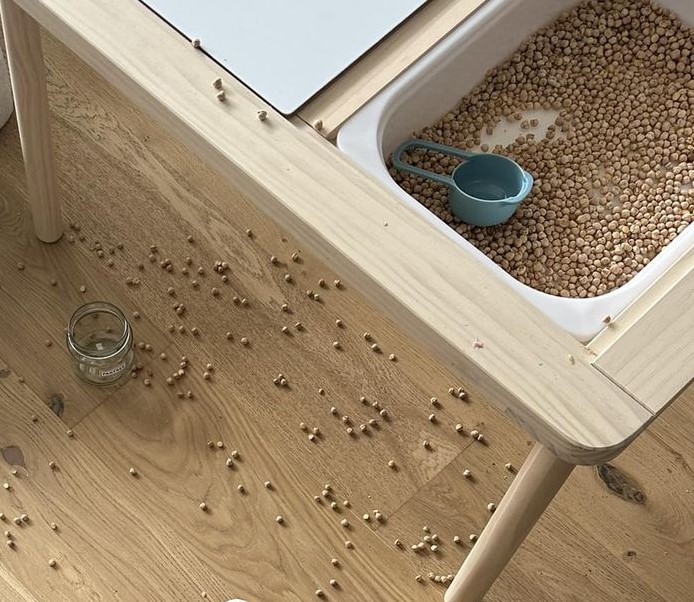
While some mess is inevitable, here are tips for reducing it.

Teach Them How Sensory Play Works

One of my core beliefs is that children want to do well. If they’re not behaving well, it’s usually because they don’t yet have the knowledge or skills they need. So, let’s teach them!

Play alongside

Over time, sensory play becomes a great independent play activity for children, where they can play with little supervision or intervention from adults for quite a while. However, first you have to teach them how to do it, and then gradually fade out your support. So, expect to be right next to them the first several sessions.

Role Model

I mostly just start playing appropriately next to them, and they quickly follow along! I narrate my play, and also narrate theirs. “Look, I’m scooping the beans – oh, you picked up the scoop – see how I use it? I can pour the beans in the bucket. Can you?”

Re-Direct

If they are doing something “wrong”, tell them the right thing to do. “Let’s keep the rice in the bin.” If they’re pouring on the floor, substitute a new target – “can you pour into this bucket?” Try to avoid saying “don’t _____”. If you say “don’t splash”, all they can think about is splashing. If you say “oh, look, when I move my hand slowly, see the ripples in the water?” they will often stop splashing.

Set Limits

Once they’ve learned how to do well in general, they may still have days when they’re having a hard time not making a mess. It’s OK to sometimes say “it looks like now is not the right time for this – let’s put it away / close it up for now, and we’ll try again tomorrow.” To be as fair as possible, I try this method: first when-then: “when you show me you can play well with this, then we can have it out more often.” Then if-then warning – “if you keep dumping things on the floor, then I’ll close the bin.” Then follow through on that consequence if needed.

Setting Up for Success

Fillers

Start with fillers that are easy to clean up. I use pompoms as the first material for my toddler class. Or paper crumpled into balls. Later, I might use pinto beans – they’re easy to sweep up. Other things are harder to clean up. For example, kinetic sand needs to be vacuumed up and can get ground into carpet, so it’s not the thing to start with.

When you start, put a small amount of sensory items in a small bin inside the large bin. If they spill outside the small bin, the large bin catches it!

Don’t use too much filler at first. Don’t feel like you have to have a 3 inch thick layer of sensory material. Start with a thin layer – they can always pile it all up in one corner if they want a deeper pile.

Remember that they will mix together any item that’s within easy reach of the bin. So, if there’s something you don’t want to be mixed in, move it elsewhere. (For example, we don’t recommend putting a bin of rice right next to the playdough table or water table.)

What Surface to Put the Table On

If possible, put sensory tables on linoleum or hardwood floors – it’s way easier to clean up than carpet!

Many parents and teachers do sensory tables outdoors where they are less concerned about mess.

Many people recommend putting a mat under the table – like this mat where the edges can fold up to make a wall, or things like playpens and crafty pods and pop-up ball pits that help to contain the mess in one area where it doesn’t get tracked around. Some use fitted sheets – like in the image below (source) or shown here. Wrap the corners of the fitted sheet around some objects to create a little nest. Or use a table cloth or shower curtain liner. Sometimes you can salvage sensory material from any of these surfaces by lifting them up so the filler all slides to one corner and then scooping it from there.
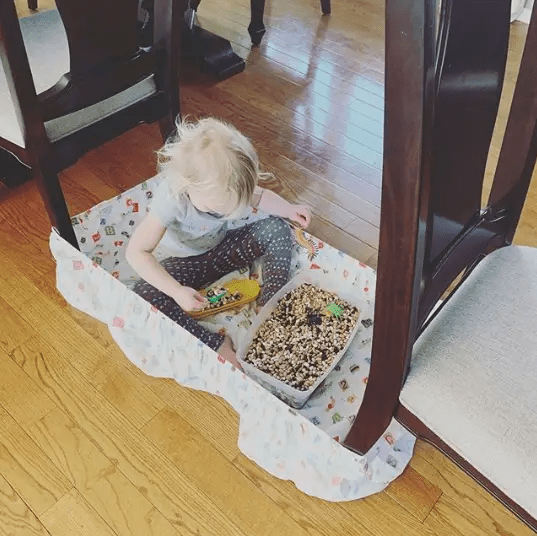
One site recommended a “builders’ tray” that looks amazing, but the link is broken and I can’t find it anywhere… Amazon has a 20×20 play tray, or you could use an oil drip pan, maybe.

Allowing for Transport

Kids LOVE to transport things. So, they often want to carry things from one place to another. Sometimes just having containers inside the bin, like having two buckets in the bin where they can move things from the bin to one bucket to the next is enough. Or setting up a cardboard box apparatus where there’s a higher spot in the sensory bin and a ramp for pouring things so they slide to the lower level, like these examples from Frugal Fun:
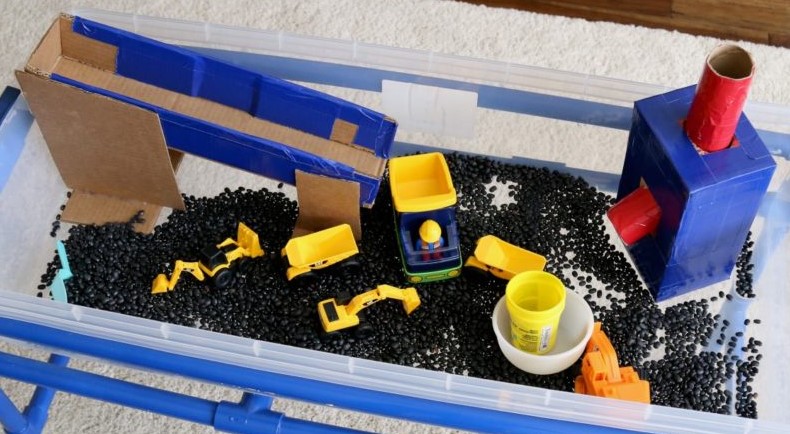
Or having a table right next to the sensory bin with containers on it they can move things into can work. But some kids like to have a separate bucket somewhere else they can carry things to – you can decide if that’s viable for you.

If they like the sound the beans make when they hit the floor, try putting a metal pie tin or hard plastic container upside down inside the sensory bin that they can pour onto to get the sound.

Helping with Clean Up

Ask your child to help with clean-up. You may choose to get them a mini broom and dustpan or a dust buster vacuum. (For some kids having to do clean-up is a disincentive – they don’t want to make a mess they’ll have to clean up later. Some kids like cleaning up the mess so much that they’ll make more of a mess!)

Remember, sensory play is a learning process, so they will accidentally (or intentionally) spill from time to time and there will be messes. Try to take a deep breath when it happens. If you’re having a day where you feel like the mess would be too stressful, it’s fine to close the sensory bin for the day and offer other activities.

Learn more

Check out my Ultimate Guide to Sensory Tables and my Ultimate Guide to Water Tables. You might also enjoy this post on Building a Child’s 8 Senses.

Books that Sing by Theme

I learned about the idea of “books that sing” from Nancy Stewart (Learn more about Books that Sing.) These are books that can be sung aloud, rather than read aloud – they may be illustrated versions of traditional songs, or may be new compositions. I built a year-long preschool music curriculum that included 4 of these books each month. Here are some of the books that I found and used.

Farm Theme

  • Old McDonald – Cabrera and others
  • Old Mikamba had a farm – Isadora
  • Barnyard Dance – Boynton – make up your own tune to this musical rhyming book
  • Mary Had a Little Lamb – Hoberman or Borgert-Spaniol
  • Pickin Peas by Macdonald – may be too long for preschoolers
  • Cat goes fiddle-i-fee by Galdone
  • Farmer in the Dell Owen

Winter Theme

  • We’re going on a bear hunt Oxenbury (notes here https://www.musicintheearlyyears.com/blog/2958-books-that-you-can-sing)
  • Ten on the Sled Norman
  • The Bear Went Over the Mountain – Trapani
  • Jingle Bells. Notes on the versions – Jeffers – words don’t go quite in the order kids expect and it does include Santa and Mrs. Claus; the version illustrated by Darcy May is simple and straightforward all the words in the right order, shows bob tail and sleigh and other new vocabulary well; Kovalski – not the best writing, so I might tell a new story to the pictures; Trapani – highlights Xmas traditions around the world, so may not be suitable for a non-secular setting

Stars/Moon Theme

  • Twinkle – several versions! I like Cabrera, Taylor and Litwin versions better than Borgert-Spaniol

Jungle/Zoo

Transportation

  • Wheels on the Bus, Zelinsky OR Raffi
  • Down by the Station Vetter
  • Riding in My Car – Woody Guthrie
  • We All Go Traveling By – Roberts

Spring

  • Five Little Ducks Kubler or Raffi (See more options)
  • Little White Duck;
  • Take me out to the Ballgame Simon
  • Singing in the Rain Freed (video
  • Dancing Feet by Lindsey Craig and Mark Brown (video) which would be so easy to make up a jazzy tune to sing it to
  • There was a tree – Isadora
  • Inch by Inch (the Garden Song) – Mallett
  • Over in the Meadow – many versions! (reviews)

Beach

  • Down By the Bay – Raffi
  • Baby Beluga by Raffi
  • Seals on the Bus Hart
  • Row Your Boat – Many versions
  • Baby Shark
  • Over in the ocean – Berkes
  • May there always be sunshine – Gill

Other

  • Roll Over by Peek
  • Tanka Tanka Skunk – the children can echo each line
  • Every Little Thing / 3 birds by Bob Marley – children can clap out 1-2-3-pause
  • Hickory Dickory Dock Borgert or Baker (all diff animals) or Summer (simple – always a mouse);
  • knick knack paddywhack introduces instruments – https://www.youtube.com/watch?v=VEHKQCtrHHw
  • If you’re happy and you know it – Ormerod

Here are other places on this site to find: lots of resources for Songs for Music Time, links to videos and lyrics for Favorite Toddler / Preschool Songs, and a post on the benefits of music for early learning.

Songs for Music Time (birth to age 5)

Whether you’re a librarian planning story time, a preschool teacher looking for new songs or a parent of a toddler who is tired of the same five songs, here are resources for learning new children’s songs.

The very best resources I know of are:

  • Tell Me a Story from the King County Library System – searchable collection of hundreds of videos of children’s librarians singing songs and showing the motions
  • Jbrary – two children’s librarians (Lindsey Krabbenhoft and Dana Horrocks) have created a huge collection of videos of children’s songs (with motions) and also have lists of favorite books, ideas for storytime, etc.
  • Sing with Our Kids, where Nancy Stewart has created a song library which includes lyrics and .mp3 audio recordings of lots of great traditional kid songs, and a collection of “Books that Sing” – picture books that you can sing aloud.
  • Jocelyn Manzanarez’s Circle Time Success on Instagram

And here are resources I have created that you are welcome to use:

And here’s why music time matters: How Music Benefits Early Learning.

Photo by Jelleke Vanooteghem on Unsplash

Books about Starting Preschool

If you child will start preschool in September, now is a great time to start getting them ready. (I’ve got tips here for how to prepare for preschool.) One thing you can do is read books about what it’s like to go to preschool.

Hello Preschool by Burris. (video) This one is my favorite – a really nice intro to what to expect in preschool that also touches on what’s expected of them (like sitting still and listening during group time.)

Rosie Goes to Preschool by Katz (video) is probably my second favorite – again, just a really clear description of what to expect.

Maisy goes to Preschool by Lucy Cousins. (video preview) This is excellent. Typical cute Maisy illustrations give a really good sense of what a day of preschool is like and what fun activities will be there. If your child won’t have naptime at preschool, skip that page.

Going to School by Civardi and Cartwright. (Video) A nice intro to preschool. It’s a little wordy for a just barely 3 year old, but otherwise quite good.

Preschool Day Hooray! by Strauss and Nakata. (video preview.) A cute book with engaging drawings and rhyming text. After you read through it once, go through and talk in detail about the activities shown, and about what a day at preschool is like.

What to Expect at Preschool by Murkoff and Rader. (Video) A helpful overview of what to expect.

Pete the Kitty’s First Day of Preschool by Kimberly and James Dean (video) is cute, but it starts with Pete packing his paintbrush and glue sticks and taking the bus, and I don’t think these things are typical for preschool.

Preschool Here I Come by Steinberg and Joven. (Video.) There’s so much to love about this book – engaging info, good coverage of everything that happens at preschool. But, oh my goodness, too many words for most preschool age children! Each page has almost as many words as you might find in a full book for a three year old. Maybe you could buy it and read bits of it at a time? Daniel Goes to School is also too wordy for most kids this age – though some love to be read wordier books.

The Things I Love about School by Moroney. (video) This is quite nice, but better reflects kindergarten / first grade experience than preschool.

My First Day at Nursery School by Edwards and Flintoft. (video preview). What I love about this book: it does a great job of showing all the activities at preschool and the day’s routine. What makes me hesitant… it has a theme of “there’s all these great things at preschool but I don’t want them, I want my mommy!” It has a good resolution, but if your child has never had separation issues, I wouldn’t introduce the idea.

On a similar note: Bye Bye Time offers a great strategy for separating when a child is somewhat reluctant, the Kissing Hand is a great book that offers a great goodbye ritual for kids who have a hard time separating, I Love You All Day Long reminds your child that you love them even when you’re not together, and Llama Llama Misses Mama shows how someone who really misses their mama can adapt. But, for all of these, my advice is: if your child isn’t worried about you leaving them, don’t read books that suggest that they should be! Save these for when there’s an issue.

This is How We Get Ready by DK. So… this book is full of helpful tips, like “lay out your clothes the night before, try to get 10 – 13 hours of sleep, and go to bed at the same time each night.” But this is supposed to be read to a 3 year old??? I don’t think it’s a children’s book, but it does have tips that might be helpful for parents.

Note: the book titles have affiliate links – I do get a small referral fee from Amazon (at no cost to you) if you click on the link and then purchase any item. The video links are to YouTube videos that I used to preview the book – I can’t ensure that the whole video is appropriate for your child – these links are not intended as a replacement for the book but intended to encourage you to purchase the book or check it out from your library and support great book authors and illustrators.

Also, be sure to check out my post on Preparing your Child for Preschool for lots of tips on getting them ready to start.