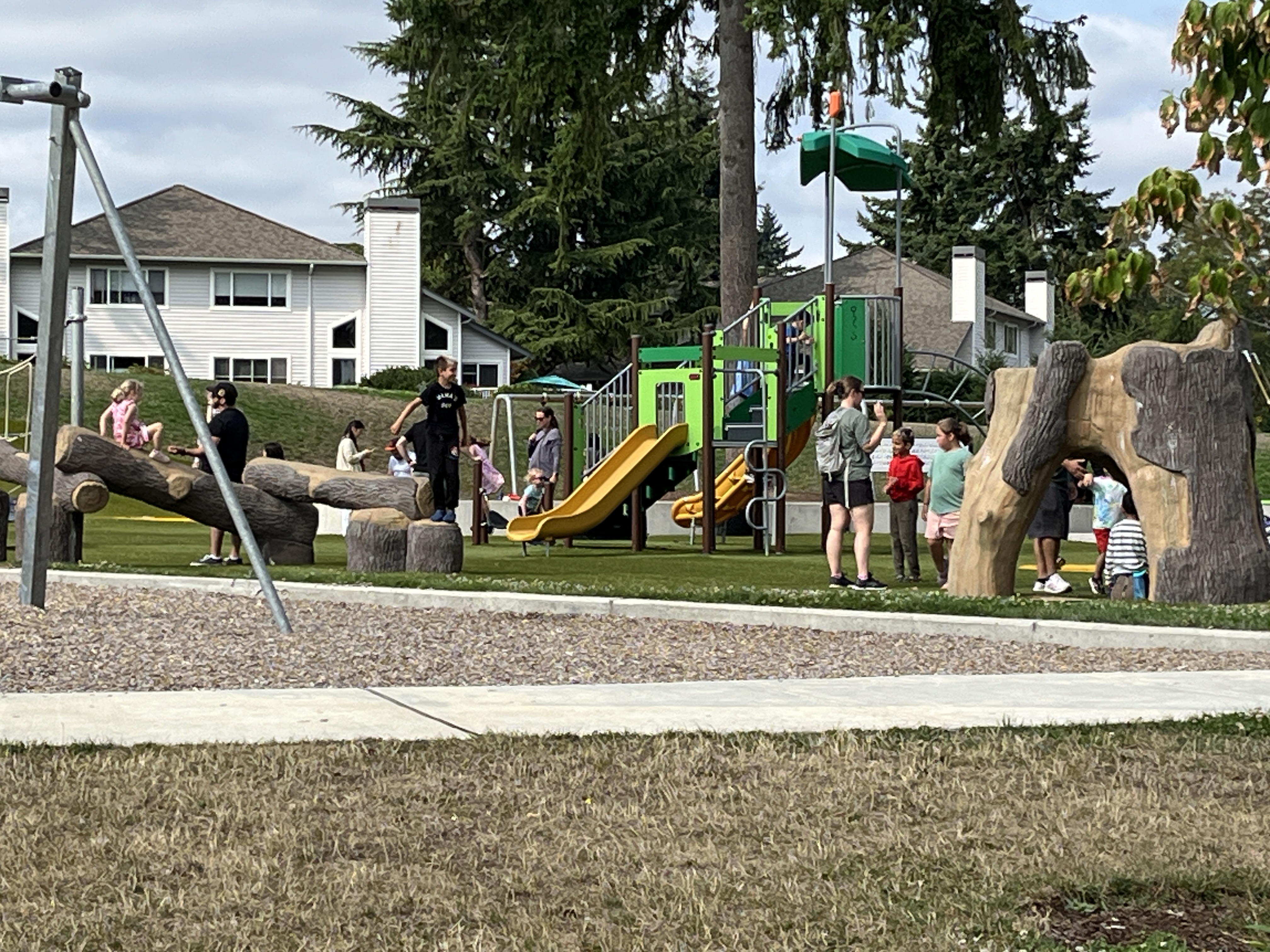
We tried out a new-to-us park recently – 132nd Square Park is located at NE 132nd St and 132nd Ave NE in Kirkland, about a mile east of Evergreen Hospital.
They have a multi-purpose synthetic turf playfield for soccer and more, a smaller grass field for softball or baseball, an all-abilities playground with zipline, year-round restrooms, and three picnic shelters. They also have a walking labyrinth and a reflexology path with raised stones to massage your feet while you do a walking meditation.
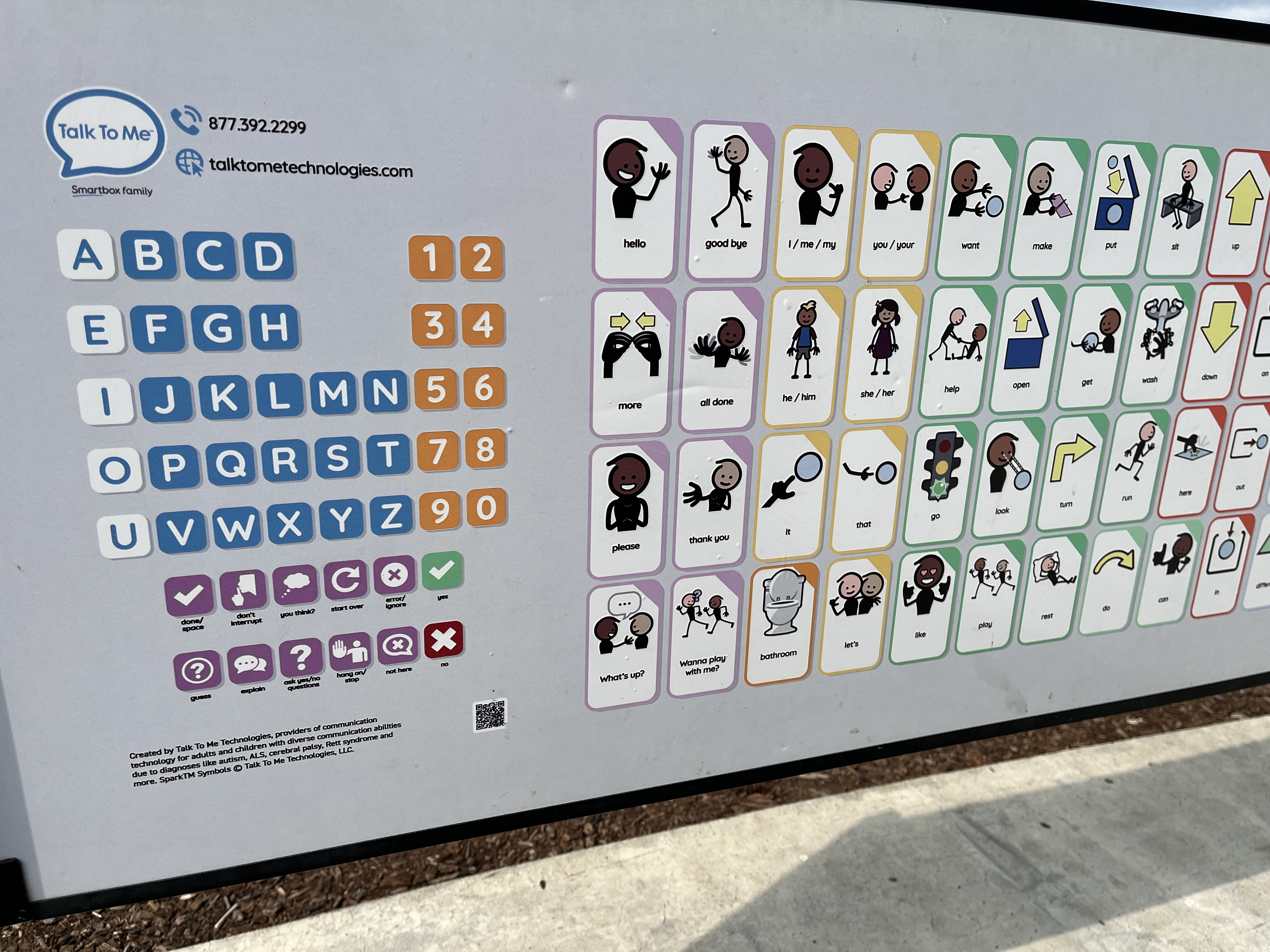
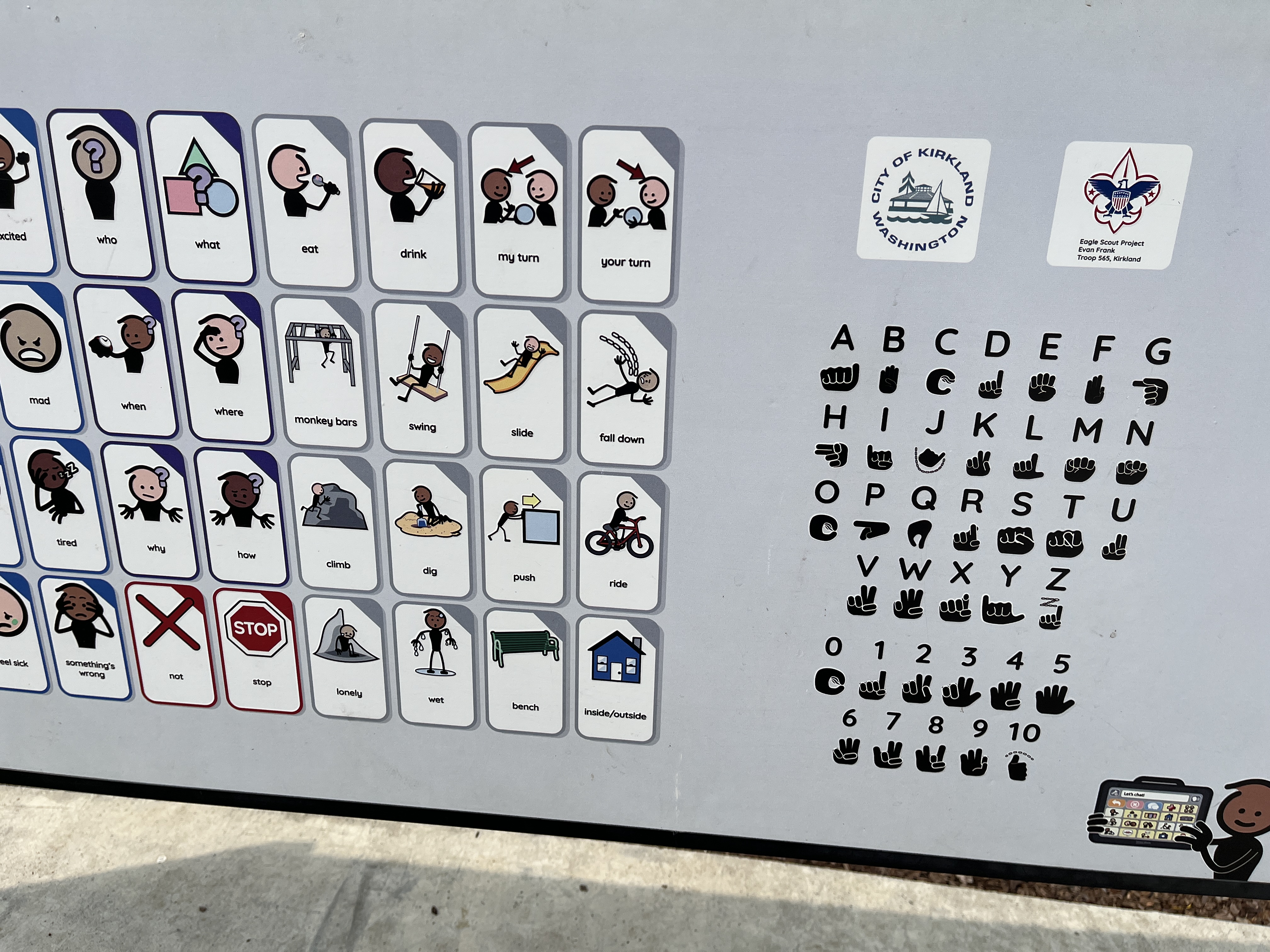
The big yellow hill is a fun and unique thing – bring a big flattened cardboard box to sit on and you can slide down that hill. On the playground there is also a communication board with symbols that a nonverbal person could use to communicate – it’s a nice opportunity to acquaint you and your child with this adaptive tool.
Some parents and pundits question whether we should be talking with young children about gender, and the reality is that we always have been! When I was a young child in the 60’s, pretty much every book I was exposed to taught a particular set of gender roles. I learned what girls were supposed to look like and act like and what activities they were supposed to enjoy. Then as a culture we began to talk a lot more about feminism and equal rights for women, and there started being more children’s stories about “girls can do anything” – they can wear clothes that are easy to move in, they can have any job. Over time, people came to realize that as we’d given our girls permission to wear anything and be anything, our boys were still trapped in “boys can’t cry” and only sissies are dancers” and “why would a man want to be a nurse.” So, again, we began to tell more diverse stories. And now, with increased awareness that at least 1% of people are transgender, children’s stories about gender identity are starting to become available. All of these stories can be “mirrors and windows” for our kids – mirrors when they see characters like them that help them to feel seen, and windows that help them better understand other people’s experiences.
I’ll share some book recommendations here – most are aimed at kid 3 – 5, unless otherwise noted.
Gender Roles
Gender roles refers to the activities that people do, as hobbies, responsibilities, or careers. Here are just a few that look at stepping outside of traditional gender roles, but there are probably hundreds of books on this topic.
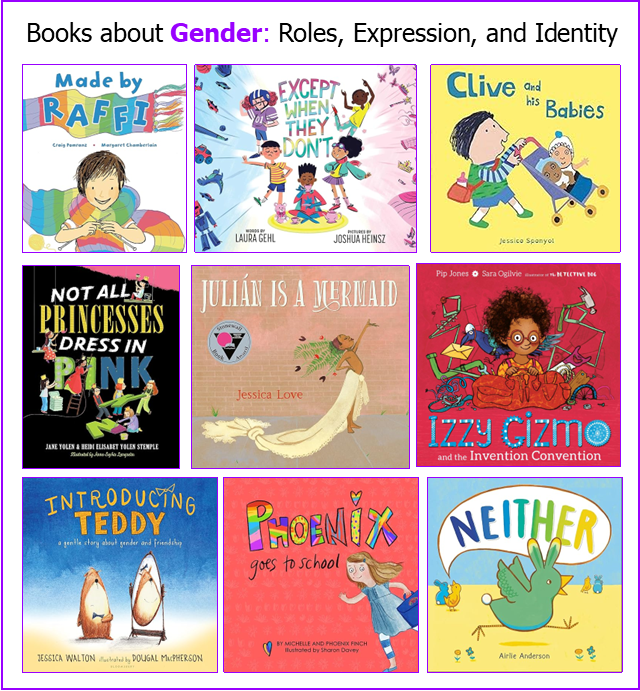
Except When They Don’t by Laura Gehl. Talks about gender role assumptions and the fact that they don’t always apply.
Made by Raffi is about a boy who likes to knit even though others say that’s a girl activity (role).
Paper Bag Princess. (video) For ages 5+. About a princess who saves the prince.
Princesses can be Pirates Too (Video) About a little girl who loves to wear pretty princess dresses AND wants to be a bold brave pirate.
Clive and His Babies (video) Shows a boy playing enthusiastically with his baby dolls. (Age 2 – 4) There’s also Clive and His Hats and Clive and His Art.
Rosa Loves CarsVideo. (age 2 – 4). There’s also Rosa Plays Ball and Rosa Loves Dinos.
William’s Doll (video) For 5+. About a boy who wants a doll. Others tease him or try to change his mind, but Grandma listens.
Gender expression is about how we dress, how we style our hair and makeup, and how we move (e.g. boldly striding along, or hunching shoulders and being small).
Julian is a Mermaid (video) tells the story of a boy who sees people dressed up as mermaids in a parade and tells his grandmother he is a mermaid too – she helps him to dress up.
Gender Identity
This refers to how a person sees themselves. Do they say that they are a girl or boy, and how do they feel when other people label them as one or the other.
Introducing Teddy by Walton. (video) Teddy explains to a friend that in her heart she has always known she was a girl and wishes her name was Tilly.
10,000 Dresses (video) is about Bailey, who wants to wear dresses and identifies as a girl, although others label Bailey as a boy.
In Phoenix Goes to School (Video), we meet a girl and learn about her, then she talks about going to school and worrying that the kids will think she’s a boy. She ends up having a positive and welcoming experience at school.
When Aidan Became a Brother (video) When Aidan was little, people thought he was a girl, but then realized he was a boy. This story is primarily about his family welcoming a new baby.
There are also some books that are metaphorical – they can be read as being about gender identity, but your child may not make the cognitive leap to understand that metaphor. For example, in Red: A Crayon’s Story, a blue crayon mistakenly labeled as “red” suffers an identity crisis and in Bunnybear, Bunnybear identifies as a bunny, and Grizzlybun identifies as a bear. If you’re just looking for books to encourage a general sense of acceptance of diversity and self-identification in your child, these are a great match. But if you want to specifically address gender identity, you will need to help your child see that message: “Remember that book we read, Neither? It was about a creature that was both a bunny and a chick, but not quite a bunny or a chick? That’s sort of like our friend Rex, who told us they are both a boy and a girl, and not quite a boy or a girl? They said that’s called non-binary. And remember how Neither felt sad when nobody accepted them, but felt happy in the Land of All where they were accepted? Can we be a Land of All for our friend Rex?”
I was just writing an end of year email to a parenting class, and wrote down my top ten takeaways from our whole year of learning together. They are also a fair summary of the information you’ll find on this blog:
Children behave better when they know what to expect and what’s expected of them. If a child is not behaving well, ask yourself: What support do they need, what systems would make it easier for them to be successful, what skills do they still need to learn?
With food: parents decide when and where it’s offered and what is offered. Children decide whether to eat and how much to eat. With all choices: Parents decide what options are on the table, children choose amongst those appropriate options.
Kids need time to run, to be loud, to be silly, to explore their world. Make sure there are a lot of “yes” times and places in their day. Taking small and manageable risks builds skills and independence, even if it means an occasional bump or bruise.
We learn from mistakes. Embrace them! Teach your child the Power of Yet: “you can’t do it yet, but someday, if you keep trying, you’ll be so good at it!”
Children learn best when they feel safe and happy, so play-based learning is powerful. Brains develop through novelty – being exposed to new experiences – and repetition – having the chance to do something again and again till they master it. Explore art, the outdoors, large motor play, building things, doing crafts, and more.
There is no one right way to parent. If you, your child, and other family members are happy, healthy, and succeeding at your goals, then all is well. If you’re unhappy or not feeling successful, seek out new ideas and seek out support. (Parenting classes, counseling, support groups or just connecting with other parents!)
You will have good days and bad days as a parent. When you have a bad day and are not the parent you want to be, acknowledge that, forgive yourself and commit to doing better in the future. When you are having more good days than bad, celebrate that! You’re doing a great job.
Today I was listening to a webinar with Ming Fung from Agents of Speech. The topic was “Decoding the Real Signs of Speech Delays” and he was primarily talking about parent coaching for language delays.
But one of his messages gave me one of those a-ha moments you get when someone says something that should be obvious, but says it more clearly than you’ve thought of it before.
When you’re trying to teach your child any new skill and it’s just not working, you should ask yourself “is it that it’s too hard? Or that they don’t want to do it?”
If it’s too hard, that may mean you’re trying to move too far too fast, and simplifying things into next achievable step might be more successful. It is better to have small successes than fail at a big reach. Ross Greene says that often when we’re thinking “they don’t wanna do it”, it’s really that “they can’t do it… yet.” And that they need more skills, new resources, or more structural supports to be successful.
If they don’t want to do it, he says “make sure they’re fairly compensated.” If it’s just slightly hard or slightly annoying or whatever, it may need just a little motivation. If it’s a big stretch, it may need a big motivation. If your child has special interests, you could find a way to teach that skill within that interest. (When my youngest child was resisting learning to write and draw, we would ask him to write requests for treats, like “kiss” for a Hershey’s kiss or “Cheez-Its”, and he would draw if we would draw Star Wars characters that he could copy.) Or, if they have a big passion, you can use that as a motivator. (My oldest was very slow to potty train, and saying “here’s the dollhouse you want – it’s a big kid toy. As long as you can keep your underwear dry, you can play with it, but if you need to go back to pull-ups, that’s OK – we’ll put the dollhouse away for a little while till you’re ready to be a big kid.”) Don’t force the learning, but show them there is a value in learning this new skill.
Now, you don’t want to overdo rewards. There are downsides to rewards. But sometimes it is a way to move your child forward toward something you want them to learn.
First, you need a ukulele. I recommend a soprano or a concert ukulele (they are tuned to the same pitch, just the concert neck is a little longer which makes playing chords easier for folks with bigger fingers, and means that the instrument has a wider range of notes to play. The concert also has a more resonant, richer tone, because it’s a larger instrument, but I think soprano sounds fine for preschool songs.)
If you look on your local Facebook marketplace or other places used instruments are sold, you’ll find ukuleles in varying quality and price points. Or, ask your friends, maybe someone you know has a ukulele they’re not using. All you really need is a ukulele. You don’t need a strap or a case, though they’re nice to have.
If you’re buying new, it may be best to go to a local shop that sells guitars and ukes and has knowledgeable staff, where you can try things out hands-on. I have ordered mine online. My Kala KA-15S was a fine starter instrument, though with only 12 frets, it will have a limited range as your skills build. It’s currently $99 including a bag, strap and tuner. I think the Enya Carbon Fiber is a better bet. It’s only $49 (with bag and strap, no tuner) but has a really nice sound, has 17 frets, and I am much more convinced that it would survive being stepped on by a preschooler. (This hasn’t happened in my classes yet, but I am certain it will someday!) Those links are Amazon affiliate links, and I do get a referral fee if you click through and purchase something. You can also find lots more recommendations for beginner ukuleles.
In this video, I compare the Enya, described above, with my Kala KA-SCAC-SLNG, which is a long neck soprano, which cost $259.
Choose a Tuner and/or App
There are ukulele specific tuners and chromatic tuners. I like a chromatic tuner. A basic tuner just tells you whether you’re playing a G, C, E, or A since those are the chords on a uke. If you’re tuning for C and you’re not in the range for C, it doesn’t show anything. When you’re getting closer to C, it shows that you’re too high or too low. When you’re in tune, it shows that. Here’s two images from beginner tuner in the Kala app.
A chromatic tuner tells you what note you’re playing – like that your G string is currently playing F# – and clues you into whether you need to tune up or down to find the correct note. From the insTuner app:
You could buy a clip-on tuner, or one might come with your uke. They probably work better than an app in a loud setting (like say at a preschool after the kids arrive!)
I just use an app on my phone – if you buy a Kala uke, it will give you access to the Kala app, which includes a basic tuner and a chromatic tuner. The YouKeLiLi Tuner app is an OK tuner, but I like that it also offers chord diagrams, for when I need to look up how to play a C6 chord or F#m. The main tuner I’m using now is insTuner, which is an easy to use chromatic tuner. Here’s a very brief video of Instuner in action.
Note: There are several apps which also have video lessons to help you learn ukulele: including the Kala app, the OK Music app. I haven’t used them much, but they’re probably worth checking out while you’re looking at apps.
Learn How to Tune
When you get a new ukulele, it is likely to be out of tune! If it’s a used uke, they do go out of tune over time. New ukes are shipped with the strings loose to avoid damage, and so you have to tune them up when you get them, and keep tuning them a lot in the first few weeks as those new strings stretch out and settle in.
When you’re holding a ukulele with the neck in your left hand, the top string is a G, the next one down is a C, then E, and A is the one at the bottom. To tune, you play a note on the string, check the tuner, and turn the tuning pegs clockwise or counter-clockwise till it’s in tune. The easiest way to learn this is to watch a video! Here’s my favorite on How to Tune a new ukulele fresh out of the box by Bernadette, who is my favorite online ukulele teacher.
Since it sometimes helps to be taught the same skill in a few different ways till you find the one that clicks with your learning style, you may also check out: How to Tune from Katie from One Music School – shows at the beginning how a tuning app works. https://youtu.be/2hZY_WzaS78?t=36; and How to Tune by Andy Guitar – easiest to see tuner as he tunes https://youtu.be/2VOuRBjmzAM?t=45
Learn How to Hold Your Uke
There are some written tutorials online, some with helpful diagrams, such as Zing instruments and the Wikihow.
Some key points: hold it so the back of the ukulele is pressed against your belly or chest, and your right forearm is braced against it to hold it in place. The neck is in your left hand – it rests in the space between your thumb and first finger – your thumb is on the back or top of the neck, your fingers are cupped, ready to make chord shapes on the fret board.
For your first few strums, let’s try strumming with your thumb. Stick your thumb up like you’re giving someone a thumbs up, then brush it across the strings like you’re brushing a hair off the strings with the side of your thumb. Here’s a video that clearly illustrates this: [note: all my video links are set to go to a specific point in a video, like this one starts at 3:04. That is the most relevant spot in this video, and then I recommend that you watch it up till 5:18. There’s lots of other good stuff in this video, but that’s the section to focus on for now.]
This is just a beginning strum technique – it works best when you just want to strum down once at the beginning of each bar of music. You’ll quickly move on from it to the next one, which is a lot more versatile, especially when we add in down-up strum patterns.
Learn to Strum with Your Index Finger
You can strum with just your index finger, or you can place your thumb against your index finger to give it more strength (and make your strums louder.) Some people use a pick for ukulele, but most do not. This video starts at 3:02 – watch to 5:07 to get the strumming technique.
Again, if you need more tips to help you find the way that works best for you, check out these three takes on strumming, from my video, which covers thumb and index finger strums, from Bernadette – https://youtu.be/VJZg_vxODOY?t=30 and from Phil Doleman – https://youtu.be/CTWCmCKggwg?t=442 – watch to 9:20.
Learn How to Play a Chord
Let’s start with the C chord. You only need to use one finger to make this chord. Just press the tip of your ring finger down on the neck of the uke, in the third fret (the space between the second and third fret markers – learn more about your fret board). First, just strum that one string (the A string, the one lowest down when you’re holding the ukelele.) Does it ring out nicely? Or is there a dull plunking sound? If it’s dull, you’ll need to press down harder, and be sure you’re pressing beteen the fret markers. Getting good pressure on the string can be tricky if your fingernails are long – that’s why most guitar and uke players have short fingernails on their left hand!
Once that note (the C note played on the A string) sounds good, strum all four strings together to make the C chord.
This video walks you slowly through how to play Row Your Boat using just a C chord. She shows you how to play it with just one strum per bar, and then gradually, playing it as half notes, quarter notes and eighth notes.