Tag Archives: preschool

Willingness to Fail is the Key to an Inventor’s Success

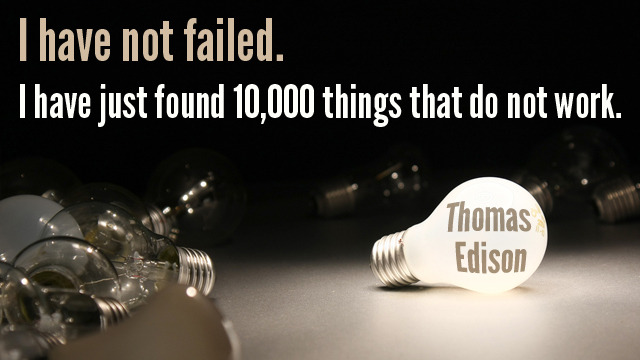
failedThe successful inventors, designers, engineers, artists, chefs, and entrepreneurs of the world know that the keys to success are hard work, sensible risk-taking, taking on challenges, failing, and trying again till you succeed.

Thomas Edison was a prolific inventor, holding over 1000 patents. His inventions include the electric lightbulb, motion picture cameras, and the phonograph. Here are quotes that give clues to the reasons for his success:

  • Genius is one percent inspiration and ninety-nine percent perspiration.
  • I have gotten a lot of results! I know several thousand things that won’t work.
  • Our greatest weakness lies in giving up. The certain way to succeed is always to try just one more time.
  • Just because something doesn’t do what you planned it to do doesn’t mean it’s useless.
  • The essentials to achieve anything worthwhile are: Hard work, Stick-to-itiveness, and Common sense.
  • The reason a lot of people do not recognize opportunity is because it usually goes around wearing overalls and looking like hard work.
  • I never did a day’s work in my life. It was all fun.

Edison clearly had “grit” and a “growth-based mindset.” He also loved to tinker, and had a passion for learning. (Click on any of those color links for tips on instilling those traits in your child. Also read here about the impact of praise on your child’s mindset.)

Here are some ways to raise an Inventor (or designer, engineer, artist, chef,  entrepreneur, author, builder, etc.)

  • Create a culture where struggle and risk-taking is valued more than the “right answer”. One parent asked this question at dinner once a week: “how did you fail this week?
  • Instead of defining things as “pass” or “fail”, try “mastered” and “not yet.”
  • Tell stories about successful people that illustrate how grit helped them succeed.
  • Let them know that everyone, no matter how talented, runs up against things they can’t do. The ones who succeed are the ones who fail, pick themselves up, fail again and persevere till they succeed.
  • Talk about mistakes and failures as normal parts of learning – not reasons to quit.
  • Let them see you fail and keep trying. Don’t say about yourself “I’m just no good at this.” Say “I guess I need to try harder.”
  • Honor them for times when they set their own goals, begin the work, face road blocks, and carry on to completion.
  • Make things together. Come up with an idea for what you want to accomplish. Draw it and plan it. Build it. Test it. Ask each other: what is working about it? What could be better? Make it better together. Show it to other people. Ask them what could be better.
Grit – The Key to Success?

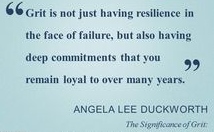
gritMany people view intelligence as the key to success. However, there are plenty of intelligent people who don’t achieve much, and lots of successful people that don’t score that well on IQ tests. Angela Duckworth, from the University of Pennsylvania, suggests that an even more important trait is grit. “Grit is passion and perseverance for very long-term goals. Grit is having stamina.” “Grit is sticking with things over the very long term until you master them.”

Duckworth studied students at West Point, competitors in the national spelling bee, and those who complete college versus those who don’t. She’s tested them on the grit scale which asks if they work hard, if they stick to a goal till it’s achieved, and how they respond to setbacks. Those with the highest grit scores were the most successful in each realm.

She believes grit can be taught. Some ways to teach it:

  • Create a culture where struggle and risk-taking and doing things outside your comfort envelope is valued more than getting the right answer.
  • Tell stories about successful people that illustrate how being gritty and working hard despite setbacks helped them to succeed.
  • Talk about mistakes and failures as normal parts of learning – not reasons to quit.
  • Let them know that everyone, no matter how talented, runs up against things they can’t do. The ones who succeed are the ones who fail, pick themselves up, fail again and persevere till they succeed.
  • Honor them for times when they set goals, face road blocks, and carry on to completion.
  • Encourage a growth-based mindset.

Some argue that grit is a byproduct of other traits like confidence, courage and curiosity. Others argue that a child is more likely to be “gritty” and persistent and complete tasks in areas where they are passionate. Duckworth agrees: “I don’t think people can become truly gritty and great at things they don’t love So when we try to develop grit in kids, we also need to find and help them cultivate their passions. That’s as much a part of the equation here as the hard work and the persistence.”

Learn more:

Growth Based Mindset

Carol Dweck, a psychologist at Stanford University, has spent decades studying achievement and success. She has developed the concept of a growth-based mindset, summarized here:

Fixed Mindset Growth-Based Mindset
Belief Intelligence and talent are static. They’re something you’re born with: you have it or you don’t. Intelligence develops with effort. The brain is like a muscle that can be trained.
Goals To look smart in every situation.
To never fail.
To push myself and try new things.
To take on new challenges.
Success Proving I’m smart or talented. Stretching to learn something new.
Evaluation of a new situation Will I succeed at it or will I fail?
Will it make me look good or bad?
Will it allow me to grow?
Attitude to challenges I avoid challenges.
I stick to what I do well.
I embrace challenges.
I persist when things get tough.
Response to setback I’m a failure. (identity)
I give up.
I failed. (action)   I’ll learn from it and move on. I’ll try harder next time
Effort Why bother? It’s pointless. Effort is the key to mastery.
Criticism Ignore criticism or deflect: “It’s not my fault.” Learn from criticism: how can I improve?
Success of others I feel threatened by it.
If they succeed, I fail.
I find lessons and inspiration in other people’s successes.
I feel good When it’s perfect. When I win. When I try hard. When I figure something out.
Results They plateau early. Never reach full potential. They achieve ever-higher levels of success.

Mindsets in the classroom:

Students were given a test. Then some of the children were praised for their intelligence: “that’s a good score. You must be smart.” Some were praised for the process: “that’s a good score. You must have worked hard.” The kids were then asked what they wanted to do next, and they were given the option of something easy where they wouldn’t make mistakes or something challenging where they might make mistakes but would learn something important. Those who were praised for intelligence chose the easy task. Those who were praised for effort chose the hard task they could learn from. Later, they gave everyone a very hard test – the kids praised for intelligence lost confidence and lost their enjoyment of the task and later lied about their scores. The kids who were praised for the effort and the process stayed confident, worked hard at the problems and remained engaged and didn’t lie about their results, because they felt they had done as well as they could on a hard test.

In other research, by Dweck and Blackwell, a group of low achieving students attended a class that taught that intelligence, like a muscle, grows stronger with exercise. As they learned to believe that intelligence was something they could learn, rather than something they could never achieve if they weren’t “born with it”, their motivation increased. They worked harder. When they had difficulty, instead of saying “I’m just not smart enough”, they would say that they needed to work harder or smarter. Their math scores improved, and continued to improve in the following year.

Another example of where these mindsets play out is in the math classroom. 3 out of 10 American describe themselves as “bad at math.” This leads to the belief that “I will never be good at math, so there’s no point in even trying.” Parents and teachers often reinforce this perception. Research shows that while genetics and inherent intelligence can help children initially score well, over time the kids that do best in math are the ones who work hard, have good study habits, and enjoy doing math.

To help your child develop a growth based mindset:

  • think about how you praise them: praise effort, not talent. Praise process not product.
  • pay attention to how you talk about your own abilities… do you say “I’m just no good at…” or do you say “this is hard for me right now, but if I keep trying I think I’ll do it”
  • think about how you respond to their failures and frustrations. Do you let them give up, or encourage them to keep trying? Do you say things like “I know it seems hard now, but I also know that the more you practice, the better you’ll get.”
  • encourage them to tinker: play around at something – try and try again until you get the result you were hoping for

Learn more about growth mindsets at http://www.whatkidscando.org/resources/spec_growthmindset.html and Mind-sets and Equitable Education: http://www.principals.org/Content.aspx?topic=61219

Read more on math at “The Myth of ‘I’m bad at math’” at www.theatlantic.com/education/archive/2013/10/the-myth-of-im-bad-at-math/280914/ and “’I’m not a math person’ is no longer a valid excuse” at www.businessinsider.com/being-good-at-math-is-not-about-natural-ability-2013-11

If you’re in the Seattle area, you can attend a lecture on the Growth Mindset by Tracy Kutchlow on Wednesday, April 29. Learn more here.

Building a mini submarine

A few weeks ago at our Family Inventors Lab, we studied submarines, and our book for the day was Papa’s Mechanical Fish, a really well-written and enjoyable book that shares the adventures of a family where the father is an inventor, who is sometimes successful and sometimes not. He is inspired to make a mechanical fish, and after several failed attempts makes a submarine the whole family can ride in.

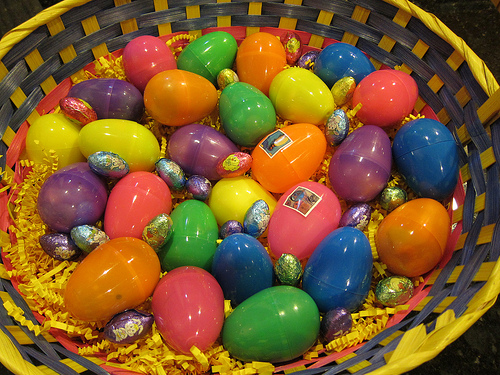
At class that day, our main tinkering activity was to make a water-tight mini submarine that would keep a little paper person dry inside for 20 seconds underwater. Our supplies included plastic easter eggs, miscellaneous plastic containers, and tools that would help to waterproof things (tape, plastic bags, silly putty, things to wrap objects in, etc.)

This activity did what we hope to do with all our activities… it adapts to various ages and it teaches kids to experiment and adapt their efforts till they succeed.

Our littlest kids (2 – 3 year olds) mostly just used this as a sensory tub. They played with whatever was floating in the water.

Some of the middle-sized kids (3 – 4 year olds) did things like  float an easter egg inside a plastic bowl boat or fill plastic Ziploc bags with water and float those.

Our next oldest (4 – 5) tested the other containers: water bottles, small food containers, and some travel-size toiletry bottles to see which would keep a paper person dry. Some would and some wouldn’t. They also tried wrapping the eggs in various things (paper, cloth napkins, plastic bags) to see if they would stay dry. All of those failed, except sealing the egg inside a ziploc.

The oldest kids (6 and 7) did the full tinkering activity with the easter eggs. Testing, diagnosing, hypothesizing, building a prototype,  testing again, and repeating till we got it right. We learned that plastic easter eggs leak water because they have holes in the ends. We tried taping the holes and sealing the gaps with play-dough or silly putty. But even after you seal the holes, there’s a gap around where the two halves come together, and the eggs still leak. (And play dough makes a big mess when it gets wet!)

We eventually discovered a working solution: seal the ends of the eggs with silly putty. Put the paper person in. Wrap a silly putty seal all around the gap where the two halves of the egg come together. Submerge it. Count to 30. Bring it out of the water, dry it off, open it up, and Voila! we had created an easter egg submarine.

This is a great activity to repeat at home during bath time. Just grab a wide variety of plastic containers with lids from your kitchen, tear up some paper from the recycling bin to be your “people” you’re trying to keep dry, and head for the bath tub. Your child will learn about sinking, floating, water-tight vs. leaking, and the  fact that bubbles coming up from your submarine is a bad sign… if air comes out, water will go in!

What to Do with Plastic Eggs

eggDo you suddenly have an abundance of plastic Easter eggs in your life? Don’t throw them in the trash!

They can be washed and re-used again and again – Just throw them in a sink (or big bowl) full of soapy water to wash – it takes minutes. Then they can be stored and re-used again the next year. So much easier on the environment than land-filling dozens of plastic eggs per kid per year.

But, beyond just re-using them in one year, there are so many other fun things you can do with plastic eggs! Try some of these before you pack your eggs away for the year.

Egg Hunts: Egg hunts are a fabulous activity year round! (Read my post from last year on what your child can learn by hunting for eggs – counting and math skills, persistence, delayed gratification, observation skills, and more.) Check out this post from Hands On as We Grow, where she links to ideas on spicing up your egg hunts with new challenges. I like this one from Sugar Aunts – the kids have to search for things to fill the eggs with – something yellow for the yellow egg, something red for the red egg… this is just good for color learning, but also a great spatial intelligence builder as they have to think about whether things are small enough to fit in an egg, and fine motor skill builder as they learn how to fill and close eggs.

Shaker Eggs: You can use eggs to make musical shakers by filling with a variety of small objects. (Tape or glue closed if you have little ones who still put small things in their mouths.) Family Sponge has a great post on this, and they and Motherhood on a Dime also suggest a sound `matching game you can do: make pairs of eggs (two with kidney beans in them, two with rice, etc.) Have your child match the eggs – great practice at sound discrimination. Here’s a sound discrimination and math game in one. Fill eggs with objects. Have the child shake and listen and guess what might be inside by the sound. Then open it up and count the objects.

Egg Critters. You can add googly eyes, sequins, pipe cleaners and other decor to create little animals and make paper bag nests.

IMG_20170415_111218784

Sink or Float: Here’s a Sink or Float experiment from No Time for Flashcards where you fill the eggs with various items and see if they will float. If they sink, add salt to the water – does the egg float now?  Try an experiment where you build a mini, watertight submarine from an Easter egg.

Writing on the Eggs: On I Can Teach My Child, she posted 20 ideas for what to do with eggs. My favorite was Posh Lil Divas word family eggs. eggs   You could also write numbers on one half egg, and then on its partner, draw a number of dots to correspond to that number. Children have to match the 7 dots egg to the number 7 egg.

Filling the Eggs: You can make your own “Kinder Surprise Eggs” by filling eggs with toys and surprises for your child. If you’re ambitious, you could also then cover the egg up with playdough so your child has to peel away the playdough first, then open the egg. (There are countless YouTube videos about surprise eggs…. ) You can also get creative by filling the eggs with materials that lead into an activity.

  • Get a Lego set and divide it up, with the 5 blocks needed for the first step in one egg labelled one, and the blocks for the next step in an egg labelled two, and so on. Do the egg hunt first, then your child can assemble the kit.
  • Divide up jigsaw puzzle pieces between several eggs. After all the eggs are found, assemble the puzzle.
  • Take the magnetic letters off the fridge. Divide them up in 26 eggs. As your child finds them, they put them in alphabetical order, and if any are missing, they know they haven’t found all the eggs yet.
  • Make a lunch of finger food snacks (cheerios, crackers, raisins, blueberries, and so on) and hide them around the house – your child gets to eat lunch as they hunt.
  • Fill the eggs with stickers or beads or other supplies for a craft project.
  • Put finger puppets (or toy dinosaurs or whatever) in the eggs, and each time your child finds an egg, they open it up, and you tell a story about the puppets and the adventures they’re having.

Drop the eggs – engineering challenge: Put a bouncy ball (or similar weight object) inside the egg. Drop it – it will break open, as a real egg would. Now try putting it inside a plastic bag filled with packing materials. Drop it again. Does it break? Continue to design containers and test them (do a search for “egg drop challenge” for lots of ideas.) Once your child has perfected a container, test it with a hard-boiled egg, or if you’re brave, test it with a real one. For lots more egg science activities, check out my Inventors of Tomorrow blog.

Egg Balancing: Frugal Fun had a fun idea: take a cardboard box, mount sturdy straws, dowels or pencils standing upright, and put out with a collection of plastic eggs. Kids can balance eggs on the sticks – it’s a surprisingly challenging motor skills game.

What do you do with plastic eggs?

credit for photo at top: IMG_3987 via photopin (license)