Early childhood is prime time for learning social skills. Although many children will figure them out on their own, some children, especially neurodiverse kids, may need concrete instruction to build the skills and everyone can benefit from practice! Here are tips for supporting your child’s social development.

Learn what’s normal / what’s next:
If you want to evaluate whether your child is on track with social skills, check out this checklist of play skills (or this one) that children typically develop at each age – you may discover they are right where they should be developmentally. If they haven’t yet mastered some of the typical skills, checklists give you a sense of what to work on.
It’s helpful to know what we’d typically expect at each age, and what’s next in typical development, so you can foster opportunities for learning.
Infants – Babies get lots of practice with social cues and interaction from the adults who care for them. Just practice serve-and-return interactions, where your baby smiles at you and you smile back. Your baby coos and you coo back. (Learn more.) And learn about infant cues to guide your responses. If your baby has the opportunity to interact with additional adults or older children, they will likely happily engage with anyone.
Older Babies. From 6 – 12 months, your baby learns to play more interactively with you and will likely enjoy peek-a-boo, copying your actions, clapping with you, passing toys back and forth, and finding toys you have hidden. Some babies may play happily with all they encounter. However, it is important to know that many infants develop a fear of strangers at around 7 to 8 months. Here are tips on reducing separation anxiety. And more tips.)
Young Toddlers – up to 2 years. Before 18 – 24 months, children primarily engage in solitary play, where they engage with toys, but often appear uninterested or unaware of other children. They do engage with adults or older children more effectively than they do with peers. To build social skills, try Floortime play, which begins with child-led play, then “stretches” the play to be more interactive and turn-taking.
Onlookers: Around 2 years old, they begin to shift to spectator play, where they may begin observing other children more. This is a great time to take them to public parks where they can watch other children at play, up close or from afar.
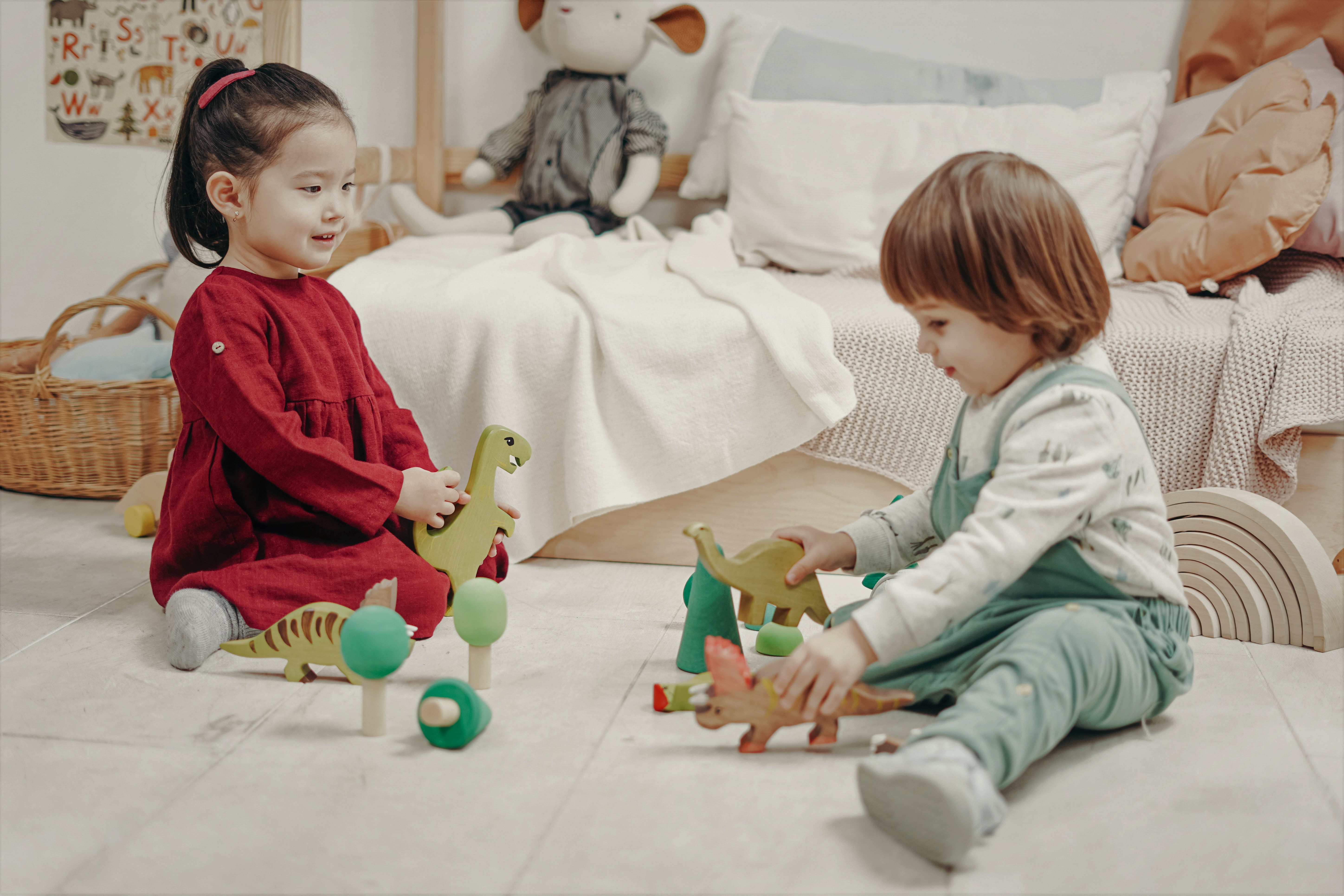
Older Toddlers – 2+ years. Children begin to engage in parallel play. They will play next to each other, often mimicking what the other child is doing. They may not often engage in reciprocal back-and-forth play with a peer, but they are learning from each other.
“Stealing” toys is very common at this age. They are not intentionally trying to deprive the other child of something… it’s just that they noticed what the other child was doing and they want to do it now. One of the most effective ways to handle this issue is distraction – let the child who seems more focused on the contested toy keep it, and distract the other child with a new toy. That will work better, and is more developmentally appropriate than telling children to share.
Three Year Olds. Around age 3, children begin to do more associate play. They start to interact more with each other, trading toys, copying each other, or “inviting” the other child to participate in what they are doing. They become more interested in the other child than in the toy. They may work together on a goal – like building with blocks, but there aren’t usually “rules” to the game. They can learn social skills by playing with adults or with older children, but it’s great if they can have peer interaction at this age. It does not have to be in a large group pre-school. One-on-one or a few children at a time is fine. It may be tempting to enroll in classes as your primary place to connect with other kids, but if your main goal is social skills, it is easier for children to learn those in settings that allow lots of free play (a playground, playdates with other families, a play-based preschool, or a family size child care setting) than in a structured class (like a gymnastics or soccer class where the teacher is trying to keep them on task.)
Check out the “skills to practice at home” section below.
Four and Five Year Olds. At this age, they have moved into true cooperative play. They share toys, they share ideas, they create “rules” or agree on which role each one will play in a pretend game, and work together toward goals. They start learning more about cooperation, compromise, and fair turn-taking. Whereas at younger ages, it’s fine to have your child play with lots of different kids, this is an important age for children to have a few consistent buddies to play with repeatedly, to build friendship skills. If they are enrolled in a group setting, like preschool or extracurricular classes, look for children there that they most connect with, and try setting up playdates with that family to give them more opportunity to connect.
Skills to Practice at Home
You can boost their social skills by practicing in advance of playdates. Do lots of pretend play, puppet shows and role plays, and talk about the social and emotional experiences of characters in stories that you are reading.
When teaching about emotions, teach children to recognize how facial expressions, body language, and tone of voice all communicate emotion
Practice give-and-take conversations, where you take turns fairly, don’t interrupt each other, and ask the other person questions about what they said rather than always just telling them things. Role model social skills by how you interact with friends, family and people in the community.
If you tell a child, “you have to share that toy”, it’s easy for that to feel like “you have to give away that thing you like right now.” It can cause them to cling tighter. It works better to introduce the ideas of taking turns. Play side by side with your child, and occasionally say ‘you can have that toy for one more minute and then it’s my turn.’ If they try to take a toy from you, say ‘I’m playing with it now. You can have it in one minute. Here’s another toy you can play with now.’ Don’t expect 2 – 3 year olds to be good at taking turns! It’s a skill that needs to be learned and practiced, and they just have to reach a stage of development where they can empathize with another child’s feelings. But practicing at home gives them a chance to build trust in the idea that if they let you have your turn that you will give it back when it’s their turn.
If your child seems shy or withdrawn, learn tips to support a “slow-to-warm-up” child. Some simple ways to help them are: get together in smaller groups in quiet, not chaotic environments; arrive before the other child(ren) to get settled; sit on the ground and let your child sit on your lap till they feel ready to venture out. Don’t push.
Learn more in my post on “Teaching Friendship Skills” and my tips for Successful Playdates. And check out Pretend Play.
 More Good Days with Kids