Tag Archives: Parenting

Family Meal Time – making it pleasant for everyone

family eating a meal

Meal time is about more than putting food into our bodies. The family meal also offers:

  • Together Time: a chance to talk and connect as a family
  • Social Skills Practice: a place to learn polite manners and the art of conversation
  • Routine and Rituals: grounding in a reassuringly predictable experience
  • Healthy Habits: modelling, practicing and discussing healthy eating

Unfortunately, children don’t come into the world prepared to be pleasant dinner companions. Proper mealtime behavior is a learned skill. There are many steps you can take to start the path to making meals enjoyable and pleasant for everyone. I offer some tips here which most experts recommend, but there is no one right way to parent, so you should do things that work best for your family.

Whose Job Is It?

I find this message from Ellyn Satter about the division of responsibilities is simple but really powerful:

You are responsible for what, when, and where. Your child is responsible for how much and whether.

Your role is to offer healthy food and be a good role model for healthy eating. But, your child will choose whether to eat something and how much to eat. Don’t turn meals into a power struggle. Help them to be a joyful time.

What to Eat

Put out a variety of healthy foods. Let your child serve himself, choosing how much to put on his plate (encourage him to start with small servings – reassuring him he can always have more). Be a good role model in your own food choices and portion sizes.

Involve your child in choosing and preparing the food. They are often more willing to eat a variety of foods if they were involved in making it.

Help your child recognize when she is full – this will decrease the chance of later obesity. Don’t praise children for a clean plate. Reward them with attention, kind words and fun activities, not food.

Don’t restrict certain foods – they may become the “forbidden fruit” and children will overeat them when they can. Offer small amounts of dessert items with the rest of the food – don’t set it aside as the “special” part of the meal.

When to Eat

Newborns have tiny tummies and digest breastmilk or formula quickly so need to be fed often. So parents get used to lots and lots of “meals” every day. As children get older, they no longer have that need, but I feel like many parents continue to use snacking as an anytime activity / distraction for their toddlers and preschoolers. It is better for older children to have a routine such as three meals a day with an afternoon snack and a bedtime snack, and avoid continuous grazing.

Allow plenty of time at the table. At least 20 minutes for a meal. When your child is full, he can leave the table, but let him know that when he leaves the table that means he’s done for that meal – he can’t come and grab bites then run off to play.

Where to Eat

Eat at the dining table or in the kitchen. Not in the play room, or in front of the TV, or in a bedroom. This helps keep the rest of the house cleaner, but also helps us remember to be conscious of what we’re eating and not just eat because we’re bored. (Most experts would say don’t eat in the car, but I have to confess that as a parent, I’m often running late to things so we eat in the car on the way there… I won’t say it’s perfect, but it’s apparently part of our reality.)

More Tips

Ask your child to help prepare for the meal, perhaps by carrying things to the table, setting the table, turning off the TV, or calling other family members in. Clean up together. Involve them in clearing the table, and wiping the table. Don’t present these things as chores that they get punished if they don’t do (if you don’t ____, then ____). Instead present them as just part of the work of the family and let them know that when we get our family work done, we get to have fun together. (“When we’ve cleaned up dinner, then we get to play.”)

A two year old can learn to use a spoon and a fork, drink from a regular cup, and feed herself a wide variety of finger foods. Allow for some mess – children are learning how to eat neatly. Help her use a napkin to wipe her face if needed, but don’t feel like you have to hover over her and clean up after bite. You may need to set limits on mess-making. If she starts throwing food or intentionally dropping it, end the meal. Take her away from the table and clean up the food. (Don’t worry if she didn’t eat “enough”. She won’t starve between now and the next meal, and we want her to get the message not to make a mess.)

During the meal, engage in conversation. Many families have a ritual question, such as “highs and lows” or “what is one thing you learned today” or “what is one thing you were grateful for today.”

Family meals matter: research shows kids who regularly eat with their families do better in school, have better self esteem, make healthier food choices, and are less likely to abuse drugs and alcohol.

More on manners: www.parenting.com/article/ask-dr-sears-table-manners-for-toddlers; https://www.babycenter.com/toddler/development/teaching-table-manners-to-your-toddler_1429019 

Learn more about nutrition recommendations for toddlers. This post from Mott’s Childrens’ Hospital is on picky eaters, but offers lots of great all-purpose mealtime tips, and here’s my post on picky eaters. Also, check out Ellyn Satter’s website.

Discipline

DisciplineFlowLooking for tips on discipline? Read on to learn about: having developmentally appropriate expectations, helping kids understand what is expected of them, modelling and rewarding desired behaviors, setting limits, and enforcing consequences.

What is discipline?

Discipline does not mean punishment after misbehavior has happened.

Discipline means guidance. It means setting clear expectations for how we would like our children to behave, not assuming they know how. It means modeling for our children the kinds of behavior we would like them to display. It means setting clear limits about things they cannot do. And, it means that when they misbehave, we let them know that the behavior was not OK, but we do still love them, and we tell them how to be better in the future. This style of discipline not only guides behavior, it also builds trust and respect between parent and child.

The first step in discipline is to consider how old your child is…

Make sure your expectations are developmentally appropriate

From birth to three, your child is going through massive developmental changes, with more brain growth than ever again. They learn through hands-on exploration of the world, which means they get into everything, and have no sense yet of what is safe and what’s not. Your role is to protect them as needed, but also allow them to explore and learn within limits. They learn through repetition, which means they need to do something over and over to learn it, and that includes misbehaving over and over and experiencing consequences over and over before they really remember the rule. Your role is respond consistently each and every time to misbehavior to help reinforce their learning.

Discipline will be more effective (and you’ll be less frustrated) if you keep your child’s developmental capabilities in mind at all times. Do encourage them to stretch themselves and work on impulse control, but don’t expect more than they are capable of. Learn about developmental capabilities by reading books, looking online, taking classes, and by watching other kids. (Though it’s also important to remember that individual temperaments have a big effect on what kids are capable of, no matter their age.) For example, typically toddlers are not yet capable of sharing, have a hard time waiting and controlling their impulses, will bite and hit at times, and can’t always “use their words.” We ask them to do better, but we shouldn’t be surprised when that’s too much for them.

Learn more: www.askdrsears.com/topics/parenting/discipline-behavior/9-development-reasons-why-toddlers-can-be-difficult-discipline and Discipline that works: Ages & Stages Approach: http://umaine.edu/publications/4140e/

Explain what to expect, and what is expected of them

Remember how little your children know about the world. They don’t know that you’re supposed to be quiet in some places and that it’s OK to be loud in other places until you teach them that. They don’t know that they need to stay at the table at the restaurant until you teach them that (and remind them again and again). The more you can tell them ahead of time what to expect and what is expected, the better. When they are young, keep it very simple: “this is a quiet place”, “you need to sit with me here”. As they get older, you can have codes. Like in our family “theater rules” means a place where you sit in a seat, and are quiet, unless everyone else is clapping or singing.

To learn more about ways to guide your child in what TO DO, rather than focusing on what NOT to do, see my post on “Saying Yes.”

Model desired behavior and praise them when they manage it

Act the way you would like your child to act. Also, point our other kids who are behaving well. Children are great at copying what they see.When you make mistakes, say so, and apologize for it. “I tell you not to use bad words, and I just used a bad word. I need to work harder on using nice words.”

“Catch” them being good – praise them for the positive behavior they demonstrate. Some people recommend you shoot for a ratio of 4 – 5 times where you tell them they’re doing something right for every 1 time you tell them they’re doing something wrong.

Setting Limits and Consequences

When misbehavior begins, let them know that what they’re doing is not OK. (They might not know. Or they might, and are testing to be sure they understand.) Use a firm voice and a serious expression to convey this. It is confusing to toddlers if we use our regular sweet smile and playful voice when we’re telling them what not to do. Also, the louder your child gets, the calmer you need to be.

Remind them what the expectations are and encourage them to behave better. If they don’t, let them know what the consequences will be if misbehavior continues. Try for logical consequences, where the ‘punishment fits the crime.’ For example: “when you throw your Duplos, I need to put them away” or “when you don’t stop when I say red light, I need to carry you to keep you safe” or “I need you to help put away toys. If I put them away all by myself, I will put them up high on a shelf out of reach” or “when you dump your food on the floor, it tells me you’re done, and I’ll put it away.”

Consistently Follow through on Consequences

If the misbehavior continues, you must impose the consequence.  Although it’s hard to “punish” a child, it actually builds more trust if you do what you said you would do than if you “let it slide.”

Punish the behavior, not the child. Let them know you still love them, but the behavior was not OK. Use a calm and firm voice and expression, not an angry tone.

No need to discuss this or re-hash it or re-negotiate it. Just be clear and move on.

Handling Quickly Escalating Situations (including hitting and biting)

When anyone (or anything) is in imminent danger of harm, we need to act more quickly. There may not be time to suggest better behavior nor time to tell them what the consequences will be. You may just need to act quickly and explain later.

Also, if your child is in a full meltdown tantrum or very wild and out of control, you won’t be able to reason with them. They’re not understanding language at that point. You may just need to remove them from the situation, go somewhere quiet till they calm down, and then explain things.

How does your child respond to your no’s? How do you respond to that?

When you set a limit, does your child beg, whine, and plead? Or throw loud dramatic tantrums? Or try to make you feel like a bad parent, shouting “you don’t love me!”? If so, do you give in? If you do, you teach your child that whining, tantrums, and guilt trips are effective tools and they will use them again. And the toddler tantrums that seemed overwhelming at the time won’t compare to the battle your teenager will be able to put on after years of learning how effective tantrums are against you.

Try to stick to your no, no matter what. If you change your mind for some reason, be very clear about why “I’m not saying yes to this because you begged for it. I’m saying yes because I talked it over with your dad, and now that we’ve had more time to think about it, it seems fair to do. In return, here’s what we expect from you….”

Remember that giving in can make things easier in the moment, but it doesn’t accomplish your long-term goals, and can reinforce behaviors you dislike. Sticking to your consequences can be really hard sometimes. One year we had to bar our daughter from participating in a school play – something the whole family was looking forward to – due to one really bad week of homework issues. My husband and I were a strong united front in her presence, and did our own grieving behind the scenes.

Discipline Tactics that are Less Effective

Avoid empty threats: Saying “I’ll just leave you here in the store” or “I’ll throw away all your toys” can be very frightening to a child and scare them out of proportion with the offense. Then someday they figure out you don’t mean it, and then it’s pointless. Either way, it’s not effective at helping the child behave well.

What about spanking? It works in the short term to discourage a particular misbehavior. But it’s not beneficial in the long-term. Murray Straus, after 4 decades of research, says “Research shows spanking corrects misbehavior. But … spanking does not work better than other modes of correction… Moreover… the gains from spanking come at a big cost. These include weakening the tie between children and parents and increasing the probability that the child will hit other children and their parents, and as adults, hit a… partner. Spanking also…lowers the probability of a child doing well in school.”  www.sciencedaily.com/releases/2013/12/131211103958.htm
It also harms brain development: www.cnn.com/2014/07/23/health/effects-spanking-brain

What about time-outs?

  • Time outs work very well for some families. It depends on the temperament of the child and of the parent. Successful time-outs are not a punishment. They are a chance for a child to go somewhere quiet and calm down. They come back out when they’re ready to get along again. A typical rule of thumb is for a maximum time-out of one minute per year old. So a 5 year old would have at most 5 minutes.
  • If your child views a time out as a rejection, it might make her very sad. That child might need a “time-in” where the two of you sit quietly together until she calms down.
  • Some children view timeouts as a call to battle, and they only escalate the situation.
  • Some parents take time-outs themselves, saying “I need to go to my room for just a minute to calm down, then I’ll come back and we’ll talk about this.”

Think before reacting – Pick your Battles

As much as possible, think ahead of time about what the limits are. But sometimes you find yourself in a situation where you need to set a limit in the moment… take a little while to think it through before acting. For example, my first daughter wanted to wear her dress-up clothes to the grocery store. I said no, which turned into a battle of wills. Halfway through, I realized I really didn’t care. But at that point, I couldn’t just back down – I had to stick to the rule I had set. So, what I should have done is when she asked for something I didn’t expect, I should have said “Hmm… I need to think about that for a minute and decide if that seems OK with me.”

Some parents have tried a system where they have in their minds three categories of behavior. Green light options: things that are always OK, that they can always say yes to. Red light options are never OK, and they can never say yes to them, no matter how much the child asks or how embarrassing the public tantrum may be. (Safety issues are a good example.) And there’s a whole lot of yellow lights: things that are sometimes OK, and sometimes not. Then when their child asks them “Can I wear my swimsuit today” they might say “hmm… that’s a yellow light thing. Let’s think it through: if it’s warm out and we’re playing outside, that’s OK. But it’s not OK if it’s cold out or we’re going somewhere like church. So, today, since it’s so cold out, I have to say no.”

Think before reacting – See things from your child’s perspective

Children love to explore but sometimes that means they make a big mess. Before getting upset, try to see things from your child’s perspective to see the joy they may have found in making that mess. And try to see that they might not have realized that the mess would be a problem. Say “It looks like you had a lot of fun playing and exploring here! But, next time you want to play with that, we need to figure out how to do it without making a big mess. Can you help me clean up now?”

Steps in the Discipline Process

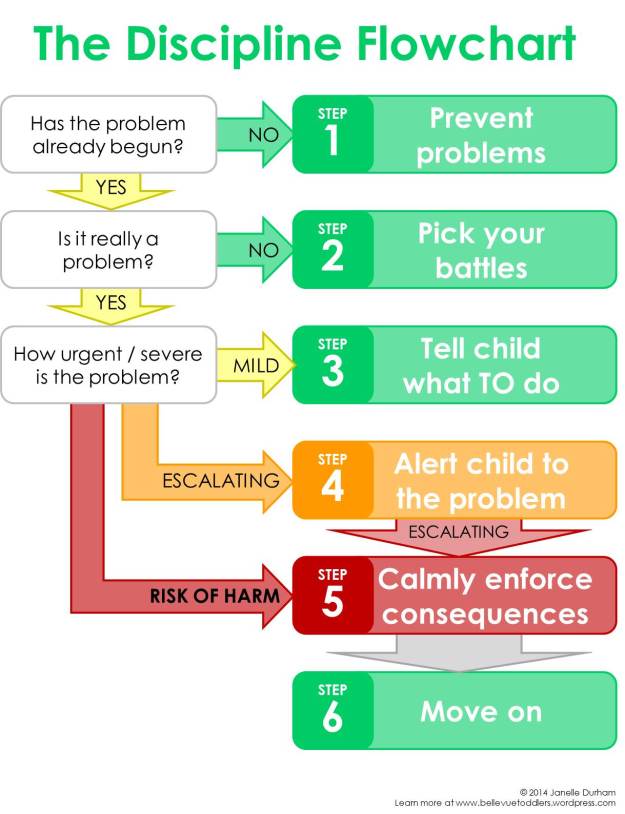
Check out this flowchart for steps which help your child to behave well.

Helpful resources

Webinar on Discipline: www.youtube.com/watch?v=sX0MQ5ZXVio&list=WLsMLXfBPSxoG3J_FkZGqnxVV2P34cr_S_

Overview Handout: www.parentingcounts.org/professionals/parenting-handouts/information-for-parents-discipline.pdf

8 tools for babies/toddlers. www.askdrsears.com/topics/parenting/discipline-behavior/8-tools-toddler-discipline

Tantrums: https://bellevuetoddlers.wordpress.com/2013/11/14/toddler-tantrums-and-emotional-meltdowns/

If you have a hard time saying no, check out:
www.empoweringparents.com/saying-no-to-your-child-how-to-be-a-more-assertive-parent.php?&key=Effective-Parenting
www.empoweringparents.com/No-Means-No-How-to-Teach-Your-Child-that-You-Mean-Business.php#ixzz2rlUqTBC9

The Marshmallow Experiment – Delayed Gratification and Trust

There is a famous study by Mischel, often called the Marshmallow experiment, where a researcher put 4 year olds alone in a room with a treat (e.g. marshmallow, cookie, pretzel). They were told that they could eat it now, or if they could wait 15 minutes then they could have a second treat. 30% were able to hold out for the full 15 minutes… It clearly took them a great deal of willpower to do so – 15 minutes is a VERY long time when you’re four, and there’s a tasty treat right in front of you. [note: on YouTube, if you search for marshmallow experiment, you’ll find entertaining videos of the ways children talk themselves into waiting to eat one. For example: www.youtube.com/watch?v=GzUS9N5aeFs)

Follow-up studies of those children when they reached their teen years found that the ones who could wait to eat the marshmallow were: more assertive, healthier, got better grades, and scored over 200 points higher on the SAT on average.

So, for years, this was touted as proof that the ability to control one’s impulses and delay gratification was one of the most essential skills a child can have for life success. And I do agree that it’s important!

But… there’s more to the story.

In a study published in 2012, children were given a piece of paper and a jar of used crayons. The researcher said she would be back soon with better art materials if they could wait. Half of the children (the “reliable condition” group) received better art materials as promised. But for the other half (unreliable), the researcher returned, apologized that there were not better materials available, and encouraged the child to use the old crayons. THEN they administered the marshmallow test to these children. Children in the reliable situation waited an average of 12 minutes. (64% waited the full 15 minutes) Children in the unreliable situation, who had been shown that the researcher didn’t keep her promises, waited an average of only 3 minutes! (Only 1 of the 14, or 7% of the subjects, could wait the full 15 minutes.)

This suggests that children are better at self-control, and at waiting for gratification, if they can trust the people in their environment. When parents respond consistently to their children, and are reliable about keeping their promises, it helps their child learn that good things come to those who wait and those who work hard at controlling their impulse for the quick fix and wait for a more long-term reward.

Sources:

2012 study: www.bcs.rochester.edu/people/ckidd/papers/KiddPalmeriAslin2012_Cognition.pdf

Related articles: www.businessweek.com/articles/2012-10-17/what-does-the-marshmallow-test-actually-test and

www.slate.com/blogs/xx_factor/2012/10/16/the_marshmallow_study_revisited_kids_will_delay_gratifcation_if_they_trust.html

Finding Time to Take Care of Your Own Needs

As the New Year is about to begin, let’s take a moment to look at ways to make time and space for meeting your own needs….

Giving Yourself Permission to Take Care of Your Needs

The first big step is to acknowledge that you have your own individual needs and that you have the right to sometimes be “selfish” and put your own needs first. Doing this will make you a happier, relaxed, more energized parent, which will lead to happier kids. It’s like when you’re on the airplane, and they say “if the oxygen mask drops down, first put on your own mask, and then assist small children.”

Working with Your Child’s Schedule and Needs

Sometimes you can fit in self care while caring for your child. What distracts your child enough that you can get a moment to yourself? Will they play happily in the bathtub while you sit on the floor nearby watching a movie on a laptop, or giving yourself a manicure? Can they play in a playground while you read a great book? Can you take them for a walk, while you listen to a podcast or call a friend? Can you take them to a swimming pool with floaties on and do water exercise while they splash around? Can you have a mostly uninterrupted lunch with a friend if you let your child watch a video while you do so?

Make a list of “5 minute self care ideas” – little things you can do for yourself when you have a moment.

Prioritizing

Is there something you would love to do, but just can’t figure out how to make it happen? If so, start making a plan. First, it’s good to figure out why you want it, and what part of it is most important to you (e.g. if you find yourself longing for a movie, figure out: is it getting caught up in a story that matters – if so, watch videos at home after you child is in bed. Is it being out in a theater that matters – if so, take your toddler to a daytime matinee of a kids’ movie, or find a sitter so you can see a grown-up movie. Is it really just important to have two hours of uninterrupted time where you’re responsible for nothing? Well, then the goal is to be child-free, and it doesn’t matter much what you do!)

Contingency Planning

Once you’ve made a plan, then have a plan for contingencies: if X happens, what will I do? If Y happens, who will deal with it? Think: what’s the worst thing that could happen? When would I know it was time to give up, and try again some other day? Have alternatives planned. Even if the plan fails, you will have accomplished one very important thing. You will have demonstrated that your own needs are important, and placed a priority on nurturing you. Celebrate that!!  And have a plan to try again.

Asking for Help

Ask other people (friends, families, or paid professionals) to help out. In addition to asking for help with taking care of your child(ren), ask them to help you take care of yourself! Often parents will get their partner to take care of the child, or hire babysitters so they can do the things they have to do, like grocery shopping or doctor’s appointments, but they feel guilty asking for help so they can do something “selfish” that they want to do, like meeting a friend for coffee, or just taking a morning off. It’s OK to ask for help getting your desires met as well as your needs. And if the first person you ask says no, find someone else to ask!

Parent Educators: here’s a free printable handout on self care for parents, which includes all these tips.

Stress and Parenting

Stress in America

On a scale of 1 to 10, where 10 is “a great deal of stress”: Americans, on average, believe 3.6 would be a healthy level of stress. However, Americans rate themselves as 5.2 on average. 72% say their stress level has increased or stayed the same over the past 5 years. 70% have symptoms related to stress, such as irritability, fatigue, feeling overwhelmed, changes in sleeping habits, or unhealthy eating habits.

Parents of toddlers certainly feel stress such as recent changes in financial status and relationships, disrupted sleep schedules, and the challenges of constantly supervising energetic, emotionally volatile children.

Types of stress

  • Positive stress comes from short-term challenges, such as getting a shot, having a toy taken away, falling and hurting themselves. If children are given support in managing and overcoming the challenge, these offer good learning experiences, and teach skills for managing future stressors.
  • Tolerable stress is from adverse experiences that are intense but fairly short-lived, like the death of a loved one, moving to a new home, a frightening accident. With support, these can also be managed.
  • Toxic stress results from intense adverse experiences over a long period of time – weeks to years. Our stress response system was designed for short-term threats, like running away from a saber-tooth tiger. If we are in stress response for a long time, the cortisol can damage the brain. The more out of control someone feels about a situation, the more likely they are to experience harm from the stress.

How stress affects children

Research and experience have shown that

  • In the short-term, stress may lead a parent to be less patient, and to get more annoyed more quickly, thus leading to sometimes over-reacting to small things. (For example, a parent who is over-burdened with tasks may get very upset at the everyday messes that a toddler creates.)
  • Children of stressed parents may have more headaches, insomnia, irritability, and behavior issues.
  • Long-term chronic stress can affect brain development and disrupt functioning of the immune system. On-going stress in childhood can increase the risk of obesity, mental health issues, learning disabilities, heart disease, and allergies.
  • If the parent models unhealthy coping mechanisms, it can also increase the risk of the child experiencing substance abuse, eating disorders, and self-harming behaviors.

HOWEVER…. If parents work to reduce stress, model healthy coping behaviors, seek support when needed, and offer their children support with coping, the chance of their children suffering these ill effects decreases.

Reducing stress and managing stress

Reducing your stress level

Make a list of the things that stress you out. Then put a check by the ones you feel out of control of. Those are the ones that create the most toxic stress. Can you eliminate them? Reduce them? What do you need to do to manage them? Can you ask someone for help?

Handling a bad day

We’re all going to have “bad days” now and then, where we’re sad all day, or cranky all day, sometimes for no reason at all, sometimes for many very good reasons. What we can do:

  • Talk to our kids about how we’re feeling and why (even if the why is “I don’t know why I feel like this”). Even young children can see our anger or sadness, and if we don’t explain, they assume it’s their fault.
  • Ask your child for ideas for what helps them when they’re feeling grumpy or sad. This helps reinforce for them that we all need to develop coping skills, and when we’re not coping, we can all ask for help.
  • If you are doing an activity to reduce your stress, like deep breathing, exercise, or dancing to music, ask your child to join you. That will help them release the stress they’ve absorbed from you.
  • Don’t be afraid to admit when you did something wrong. Apologize to them if you yelled or hurt them.

Model healthy coping behaviors

Children learn a lot from what we say to them when we are meaning to “teach” them. They learn even more from observing us as we go through our days. Sometimes they learn positive things – like when we model healthy coping strategies and self-care. Sometimes they see the less positive ways we respond to stressful situations. John Medina, in Brain Rules, recommends this exercise.

  1. Make a list of all the behaviors you usually demonstrate to the world: do you laugh a lot? Swear a lot? Express joy? Express frustration? Eat healthy? Spend a lot of time looking at screens?
  2. Circle the ones you are most proud of, and/or the ones you want your child to copy. If there are things you’re not proud of, and you would be ashamed to see your child doing them, cross those out.
  3. Commit to doing something about it. Do more of the good, and less of the bad.

Stress reducers to try

  • Take a few deep breaths. Imagine breathing in calm, and releasing tension with the exhale.
  • Visualization. Imagine yourself in a calm, safe environment. Visualize what you would see, smell, hear, feel, and taste there. The more vivid the image, the more it will calm you.
  • Muscle relaxation. When you catch yourself worrying, instead, focus on this exercise. Notice where you are tense, take a deep breath, and let that muscle relax and soften.
  • Social support. Reach out to a friend. Ideally, you talk about what’s stressing you and get support with that. But sometimes even a chat about the weather can reduce your stress level.
  • Re-define success. If you think you must be a perfect parent every day, you’re going to fail at that. But, if you think: I hope to have more good-parent days than crappy-parent days, your stress level will drop.
  • Eat well: Eat whole, non-processed foods, especially those high in potassium, magnesium, calcium, and omega-3s. Caffeine in moderation.
  • Be physically active. Exercise is one of the best stress relievers. This doesn’t mean you should get stressed out that you failed to go to the gym! Just be active in whatever way works for you.
  • Relax with music. Listen to music, dance, or make music.
  • If you’re angry at someone (like the person who just cut  you off in traffic), try thinking positive thoughts about that person, and empathize with why they might be having a bad day too.
  • Make more space in your life for self-care: doing the little things that make you happy, whether that’s reading, playing piano, visiting friends, or whatever! You deserve some special time!

Sources

When Mama has a Bad Day: http://coreparentingpdx.com/2012/when-mama-has-a-bad-day/#sthash.rpefX6YN.dpuf
How parental stress can affect your children: http://ezinearticles.com/?How-Parental-Stress-Can-Affect-Your-Children&id=6598316
Early Childhood Adversity, Toxic Stress, and the Role of the Pediatrician http://pediatrics.aappublications.org/content/129/1/e224.long
The Effects of Childhood Stress on Health Across the Lifespan. CDC. http://www.cdc.gov/ncipc/pub-res/pdf/Childhood_Stress.pdf
Stress-Busting Secrets http://www.spu.edu/depts/uc/response/summer2k9/features/stress-busting.asp
Healthy Ways to Cope with Stress: http://www.spu.edu/depts/uc/response/summer2k9/features/cope-with-stress.asp
The biological threat of stress. http://brainrules.blogspot.com/search?q=stress
Impact of stress. APA. http://www.apa.org/news/press/releases/stress/2012/impact.aspx#
www.aboutourkids.org/articles/parenting_hardest_job_in_world_coping_strategies_parents_when_going_gets_rough
www.webmd.com/parenting/baby/crying-colic-9/stress-and-your-baby