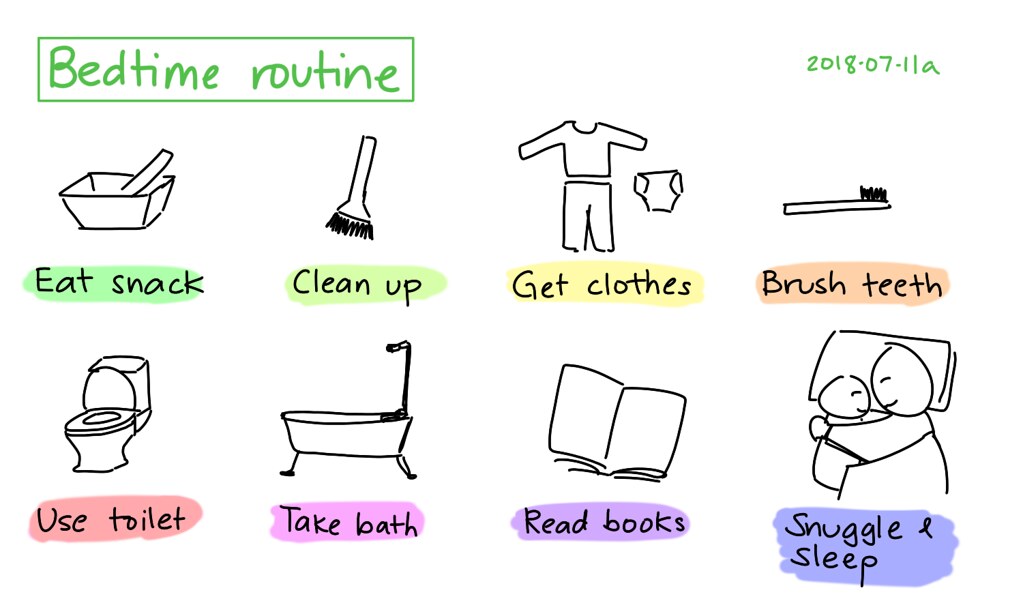
Routines are very powerful tools for kids – although you may not think of them as a discipline tool, they absolutely are. When kids know what to expect and what’s expected of them, it is so much easier for them to do well! Routines are especially important around the big transitions in the day – getting up and out the door in the morning, mealtimes, and bedtime.
This post is about one sample bedtime routine. It’s not meant as the “Single Best Bedtime Routine for All Children Every Where.” Because there is no such thing, because every child is different and every family circumstance is different. But it may give you some insight with where to start building your routine.
Where to Start
Maybe you already have a bedtime routine that’s working for you and your family, but you’re not sure if you’re “doing it right.” Or, if you searched for a post on bedtime routines, it’s more likely that your current bedtime routine is not working for you.
How would you know if you have a sleep problem?
Don’t listen to outsiders on this one: it doesn’t matter what your friend, neighbor, or mother-in-law thinks. It doesn’t matter if what you do is different than the advice you read on some website or in some book. It matters how you feel! If your routine is working for you, your partner, and your child, then NO, you don’t have a sleep problem. If, however, you, your partner, or your child are miserable, stressed out, sleep-deprived, frequently ill, resentful or just tired of the situation, then take steps to fix the problem!
Assessing the Current Situation
If your routine is working, don’t expect that you can make a simple switch and overnight everything will be magically fixed. It takes a while to adjust to new habits.
It helps to start off by thinking about where you are now and where you want to get to.
Spend a few days keeping a journal of what you are currently doing, and see what the patterns are. Then write down what your ideal schedule would be. How are those different? Make a one-step-at-a-time plan for how to move in that direction. (For example, if your child stays up till 9:00 or 9:15 every night, you can’t declare that “starting tomorrow, you must go to sleep at 7:30.” But, you could do bedtime at 9:00 one night, 8:50 the next, 8:40 the next, and so on.)
One thing to watch for during these journaling days: when does your child show tired cues? As they near the end of their day, do they have a quiet time, where maybe they get bleary-eyed, rub their eyes, yawn, snuggle down and rest a lot? If you settle them down when they’re in this state, it can go easily. If you miss this “magic window of opportunity”, then often they get a wave of energy. I’ve worked with many parents who say their child is full of energy – wild and wired and running around crashing into things at 10:00. That doesn’t mean they “want” to stay up till 10:00. That might mean that you missed the tired cues they showed at 7:00 and their adrenaline kicked in to keep them going.
Figure out when your child’s internal clock hits its sleepy time in the evening. Try to start your wind-down time before that so you’re ready for the bedtime routine when it hits. Lots of kids will go from tired-but-not-yawning to yawning to overtired-wild-child if you wait too long.
Once you know your current routines, start working on taking steps toward a new one. Here are some ideas to get there.
Create a sleep-supporting environment
It’s worth putting thought into what best helps your child sleep. Don’t feel like you have to spend a ton of money to get these things, but think about how to best re-purpose what you have or can find cheaply.
- A comfy bed and pillow
- The right sheets and blankets. Our whole family loves flannel sheets year round. We discovered when my son was a toddler that sleeps much more deeply with a fleecy blanket than with a puffy bedspread. We discovered when he was 5 or 6 that he sleeps even better with a weighted blanket in a fleecy cover. (He’s autistic and finds the weight to be comforting.) Your child might be different – they might overheat at night and love their jersey knit sheets and lightweight duvet.
- White noise? Music? Many children sleep better with a white noise machine (or a fan running) or with quiet music playing at bedtime.
- Nightlights? My oldest child could sleep without a nightlight but Mr. Turtle made him happy so we used it off and on. Then when my daughter was little, I remember seeing research that showed use of night lights was linked to early puberty (and now they say blue light from screens on devices might be as well), so we avoided night lights. Now as an adult, she has a hard time falling asleep when there’s any light in her vicinity. My youngest likes the light on in the hallway. And he had a period at age 10 where he was having a lot of night-time anxiety that was stopping him from sleeping. I asked him what would help and he said a disco light! I thought that sounded crazy – but it turned out it worked great. Watching the swirly lights distracted his anxious ADHD brain just enough that he could settle down.
- Stuffed animals and toys? For a baby under 1 year old there should be no soft items in the crib. But for older children, you can make the choices that work best for you and them.
So yes, do think about creating the best sleep environment. Think about having multiple sleep “cues” that help cue your child to settle down. However, don’t let anything become a sleep “crutch” without which they can’t sleep! For example, your child might usually have: bedtime music, bedtime story, pajamas, a favorite stuffed animal and snuggles with you. But not always all of them… that way if one night you can’t find the stuffed animal they can still sleep. Or if you’re travelling, and forgot pajamas, they’re still able to fall asleep in their clothes. Or if you leave them with a babysitter they’re still able to fall asleep. We practice rotating out items so that none of them are absolutely essential.
Wind down routine
The original version of the illustration at the top of this post had 8 steps in it. That’s too many steps for a bedtime routine, I like separating thing into two chunks. Wind down may take 30 – 45 minutes. The bedtime routine might take 10 – 15.
For wind-down time: turn off screens (videos, video games) or at least switch to blue shade, turn down the lights in the room, turn down the heat (cooling down signals the body that it’s time to sleep), and turn down the activity level. (No rough-housing or big physical activity right before bed.) Consider an evening snack or bath time, whatever best helps them and you let go of daytime energy and settle down.
Bedtime Routine
I like to have a four or five step routine that I teach to my child. I might make a poster with pictures of the steps on it as a visual signal. I reinforce the routine by talking about “this is how we always do things. Remember, we always have four things we do before bed. What are they?” A preschooler should be able to recite the four steps.
I will sometimes give a last chance alert before we start that routine: “it’s almost bedtime – is there anything you need to do before we start our routine.” That gives them that last chance to have a snack or find a toy or finish something up – that way they can’t ask for that later because you already gave them this chance. But set a time limit on this option… like “I’m going to start the timer and in five minutes you need to walk away from the Legos even if it’s not done.” Or, if my son asked for a snack at his five minute notice, he couldn’t choose a snack that takes a long time to eat or prepare. He could choose what we jokingly called the “suck it down” snacks: yogurt tube, applesauce packet or a cheese stick.
In our family, when my son was in preschool, our steps were: going to the bathroom, brushing your teeth, bedtime math and two stories, music on / lights out. The process takes 10 to 15 minutes and then we’re done and out of other options for the day. If they’re dawdling, use a when / then: “when you’ve brushed your teeth, we get to read stories and I’m really looking forward to that.” If they continue to resist, use an if / then: “if you don’t finish in the next two minutes, then I can only read one book, and that would make us both sad.”
Whatever your routine, you gotta stick to it! Clear limits are really important. For example, we always read two bedtime stories. NEVER more. If kids learn some nights you’ll read 5 stories, they’ll ask for 5 every night!
If they learn that every time you turn off the light and walk away all they have to do is ask for a snack you’ll come back, they’ll ask every night.
How to Respond When They Get Back Up
Now, just because you set up this plan for a routine doesn’t mean it magically works the first time. It takes a while and a lot of consistency on your part to make it stick.
After the bedtime routine, your child may try to “escape” from bed. Don’t let them, because if you let them escape once they’ll try every night… Instead, every time they get up, calmly and gently pick them up, stating simply “It’s now your bedtime, you need to be in bed. I will see you in the morning.” And place them back in bed. No long lectures, no anger, just a matter-of-fact unbreakable rule. Use a when/then: “when you do a good job at bedtime, then we get to do [something fun] tomorrow.” If they continue to escape, use logical consequences: “if you get up again, then….”
We just stick with it till it sticks. So, make sure you’ve set a bedtime plan that is something you can stick with reliably, even if you yourself are tired or sick or busy or whatever. Consistency is key. Over time it will become how things work in your family.
I do need to caution that even once your bedtime routine is well established, it doesn’t mean there won’t be days when it fails. (We expect sleep regressions around big developmental changes (periods of disequilibrium) daylight savings time, or the night before a big event when they’re excited, or on trips or other changes to the routine.) When those changes happen, the best way to get back on track is to ground yourself in the routine. It will evolve and adapt as your child grows, but it’s a reliable and comforting thing to return to for both of you.
 More Good Days with Kids