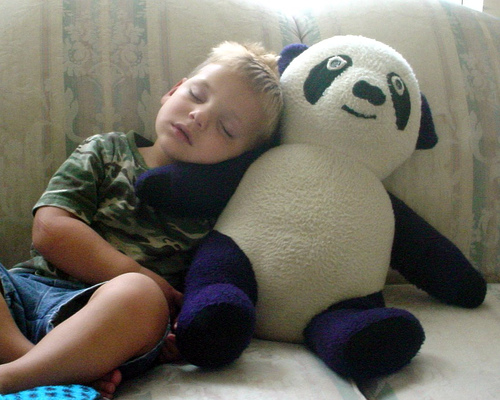
Category Archives: Parenting

Sleep and Young Children

sleepWhat’s “Normal” for a Young Child?

The amount of sleep an individual needs ranges a lot, based on their temperament, physiology, and daily activity level. The quality of their sleep also varies. Some children fall asleep easily, and some struggle to let go of the day. Some sleep solidly through all disturbances, others wake frequently. Some wake up happy and bright in the morning, others are sluggish. These sleep temperaments can appear at birth, and remain with the child throughout life. However, don’t be too quick to “label” your child as a ‘good sleeper’ or a ‘bad sleeper’, because there are definitely things that parents can do to improve any child’s sleep, and also habits we can develop that impair our child’s ability to rest well.

As a broad, sweeping generalization, experts estimate that a “typical” one-year-old needs about 10 – 13 hours of sleep at night, and one or two naps (a total of 2 hours of nap.) A typical two-year-old needs 9.5 – 12 hours a night, and one nap (1.5 – 2.5 hours). 1/3 of toddlers still wake in the night. Preschoolers need 10 – 13 hours at night, school age children need 9 – 11 hours. (Read more sleep recommendations here.)

Children who sleep in the same room, or same bed, as their parents tend to have more night-time wake-ups, but may also have more total sleep than those who sleep solo.

Sleep patterns shift during travel, around daylight savings, when a child is ill, having a developmental growth spurt, is going through a separation anxiety phase, or when the family’s routine changes (after a move, a new baby, new day care, change in parent’s work schedule, etc.)

Things that help with sleep at any age:

  • Have a fairly stable, reliable daily schedule to help set their biological clock.
  • Include plenty of physical activity during the day. This will help them rest better at night.
  • Teach day and night: in the daytime, keep the house light, don’t worry about noises, and be interactive. In the night-time, keep lights dim, be quiet, and interact as little as possible.
  • Try to create a consistent sleep environment. Having familiar toys, standard bedtime music, and a typical light level help reinforce that this is the “time and place for sleep.” Do change things a little from time to time, as you don’t want to get into a situation where your child is ONLY able to sleep if they have one specific object with them, since that object might get lost!
  • Know your child’s tired cues. As they near the end of their day, do they get bleary-eyed and yawn and rest a lot? Or do they get wild and wired and run around crashing into things? Try to start your wind-down time before you see these cues! It’s usually easier to settle a just-tired-enough-to-sleep child than an overstimulated-overloaded child.
  • About a half hour before bedtime, start your wind-down time: turn off screens (TV, video games.), turn down the lights, turn down the heat (being cool signals it’s time to sleep), and turn down the activity level. (No rough-housing or big physical activity right before bed.)
  • About ten minutes before bedtime, start the official bedtime routine.

Bedtime Routines

Keep it short and simple! No more than fifteen minutes. Set clear limits on time and number of activities. Tell them the routine and stick to it: “remember, every night we read exactly two books.” If kids learn that some nights they can talk you into more, they’ll negotiate for more every night!

Some helpful tools:

  • Changing into pajamas can be a signal that bedtime has come.
  • Many parents use bedtime as a chance to reflect on the day: what was the best part of the day, what was the worst, what did they learn? Some parents review the day in story-style: “One spring morning, Mary woke up and had blueberries and puffs for breakfast…”
  • Some parents teach relaxation and visualization techniques to help the child self-soothe.
  • Some do bedtime math.
  • The standard is bedtime stories… choose calming sweet stories, and save the rollicking stories for other times of day. Some children like variety, some want the same stories every night.

After the bedtime routine, your child may try to “escape” from bed. Don’t let them, because if you let them escape once they’ll try every night… Instead, every time they get up, calmly and gently pick them up, stating simply “It’s now your bedtime, you need to be in bed. I will see you in the morning.” And place them back in bed. No long lectures, no anger, just a matter-of-fact unbreakable rule. If they continue to escape, use logical consequences: “if you get up again, then….”

Night Wake-ups

After 6 months, children no longer have a nutritional need for night feeds. If they are still waking, do the bare minimum intervention to help them get back to sleep. Don’t make this fun time, or snuggle time – just a simple settling back to bed. Some working parents can feel guilty about lack of connection during the day and try to make up for it at night, but that’s going to cause sleep issues…

How do I know if my child has a sleep problem?

Don’t listen to outsiders on this one: it doesn’t matter what your friend, neighbor, or mother-in-law thinks. It matters how you feel! If it’s working for you, your partner, and your child, then NO, you don’t have a sleep problem. If, however, you, your partner, or your child are miserable, stressed out, sleep-deprived, frequently ill, or just tired of the situation, then take steps to fix the problem!

If you want to change things

When your toddler was a baby, you found things that worked to help him sleep. And you’re probably still doing them! What seemed manageable then may be getting old now. If you’re ready to make a change, such as moving your child to his own bed, changing the bedtime routine, or changing how you respond to night wakings, here are some helpful strategies.

Sleep diary: Spend a week tracking: what time does your child go down to sleep, what steps did you take to get her there, how long she slept, mood on waking, and so on. Once you have a better sense of what’s actually happening right now, it’s easier to begin figuring out what to change.

Goal Setting: Figure out what things would look like if sleep was going better. How are things for you and your child? Having that end goal in sight can help you prioritize the steps to get there.

Make a plan. Prep your child for the change, letting them know what to expect. Writing down the new plan, or creating a picture calendar of the plan may help them. Make changes gradually.

Set your own limits for how long you’ll try something… maybe you’ll try for ten days straight, and if that doesn’t work, you’ll give up for a month, then try again. Children usually begin to learn a new behavior after 7 repetitions. But sometimes you just need to wait till they grow up a little bit more.

photo credit: JasonTromm via photopin cc

Getting through the Day with a Young Child: Daily Routines

scheduleBenefits of Routines

Establishing a daily schedule with predictable routines can make life with a young child more manageable. Children feel confident and are more independent and competent when they know where things are, how things work, what to expect, and what steps need to be done in what order to accomplish what they need to accomplish. They are less likely to battle things (like cleaning up toys or brushing teeth) when they know they are just something that has to happen every day. They are less likely to melt down when they are well-rested and fed on a regular basis. Children feel safe and secure when life is predictable, and the more secure they feel, the more energy they can focus on playing, exploring, and learning. And for tired parents, routines mean that we don’t have to think as much about what to do next – we know! Instead of spending hours trying to decide where to go and never actually getting anywhere, we say “It’s Tuesday. Tuesday is library story time! And off we go. (And, of course, routines can be flexible when needed – you can change the plan, but it’s often nice to feel you HAVE a plan.)

Building a Daily Schedule

Start with mealtimes, naptime, and bedtime. Spend a few days keeping a journal of what you are currently doing, and see what the patterns are. Then write down what your ideal schedule would be. Make a plan for how to move in that direction. (For example, if your child stays up till 9:00 or 9:15 every night, you can’t declare that “starting tomorrow, you must go to sleep at 7:30.” But, you could do bedtime at 9:00 one night, 8:50 the next, 8:40 the next, and so on.)

Then fill in the rest of the schedule: together time, solo play time for your child, and lots of physical activity – I’d recommend a minimum of an hour a day of physical activity, but more is better. Build in hygiene habits (hand-washing, tooth-brushing), and clean-up times. If there are chores that need doing, put those just before a favorite activity, so they always know that as soon as they finish their clean-up they get to play.

Reinforce the routine by talking about “this is how we always do things.” You can make a poster with pictures of the daily cycle. [Note: Try to keep a weekend schedule similar to the weekday schedule.]

Morning Routine

If you have a child that wakes up earlier than you want to be up yourself, then make a basket of “quiet morning toys” for your room, and set limits on how/what they can play early in the morning, and how they know when it’s OK to transition to louder morning activities.

If you have a child who will sleep late and who you have to wake up, go ahead and spend time taking care of yourself, and getting yourself ready for the day first. Then put on some cheerful morning music, start with morning hugs and kisses, and read a few stories together to start them on their day.

Morning routine might include getting dressed, breakfast, brushing teeth, feeding the dog… try to do the same activities in the same order, each morning. You could make a small flip book showing the steps in morning routine. Hang it on their doorknob. They can walk themselves through it each morning.

Along the way, you can offer choices, but only offer simple options that you can live with, and keep the number of options small. A good rule of thumb is to take their age plus one: so, a one year old would be offered two choices: red shirt or blue shirt?

Getting out the Door

If you notice that every single morning, you’re stressed and yelling “hurry up”, start a new habit: do some work the night before to lay clothes out, prep some food, and so on. Also, whenever you return home from an outing, re-pack your diaper bag or whatever else you know you’ll be taking with you the next time you leave.

Set an alarm on your phone for ten minutes before you have to leave. When it goes off, remind your child of the steps they need to do to be ready on time. Tell them they can have a few more minutes of playtime, then you’ll start the leaving-the-house countdown. While they have their playtime, you get all your things ready to go so you can give them your full focus in those last few minutes. Two minutes before time to go, do the final steps of shoes, coats, picking up your bags and heading out.

Naptime

A “typical” one-year-old needs about 10 – 13 hours of sleep at night, and one or two naps (a total of 2 hours of nap.) A typical two-year-old needs 9.5 – 12 hours a night, and one nap (1.5 – 2.5 hours). Most children begin to give up naps by age 3, but you may still have a “quiet time” in the afternoon if that’s helpful for them (or for you).

To settle your child down, try an abbreviated version of the bedtime routine. If he falls asleep, let him go till he wakes himself. Don’t feel like you have to wake him to be sure he’ll sleep at night – good naptime sleep begets good night-time sleep. If your child won’t sleep, you can still enforce a quiet time in their room. Be very matter of fact that they must stay in their room for a certain amount of time, and can only get up when you say it’s OK. If you are consistent every day, they’re less likely to fight it. If they learn that sometimes you let them get up early, they’ll fight for that every single day.

Dinner Time

If dinner prep time is hard every day, then plan for it! Have an activities basket that only comes out at that time (keeps it special). Involve your child in meal prep. Give yourself plenty of time to get things done despite distractions. Planning out meals in advance can make this time less stressful. More mealtime tips here.

Bedtime Routine

Start your bedtime routine before the first yawn. Lots of kids will go from tired-but-not-yawning to yawning to overtired-wild-child if you wait too long. Start winding down about a half hour before bedtime: dim the lights, turn the temperature down in the house so they want to get under their snuggly blankets. Turn off all screens, for you and them. Consider a bedtime snack and/or a bath.

About ten minutes before bedtime, start final steps: pajamas and stories. Set clear limits on time and number of activities. Again, if kids learn some nights you’ll read 5 stories, they’ll ask for 5 every night!

Think about having multiple sleep “cues” that help cue your child to settle down but don’t let them become sleep “crutches” without which they can’t sleep. For example, your child might usually have: bedtime music, bedtime story, pajamas, and favorite stuffed animal. But not always all of them… that way if one night you can’t find the stuffed animal they can still sleep. Or if you’re travelling, and forgot pajamas, they’re still able to fall asleep in their clothes.

Adjust as Needed

Make changes to routine gradually. If you know a big change is coming, talk about it beforehand.

Resource

Everyday learning opportunities. 101 tips for incorporating learning in your day: www.pnc.com/content/dam/gug/PDFs/GUG_Eng_Everyday_Learning_Tips_Download.pdf

photo credit: woodleywonderworks via photopin cc

Parenting an Only Child

How common are only children?

In the US today, families have an average of 1.9 children. 20% of women only have one child.

Benefits

Raising kids is very expensive, so having just one saves the family money, but also may allow them to fit in luxuries like vacations, private school, and activities they couldn’t afford if they had multiple children.

Having fewer children is better for the environment.

It may be easier for a parent to manage their career with only one child.

Parents of one may feel much less frazzled and overwhelmed than if they had multiple kids to juggle.

An only child doesn’t feel like they have to compete for love and attention.

Strengths of Only Children

Research shows that only children score just as well as siblings on traits such as maturity, popularity, generosity, cooperativeness, flexibility, independence, emotional stability and contentment.

Only children have higher intelligence, are more motivated in school, have higher self-esteem, good language skills (from all that adult conversation), and better relationships with parents.

Parents of only children tend to be happier than those with multiple children.

Sources: www.nytimes.com/2013/06/09/opinion/sunday/only-children-lonely-and-selfish.html?_r=0

www.cyh.com/HealthTopics/HealthTopicDetails.aspx?p=114&np=99&id=1926

Potential Pitfalls and how to minimize

Avoid the “lonely only.” Help your child build friendships.

  • It’s easy for parent to become the child’s best friend. Those children may seek out adult company and have a harder time relating to peers.
  • Ensure that your child has plenty of play time with other kids. Especially seek out long-term connections – friends or family your child will have the opportunity to interact with for years. That gives them some of the long-term history of relationhip they would have with a sibling.
  • Consider joining boy / girl scouts, 4-H, church group, or some other long-term group activity.

Help them learn to manage conflict. Only children don’t have the built-in practice at conflict resolution that kids with siblings have.

  • Try not to become too involved in playground conflicts. Children will learn more from the experience if they have to figure out on their own how to resolve it.

Don’t pressure your child to be everything you ever hoped your child (or you) could become. In some families, onlies feel like all the hopes of the family are riding on their shoulders. They can become anxious, pressured perfectionists.

  • Let them be kids. The good news about onlies is that they’re very good at operating in an adult world, with good manners, sophisticated vocabulary, and so on. But make sure you also take some time to go to the playground and let them run around and scream all they want.

Don’t pressure yourself too much. Parent of only children often feel like they only have “one chance to get it right” and are very hard on themselves when they make any mistakes.

Help them to be responsible and independent.

  • It can be easy to do everything for your child and always step in to rescue things when they have any challenge. Some day observe a large family, and you’ll see how much more parents expect and how much more their kids can do without that parental intervention.
  • Give your child chores and expect them to get done.
  • Your child won’t have the built-in opportunity to teach and mentor a younger sibling. Look for places where he or she can have a positive influence on a younger child.

Don’t let other people’s comments / judgments get to you or your child. Insensitive people may ask your child if they want a sibling. They may ask you if you’re planning more and want to know why not. They may assume you’re selfish, don’t like parenting, are infertile, are having marital strife… Feeling positive about parenting an only child, and letting your child know why you feel good about it can help both of you withstand these moments.

Don’t spoil / over-indulge your child. Set clear limits, and be sure they don’t always get their way. This also reduces the chance you’ll have a “bossy” child. If they’ve learned that it doesn’t work to boss you around, they won’t try to boss others around.

Find ways to teach and model generosity and sharing.

Don’t over-protect. It can be easy to become a helicopter parent, hovering closely around your only child. Try to stand back and give them space to make their own mistakes (and learn from them).


Helping Your Child Adapt to a New Baby

medium_2681695116Preparing for the New Baby

Follow your child’s lead. When they want to talk about the baby, take advantage of that, but as soon as their attention shifts elsewhere, let it go. Don’t force the topic.

Read books about what to expect. Look here for my Recommended Kids’ Books about Pregnancy, Birth, and Babies.

Watch a video about a new baby coming to a family. This was made by Penny Simkin, who had taught sibling preparation classes for 30+ years when she made it. Includes details about the birth process at an age-appropriate level. Available to stream (rent or buy) at https://www.pennysimkin.com/project/theres-a-baby-a-childrens-film/.

Take a sibling preparation class. Check with your local hospitals that offer childbirth preparation classes. They may offer sibling classes.

Tell stories to your older child about when they were a baby. Look at their baby pictures together.

Provide dolls and doll accessories for your toddler to “practice” baby care behaviors they’ll soon see.

If there are any behaviors or routines that just won’t work after baby comes, try to change them at least 3 – 4 months before the birth, so your child has a chance to adapt, without feeling like it’s “the baby’s fault” things had to change.

If one parent provides almost all the care for your child, try to increase the amount of time they receive care from other providers so they know they have other adults to rely on.

In the early weeks with the new baby

Try not to change day-to-day routines. Your child will need consistency and reliability.

The safety of the baby is top priority, so set clear limits to protect the baby.

Have some time of each day where the older child knows they are your top priority. Let them choose the activity for their “special time.”

Let your older child continue to be a “baby” when he needs to be. Don’t expect instant maturity and independence.

  • Regression is common – listen to your older child’s feelings and validate that it’s hard for everyone to adjust to the new baby.

Make sure your older child has some space and things that belong only to them.

Expect to have good days and bad days. Don’t worry that it will “never get better.”

Don’t blame things on the baby: Instead of saying “I can’t play with you because of the baby”, try saying “I really want to play with you – in just a few minutes baby will be done nursing, and you and I will have play time. Or, you can bring your toys here right now.”

Have ‘special times’ with your older child: a quick trip to the park, a bedtime story, an outing.

Give the older child special responsibilities. Making the older child a “helper” in the care of the new baby will help the child feel involved instead of neglected. However, it is important to remember that the new baby is not your older child’s responsibility.

Encourage and reinforce the positive behaviors you want to see in your older child.

Sometimes, parents feel guilty that they can no longer give the older child the same attention that they used to. It may help to remind yourself that although this doesn’t seem fair to your older child, they are also benefitting from the experience of having a younger sibling.

As your children get older

Look here for lots more tips on sibling relationships.

Resources

photo credit: K. W. Sanders via photopin cc

Four Parenting Styles

Developmental theorists categorize parenting styles as authoritarian, authoritative, permissive and uninvolved. Let’s look at those categories and the possible benefits and downsides of each approach. We’ll start with this illustration to summarize the idea, then walk through the details.

GRID

Two Gradients of Parenting Style

Responsiveness. The horizontal line addresses how much attention a parent pays to the child’s needs, demands, and unique temperament. Highly responsive parents attempt to foster individuality and independence by being attentive, supportive, and responsive to the child’s needs and the demands of the moment. A non-responsive parent applies the same rules / expectations to all children and all situations.

High Expectations (aka Demandingness), is how high the parent’s expectation is for obedience and “fitting in” to the family rules or to social norms. Demanding parents set clear goals and expectations, confront a child who disobeys, and disciplines when limits are crossed.

Four Parenting Styles

Note, for each I list potential benefits – how things can work out if this style of parenting is done well, and potential pitfalls – if you’re aware of them, you can work to avoid them.

Authoritarian (aka “The Boss”)

The parent is in control, the goals are obedience and reaching high expectations. Parents provide structured environments, set strict rules, and don’t explain rules beyond “I know what’s best for you.” Children may face consequences if they don’t meet standards, and may or may not be rewarded when they do. Children are scolded for showing negative emotions. Parents may not show overt affection. Potential Benefits: Children may perform well in school and not get in much trouble, and may excel at skills that require focus and discipline to learn. Potential Downsides: Some children may rebel and have poor relationships with parents. Some children may experience low self-esteem or an inability to make their own decisions.

Authoritative / Democratic / Balanced (aka “The Friendly Boss”)

The focus in on teaching decision-making, the goal is finding a balance between personal happiness and accomplishment. Democratic parents provide clear, reasonable expectations, explain why they expect children to behave that way, and monitor behavior in a warm and loving manner. Mistakes are used as a chance to teach important lessons rather than as an opportunity for punishment. Parents give limited choices based on developmental ability, balancing freedom with responsibility. Potential Benefits: Children are self-regulated, self-determined, cooperative, and socially responsible. Potential downsides: This style is harder work for the parents than the other styles.

Permissive (aka “The Friend”)

The focus is on meeting the child’s desires in the moment, the long-term goal is a happy life rather than specific accomplishments. Permissive parents have an indulgent laissez-faire attitude. They make few rules and routines, and may not consistently enforce the rules and routines they do establish. They want children to feel free, and have as many choices as possible. They may not have specific expectations for appropriate behavior, and accept their child in a warm and loving way, no matter how the child behaves. Potential Benefits: kids may have high self-esteem, good social skills, low depression, and be creative. Potential Downsides: Might perform poorly in school/work due to challenges with following rules, may alienate people by over-stepping boundaries.

Uninvolved 

Uninvolved parents may not give any guidance, punishment, or rewards. They may simply be detached, and un-interested in their children and their activities. Most provide the basic needs of life, but shrug off responsibility for their child’s activities and concerns. In extreme cases, this might include rejection and/or neglect. Children tend to be rebellious, irresponsible, perform poorly at school, and show signs of emotional distress.

Inconsistent Parenting (aka Wishy-Washy)

We’re all guilty of this at times… Some days you’re tired so you’re overly permissive and let your child do anything they want; then you over-correct and are overly authoritarian and set strict punishments. This is confusing and stressful for children. Children want to do well, and when the rules change it makes it hard for them to know how to do so. When setting family rules and expectations, be realistic with yourself about what you can consistently enforce.

choices grid

Parenting Style – Approach to Choices

Your parenting style may effect how many choices you let your child make. The authoritarian parent makes the choices for the child, dictating what should be done and what the consequences will be if it’s not done. An authoritative / democratic parent offers limited choices and teaches the child about the consequences of each choice. The permissive parents offers a wide range of acceptable options. The uninvolved parent leaves it to the child to figure out their own way in the world. Learn more here and in my post on how to effectively offer choices.

Learn More about Parenting Styles