Category Archives: Music

Music Books for Kids

Check out my recent post on sound books for the big picture on interactive books where kids press a button to play a sound. This post focuses on some great music-themed sound books. (Pressing a button starts a song, pressing it again stops the song.)

At the bottom of the post, I have a video, where you can hear a sample of what each of these books sounds like.
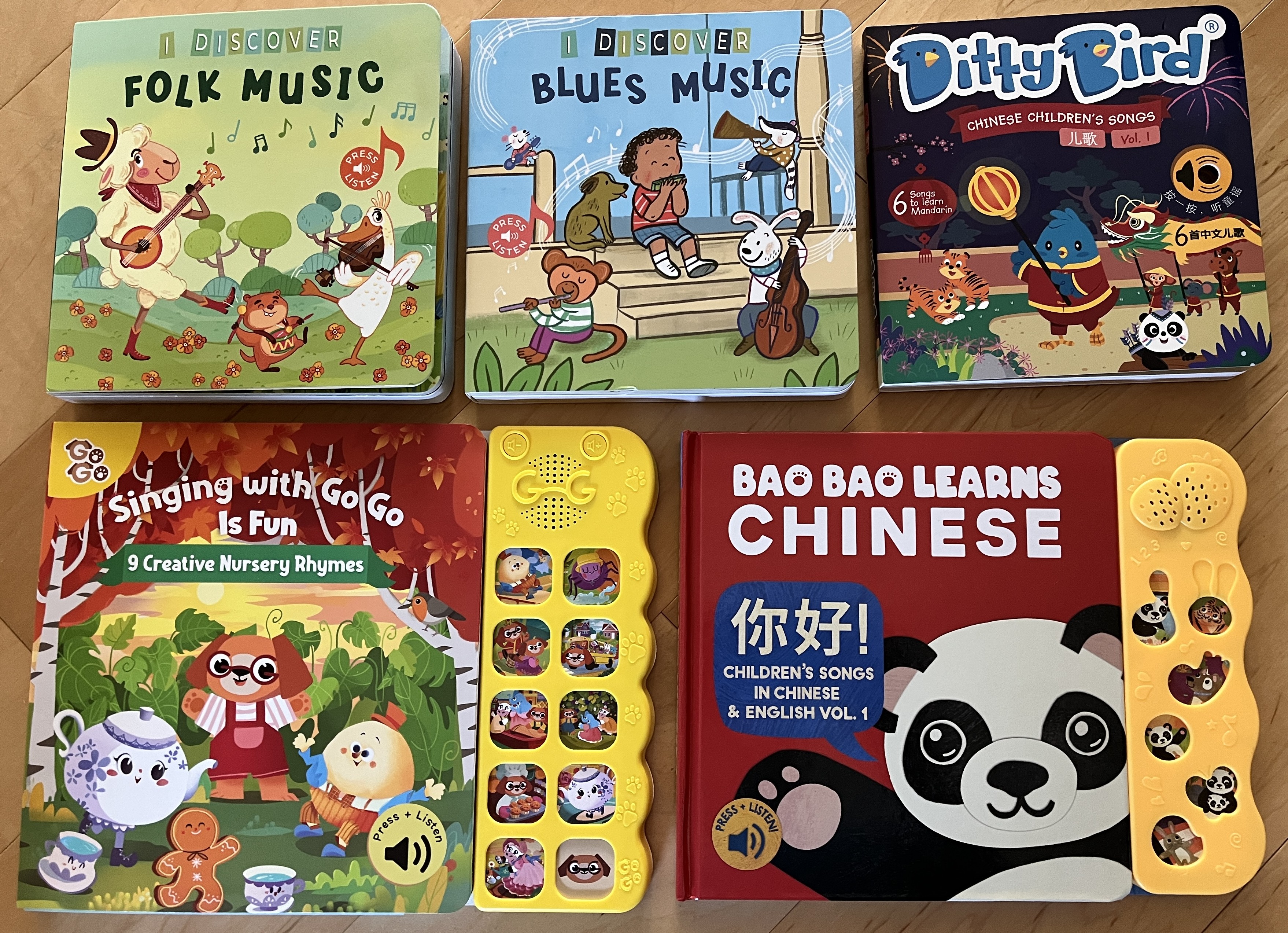
Disclaimer: Pirouette Kids sent me two of their books to review. This post includes my unbiased review of those books, and info on books from other publishers for comparison.

Pirouette Kids

Their focus in on “music beyond nursery rhymes”. They have four books at this time, the two I review below, plus World Music and Classical Music.

Some overall impressions: I like the size of the books – easy to pack, easy for small hands to hold. The pages are sturdy. The buttons to activate the music can be a little tricky for a child to spot for the first time, and activating them requires pressing precisely on them (a fine motor skill builder) but they work reliably. The speaker is on the back – so, if it’s laying flat on a surface, it is much quieter than if held upright. (That can be an advantage if you’re holding the book as you can adjust the volume a bit. If the child is using it lying flat on carpet, it’s pretty quiet.)

The books can be purchased on Pirouette’s website for $18.99 each.

Pirouette’s I Discover Folk Music

This board book has snippets of 6 folk music tunes (Oh Susanna, This Land, Little Liza Jane, Sarasponda, Home on the Range, This Little Light). Each page has the lyrics for 3 or 4 lines of the song, and a button that plays a 15 second clip. They are all performed by the same musician – Daria, who is pleasant to listen to and not cutesy / chirpy as many performers are when doing children’s songs. The illustrations by Margarita Fomenko, which feature animals doing human things, are pretty cute.
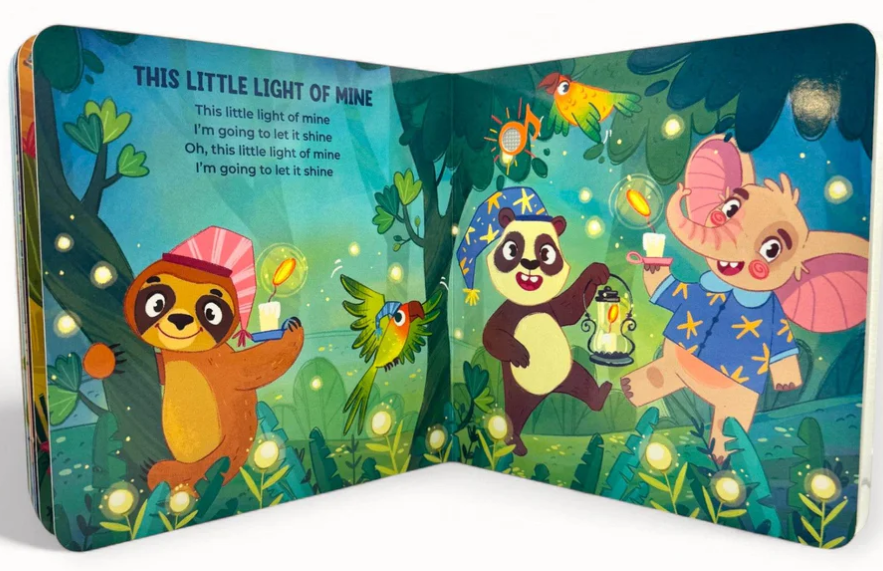
I like the choice of songs – it expands outside the typical kid songs repertoire but still all quite accessible. The 15 seconds is really short. It works OK on some songs, like Little Liza Jane feels complete on its own, but many feel like a song is just getting started then gets cut off abruptly. (They do have full versions of each song available on Spotify and there’s a QR code on the back of the book that takes you there.) For me as an adult who knows these songs well, they leave me feeling a little incomplete, and I wish they could wrap up a full verse or chorus. But that likely won’t trouble a child who is new to these songs.

Overall, it’s a cute book with nice tunes you might not find elsewhere, and I would recommend it.

Pirouette’s I Discover Blues Music

This book has snippets of 6 blues songs – recordings by original artists. There are 3 vocal tracks: Goodnight Irene by Jerry Lee Lewis and his band (1958), Careless Love by Big Joe Turner (1958), See See Rider by Louis Armstrong and Velma Middleton, and 3 instrumental: John Henry Blues by Erskine Hawkins and his Orchestra (1950), Old Stack O’Lee Blues by Sydney Bechet and Nicholas Blue Five (1949), Jumping at the Woodside by Buddy Tate and his Celebrity Orchestra. I love that they included the “real” versions of these songs, and chose songs that children are unlikely to be exposed to elsewhere (a few of these are even new to me, and I thought I had listened to a lot of old blues!) I love the John Henry Blues especially.

Illustrations by Sakshi Mangal are cute, and show animals doing human things. Since many of the songs are instrumental, instead of having lyrics on the page, they have information about the tune, and questions to ask a child. Here are two examples.
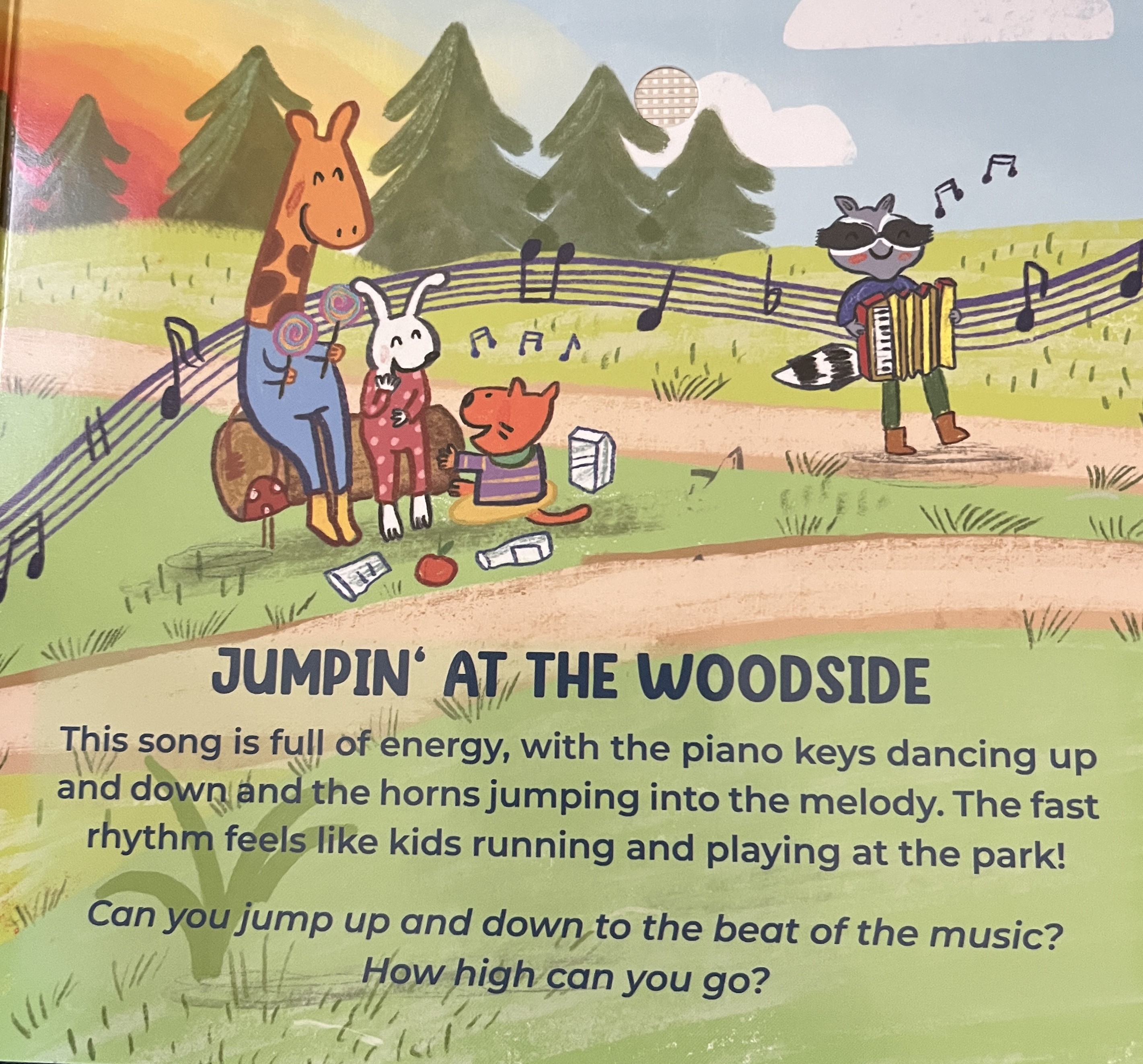
and
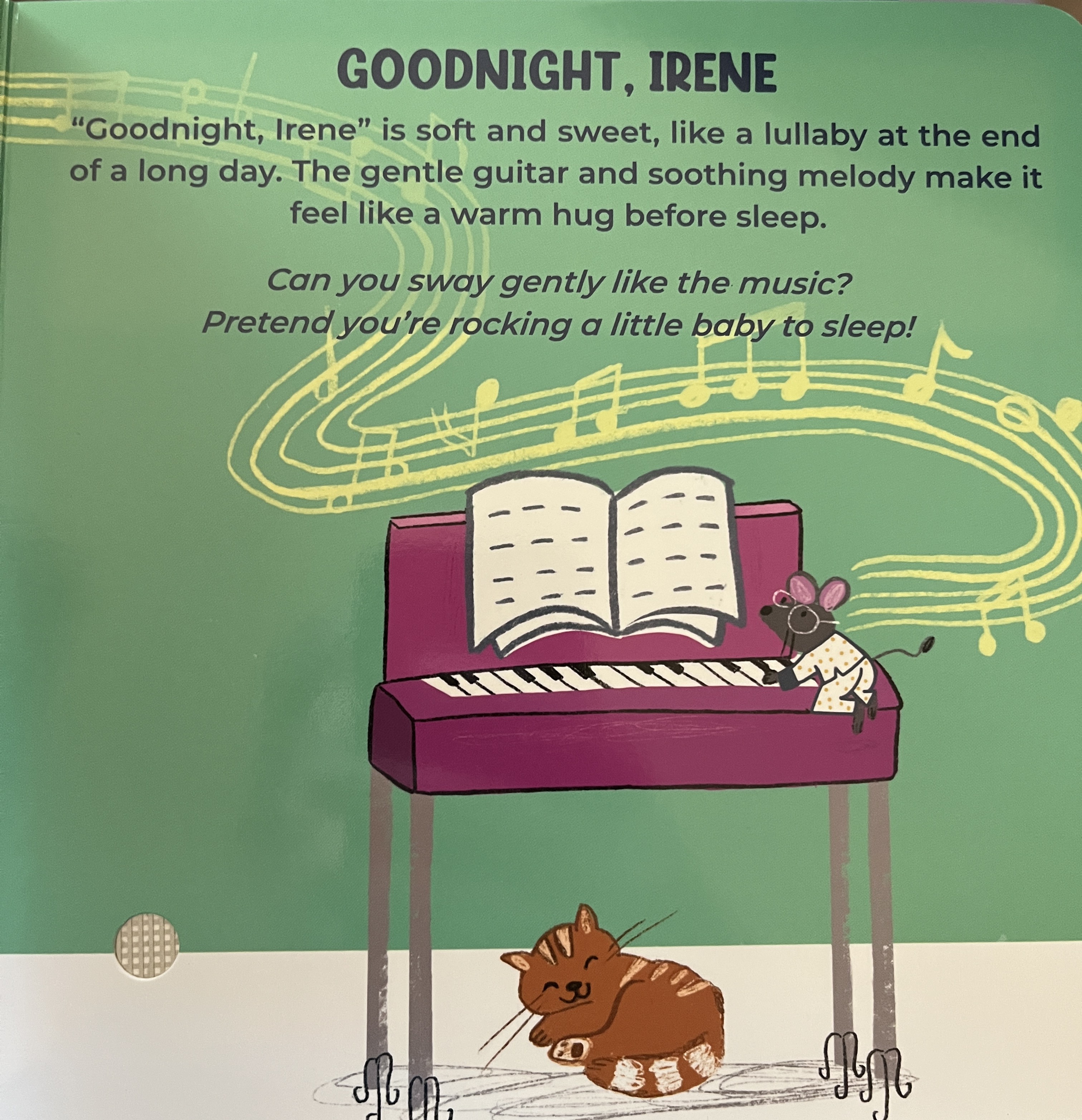
On Pirouette’s website, they have links to where you can find full versions on Spotify. (Though there’s not a QR code on the book to point you to this page.) A caution though: these are blues songs, so some of the lyrics in the full vocal performance aren’t kid friendly, for example, See See Rider says “I’m gonna buy me a pistol, Just as long as I am tall… Kill my man.” But you can also find instrumental only versions of the tunes. For Good Night Irene, there are kid friendly versions of the lyrics.

These song clips are again only 15 second snippets, but it doesn’t bother me on these like it did on the folk music one… since I know they’re long songs it makes sense that it’s only a sample vs with the folk songs, sometimes I felt like if they’d just had one more line of the chorus it would have felt more complete.

I definitely appreciate the way this book helps to stretch our repertoire of “fun music for kids to listen to.” I recommend it.

Ditty Bird’s Chinese Children’s Songs

Ditty Bird has LOTS of books. Sounds, Songs, Bilingual… the one I reviewed was Chinese Childen’s Songs Volume 1 It includes 6 songs: Two Tigers, Where’s Spring, Little Donkey, Picking Radish, Good Little Rabbit, Where’s My Friend. I love that these are traditional Chinese songs. I do not speak Mandarin but the reviews say the pronunciation is good and that traditional Chinese instruments are used. The recordings are pleasant to listen to. They are as long as they need to be for the complete song, so 12 – 25 seconds.

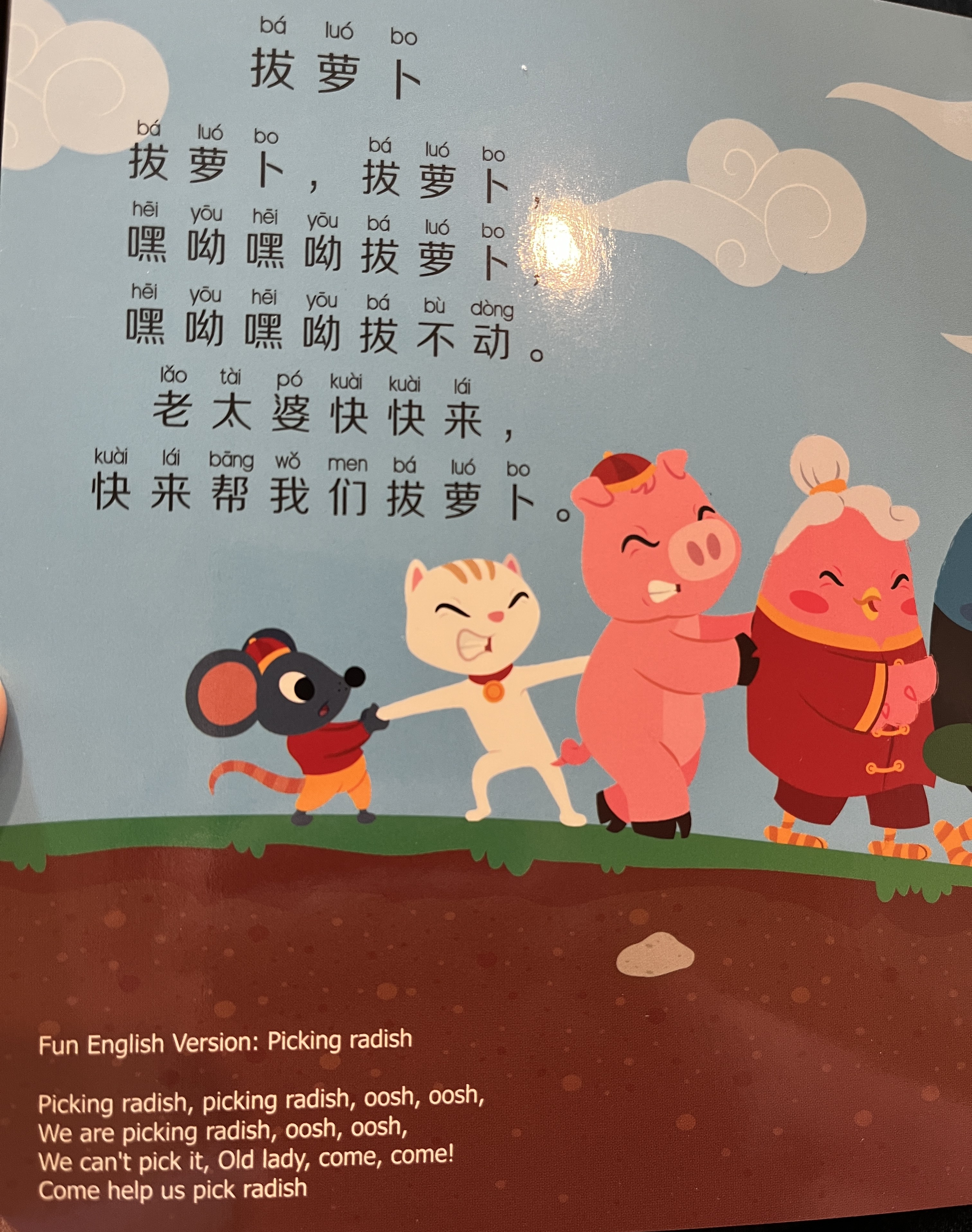
They include the lyrics, in pinyin and traditional characters, and an English translation. (Unfortunately the English words don’t seem to scan to the tune.) I wish the lyrics were printed in a larger font for all of us who are over 40 to read! The illustrations are cute, showing animals in Chinese settings, wearing both traditional and modern clothing.
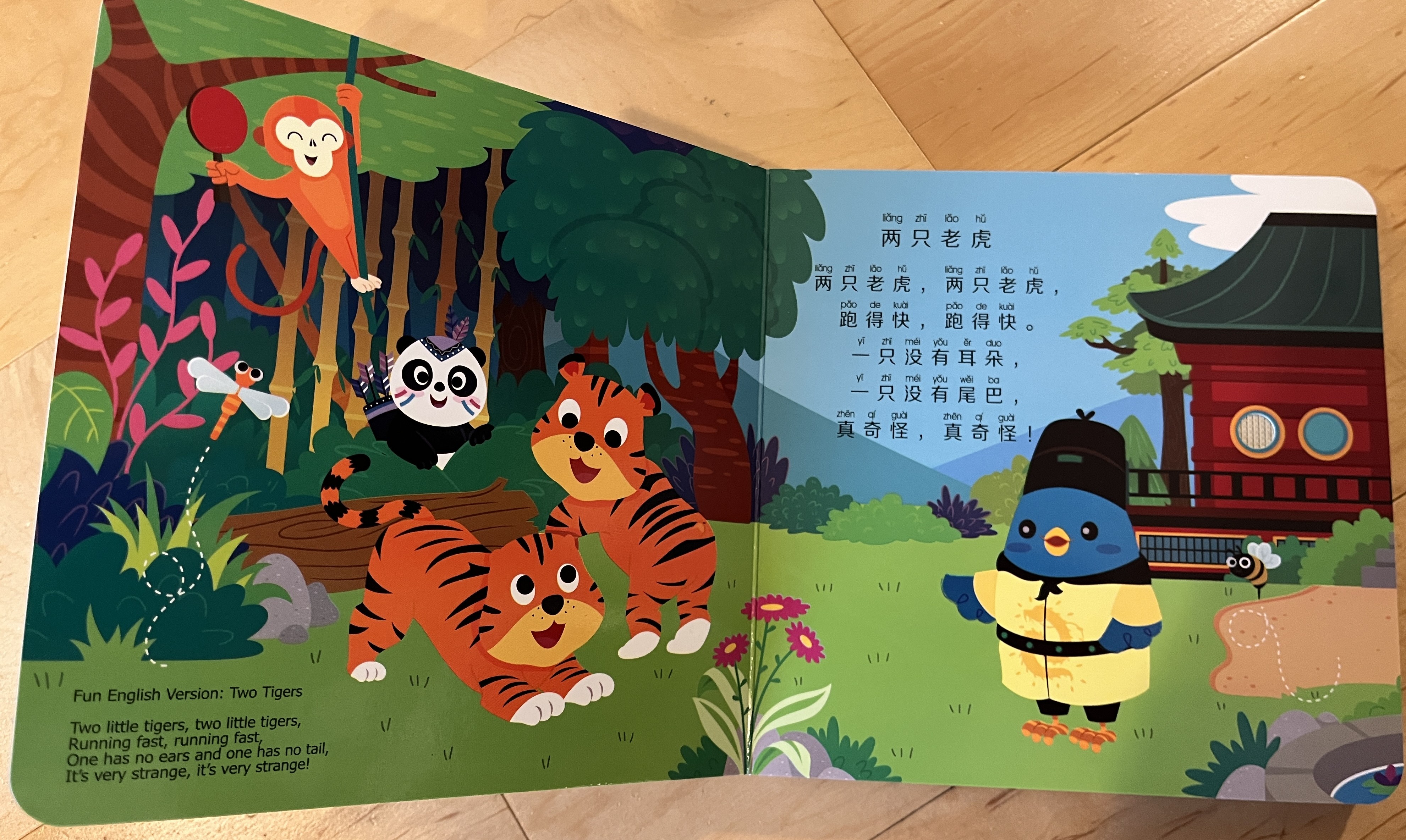
Like the Pirouette books, this is a nice small, sturdy board book, with the speaker on the back. The music buttons seem to be the same technology – so they work well, though do require a child to put their finger in a specific place. It is $19.99 on Amazon. (affiliate link). Reviews on Amazon say that durability can be an issue, with some reviewers reporting the buttons stopped working.

I purchased this book because I mean to learn some children’s songs in Mandarin, and although there are many YouTube videos and other resources online, I have not been remembering to use them. Having a physical book on the table reminds me to listen.

I recommend this book too.

Bao Bao Learns Chinese

This company has 3 Chinese books, plus similar books in: Tagalog, French, Spanish, Korean and English. I reviewed their Chinese Volume 1 which includes 6 songs – some traditional Chinese – Two Tigers, FInd a Friend, and Mama is the Best in the World, and some traditional English – Itsy Bitsy Spider, Row Your Boat, and Twinkle Twinkle. It includes lyrics in English, pinyin, and Mandarin. (In a larger font than Ditty Bird.) The Mandarin words do line up with the English tunes. But I can’t make the English words scan well to the tunes for the Chinese songs.
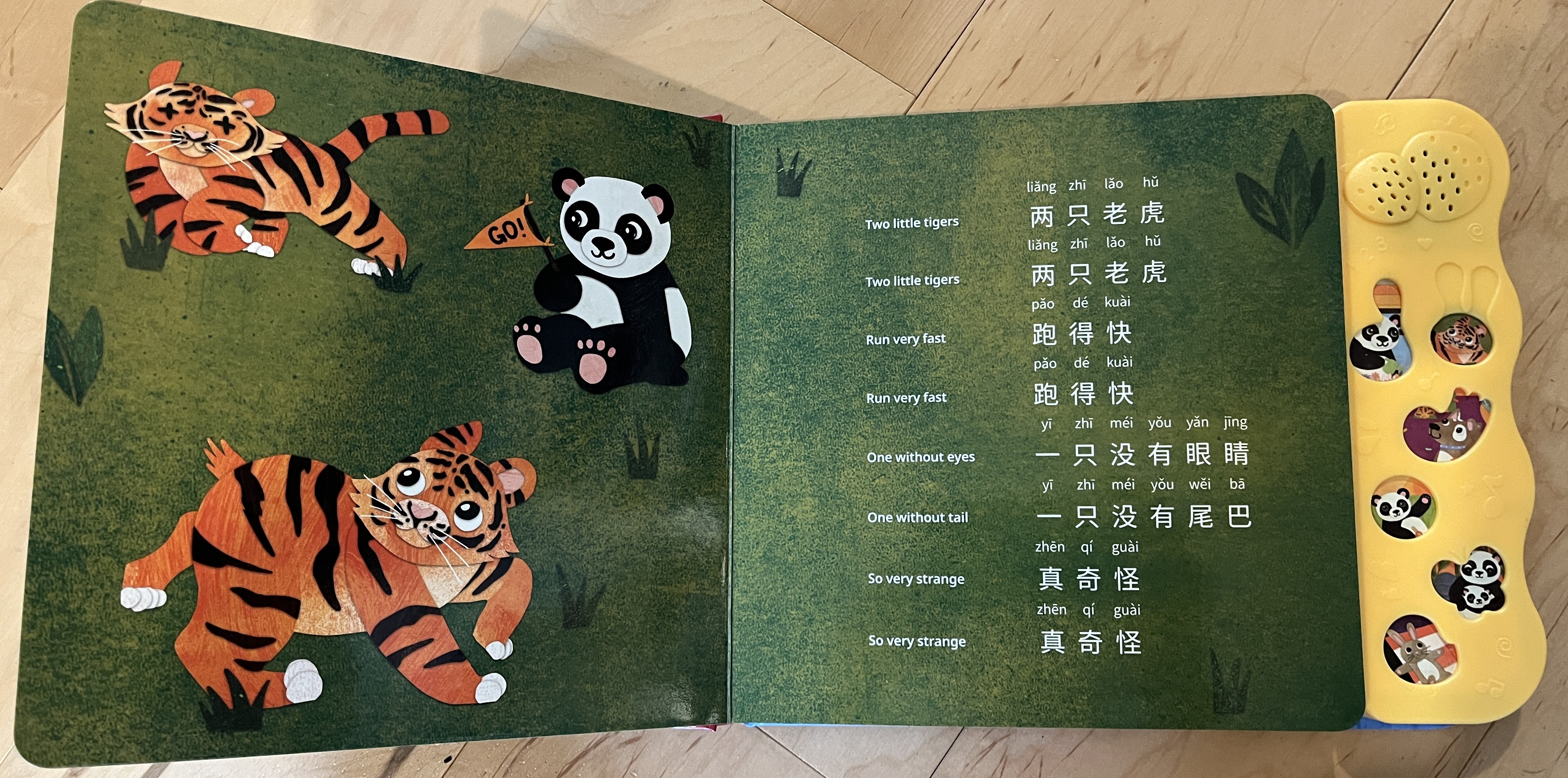
This is a bigger book – a little harder for little hands to hold. The soundbox is to the side of the pages. It does have two volume settings to choose from. Since the buttons are off to the side, a child has to figure out which one to press to get the song that matches that page – the image on the button is just some small portion of the image that’s on the page, so I’m not sure it’s obvious to kids which image goes with which page. (And the soundbox has random shaped openings for the buttons that don’t really line up with the illustrations.)
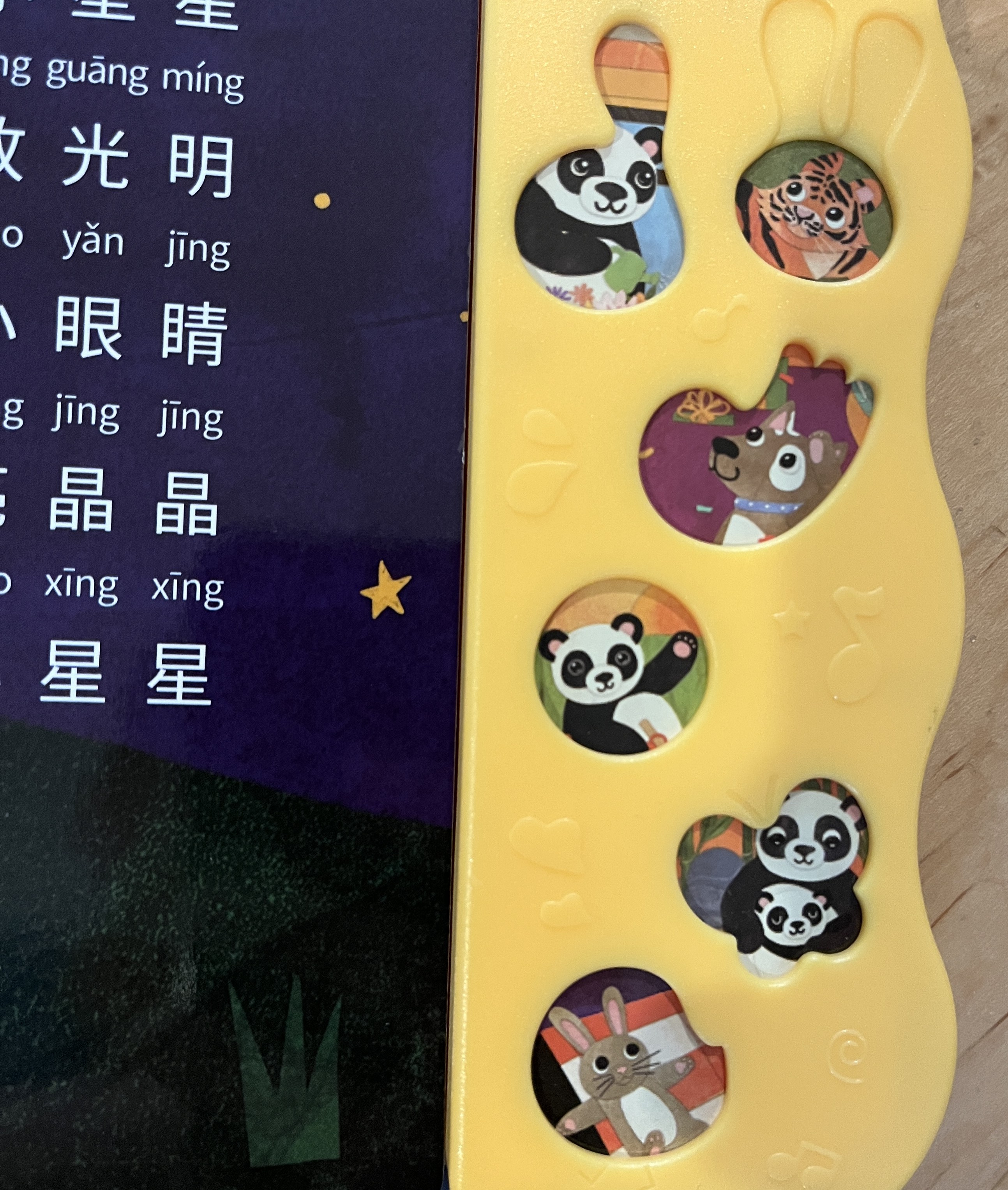
Songs repeat twice so recordings range from around 30 seconds to 85 seconds. The repetition helps with learning. They’re nice recordings and very pleasant to listen to. They offer super helpful resources on their webpage, like information on how to pronounce Mandarin words, and videos where they talk you through the lyrics of each song, clearly enunciated so you can get the pronunciation right. (I wish they had a QR code on the back that would take me right to that page.) $28.99 on Amazon.

For learning Mandarin songs, if I had to choose just one of Bao Bao or Ditty Bird, I would choose Bao Bao, but am happy to have both.

Singing with Go Go is Fun

There are LOTS of Go-Go books. Including English, Spanish, Mandarin and a Christian themed line. They are $29.99 each. I have the “9 Creative Nursery Rhymes” volume. (I’d swear that what I put in my Amazon cart was one of the Go Go Mandarin books, but this is what Amazon says I ordered and what they sent….) It has 9 songs – Humpty Dumpty, Itsy Bitsy Spider, Jack and Jill, Wheels on the Bus, London Bridge, Mulberry Bush, Muffin Man, I’m a Little Teapot, and Mary Quite Contrary. Many of the songs are pretty traditional, but on Itsy Bitsy and Jack and Jill, they added a little riff at the end, and the Wheels on the Bus became “the Go Go Bus goes round and round.”
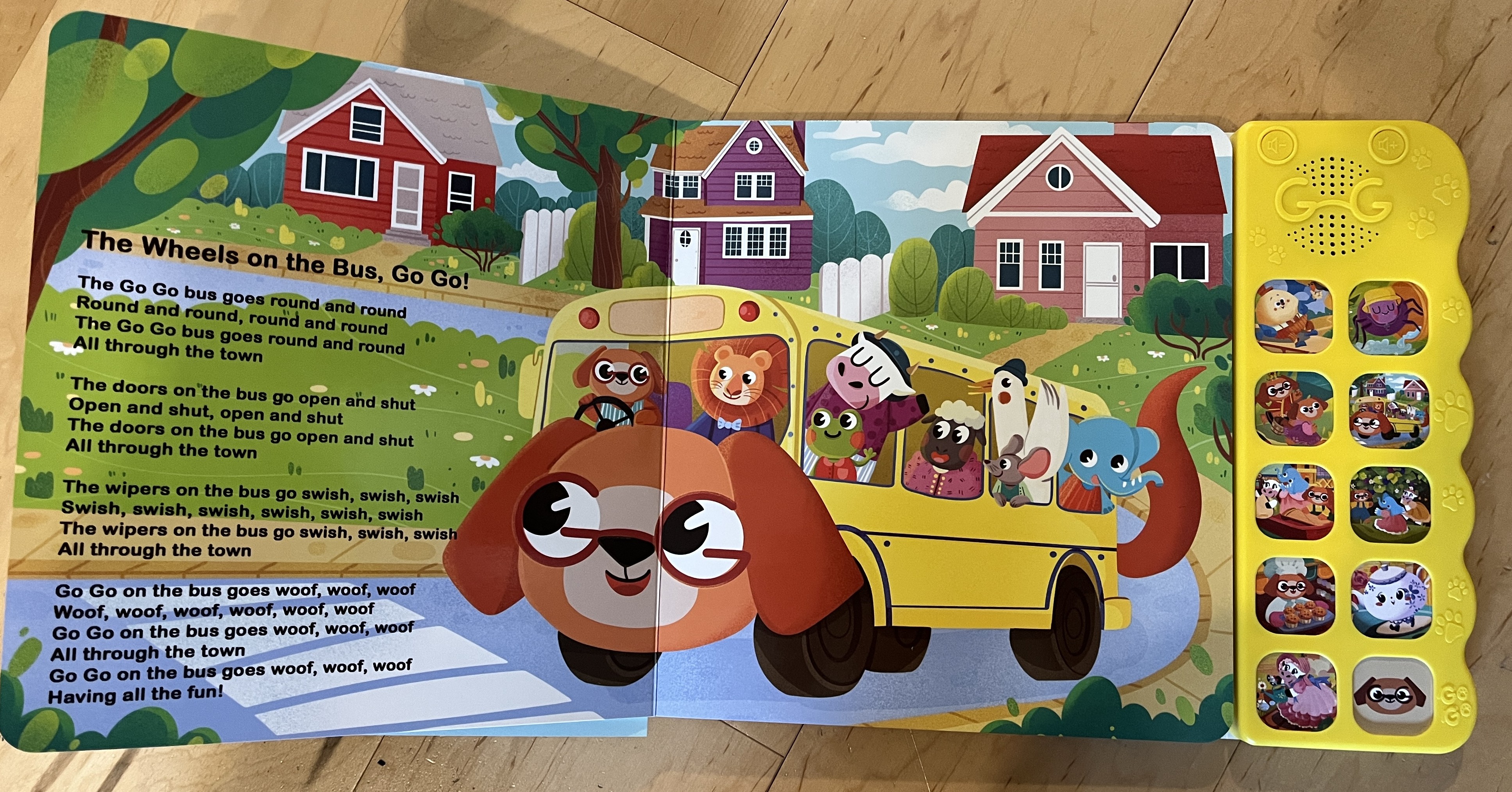
This is another large board book, with the controls on buttons off to the right side. There are two volume settings, controlled on that side panel. The child needs to figure out which of the 9 buttons matches the song for the page they’re on (the 10th button is just announcing the name of the book). Songs are up to 60 or so seconds.

Personally, I don’t like the style of these recordings. They’re like Barney the Dinosaur vibe – just a little too enthusiastic / peppy with kiddie pronunciation. I’m not a fan.

Hear samples from every book:
Mandarin Children’s Songs

At my toddler class and preschool, I have children who speak lots of different languages at home: including Spanish, Russian, Mandarin, Vietnamese, Hindi and diverse Indian dialects. I speak a little Spanish, French and German – enough that I can count to ten, and name some colors and some farm animals. That means that I can sometimes talk with children in their home language. I’m now trying to take on some Mandarin, and feel like I’m way out of my league. But here’s where I’m starting.

First, this helpful video which explains the whole idea of tones and reading pinyin – the romanized version of writing Mandarin that includes pronunciation cues:

This was an a-ha moment for me. Last year, I had a student in class that I asked his mother how his name was pronounced. She said it, I echoed back what I thought I heard, she said no, and said it again – after several attempts I couldn’t get it right and couldn’t hear what I was doing wrong – I worked with my teacher who speaks Mandarin, and she couldn’t explain what I was doing wrong. (There’s research that shows that young babies can hear any tone human mouths can make, but by the time they are toddlers, they have learned to ignore tonal differences that don’t matter in their language – for example, the difference between L and R sounds in English matters, but it doesn’t matter in Japanese.) Because I was raised in an English speaking home, these different vowel tones are just not something my brain easily hears, so I will have to actively teach it to notice these differences. This video helped with that.

I know that music helps us to learn, so, to embark on Mandarin, I’m starting with children’s songs.

Where is My Friend

Lyrics:

yī èr sān sì wǔ liù qī
wǒ de pénɡ you zài nǎ lǐ
zài zhè lǐ zài zhè lǐ
wǒ de pénɡ you zài zhè lǐ

1, 2, 3, 4, 5, 6, 7 / Where is my friend? / Over here, over here / My friend is over here

The song starts with counting to 7, so it’s a great early one to learn. I also like the video from our local library.

This video includes really clear pronunciation on the song, then teaches each of the words. (You’ll also see how she uses the fingers one one hand to count to 10 in the Chinese way rather than the method I’m familiar with which requires both hands.)

There’s also a Bao Bao Learns Chinese video where she really clearly reviews all the pronunciation. The song appears in Ditty Bird volume 1 sound book.

Two Tigers

Liǎng zhī lǎo hǔ, Liǎng zhī lǎo hǔ,
Pǎo de kuài, Pǎo de kuài,
Yī zhǐ méi yǒu yǎnjīng, (or: Yī zhī méiyǒu ěrduo)
Yī zhī méi yǒu wěibā,
Zhēn qí guài, Zhēn qí guài.

Two little tigers, two little tigers / Running fast, running fast / One without eyes (or one has no ears) / One has no tail / it’s very strange, it’s very strange

This uses the same tune as Frere Jacques.

There are additional recordings at Bao Bao, and lots more. Here is a pronunciation guide from Bao Bao Learns Chinese.

The song appears in Ditty Bird Chinese songs volume 1 sound book, and Bao Bao Learns Chinese, volume 1.

Pulling Carrots (or Picking Radish)

bá luó bo, bá luó bo;
hāi yāo hāi yāo bá luó bo;
hāi yāo hāi yāo bá bū dòng;
lǎo tài pó, kuài kuài lái;
kuài lǎi bāng wǒ men bá luó bo

Pull the radish, pull the radish / hey-o, hey-o, pull the radish. / hey-o, hey-o, we can’t pull / Old lady come, quickly come / Come help us pull up the radish now

This video translates the title as picking carrots, but everything else I’ve seen says radish… In repeat verses, instead of calling the old lady, you could call for little girl, little kitten, little mouse, etc.

Or here is another version – I like this song, because I really like the sound of the hāi yāo hāi yāo bá luó bo refrain. The song appears in Ditty Bird Chinese songs volume 1 sound book.

Row Your Boat – Huá xiăo chuán

I decided to try a Mandarin version of a traditional English children’s song.

Huà huà huà xiǎo chuán
shùn zhe xiǎo hé liú
Kuài lè ba (4X)
Rén shēng shì gè mèng

This one appears in Bao Bao Learns Chinese, volume 1.

There’s another slow version here.

Here’s the pronunciation guide.

Wish me luck on stretching my brain to learn something new!

100 Days of Ukulele

For the 100 days challenge, I created a collection of fun songs for singalongs with video tutorials. Start reading here to learn about the challenge and learn more about Rise Up Singing, or skip straight to the song list.

Introduction

Cynthia Lin organizes a “100 days of ukulele” challenge, starting each year in March. Participants are encouraged to record a video every day of themselves playing ukulele and post it for the community to see. (Find it on Facebook, or her Patreon or on Instagram or YouTube using #100DaysUke2025.) The goal is to commit to a practice, and daily work on your skills. This year, I gave myself the challenge of playing lots of new songs, using each to practice and strengthen my: chord changes, choosing the best strum pattern and/or building my skills at finger picking. I figured I might as well record these as tutorials that I can share with others.

I chose to work with songs from the group singing book Rise Up Singing (Amazon affiliate link, or buy directly from the publisher). There are 1200 songs in the book! So, I am choosing some of my favorites / things I think may be commonly sung. Many of them also appear in the Daily Ukulele Songbook. (Amazon, publisher). Or they appear in the songbooks for the Eastside Ukulele Players group I play with.

Most of my videos will include chord diagrams. They contain at least some of the lyrics, and some contain info on how the chords align with the lyrics. If I don’t have all the lyrics and chords in the video, I will try to link to where you can find them. I do strongly encourage you to support the authors/publishers of Rise Up Singing and Daily Ukulele and honor their copyright by purchasing your own copy of each book. If you do singalongs in a group, purchase enough copies of the book for everyone in the group.

Rise Up Singing

Rise Up is a folk music singalong book, first published in 1988. It contains 1200 songs, sorted into 35 categories, well indexed by title, artist, and subject. For sheer number of songs, it’s incredible! In order to fit that many songs into a compact, affordable book, this is not full sheet music and comprehensive lyrics for all know verses. It just includes the lyrics and chords, not the melodies, so you either need to know the song, or look for a recording online to learn it. I love this book!

And… as a beginning musician, it was really hard for me to use it, even for songs that I knew.

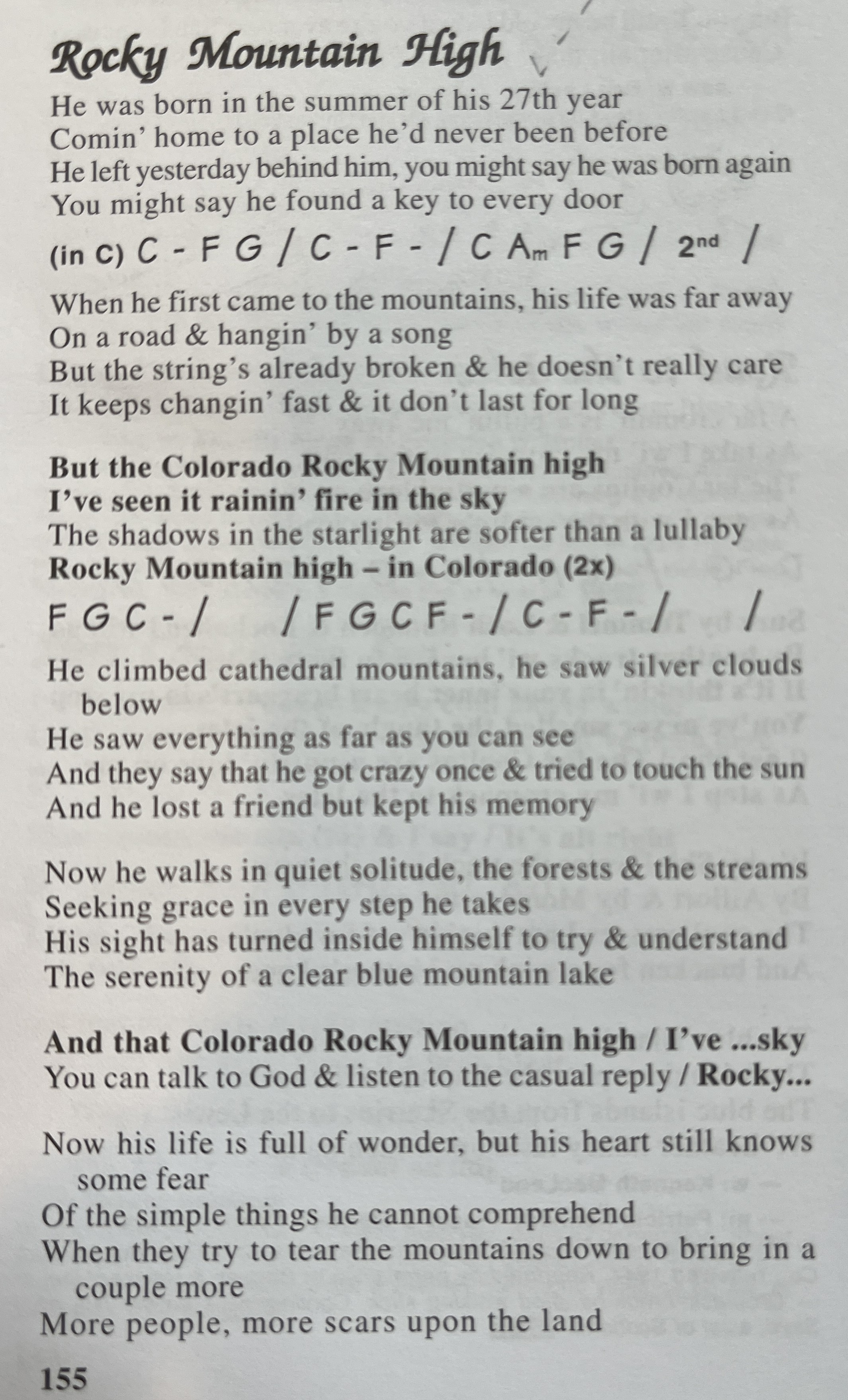
Here’s a sample song. So the “C – F G /” means that for the first line of lyrics, you’ll play C, continue playing C, then F, then G. You have to figure out for yourself when to switch from one to the other. The second and third lines of lyrics are similar, then you’ll see for the fourth line, it just says 2nd. That means you play the second pattern. There’s a lot of thinking involved as you play, which was hard for me when I started.

The Rise Up Singing versions aren’t the fanciest arrangements – they lean toward using simpler chords and not a lot of chord changes, so in some videos, I include more interesting variations on the song. Also, I find the key doesn’t always feel right to me. An Amazon reviewer says “The keys chosen work well on guitar (tuned to key of E so lots of Es and Ebs and whatnot), not always so easy for uke players. I do find myself transposing on the fly.” I agree, so in some videos I offer a second version of the song, played in a different key than shown in Rise Up.

Song List

Here’s a list of all the recordings I did, in alphabetical order. Some are full tutorials, some are playthoughs of the full song, some just snippets… just what I was able to complete on that particular day of the challenge, depending on my other commitments. I starred the easier songs for beginners.

Simple Children’s Songs

I also have a series of videos made for preschool teachers or children’s librarians, using just a few simple chords on the uke to play these songs:

  • using C and F – Row Your Boat, Brother John
  • C7 and F – Skip to my Lou, Mulberry Bush, More We Get Together, etc.
  • C and G – Open Shut Them, Ring Around the Rosie, Clean Up
  • C and G7 – London Bridge, Looby Loo, Peekaboo
  • C, F, G7 – Twinkle, ABC, You are My Sunshine, Happy Bday, and more
  • C, F, G – If You’re Happy, Teapot, Baa Baa Black Sheep, Teddy Bear
  • D7, C, G – Old McDonald, Thumbkin, Coming Round the Mountain,
  • More Chords and Songs: Dm – Muffin Man; D and A7 – Bingo, A and E7 – Speckled Frogs, Em and B7 – Ants Go Marching; Am – Over in the Meadow

4 Chord Progression

If you have worked your way through my full series on Learning to Play Ukulele, and are ready to play around some, here’s a fun approach.

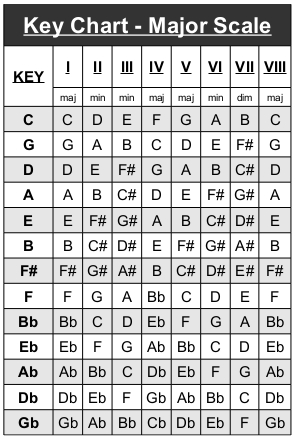
Lots of pop songs are written around a standard chord progression. They’ll describe it as I V VI IV. (Within a key, these are the first, fifth, sixth and fourth chords in the scale.)

So, in the key of C, you’d play a chord progression of C G Am F. In G, it’s G, D, Em and C. In the key of D, it’s D, A, Bm, and G.

So, try just playing the chord progression: for example, strum C twice, then G, then Am, then F. Does that remind you of any song you’ve heard?

It might remind you of Don’t Stop Believing by Journey? Or I’m Yours by Jason Mraz? Or Let it Be from the Beatles? Yep, it’s in all those.

In the video below, they play snippets of all these songs that use this four chord progression. Journey — “Don’t Stop Believing” James Blunt — “You’re Beautiful” Black Eyed Peas — “Where Is the Love” Alphaville — “Forever Young” Jason Mraz — “I’m Yours” Train — “Hey Soul Sister” The Calling — “Wherever You Will Go” Elton John — “Can You Feel The Love Tonight” (from The Lion King) Akon — “Don’t Matter” John Denver — “Take Me Home, Country Roads” Lady Gaga — “Paparazzi” U2 — “With Or Without You” The Last Goodnight — “Pictures of You” Maroon Five — “She Will Be Loved” The Beatles — “Let It Be” Bob Marley — “No Woman No Cry” Marcy Playground — “Sex and Candy” Men At Work — “Land Down Under” Theme from America’s Funniest Home Videos Jack Johnson — “Taylor” Spice Girls — “Two Become One” A Ha — “Take On Me” Green Day — “When I Come Around” Eagle Eye Cherry — “Save Tonight” Toto — “Africa” Beyonce — “If I Were A Boy” Kelly Clarkson — “Behind These Hazel Eyes” Jason DeRulo — “In My Head” The Smashing Pumpkins — “Bullet With Butterfly Wings” Joan Osborne — “One Of Us” Avril Lavigne — “Complicated” The Offspring — “Self Esteem” The Offspring — “You’re Gonna Go Far Kid” Akon — “Beautiful” Timberland featuring OneRepublic — “Apologize” Eminem featuring Rihanna — “Love the Way You Lie” Bon Jovi — “It’s My Life” Lady Gaga — “Pokerface” Aqua — “Barbie Girl” Red Hot Chili Peppers — “Otherside” The Gregory Brothers — “Double Rainbow” MGMT — “Kids” Andrea Bocelli — “Time To Say Goodbye” Robert Burns — “Auld Lang Syne” Five for fighting — “Superman” The Axis of Awesome — “Birdplane” Missy Higgins — “Scar”. In the video , they are in the key of D, using D, A, Bm, and G.

So, you could choose any of the songs off that list, do a google search or YouTube search for “[song title] ukulele” and find a chord chart and a video and start learning that song, playing with that four chord progression.

Another common progression, called the 50’s progression or the doo-wop progression, in Nashville numbering is I VI IV V (the same chords as I V VI IV described above, just in a different order). In the C major scale, that’s C–Am–F–G

Just a few of the songs that use it are: All I have to Do Is Dream, Beyond the Sea, Blue Moon, Breaking Up is Hard to Do, Chain Gang, Crocodile Rock… find more here.

Resources for Learning Ukulele

Once you’ve mastered all those preschool songs in my Beginner Uke for Preschool Teachers series, you may find you’ve fallen in love with ukulele and want to learn more.

Here’s my approach: Most mornings when I’m playing on my ukulele, I think of a song I want to work on, go to YouTube and search for “[song title] ukulele” and then work through the tutorials I find.

I’ve also used the book Daily Ukulele (Amazon affiliate link). I flip to the next song, try it on my own, then search for tutorials of it to build more skills or search on YouTube for “[song title] play-along” if I am feeling confident and want to practice playing it at tempo.

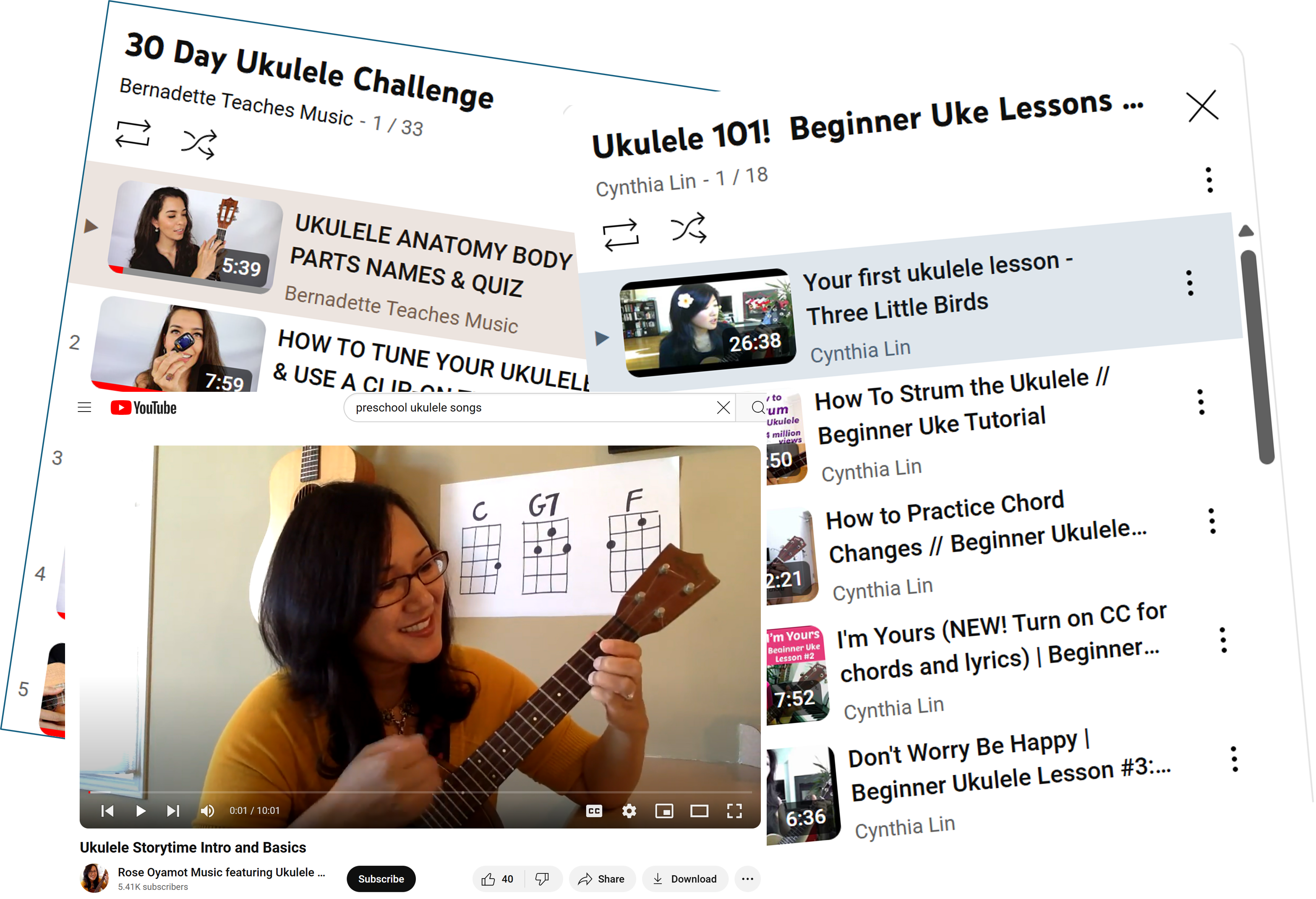
Here are the YouTube channels I have learned the most from:

Someday I’ll be good enough to keep up with: Matt Dahlberg and Christopher Davis-Shannon.

Many of those instructors have Patreons, where for a small monthly fee you can access PDF song sheets, additional tutorials, live jams and lots of other supplemental material. Morristown has all of their song sheets available for free.

I’m working on a collection of singalongs from the songbook Rise Up Singing.

If you want written chords for songs; For any song you want to learn, you can do a google image search for “[song title] ukulele chords” and come up with several versions in different keys – play around to find the one that suits your voice best. 

If you really want to improve your playing, find other people to play ukulele with!! Search for a group in your area – they’re often free, drop-in-anytime groups. Or if you can’t find one locally, there are some online groups as well. My group, on the Eastside of Seattle has some free songbook PDF’s with lots of fun songs to play along to.

Have fun playing ukulele!!