Category Archives: For Professionals

Stations at a Play-Based Preschool

I wrote a full post about play-based preschool that provides an overview of how it works, and what the benefits are. This post gives specific examples of the types of activities you might find at a play-based preschool and has concrete examples what children learn from each.

Blocks / Building Materials

The Invitation to Play: the teachers may offer construction toys (like Legos, blocks, Magnatiles) or other creative building supplies (TP tubes, toothpicks and gum drops). Children are encouraged to use them to build any structure they choose. Teachers often mix in other supplies for inspiration: for example, add a toy giraffe and an elephant and children may build a zoo. Add cars and they’ll build roads and cities. Add pictures of famous buildings and they’ll build their representation of the Eiffel Tower. If one child wants to build a stable for her toy horses, and the other wants to make a spaceship, they have to negotiate how to share the blocks fairly.

When children build, they learn the basics of physics, spatial awareness, an understanding of what makes something stable. They learn about sizes and shapes and patterns – essential math skills. They problem solve and experience logical consequences that guide them in how to try again and build it better. They view themselves as competent creators.

Puzzles, shape sorters, manipulables

When a child puts a puzzle together or works with specially designed early learning materials, they learn important ideas about shapes, sizes, patterns, the relationship of the part to the whole, eye-hand coordination, small motor skills, and problem solving. However, many parents don’t buy many puzzles or pattern blocks, because they may be something a child just does a few times and masters. But at a preschool, they may have a whole cabinet full of spatial challenges for your child to explore.

Sensory Play and Play Dough

Sensory Play was once a staple of most preschools and many kindergartens. As public schools have shifted toward teaching academic skills that can be evaluated in standardized tests, sensory play is often phased out.

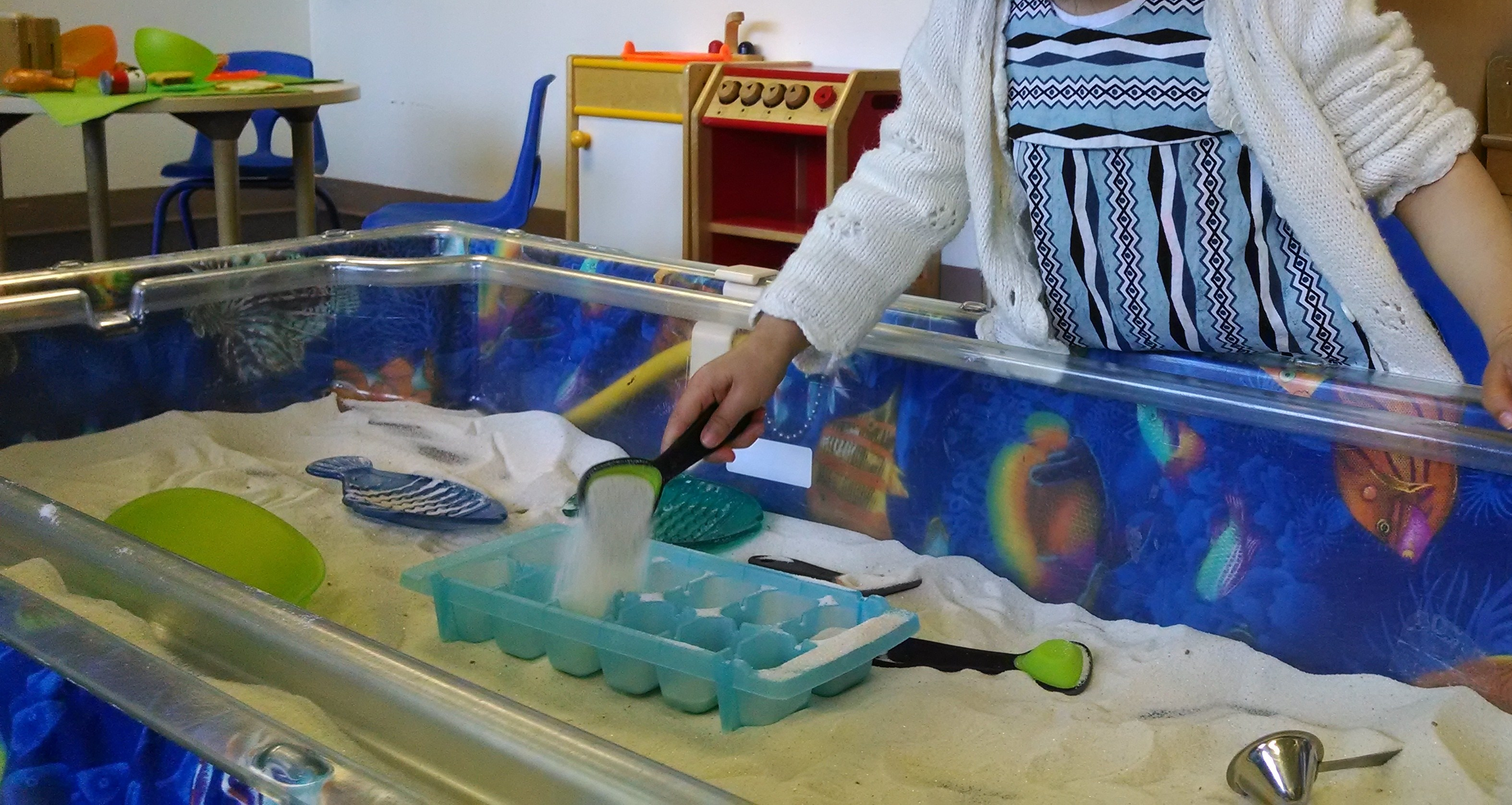
But when children play in a sandbox, or in a sensory bin full of rice or pompoms, or a water table, or on a light table, this multi-sensory experience can teach so many things. They build eye-hand coordination as they pour and scoop; learn concepts of empty and full, volume and weight – relevant to math; properties of solids and liquid in motion, that the amount of a substance remains the same even when the shape changes, and that some things sink and some things float (science!) They get comfortable with their hands being messy. (This is an important life skill – sometimes we all have to do messy things!)

In the sensory tables, and with play-dough, they can explore how to use so many tools: tweezers, tongs, spoons, scoops, shovels, funnels, rolling pins, cookie cutters, egg beaters and whisks, pipettes and eye droppers, scales, measuring cups and spoons, potato mashers, pizza cutters…

Playdough also gives children the opportunity to

  • express feelings, squeezing and pounding
  • learn about negative and positive space when they cut out shapes with a cookie cutter (this helps with reading)
  • build finger muscles

Art Process / Writing Practice

Preschools often have an easel set up every day, with various kinds of paints and various kinds of painting tools – brushes, rollers, sprayers, or sponges. Children are free to paint anything that they choose to. Many preschools have a “creation station” for collage, offering cardboard and paper for bases, glue and tape, and miscellaneous things to glue on: pompoms, googly eyes, plastic lids, tissue paper scraps, styrofoam popcorn, pretend jewels… almost anything! Many preschools have a writing station with office supplies – paper, markers, pencils, pencil sharpeners, staplers, hole punches, scissors, stickers, rubber stamps, envelopes and so on. Children can make cards for their parents, signs to support their pretend play, booklets, anything they choose. We also do wacky things like salad spinner painting or painting with cars or putting a paper plate on a record player and drawing as it goes round and round.

These are all process-based art activities. No one is dictating what they must create there or what the final product needs to be. It’s completely up to the child to envision something and to make it real.

The children learn how to use all the tools and all the media, they build their finger muscles and their pencil holds, they learn names of colors and how to mix new colors, they learn to recognize shapes and to create shapes, they learn about symmetry, balance, and design. The art is a creative outlet for expressing their feelings and learning that their ideas have value.

Art Projects and Crafts

In addition to art process, we also have projects. These are activities where the teacher creates a sample and puts out all the materials for kids to make a project similar to the sample. It’s up to the child whether they want to use the materials in that way or do something else with them. But we do encourage them to try re-creating some projects, because it gives them practice with following multi-step directions. It lets them practice close observation skills and learn how to imitate or re-create what they see. We can build new skills into these projects they can then apply elsewhere, such as a project where they practice cutting curvy or zigzag lines.

Cars and Trains / Doll Houses / Play Farms

We have toy trains, toy cars, bulldozers and more. Children learn how wheeled vehicles move through the world and what happens when they crash. They learn how things need to be pushed up hills, but going downhill, they go fast on their own (physics!). And, because these toys tend to be very popular with our active, high energy kids, they also often provide opportunities to practice sharing and conflict resolution!

We have small dolls and doll house furniture. We have small plastic farm animals and farm equipment, woodland animals, and zoo animals. Kids may play with these and the cars on their own or they may be combined with the blocks, sensory bins, art supplies, pretend houses we made, and more. When children play with these small worlds, they do a lot of sorting (“I’ll put all the cows in this stall and all the horses in this stall”), counting (“I have 7 racecars that are ready for the race to begin”), and story-telling (“the lions were all roaring at the elephants”). They also co-create with other children – playing side by side sometimes, but then having their horse talk to the other horse, or their doll call the other’s doll to the table for food.

Dramatic Play

Most preschools have a play kitchen full of pretend food, dress-up clothes that allow children to play out many roles, plus baby dolls and stuffed animals to practice nurturing skills with. Many of those materials may be available every class during the year so children have lots of chances to explore them and use them in many ways. Teachers may also have special themes for dramatic play: maybe a farmer’s market in the fall, a gingerbread bakery in December, a valentine post office in February, or a spaceship and mission control.

With dramatic play, children learn to use their imagination, try on different roles, explore other cultures, imitate parenting behaviors they see in their lives, role play a variety of careers, and explore gender roles. Lots of complex language practice happens during pretend play. This area also builds social skills as they have to negotiate about which roles each child will play and what the story line will be.

Board Games and Active Games

Whether it’s Candyland, Bingo, Hide and Seek or Tag, all games offer practice at understanding and following rules, learning how we all get along better when we can agree to and follow the same rules, and learn how to be a good sport – winning with grace, and recovering from the disappointment of losing.

Books and Literacy

Stories are always available in a preschool classroom. Some schools (like Waldorf) use only oral storytelling, but in most, there are books available. They may be used during group time, but also available for independent exploration. Literacy practice may also be incorporated elsewhere: signs or menus in the pretend play area, books on CD to listen to, board games, and in art projects.

Children learn that letters on a page represent words – language written down, then learn to interpret pictures and to follow the development of ideas in the plot of a story. Most important, they see that learning to read is important and enjoyable.

Large Motor Activities / Outdoor Play

So much brain development happens in these early years, and children form the foundation of all the skills they need for a lifetime. This is especially true of motor skills. In addition to all the fine motor practice of puzzles, writing and playdough, preschools also offer lots of opportunity for large motor practice indoors and outdoors. Playing in the playground or on tumbling equipment indoors, throwing balls or throwing paper “snowballs”, digging in the sandbox or running on an ever-evolving obstacle course.

They are building physical strength, coordination and balance as they build all the key physical skills of running, jumping, climbing, and rolling. They learn to take some risks and be bold, while also learning when they need to be cautious, and learning to emotionally regulate through it all. There’s also important skills in taking turns on the slide, watching out for other people before moving, and moving around others carefully. As our kids ride trikes madly around the playground they’re learning skills they’ll need in driver’s ed someday!

Snack and Clean-Up Time

Snack time can always include practice at choosing and trying new foods, practice using silverware and table manners, learning to sit with others while eating, and practicing social conversation. Many preschools also involve the children in making their own simple snacks, which can include practice with cutting with a knife, stirring, spreading, sprinkling, measuring, and so on. Learning these life skills at an early age builds confidence and competence.

Children also learn confidence and competence as they help out with clean-up time. They may help put all the toys away, wipe tables, sweep the floor, put lids back on markers, and fold up the tumbling mats. This teaches life skills, teaches them that they can make meaningful contributions to a community, and motivates them not to make too much of a mess in the first place! But also, putting away toys is a great exercise in sorting things into categories (a key science skill) which requires noticing details, observing similarities and differences in object, concepts of color, size, and shape.

Check out the overview of play-based preschools.

Parachute Play with Children

Parachute from Lakeshore Learning

Parachutes can be a fun accessory for indoor story-times or outdoor play, for groups of children from birth to adolescence.

Benefits of parachute play:

  • Collaborative and non-competitive – children work together, need to spread out around the chute and all participate for it to work
  • Helps to develop rhythm
  • Builds shoulder, arm and hand muscle strength
  • Good for practicing listening to instructions – if they didn’t understand it when you say to lift it up, but then their hand is lifted up into the air along with the parachute, that helps them learn the meaning of the instruction
  • It’s a great way to gain children’s attention when it’s wandering, or to settle down chaotic energy in a group time
  • It’s fun!

Choosing Equipment

If you don’t already own one, buy a parachute. (That’s an Amazon affiliate link to a product that looks good quality and comes in a variety of sizes.) Parachutes are fairly inexpensive, and fold up pretty small so they don’t require a lot of storage space.

The size you need depends on two things – how big is your room and how many people will participate?

Parachutes are described in diameter – so 12′ means 12′ from one side to the other. You need space all around it for the people to move, so it’s best to have a 20×20 space at least for that 12′ parachute.

Parachutes typically have one handle per foot of diameter. So, a 12′ parachute could work for 6 people if they all held onto two handles, or for 12 people if each holds one handle – you can squeeze in more than that, but it gets tight.

A parachute alternative – in some of our classrooms, we have a red elastic band that is probably about 12′ in diameter. Many things you can do with a parachute you can do with this elastic band, and in some ways it is easier to start with because they practice all holding something in a circle without having all that fabric to get tangled up in. I have not found one of these for purchase, but it seems similar to this stretchy band. Learn about stretchy band play.

image from https://www.singplaycreate.com/2016/01/stretching-learning-with-stretchy-bands.html

Ages

In my activity descriptions below, I’ll code what age groups they work best for:

  • B = Babies. The parents hold the parachute and do the actions while the babies observe
  • P/C = Parent/Child. For toddlers and preschool age. Parents all hold the parachute and do the actions. The children may hold on, they may go under the parachute, they may wander off…
  • P = Preschool. A group of 3 – 5 year old children and 1 or 2 adults can do this without needing more adults to help.
  • O = Older Kids. Kids 5 and up can do this.
  • All = OK for any of these contexts

Up and Down

You can simply stand in a circle, say “up” and everyone lifts the parachute up high and “down” while everyone lowers it. Kids can be holding on the edge raising and lowering, or they can be standing under it or lying down under it. So easy, and it manages to feel intriguing yet soothing at the same time. ALL

You can also put on calming music and raise and lower in rhythm with the music for a calming moment in the midst of a story time. B, P/C

Sing this song to the tune If You’re Happy and You Know It. “When the parachute goes up (raising it up), shout hurray. Hurray! (as you lower it down). When the parachute goes up, shout hurray. When the parachute is high and floats up in the sky. When the parachute goes up, shout hurray.” Repeat with “dance a dance” or “stomp your feet” and so on. P/C, P

Toast in the Toaster chant – shake side to side, then “pop” it up at the end
I’m toast in the toaster / I’m getting very hot / Tick tock, Tick tock / Up I pop!

You can also do lap songs with up/down motions like “Grand Old Duke of York” or “Let’s Go Riding in an Elevator” except instead of lifting a child up in your lap, you’re raising the parachute.

Side to Side

You can stand in place and swish the parachute from side to side. Here’s a chant to go with that motion: “I am a washing machine. Washing clothes till they are clean. I am a washing machine. Swish swish swish swish swish.” P

Making Waves / Shaking

You can shake a parachute slow and gentle, or fast and rough.

With slow waves, sing “My Bonnie Lies Over the Ocean.” B, P/C, P

With shakes, you can use some songs you use with shakers: “Oh you shake and you shake and you shake and you stop… (3x) Shake it up high, shake it down low, shake it on your tummy, and way down to your toes.” P/C, P

There’s a video here of a nice shaking song: https://nancykopman.com/parachute-songs-and-games-for-young-children/

Walking Songs

Merry Go Round. The children hold onto the parachute with one hand and walk around the circle clockwise. Play any music – as long as music is playing, they walk, If the music stops, they stop. Turn to face the other direction (e.g. counterclockwise) and wait for the music to begin, then walk more. P

Ring around the Rosie. P/C, P
Walk around as you sing: Ring around the rosie, pocket full of posy, ashes, ashes
Kneel Down: All fall down!
Shake gently, close to the ground: cows are in the meadow, eating buttercups.
Then shaking fast: Thunder, Lightning, stand We all Stand Up!

Roly Poly (a chant) P/C, P
Roly Poly, Roly Poly, Up, Up, Up lift the parachute up
Roly Poly, Roly Poly, Down, Down, Down parachute down
Roly Poly, Roly Poly, In, In, In, walk toward the center of the circle
Roly Poly, Roly Poly, out, out, out
…. fast… slow… shake it

Zoom. (tune) P/C, P
Zoom Zoom Zoom. We’re going to the moon. walking around
Zoom Zoom Zoom. We’re going to the moon. stop walking at the end of this line
In 5…. 4…. 3… 2… 1 lower the parachute gradually to the ground
Blast off!!! quickly raise your arms and let go to launch the chute up in the air

Pop Goes the Weasel P/C, P
All around the cobblers bench (walk around a circle),
the monkey chased the weasel (rattle parachute).
The monkey thought it was all in fun (lower the parachute to the ground).
Pop goes the weasel (pop it up)

Wheels on the bus. Go round and round… wipers go swish… babies go up and down…

Children on Top of the Parachute B, P/C, O

For 3 – 6 month old babies, you can lay the babies on the parachute, and the adults hold on to the parachute and walk in circles, and give the babies a ride. You have to be slow and gentle so they don’t roll on top of each other!

For older toddlers, who are able to sit well and stay where you tell them to stay, you can have them sit up on the parachute and take them for a ride.

This activity does NOT work well with the “wobblers” in between those ages – the children who can sit but not very well and would tip over, or the children who will try to crawl away, and knock over the other children.

Many of the songs above and below here combine well with taking the children for a ride, as does “Here we go round the mulberry bush” or “we’re going to the zoo”.

Children Under the Parachute B, P/C

Babies can lay on the ground as the parents hold the parachute above them. Toddlers or preschoolers can sit or walk under the parachute as the parents hold it.

Colors Over You. (tune)
Red and Yellow, Green and Blue, these are the colors over you. Red like the apple, green like the tree, yellow like the sun and blue like the sea. Red and yellow, green and blue, these are the colors over you.

Peekaboo. hold the parachute low, just above the children Someone is hiding, hiding, hiding, someone is hiding, Who could it be? lift it up high Peekaboo!

Come Under My Umbrella (tune of The More We Get Together)
Come under my umbrella, umbrella, umbrella. lift it up high so it “balloons” up a bit
Come under my umbrella, it’s starting to storm. again
There’s thunder and lightning and wind and rain. shake it hard and fast
Come under my umbrella it’s starting to storm. lift it high

Sitting Down with the Parachute P

The children sit on the floor in a circle, holding on to the parachute.

10 Little Bubbles (tune: 10 little indians)
shake the chute as you do the counting part – pat the parachute with your hands for the “pop the bubble’ part
1 little, 2 little, 3 little bubbles. 4 little, 5 little, 6 little bubbles.
7 little, 8 little, 9 little bubbles. 10 little bubbles go pop, pop, pop!
Pop pop pop pop those bubbles. (x3) Popping all the day.

Row Your Boat – divide the children in half – those on the left half and those on the right half. (It helps if there’s a teacher on each side! They “row” the parachute – holding on and leaning back, then forward. So, as left leans back, right leans forward, and so on. Sing row your boat.

Props on Top – P/C, P, O

For parent/child classes, it’s easier for toddlers to see what’s on top of the parachute if the parents are sitting down and the parachute is down low. Preschoolers or older children could do it sitting or standing.

Popcorn – put several balls on the parachute and do this chant:
Popcorn, popcorn in a pan (hands go gently side to side),
shake it up, shake it up, (shake it fast side to side)
bam bam bam! (three quick “pops” of the chute – will send balls flying off the chute.)

Autumn Leaves. Put lots of silk leaves on the parachute. Sing this song to the tune of London Bridge is Falling Down
Autumn Leaves are Falling Down, Falling Down, Falling Down… All Around the Town. up and down gently, so the leaves lift off the chute just a little
The wind will blow them round and round… swish the chute
Then you shout “oh no, it’s a storm” and you all shake like crazy till all the leaves fly off.
Now it’s time to pick them up…. gather up the leaves

Five Little Monkeys Jumping on a Bed. (use monkey puppets)

Games – O. (maybe P)

Ball through the Hole: Only works for parachutes with a hole in the center!
Place a ball on the parachute. Try NOT to let it fall through the hole in the center! For children 4+, divide the kids into teams (e.g. everyone who is holding onto a blue or green section of the parachute is one team and the other team is everyone holding onto red or yellow). Put two balls on the parachute – team 1 is trying to get their ball in the hole before team 2 can get their ball in.

Knock the Ball Off: If your parachute has a mesh circle in the center instead of an opening, you can adapt this game and have them try to keep their ball on the parachute while they knock off their opponents ball.

Swap Places. Everyone is raising and lowering the parachute. Then you say “stop” and everyone freezes with the parachute held way up high. You announce who needs to trade places. They swap quickly, then you continue going up and down. “Up and down, up and down. Up and stop! Bobby and Sally swap!”

Parachute Cave – lift up on 1, 2, 3 – when you get to 3, everyone (still holding on!) steps 3 steps forward under the parachute, then sits down with the parachute under their bottoms. You’re all in a parachute cave together!

Pass the ball – put a beach ball on the chute. Person A lowers the parachute till the ball comes to them – they raise one hand to roll the ball to the person next to them. That person then raises the chute to pass the ball to the next person. Keep going, trying to make it all the way around the circle.

Cat and Mouse – Children sit on the floor holding the parachute. One child is the cat – they sit on top of the chute and close their eyes while everyone counts to 10. The “mouse” child crawls under the parachute. Then the kids all shake the parachute to hide the mouse. The cat opens his eyes and crawls around trying to find the mouse.

Sources: https://childcarelounge.com/pages/benefits-of-parachute-play; https://www.earlyyearscareers.com/eyc/learning-and-development/top-5-parachute-games-children-early-years/; http://brampton.momstown.ca/baby/parachute-songs-kids; https://earlyimpactlearning.com/14-parachute-songs-for-preschoolers-games-lyrics-tips/; https://klmpeace.wordpress.com/2013/03/20/parachute-play-with-babies-and-toddlers/

More Resources

Also check out my posts on

Can We Do Sensory Bins In Class During COVID?

I’m about to return to in-person teaching of toddlers and preschoolers for the first time in 18 months. I have many questions about sensory bins, shared toys, and craft supplies. I don’t have a lot of answers, but here’s what I’ve found.

Official Recommendations for Child Care Settings

Safest Options: Here are some recommended Sensory Ideas from King County public health. These are from May 2020, when worries about surface transmission were high, so the fact that these were considered safe then means they would definitely fit under current recommendations.

  • Individual sensory items in containers. To clean, just wipe down the outside.
    • Double-bagged ziplocks, sealed with tape. Fill with slime, gak, water beads, hair gel, etc. Kids hold and squish around.
    • Fill rubber gloves with sand, lentils, etc. Tie off.
    • Water bottles filled with colored water, oil, sequins, shells, etc. Tape or glue lids.
  • Individual sensory bins in plastic tubs. Each child has their own bin they use each week, filled with rice, beans or other material. Swap tools each week: cups, scoops, toys that can be cleaned.
  • Play-dough in individual containers for each child. For play, put them on a tray, or tape off part of a table. Give the child tools to play with – like cookie cutters. When done, put child’s playdough back in their bag, and clean tools before another child uses them.
  • Give child their own containers of finger paint. Use plastic handled paintbrushes, and clean before another child uses them.

Guidelines specific to sensory bins and shared items in childcare settings

The current recommendations from the Washington DOH (they’re supposedly releasing new recommendations soon) and the CDC, were originally developed when there was high concern about surface transmission.

DOH says (https://www.doh.wa.gov/Portals/1/Documents/1600/coronavirus/DOH-OSPI-DYCF-SchoolsChildCareGuidance.pdf)

  • “Children should have their own set of items to limit the sharing of supplies or equipment.
  • Some items cannot be cleaned and sanitized. This includes things like playdough and some items in sensory bins or tables, stuffed animals, and dress up clothes. Remove these items from the program unless they are individually assigned and labeled.
  • If using sensory materials, use items that can be disinfected or discarded and replaced between sessions…. All sensory table activities should be supervised for toddlers and preschool children. Hands should be washed before and after sensory table use.
  • Books and other paper-based materials are not high risk for spreading the virus and do not need to be cleaned more than normal.”

CDC adds “Machine washable cloth toys should be used by one person at a time or should not be used at all. These toys should be laundered before being used by another child.” https://www.cdc.gov/coronavirus/2019-ncov/community/schools-childcare/guidance-for-childcare.html

What is known, but not yet reflected in the guidelines

Does the type of surface matter?

Viruses live a different amount of time on different surfaces. There were studies in the NEJM that looked at half-life – how long till it’s reduced in half and Lancet that looked at how long it took before the virus was undetectable. Department of Homeland Security has a page that addresses estimated surface decay. (Here’s a plain language summary of the research.)

When first “deposited” – like if an infected person without a mask just sneezed droplets on a surface – there’s more virus there. As time passes, the amount of virus drops, till there’s no longer any detectable. (Imagine a puddle on a sidewalk – at first it might be two feet across, then it gets smaller, and then the pavement is just damp, and eventually the pavement is pretty much dry… the water is undetectable.)

When the virus was intentionally deposited on surfaces, it’s virtually gone from paper in a few hours, from cardboard in 24 hours, wood and cloth in 2 days, glass in 4 days, and steel and plastic in 3 – 7 days.

So, that’s how long some small amount of virus might be capable of living (if not cleaned with soap and water, or sanitized with bleach, or disinfected.)

So… if we had someone in class with active coronavirus, and virus was deposited on a surface and we didn’t clean it, there is some small amount of virus on that surface the next day. The question is – how likely is it that someone who is masked and washing hands frequently would catch COVID from that?

What do we now know about surface transmission?

  • In April 2021, the CDC released a brief (https://www.cdc.gov/coronavirus/2019-ncov/more/science-and-research/surface-transmission.html) which stated: “… surface transmission is not the main route by which SARS-CoV-2 spreads, and the risk is considered to be low. The principal mode by which people are infected with SARS-CoV-2 is through exposure to respiratory droplets carrying infectious virus. The risk of fomite transmission can be reduced by wearing masks consistently and correctly, practicing hand hygiene, cleaning, and taking other measures to maintain healthy facilities.” “… the risk of SARS-CoV-2 infection via the fomite transmission route is low, and generally less than 1 in 10,000….” “Routine cleaning … with soap or detergent, at least once per day, can substantially reduce virus levels on surfaces. When focused on high-touch surfaces, cleaning with soap or detergent should be enough to further reduce the relatively low transmission risk from fomites in situations when there has not been a suspected or confirmed case of COVID-19 indoors.” “Disinfection is recommended in indoor community settings where there has been a suspected or confirmed case of COVID-19 within the last 24 hours.”

How much does cleaning reduce risk?

“From studies of cleaning focused on other microbes, a 90–99.9% reduction of microbe levels could be possible depending on the cleaning method and the surface being cleaned.”

So, if a different group of people is entering the classroom within 24 hours, then cleaning does get you a substantial reduction in risk.

The Context of Our Classrooms

Child care can look like lots of things – there are some 24 hour child cares that are back-up emergency care for essential workers – those might be more likely to have a higher load of any virus, and may be harder to clean between children. A full-time child care with unvaccinated workers might be more likely to have virus, and harder to clean between children.

In the context of my classes, things might look very different and might lead to different decision making. Here are the layers of protection we have in place to reduce the possible viral loads in our classrooms:

  • We require all adults to be vaccinated. (Also, on the Eastside, over 90% of adults have received at least one dose of the vaccine.) We will ask them to do temperature checks, and symptom and exposure checks before coming. This reduces the risk that families will bring the virus to class.
  • We will require adults to wear masks and recommend that children do so. We will also increase ventilation. These practices reduce droplets and the risk of airborne transmission.
  • We will practice frequent hand-washing and hand sanitizing which reduces the risks of fomites being transferred to surfaces.
  • We have much higher adult to child ratios than a typical child care (between 1:1 and 1:5) and can provide closer supervision.
  • Some of our classrooms are only used once a week by one group of families.

Questions there aren’t official answers for

  • If an item is used by one child for a brief period of time, then put away for a week before being used again (like maracas or jingle bells at group time), does it need special cleaning?
  • Given frequent hand cleaning protocols, would it be reasonable to share materials like scissors and markers between children, or is it essential to have a system like a bin of clean markers, and then a bin for dirty markers where any marker that has been used by a child is placed?
  • If children hand sanitize before and after, is a shared sensory bin reasonable? Should it be filled only with materials that can be cleaned with soap and water and sanitized with bleach solution? Could some items (like rice and lentils) maybe be disinfected after class by stirring in alcohol? If health guidelines for child cares allow for sandbox play outdoors (they do) – what about sand in an indoor sensory bin?

These are the things I’m thinking about. If you have additional insight into this, let me know in the comments!
The Economics of Parenting Style

I’ve written before about the four parenting styles, about other parenting labels like helicopter parents, free range, and tiger moms, and how parenting style might affect how we handle choices in our families.

Yesterday, there was an article in the NY Times called Is Education No Longer the Great Equalizer, and it quoted extensively from “The Economics of Parenting,” by Doepke, Sorrenti, and Zilibotti, that is a fascinating way to think about parenting through an economists’ lens. They say the “basic parent-child conflict is that the parent attaches a higher weight to the future utility of the child” versus the child places a higher weight on their “full enjoyment” of the moment.

They say that parenting styles “come down to whether, and how, parents interfere with the child’s choice.” The permissive parent lets the child have their way, and may go out of their way to offer a wide range of choices. The authoritative parent attempts to shape the child’s preferences, by offering choices but also educating about why they believe particular choices are the best ones for the child’s long-term well-being. The authoritarian parent offers few choices, dictating what will be done. Their emphasis is on what children do, not what they think, so there’s no need to persuade them that it’s the right option… it’s the only option.

They also state that permissive parents value either independence or imagination, authoritative parents value hard work, and authoritarian parents value obedience.

Doepke, Sorrenti, and Zillibotti then look at the interaction between the economy and parenting styles. In societies with a wide array of career opportunities and a low degree of income inequality, “the gap between the top and the bottom is small… Parents are less concerned about children’s effort, and thus there is little scope for disagreement between parents and children. Therefore, most parents adopt a permissive parenting style, namely, they keep young children happy and foster their sense of independence so that they can discover what they are good at in their adult life.” If parents believe that their child can be financially successful no matter what, it’s easy to let them pursue their talents and their joys.

In societies where there’s little social mobility, where most children will have the same profession as their parents, the parents have little incentive to be permissive and let their children discover something they’re good at (they may see talent as irrelevant in a world where there aren’t career choices available) and or to be authoritative and convince their child of anything. If the parents’ experience is that you need to do whatever work that is available to survive, they tend to be authoritarian – conveying ideas like “you just have to follow the rules – you don’t have to like it.”

In a society with a high degree of income inequality, the choices a child makes could have a big impact on their economic well-being. The parents know their children have a wide array of job opportunities and want to persuade them to choose the one that will give them the best chance of success. So, a larger share of parents are authoritative. They also tend to be highly involved, ensuring that the child is taking the best advantage of any available opportunity and learning to make “good choices” (as the parent defines them). The authors acknowledge that authoritative parenting requires more effort on the parents’ part than the other options.

The parents’ current economic status also influences parenting style. “richer parents can use monetary rewards to persuade their children to comply with their wishes. Poor parents lack the resources… and may be more likely to resort to authoritarian methods such as corporal punishment.”

Doepke, Sorrenti, and Zillibotti were discussing how this might be see on a country by country basis, but it clearly also comes into play in micro-societies of neighborhoods – for example, a neighborhood with few economic opportunities might tend toward authoritarian values.

For parent educators and others who work with families, I think these ideas add to a deeper understanding of influences on parenting style. Understanding a family’s culture and socioeconomic class, especially if it is different from our own, increases our empathy and ability to communicate.

Parent Educators, here’s a handout you can share to introduce parenting style.

Circle Time for Toddlers

music-play-youth-musical-instrument-children-sports-sound-music-group-human-positions-music-garden-995658

I teach a parent-child class where the toddlers are 12 – 30 months in September. Each week, we do a circle time for music and stories. I tell the parents that not only does music have many benefits for children’s learning, and not only do rhymes and songs help teach language skills, circle time is also a chance for children to begin to practice key skills for kindergarten readiness: the ability to sit still, to listen to a teacher, to notice and do what the other people around them are doing, and to stop doing something when asked. (We do the shaker song every week, “oh you shake and you shake and you shake and you stop” and I talk about how huge this is for practicing impulse control.) My secret agenda is that teaching parents things to do with their children builds connections. Plus, of course, circle time is fun!

At the beginning of the year, I make sure parents know that their children will not yet be good at sitting still and paying attention for the full circle time, but the more we practice, and the more we model that behavior for them and encourage them to try, the better they’ll get. At the beginning of the year, circle time is about 10 minutes long. By the end of the year, it’s 20 – 25 minutes.

I always go in the same order each time, just adding more pieces to each segment as we go along. That way the children learn the ritual, and are better able to participate because they can predict what will happen next.

  1. Greeting Songs – each week we do the “I roll the ball to [name] song” and one other greeting song which uses the child’s name and gives each child a moment in the spotlight.
  2. Lap Songs – when we bounce children in a rhythm, it helps to instill rhythm in them at a fundamental level. It also helps to build their vestibular system. These songs are also super fun, and get lots of giggles going.
  3. Finger Rhymes – these teach a lot of vocabulary, and also teach children to notice patterns… “after dad says ‘with a one step and a two step’, he’s going to tickle me.”
  4. “Theme Activity” – I always have some small toys, puzzle pieces, or decor items tied into the theme gathered in my red gift bag. We sing “what’s in the red bag, the red bag, the red bag…” song. The kids come running over to find out. I give each one an item to take back to their parent – they talk about it together, then we do a few rhymes or songs that are related, then they bring them back to me.
  5. Book (we start these about halfway through the year)
  6. Shakers – we do the shake and stop song, sometimes some other songs, sometimes we turn on recorded music and dance and shake to the music.
  7. Active Songs, with or without parachute. Moving around the room in rhythm to the music is great at building coordination, rhythm, and large muscle skills.

I’ve gathered the ideas for my circle time rhymes and songs from many great sources. I have lots of favorite songs (here are links to lyrics and to videos showing hand motions). I have some favorite toddler books I share.

I have a full year’s worth of circle time plans for my toddler class – it’s organized by theme, and we do each set of songs for about 4 – 6 weeks. Themes include: fall, winter, spring, farm, zoo, stars, transportation, ducks, and beach.

For my science class for 3 – 6 year olds, we do two completely different circle times each week – opening circle teaches a rhythm activity, a discussion of the day’s topic, and a non-fiction book. Closing circle teaches a song, we read a fun imaginative fiction book related to the day’s theme, and we often do a group game to reinforce the day’s learning. You can find about 35 topics worth of circle time plans at www.InventorsOfTomorrow.com.

Do you have any great tips for how to help circle time go well, any favorite songs, or favorite resources for finding more ideas?