Category Archives: Early Learning

Finding a Balance of Learning Methods

BalancedLearningChildren learn in a variety of ways.Parents and teachers can help them learn by varying our schedule and activities so they have a chance for some guided learning, some self-directed learning and some down time to process it all.

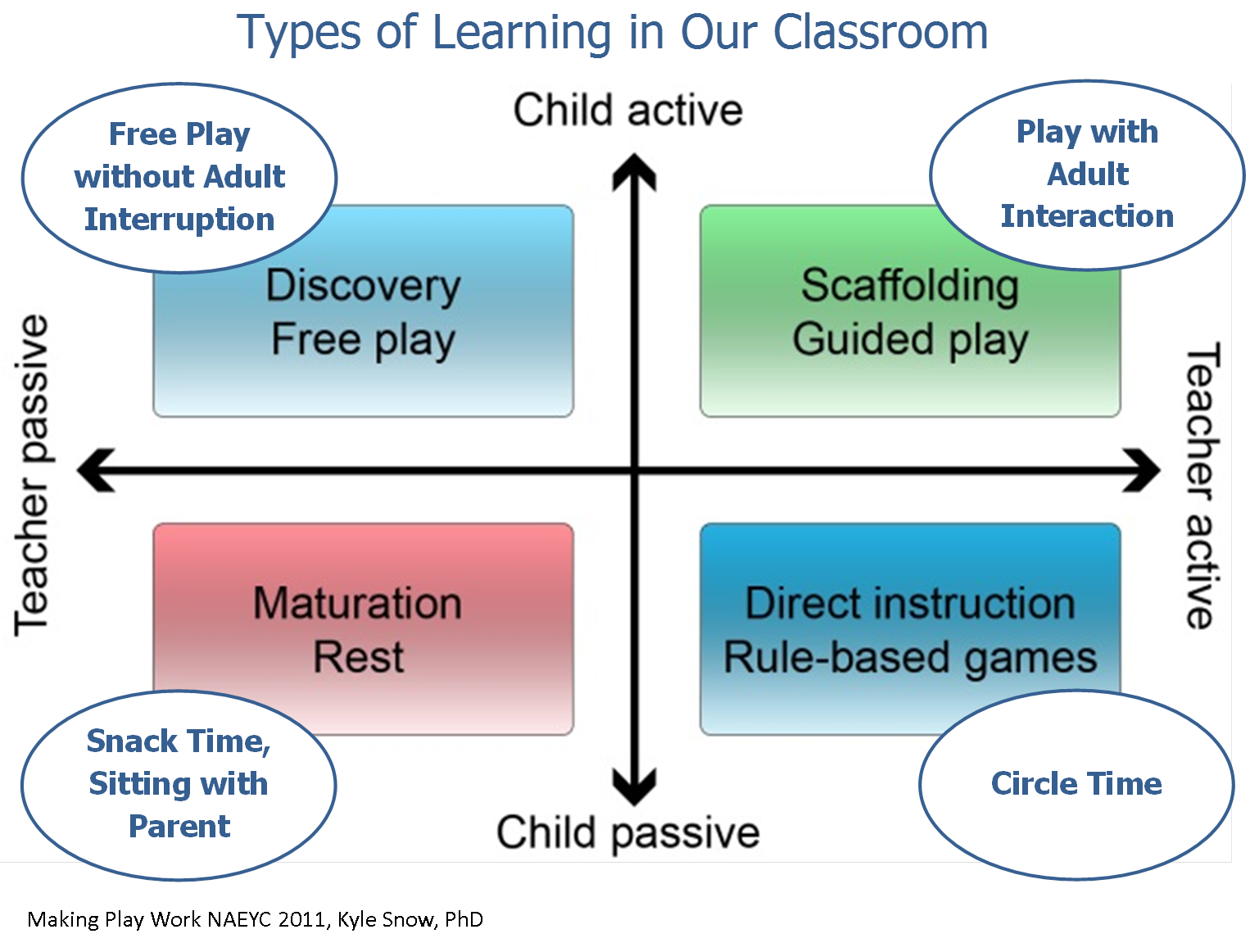
In this diagram by Kyle Snow, he divides four types of learning up by whether the teacher and child are active or passive. (His diagram shows the rectangles of types of learning – I have added the circles.) Whatever classes or daycare your child attends, it’s worth thinking about whether there are opportunities for all four types of learning.

Here’s how we use the four types of learning in my toddler classes with Bellevue College Parent Education.

Direct Instruction

Direct instruction is what we think of when we say “Teaching.” This is an adult telling information to a child, or doing an instructive demonstration of how to do something. Direct instruction from a parent or a teacher is a good way to convey core information and build “crystallized intelligence” – the database of information we carry around.

In our toddler classes, we offer little snippets of direct instruction throughout the day, doing simple things like showing a child how to pour rice in the sensory bin. But the main structured learning happens in circle time when we read stories, sing songs, and play with felt boards. We encourage all children to participate in the group activity together. (At the beginning of the year, we often have some wanderers, but by the end of the year most are engaged most of the time.)

Scaffolding / Guided Play and Free Play

The best way to build “fluid intelligence” – the kind that helps us adapt to new situations and learn new skills, is hands-on play and interaction with real world experiences.

We always have multiple stations set up around the rooms, and children have the ability to choose what to play with, how to play with it, and for how long. Sometimes the children play independently, exploring and discovering on their own. (Free play.) Sometimes, the parents or teachers are asking questions, giving suggestions, or modelling ways to extend the play and involve new concepts. (Guided play – read more about the teacher or parent’s role in play-based learning here.)

Rest

Children also need down time. Quiet time, with little to no input, so their brain can process all the new information, and cement the connections that help them remember what they have learned. Since our program is just two hours long, we don’t have a lot of down time built in – we hope that children are coming in well-rested, and that they have a chance to nap afterwards. (More on toddler sleep here.)

During class, we do have a book corner where parent and child can snuggle and read for a while. Children are also welcome to come sit with their parents during our parent ed sessions. Snack time also serves as down time for many kids.

Four Types of Learning at Home

Think about your family schedule for a moment. Do you have times when you’re teaching your child? Times when they are playing with you nearby, giving occasional suggestions or playing along? Times when they’re playing independently? Quiet time? A nice mix of these will help them learn and grow.

Some parents say “my child NEVER plays alone. He always wants me to play with him.” It’s wonderful when our children like us and want to spend time with us. But, it’s also good for them to learn to play on their own too. Can you choose some times each day where you say no to them and encourage them to play alone for a while. They may resist at first, but if given a moment to “get bored” and frustrated, most can find something to do. (You can plan ahead for these times by setting up “Invitations to Play” that you think will capture their attention.)

Play-Based Learning

What is play-based learning?

The teacher or parent sets the stage with engaging and fun activities. Then the child explores through play: observing, experiencing, wondering, exploring, and discovering. The teacher or parent is nearby to observe, ask questions, make suggestions, or play along with the child. But the child decides which activities to do, which toys to play with, what to do with them, and for how long.

[The video linked above, by Jessica Lubina, is a nice quick overview of the concept.]

What is play?

Play can be defined as anything that has these characteristics:

  • Child-Led. Freely chosen. The child is in control. He makes the plan.
  • Process, Not Product. Play is done for its own sake, not to accomplish a task. It involves lots of exploring of possibilities, experiments, trial and error, and repetition.
  • Creative. The child can adapt items, create something new or experience things in a new way.
  • Spontaneous. It’s flexible and open-ended, and it changes and evolves as play time goes on.
  • Fun. The player looks happy and engaged.

Does a child really learn by “just playing”?

We know the brain builds connections when it is exposed to novel experiences, and then allowed to repeat them again and again till it achieves mastery. This process builds two 2 forms of intelligence: memory – crystallized intelligence – the database of information that we access, and improvisation – fluid intelligence – what allows us to adapt that information to new situations. (Medina)

Direct instruction from a parent or teacher can be a great way of adding information to the database of crystallized intelligence. But, the best possible way for children to build fluid intelligence is by hands-on, engaged, self-guided improvisation… in other words, by playing.

What play-based learning is not:

  • Specialized toys. Despite what marketers tell you, learning does not require scientifically designed educational toys and apps or flash cards. Simple, open-ended toys will do.
  • Uninvolved babysitters. Some schools have co-opted the phrase “play-based learning” as a justification for sitting back and letting kids do whatever they want to do with no forethought by the teachers, and no input along the way. We’re talking about a more engaged process.

Benefits – Kids who learn by playing gain:

  • Physical competence. Free play allows a child to practice emerging skills till they are mastered.
  • Self-direction. The child gets to make decisions, make plans, and see them through.
  • Creativity. Experiments show that children who are taught “the right way” to use a toy will use it in limited ways. Kids who are allowed to freely explore develop many more creative uses.
  • Problem-solving. When a child creates her own plan for play, she doesn’t foresee challenges that will come up that an adult might see. This offers lots of chances for problem-solving.
  • Language skills. Play requires asking and answering questions, giving commands and acting on them, and explaining your goals to the person you are playing with.
  • Conflict resolution skills. There’s lots of negotiation that goes on in cooperative play.
  • Emotional intelligence. Dramatic play helps children understand emotions, learn how to express emotions, and distinguish between real emotions and “pretend” emotions.
  • Symbolic play. If a child can use a stick to simulate an ice cream cone, it helps her later understand that numbers on a page represent how many objects they have, and that letters represent sounds, and musical notes on a page indicate where to place her fingers.
  • Better memory. Kids are motivated to remember things they need to know for a play scenario.
  • Reduced stress. Play is fun. Children play when they feel safe. We are all more capable of learning new things when we are having fun and feeling safe.

Teacher’s Role / Parent’s Role

The adult plans an environment and schedule which promotes learning. Children learn best when they feel safe, so familiar routines, consistent rules, and respectful caregivers are essential components. The adults offer meaningful experiences that are stimulating, invite exploration and engage kids. The teacher often has outcomes in mind: knowledge, skills, abilities and understandings children will acquire. But they have not determined an exact path the child must take to get that knowledge.

As Teacher Tom says: “One thing I don’t do is decide what the children will learn… That’s not the job of a teacher… that’s the job of the children. My job is to create an environment, then play with them in it, helping them, but only when they really need it.” Some roles an adult may play are:

  • Stage manager: Sets the stage. Creates an “invitation to play” that combines familiar objects and activities (for repetition/mastery) with novel objects to explore and discover.
  • Observer. Observe quietly. Be there so if they look up with an “a-ha” moment, or an “I did it”, you’re there to reflect that success back to them. A good rule of thumb is to observe for at least 3 minutes before talking. Then make suggestions or ask questions to extend their thinking, or encourage reflection. But don’t change their play, or tell them what their results need to be.
  • Recorder: Ask them to describe what they are doing. (Remember, ask about the process, not the product they’ll end up with.) Write it down to share with a parent or friend later.
  • Facilitator: Help get them the tools they need to accomplish their play plan. Help clear away the “clutter” that gets in the way of their play. Ask more, answer less.
  • Mediator: For children age 3 and up, it’s best to sit back and let kids work out their own conflicts and learn from doing so. But sometimes, especially with younger children, an adult helps resolved conflicts by offering new materials or suggesting alternatives, and modelling flexible thinking needed for peer interactions.
  • Interpreter: help children understand what is meant by another’s words and actions.
  • Participant in play: You follow their lead, respect their individual style of play. Don’t try to make the game your own. Simply be one of the kids who is playing! (As the “big kid” in the group, you can role model respect, creativity, flexibility.)
  • Tools of the Mind style. Kids develop a plan for their pretend play. Teacher offers instruction in pretend play – suggestions specific to the scenario. Kids play. When play comes to an end, the teacher discusses it with them and asks about what they did.
  • Reggio Emilia – inquiry-based or project-based learning style. When your child demonstrates interest in a topic, you collect resources related to it: books, videos, tools, resources for dramatic play related to it. The child chooses a project and must plan their actions, gather information, and develop new ideas. The teacher / parent observes, participates, guides the play when needed, asks questions, and encourages deeper thinking.

A key element of play-based learning is Scaffolding. Development advances and learning occurs when children are challenged to do something just one step beyond their current mastery, and then allowed to practice newly acquired skills. Adults and older children help them make the step by giving a hint, modelling the skill, or adapting materials or activities, and then allowing them to continue to play.

Resources

Read: Brain Rules for Babies, by John Medina.

Collections of resources on Play & Learning: www.naeyc.org/play and www.zerotothree.org/child-development/play/

Watch: The Power of Play documentary: https://vimeo.com/20964066

If you ever find yourself wondering about our class: “Why aren’t they teaching my child anything?? All they do is play!” watch this video to remember everything kids learn when they are playing: www.youtube.com/watch?v=GNlW7YIX7pk

Additional Sources Used:

The Playing Learning Child: Towards a pedagogy of early childhood. Samuelsson & Carlsson. 2008  Scandinavian Journal of Education.  http://www.tandfonline.com/doi/pdf/10.1080/00313830802497265

The Role of Play in Today’s Kindergarten, Lori Jamison. http://lorijamison.com/blog/wp-content/uploads/2011/06/The-Role-of-Play-in-Todays-Kindergarten.pdf

References to Play in NAEYC Position Statements: http://www.naeyc.org/files/naeyc/file/ecprofessional/Play%20references%20in%20NAEYC%20position%20statements_10%2009%20update.pdf

Play in the Preschool Classroom: Its Socio-emotional Significance and the Teacher’s Role in Play, Godwin S. Ashiabi1,2 Early Childhood Education Journal, Vol. 35, No. 2, October 2007. http://leadershiplinc.illinoisstate.edu/play-based-learning/documents/play_in_the_preschool_classroom.pdf

Go Play – Promoting Your Child’s Learning Through Play www.zerotothree.org

Teaching a Play-Based Curriculum by Teacher Tom. http://teachertomsblog.blogspot.com/2012/04/teaching-play-based-curriculum.html

What is child-led play? On nature-play.co.uk

An Invitation to Play

inviteChildren learn through:

  • being introduced to new ideas and activities (novelty)
  • having the chance to experiment, explore, test & re-test (repetition to achieve mastery)

In play-based learning, a parent or teacher’s role can be to set the stage with new materials, or with familiar materials combined in new ways. Then it’s the child’s role to play: experiment, explore, test and re-test.

“Invitations to play” is one way of approaching these tasks. Parents often say “my child has so many toys that they don’t even play with.” If all the toys are tidily put away in baskets, it’s hard for a child to decide what basket to pull off the shelf. If all the toys are randomly scattered about the floor, it’s hard to decide what to play with first.

We can better engage the child with a little intention. Like instead of just a box of magna-tiles sitting next to a box of toy cars on the shelf, I could set up a magna-tile garage on the table with supplies nearby to build more garages. Instead of just having a toy kitchen with all the things that are there every day, I could create new play ideas by scribbling out a menu for a cat cafe, and place a couple stuffed cats there. Even just setting a puzzle on the table with one piece sitting loose next to the puzzle is more engaging than seeing an assembled puzzle sitting there. When you look at the table, you know what to do!

Read more about invitations to play

Today, I set up an invitation to play for my 3 year old.(I knew I had a busy day with lots of work to do, so wanted something ready to go that would keep him busy for a while.)

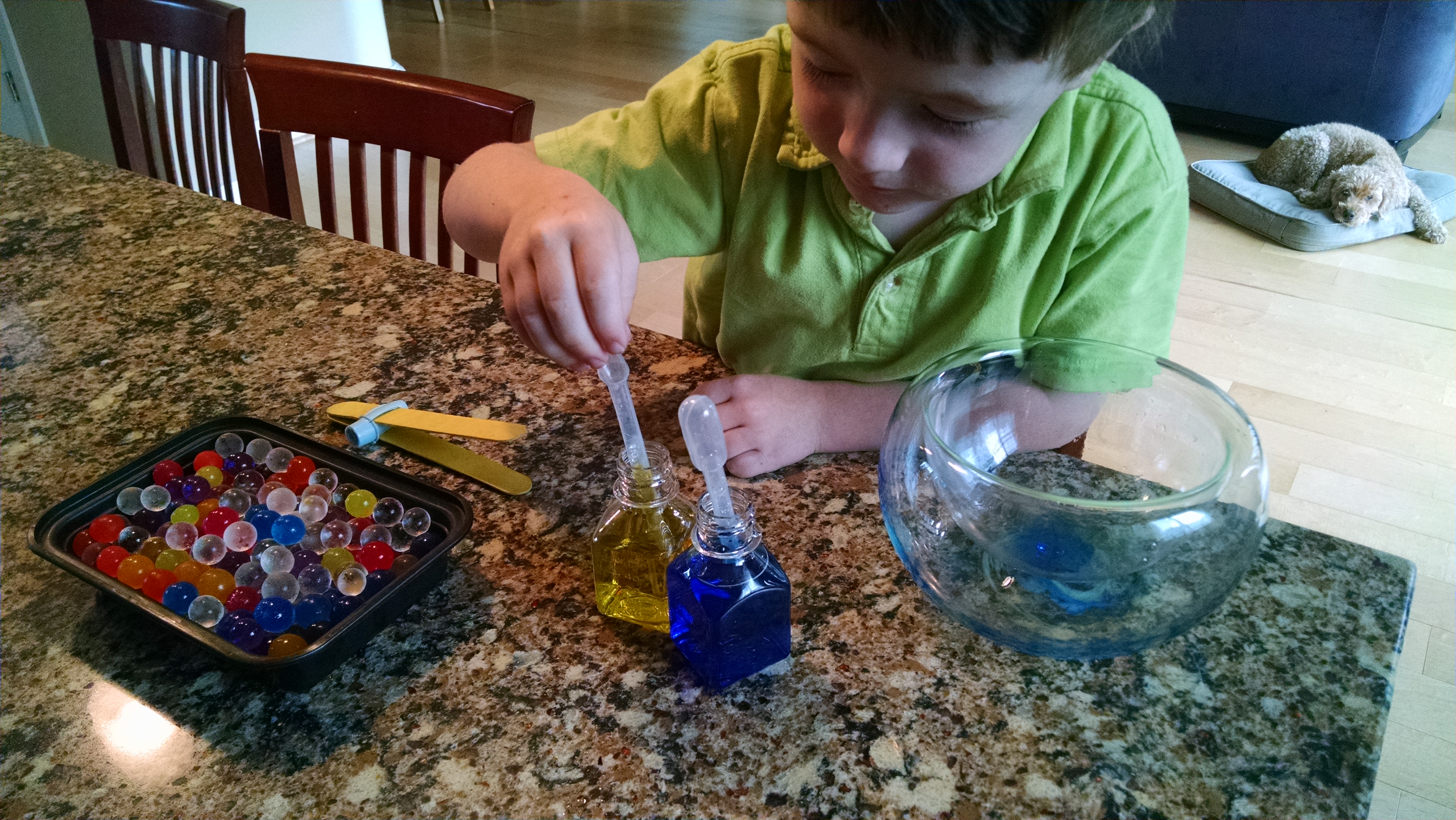
Yesterday, we did “science experiments” with a new set of tools: pipettes and water mixed with liquid watercolors. We would give him two containers of colored water, with pipettes, and a glass vase to mix the colors in.

,Today I set out two colors of water, pipettes, and a glass bowl to mix them in, instead of the vase. I had his container of water beads nearby. When he came into the room, he immediately settled into playing with the pipettes and water, which occupied him for quite a while. When his interest started to wane, I pulled over the water beads and tongs. I didn’t even need to say anything. He immediately started adding water beads. After he’d added them all and taken them all back out, he said “I’ll never do that again.” Apparently he prefers his water beads as a separate activity.

When he ran out of yellow water in his container, I said “Well, you put lots of yellow water in the bowl. Let’s just take some yellow back out of the bowl.” When the pipette pulled up green water from the bowl, I said “Hey! Where’s my yellow water!” That then led to a long play time of trying to pull up blue water or yellow water, and him learning that once things are mixed, they often can’t be unmixed.

This activity gave him chances to further explore materials he’s learned about recently, and combine them in new ways, thus deepening his knowledge of all the materials, and gaining a new insight about color mixing. And, it gave me a chance to get some work done…. Wins all around.

Benefits of Multi-Age Classrooms

multi-ageAs fall rolls around, you may be looking for a preschool, or scheduling other activities for your little ones. One thing you may encounter is preschools with a “multi-age” classroom, or activities with a wide range of ages: where some programs are limited to children born within a few months of each other (age 2 – 2.5), others are open to children from toddler to kindergarten (age 2 – 5).

The advantages to close age groupings is that all activities can be tailored to the exact developmental capabilities of that age group. My kids have had lots of great experiences in these types of programs.

But, I also like to be sure my kids have exposure both to formal / facilitated programs that are multi-age and to opportunities for free play with kids of wide ranging ages. I think there’s a lot to be learned in these experiences.

A Historical / Evolutionary Perspective

Historically, children were more likely to be from large families, sharing a home with siblings of a wide range of ages. In the U.S. today, we tend to have much smaller families. Amongst women born in 1935 (parenting from approximately 1955 – 1985), 37% raised four or more children. Of women born in 1960, only 11% had four or more children. In 2010, only 9% of households had three or more children. (20% of kids are only children.) So, children used to have a multi-age experience in their own home, and are much less likely to have that now.

Also, through much of human history, we have lived in small tribes or, later, small towns. With a small community, there are only so many children, so it’s likely that those children represent a wide age range. Think of rural “one room school houses” that might serve 15 children ranging in age from 5 to 18. So, in the community, formal education and informal play was almost always ‘multi-age.’ Now we put thirty 5-year-olds in one room for kindergarten. Or, in recent years in the Seattle area, we had one “freshman campus” school that was for 9th graders only – putting approximately 1000 kids of the same age into one building. In The Benefits of Mixed Age Grouping (1995), Katz wrote “Although humans are not usually born in litters, we seem to insist that they be educated in them.”

So, historically, most kids have interacted with kids of all ages. Currently, many kids spend most of their time with their age cohort. Is anything lost by doing that? Here’s an examination of some of the benefits of multi-age education and play.

What is a multi-age classroom?

A class where students range in age, with an age span of 2 or more years. Typically, children stay in the classroom for a few years. For example, in a multi-age preschool serving ages 3 – 5, children typically enter at 3 and are the younger ones that year, then stay on for a second year as the older ones. In their second year, they may attend more days a week than they did as a 3 year old.

The goal of a multi-age classroom is heterogeneity. You want a wide range in experience, knowledge, skills, and interests. The teacher uses a variety of techniques, including individual work, small groups, and large group exercises to ensure that each individual child is receiving an education that is stimulating and effective while not being overwhelming.

Note: in this post, I am not referring to an accidental multi-grade classroom, where due to budgetary constraints, space limitations, or a limited student population, multiple ages of kids have been thrown together in a classroom with a teacher who may or may not be prepared to handle this. I’m talking about intentional multi-age programs where the curriculum is set up to maximize the strengths of the diverse grouping.

Benefits of Multi-Age Classrooms

  • If you have two children of different ages, they can be in the same class together, which might be reassuring to them and is definitely easier for your daily logistics.
  • Knowledge-Building and Skill Development: Younger children learn from older children. Older children reinforce and deepen their own understanding of a topic or skill by teaching it to the younger kids. This knowledge is passed on in a variety of ways:
    • Unintended modelling – when an older child is just doing something they want or need to do, not attempting to teach (like using the potty or drawing a picture of a dog). The older child may not even be aware the younger child is observing and absorbing. “Nothing is more interesting to a child than another child who has the skills that he or she wants to acquire” (Merrick, cited in Panko)
    • Social play: The younger ones are exposed to things like better emotional regulation and more sophisticated problem-solving which helps them learn these skills earlier.
    • Casual mentoring. When an older child wants the younger one to participate in a game or activity, she will just quickly explain it to the younger one so they can have fun together. When the older one is slowed down by the younger one’s lack of knowledge, sometimes they move in to help rather than waiting for the teacher to help. (Like putting on boots so they can go outside for recess.) Also, younger children learn which classmates they can go to for help with various tasks, and may seek out their help before asking a teacher. (At one lunch, kids were given fortune cookies. All the non-readers went straight to the kids who could read to ask for a quick answer to ‘what does this say?’)
    • Intentional teaching. Sometimes teachers will ask a child who has mastered a skill to teach it to a child who hasn’t yet mastered it. (Sometimes this is an older child teaching a younger child, but it can also be the other way around, as children gain skills at diverse ages.) The learner benefits by gaining information in a way that may be more fun and more confidence-building than learning from an adult. The child who is teaching has the chance to review his own knowledge from a new perspective, and practice mastering skills.
    • If older kids give incorrect information, the teacher can correct it, and both kids benefit – the teacher has discovered the older child’s misconception, which she otherwise might not have known about and makes sure both kids know the correct info. (This can remind the younger child that we’re all learners, and we can all make mistakes.)
  • Individualized curriculum, tailored to children’s unique skills, not just their age
    • A good multi-age program is child centered. Projects and assignments are tailored to the needs and interests of the children as individuals.
    • Children are more able to learn at their own pace, making continuous progress rather than having to “wait till second grade, when we cover that.”
  • Children stay with the same teacher for multiple years.
    • The teacher gets to know the child’s strengths and weaknesses, and is better able to tailor the lesson plan to meet that child’s unique needs.
    • There is a stronger parent-teacher relationship.
    • For the child, there’s the benefit of consistency, and a sense of safety and security in the classroom which enables better learning. (Assuming the teacher and child are a good match – if not, then your child could be stuck in a non-ideal situation for a while.)
    • Benefits in year-to-year transition: youngers have less anxiety about moving up, because they can see what comes next. Olders gain confidence as they can see how far they’ve come. Big kids feel like “grown ups.”
  • Less competition / labeling.
    • In a single age classroom, it’s easy to compare kids and say that some are gifted, some are delayed. In a mixed age classroom, it may be clearer that there’s a range of development: the one who does best in math class may have the hardest time in music class, regardless of age.
    • A child who struggles more with social skills might be ostracized by their age peers, but might find companionship in the younger kids in the classroom.
  • Better for a variety of kids:
    • Better for those August / September birthdays. In single grade groupings, parents end up deciding at age 5 whether their child will always be the youngest or the oldest in a classroom. In a multi-age program they have the opportunity to be in the younger half one year, and the older the next.
    • Better for gifted children. They can be pushed to achieve their potential with an individualized curriculum.
    • Better for children with learning challenges. Challenged students may have more self-esteem because don’t always feel like “the dumb one” in the class.
  • A more cooperative, caring learning environment.
    • Older kids learn to be patient, nurturing, responsible. (With guidance from the adults!)
    • Role-modelling. The older children learn how to set a good example.
    • Less misbehavior: Students are less likely to misbehave in multiage groups than in single-age classrooms (Logue, 2006 as cited in Song, et al 2009) “When the teacher asked the older children who were not observing the class rules to remind the younger ones what the rules were, the older children’s own “self-regulatory behavior” improved.” (Katz)
  • Prepares children for work in the “real world” where co-workers are varying ages and experience levels.
  • Research consistently shows that on standardized testing, children from multi-age classrooms perform as well or better than their peers in single-grade classrooms.

Questions to Ask:

Why is the class multi-aged? If it’s for philosophical reasons – because the school believes in the benefits of multi-aged classrooms–that’s a good sign. If it’s for budgetary reasons, or limited student population, or limited classroom space – that’s not a good sign.

Has the teacher taught a multi-age class before? That’s best. Or, has the teacher at least worked in the past with children of all the ages she will have in the classroom? Or at least received training in how to do it?

How does the teacher adjust the curriculum to meet all students’ needs? You’re hoping to hear that each child’s learning is individualized… one child might be in the ‘advanced math’ group and the ‘still working on reading skills’ group. If the teacher teaches the kids as two separate grades, taking turns between the ‘third graders’ and the ‘fourth graders’, that’s not good…

Does the teacher want to be there? The majority of teachers are opposed to multi-age classrooms, often because they doubt their ability to juggle the needs of the diverse learners in their classroom. But some teachers love this environment, and are passionate about the benefits of multi-age.

Is the whole school multi-age, or just a few classrooms? It tends to work best if multi-age is the assumption at the school, and all the programs are set up to work with that plan.

How do they assign kids? It does not work well to place low-performing older students with high-performing younger students. This tends to lead to labeling of the ‘dumb kids’ and the ‘smart kids’ and the self-esteem and social stigma that come with those labels. It’s better when there’s a wide range of achievement and skills in all the kids, so diversity is valued.

What else to consider:

Even more than in a single-grade classroom, the success of a multi-aged class depends upon the skills of the teacher.

Teachers need to be well-organized, knowledgeable, and flexible. They need to do frequent and holistic assessments of learning to make sure all the students are well-served, challenged, but not overwhelmed. Teachers need to have appropriate expectations for the youngers, not asking more than they are capable of. They also need appropriate expectations of the olders, giving them challenges that help to build their skills.

As the parent, you may be more closely involved than you would be in a single-grade classroom, just because many schools that believe in multi-age also believe in parent involvement and will ask more of you. You will also appreciate closer involvement. If you have a younger child, it’s exciting to see where they’ll be in a year. If you have an older child, it’s exciting to see how far they’ve come!

Sources:

Multi-Age Education: http://arobi77.files.wordpress.com/2012/02/the-multiage-concept-explained.pdf. Collects several articles, originally published 2006 – 2011. Includes:

  • The Multiage Classroom, by Marion Leier.
  • A Multi-Aged Approach. Marion Leier.
  • My Thesis. Michelle Panko.
  • Benefits of Mixed Age Grouping. Lillian Katz. 1995
  • Interview with Tim Laner, 1998

The Advantages and Disadvantages of Multiage Classrooms in the Era of NCLB Accountability. CEEP Education Policy Brief. Song, Spradlin, and Plucker. Volume 7, Number 1, Winter 2009. http://ceep.indiana.edu/projects/PDF/PB_V7N1_Winter_2009_EPB.pdf

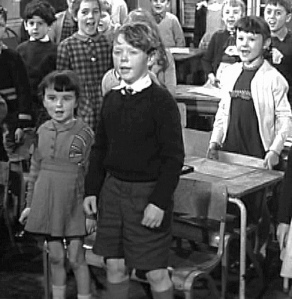
photo credit: theirhistory via photopin cc
Mixed Age Play

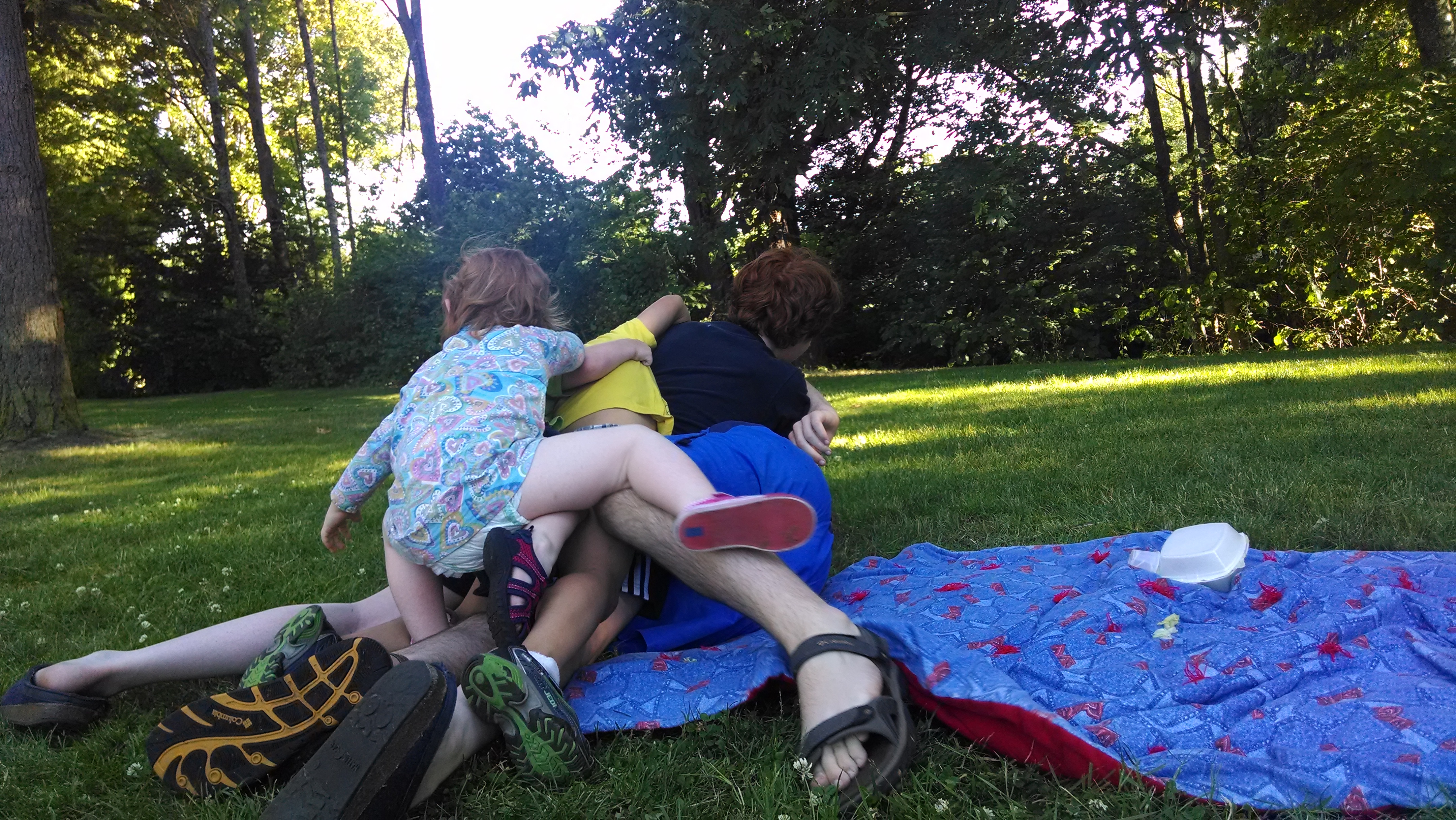
A 16 year old buried under a puppy pile of 7 year old, 3 year old, and 2 year old buddies...

A patient and tolerant 16 year old buried under a puppy pile of 12 year old, 7 year old, 3 year old, and 2 year old buddies…

I’m working now on a longer post about the benefits of multi-age classrooms. (To be posted September 2) but I wanted to share some observations from my recent personal experiences with multi-age play.

Modern American kids tend to spend much of their time in age segregated activities: schools, sports teams, and extra-curriculars where all the kids were born within a one year age span. During the school year, much of what my child does is with his own age cohort.

But this summer, my three-year-old has had lots of opportunities for mixed age play:

  • Lots of spontaneous play on public playgrounds with whatever strangers happen to be there… he tends to play most with kids age 2 – 6.
  • Monthly social for a club we’re involved in. We gather in a gym, and there tend to be about 5 kids…. last month they were 3, 5, 7, 9, and 12 years old. My son has played with each of them a few times before.
  • Play time on the playground at church. There’s usually about a dozen kids, ranging in age from 3 – 12. We’ve known them for six months.
  • “Dinner in the park with friends” – we gather with two other families once a week in the park. Our 7 kids are 20, 17, 16, 12, 7, 3, and 2 years old. And they’ve all known each other since birth.

As I watched him play in each of these settings, here’s what I observed (and also what is described by authors and researchers in this area.)

What do I love about mixed age play?

Benefits for younger kids:

  • They get exposed to new ways of thinking. My son doesn’t yet do a lot of imaginary play on his own, but when playing with older kids, suddenly, he’s talking about how they’re pirates on a pirate ship. Or he’s serving up “ice cream cones” made of bark.
  • They learn new ways of moving. My son has learned how to use all the playground equipment – even the challenging stuff – by watching the older kids do it. He learned how to do somersaults recently.
  • They learn new skills. My second child (like many younger siblings) learned to read, write, tie her shoes, dress herself, and more by watching her big sibling do it. I’ve heard countless stories of kids potty training after attending a camp or class where older kids routinely use the potty.

Benefits for older kids:

  • They learn to be flexible. At the social we attend, I watched the kids play an improvised ball game with invented rules. The older kids had teams, and were always trying to move the ball toward their team’s goal. But they understood that the younger ones couldn’t remember or follow the rules reliably. So, the littlest kids could kick the ball any direction they wanted to, and the older ones just worked with the chaos of that.
  • They learn to explain and enforce rules. But the older kids also did set limits sometimes on what was allowed and what wasn’t allowed. They had to figure out how to explain it so the little kids could understand.
  • They learn empathy, to be gentle and watch out for little ones. At church, I watched kids on the swings figure out that if big kids are walking near them, it’s OK because they know to be careful, but if little kids start to wander near, they call out a warning and they slow down their swings.

Benefits for parents:

  • Can give parents a break: If there are responsible (or semi-responsible) older kids around, the parents of the little ones may be able to sit back a little. For example, when we’re with our friends in the park, often the teens and tween supervise the 3 little ones while the parents relax and talk.

What can be challenging about mixed age play?

  • Kids get exposed to new ways of thinking: Sometimes things they might not have otherwise thought of…. In the movie Boyhood, there’s a scene where the 6-year-old and the older neighbor boy are flipping through a lingerie catalog ogling the models in their lacy bras. The 6-year-old probably would not have pursued “girly magazines” as young without that influence.
  • They learn new ways of moving: I still remember when my oldest was 6 or so, a girl who was probably 12 years old was shimmying up the pole of the swing-set till she was 15 feet in the air. My daughter watched her very intently, then pulled off her socks and shoes and scaled the pole. Something that would have never occurred to her to do on her own. And that was much higher in the air than I wanted her to be!
  • They learn new skills. I learned how to work pocket knives, matches, and other cool tools from my older brothers. Probably much younger than my parents might have wished I learned those skills.
  • Big kids aren’t always nice. We’ve had two incidents with my little guy this summer. One was at a playground where there was a group of 4 girls who were probably 9 or 10 years old. When we arrived, they played happily with my son and were having a great time. Then they decided they were bored of the “baby” and wanted him to go away. He had a hard time understanding what had changed. Another was at a different playground where there was a large group of older boys (age 7 or 8 maybe). My son was following them around, and laughing and engaged with them, but when we moved close we discovered that what was happening was they were asking him to say things like “I’m really stupid” and then laughing at him when he did. He didn’t get that it was mean – he thought it was a fun game. But clearly it was bullying and not appropriate behavior for those kids. (Their camp counselor was not providing sufficient supervision to even notice, much less intervene in the situation.)
  • Parents of older kids don’t always pay attention. When my child is the youngest one, he may be getting into situations that are more dangerous than he might typically be in (see above under “learn new ways of moving”). So, I have to supervise more closely than I normally would. But the parents of the older kids may be used to not having to do much supervision at all of their child, and may not realize that a) their child might need guidance on what is and is not appropriate play when younger kids are involved, and b) the parent who is supervising the youngest one then kind of gets stuck supervising all the kids by herself and managing all the needed interventions.
  • Unfair Expectations: In mixed age settings, it can be easy for adults to expect the younger children to have the same capabilities as the older children. When my younger daughter was 8, she was placed in a class where most of the kids were 10 years old. Academically, it was a good fit. She was one of the most advanced in the class. Socially, she did fine. She had a big sister, so she was used to playing with older kids. But emotionally it was hard. If something upset her, she had a hard time calming herself down. Parents who volunteered in the class sometimes had a hard time managing it, because they were used to their older children. Even the teacher failed to manage it well – reporting to us that our child was just much less emotionally mature than the other kids in the class. It was as if she’d forgotten that all those other kids had 25% more life experience than our daughter.

I think it’s important to be aware of these possible pitfalls, but don’t let it deter you from multi-age play.

I grew up as the youngest of four kids, with piles of kids of all ages in the neighborhood, at church, in 4-H, Girl Scouts, etc. I want my kids to have that experience of all the benefits  that mixed age play can give. And for that, I’m willing to take the challenges – think of them as learning experiences…