I just stumbled across a great resource! The Book Nook on http://csefel.vanderbilt.edu/resources/strategies.html lists great children’s books for teaching social emotional skills, and then has accompanying activity ideas including art, dress-up, games, and more.
For example,
the guide for Llama Llama Misses Mama has tips on separation issues and a song “if you’re lonely and you know it…”
Or there’s Sometimes I’m Bombaloo on tantrums / meltdowns and making a classroom Feel Better book and getting big feelings out with playdough.
Or I Have a Little Problem with games to help you learn to be a good listener.
This fall, many young children may be returning to in-person classes or preschool after a long time away, and some toddlers may be joining their first group activities with peers. Parents may worry about how their child will adapt. We can support the transition by: getting ourselves ready, choosing the right program for the moment, preparing children by teaching social skills and self-help skills at home plus talking to them about what to expect and what will be expected of them, then supporting them through all the new experiences in the first few weeks of class. We should expect that it will not all go smoothly and all children will have some rough days at school – because that has always been the case!
I know this feels like an unprecedented situation, and yes, COVID is unprecedented. But parents have always worried about sending their child off to school and wondered how they can help with the process. Those steps that parents have been following for decades all apply here, and we’ll throw in a couple COVID specific tips in our suggestions about what you can do to increase the chances that the transition to in-person learning will go smoothly.
Prepare Yourself
If you are anxious, your child will pick up on that, and they’ll be anxious too. So, before you start talking to them about going to classes, do whatever you need to do to build your own confidence that it will be OK. Get support from others if needed.
If you’re worried about COVID – remind yourself that even if children catch COVD, they typically have mild cases. (Yes, there are exceptions – some children who get very sick – but the chances are small.) The American Academy of Pediatrics recommends a return to in-person school. You can also think about layers of protection – all the things you can do to reduce the risk for your child. [If you’re evaluating whether or not to return to in-person classes, here are factors to consider.]
If you’re worried your child won’t adapt well to being around other children, listening to other adults, or being away from you, keep in mind that children are very resilient – they often adapt to things much easier than adults do.
Ideally, you should work on your worries out of sight of your child. But, if your child notices your anxiety, then trying to pretend it’s not there can actually cause them more worry than if you just calmly say “I’m feeling worried now – here’s what I’m doing to calm myself.”
Planning for Success
Jumping from social isolation at home to a full-time program could be overwhelming for some children. Some parents are choosing to start small with a program that meets for only a few hours a week, and gradually build up to more. Some are choosing to start with a parent-child class or a cooperative preschool where they can stay with their child in the new setting to help make the transition to being with other kids and adults easier. Some will choose full-time school but simplify the rest of the child’s schedule to keep things manageable.
When looking at programs, I would consider their COVID protocols: Vaccines for the adults, masking for everyone over age 2, increased ventilation / more outside time, and social distancing can all reduce the risk.
I would also look more broadly at their approach to scheduling and rules. I would look for one that has a nice balance between providing structure with predictable routines and a little flexibility to adapt to your child’s needs of the moment. Our children really need both predictable routines at this time and responsiveness to their needs as they re-adapt.
Preparing Your Child
While returning from COVID is new, asking kids to adapt to new situations is not new. So there are a lot of things we know to do to ease transitions into toddler classes, daycare or preschool.
Teach self-help skills. Help your child learn how to put on their coat, take off their coat and hang it up. Help them learn how to open their string cheese or yogurt containers by themselves. Teach handwashing skills, and also practice how to use hand sanitizer.
During COVID, teach them how to wear a mask, how to take it off to eat, and put it back on, and what to do if their mask gets wet or dirty. (Early in COVID, many parents wondered if they could ever teach their child to do something “as weird” as wearing a mask – but remember, that’s not weird to a kid. It’s no weirder or harder to learn than how to wear pants in public.)
Teach and practice social skills: how to make friends, how to invite someone to play with you, how to ask to play with a toy someone else is using, taking turns, and so on. Set up playdates where your child can practice these skills.
During COVID, teach them about “giving space” around them rather than crowding other kids. In dance classes and sports classes, teachers have long used the idea of “bubbles” – imagine you have a big invisible bubble around you and so does everyone else and you can’t bump inside anyone else’s bubble. You can teach and practice this. Be careful not to give your child the message that it will always be dangerous / scary to be close to other people. Just say that right now with COVID we need to make extra space.
It always helps to teach emotional literacy skills – how you can tell how someone else is feeling. During COVID, be sure teach your child to watch for body language and tone of voice since they can’t see facial expression for people who are masked.
Create routines. What routines can you establish at home to make it easier to get out the door in the morning? If you’ll need to be up earlier in the morning than you’re used to, do you need to adjust bedtime? Learn about what routines they use at school and try to have similar practices at home. (For example, washing hands before snack time.) If your child will use new tools at school – like a backpack or a lunchbox or water bottle – get them early and practice.
Preparing them for Class
Talk about what to expect at their class, and what will be expected of them.
Note: Many books address separation anxiety and other fears. If your child is already fearful, these can be reassuring. But if your child is feeling confident, don’t read these books – you don’t want to introduce anxiety! Some examples: Bye Bye Time by Verdick (video) is great for kids who are just a little anxious – it helps you develop a ritual for goodbye time and a plan for them for what to do if things are hard. “Llama Llama Misses Mama” by Anna Dewdney (video) is about a llama who has a really rough first day at school – it’s a perfect book to read after your child has a rough day. “The Kissing Hand” by Audrey Penn (video) is about a raccoon child who is very reluctant to go to school – if your child is already reluctant, it offers good tools. Or watch Daniel Tiger Goes to School.
Talk about what to expect at their school. Visit the school, if possible. Or, at least look at pictures or a video tour if available. Visit the outside of the building and walk around. Show your child pictures of the teacher. Get some materials like they’ll have in the classroom – like markers – and practice using them at home. There’s an idea called a social story which was created for kids with autism – where you create your own little book with pictures that clearly describes what to expect, what’s expected of them, and what they’ll do if something is challenging – I find these can benefit any child, so you could create one for your child.
Teach and practice how to interact with a teacher. Explain that the teacher is there to help them and will take care of them. Explain that the teacher is in charge. Teach how to get the teacher’s attention and how to ask for help. Teach them that sometimes they have to wait for a grown-up to be available to help them. Play listening games (like Simon Says, Red Light Green Light, or Copy the Rhythm I Clap).
Pretend play. Pretend to be going to school – who will play the parent? The child? The teacher? Play at things like: waiting in line (with stuffed animals), doing circle time, taking turns, asking the teacher for help, saying goodbye at drop-off time.
When Classes Begin
Don’t make too big a deal of the first day. That anticipation and excitement can turn into anxiety.
Don’t introduce all new clothes and shoes and backpack on the first day. Let them wear familiar and comfortable items. Pack their favorite foods, and pack the exact same lunch for the first several days so they know exactly what to expect. Ask your school’s policy about “transitional objects” – for some children, having a toy from home or a picture of family or favorite book, can help them adjust to all the new things around them.
Note: pre-COVID, this was often a stuffed animal, but during COVID, only send things to school that can be easily cleaned.
Allow extra time to get there – you want time to relax beforehand, remind your child what to expect, and get there with everyone calm. (Note: this is especially true if you have a child you think of as shy – I call them “slow to warm up.” These children do best when they can arrive a little early, before most of the other children and settle in. They don’t do well running in frantic and late to a full and busy classroom.
Build a relationship with the teacher(s), other kids, and other parents. When your child sees that you feel comfortable interacting with them all, they will feel comfortable too. Let the teacher know what things most engage and calm your child. (When my child was three, I told his teacher(s) that any time Ben was feeling worried, all they had to do was ask him about the planets, and give him nine objects to line up to show which was closest to the sun and which was furthest… it was guaranteed to calm him any time!)
For drop-off programs, ask if it’s possible to stay a while at drop off time in the early days. (It may not be possible during COVID.)
When it’s time to leave, keep your goodbyes brief, radiate confidence that they will be OK. Do say goodbye – don’t try to sneak our when they’re not looking. Tell them what they will be doing while you’re gone, and when you’ll return. (Be sure to honor that promise, and be prompt and predictable for your return.)
Make your goodbye ritual simple and sweet. Make sure your child is either settled into an activity or knows that to do next, or hand them off to an adult for care so that when you walk out the door, your child has something else they’re focused on other than your absence.
Remember that fear of strangers is developmentally normal for all children 7 months and up, and that separation anxiety is common in all toddlers around 18 months. If you see them, they’re likely not due to coronavirus or anything you did or didn’t do. And any advice that you can find for separation anxiety at any time will apply, whether or not it’s COVID specific.
Resist the rescue. If your child is sad/crying when it’s time for you to go, be caring and validate their feelings but stick to the plan and leave. Trust the teachers to be the professionals they are and manage the common challenges of separation anxiety. Typically a child who cries at drop off times cries only briefly and will soon calm down.
After class, give your child a chance to debrief and talk about how the day went.
Handling the Challenges
You may be one of the lucky few parents that everything goes well for and your child sails on through with no challenges. Or you may have a toddler who bites his classmates. If that happens, it’s not your fault and it’s not because of COVID isolation – it’s because sometimes toddlers bite their classmates. If your seven month old cries when strangers hold them, it’s good to know that 7 month olds have always been prone to fear of strangers. If you have a child who has a hard time sitting still for story time – maybe it’s because they didn’t have to sit still during quarantine… however, there have always been children who had a hard time sitting still! And the teachers will work with your family through the challenges, as they always have.
Be careful not to catastrophize. If your response to every setback is stress, anxiety, and “why does everything always go wrong?” that makes it worse. Try to have a resilience approach – “this is hard right now, but we’ve faced hard things in the past, and we’ve made it through, and look how much we learned.”
Some things to be aware of: if your child is having big feelings, it’s important to acknowledge them, not just try to distract them away. Regression is normal – for example, a child who was potty trained may have accidents – don’t punish or shame, just acknowledge the issue and say “let’s try to do better tomorrow.” If your child is really clingy, maybe they just need more snuggling for a while – soothe and reassure them. If they are misbehaving, remind yourself: children who are loved will always try to do well if they can. If they are misbehaving, ask yourself – is there a skill or support that they are lacking? If so, help them build it. Ask yourself – could it be that they have an underlying need that is driving the misbehavior? If so, meeting that need may resolve the issue.
Be patient and remember that any challenges are just a phase. Just keep doing your best every day and encourage them to do their best, and you’ll make your way through to the other side of this challenging time.
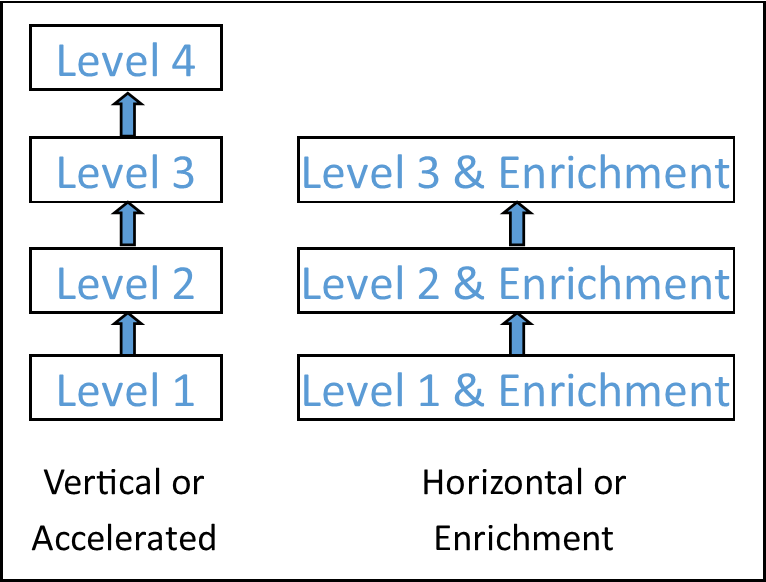
In gifted education, there are two major approaches – acceleration or enrichment. Acceleration just means moving more quickly through the stages of the same curriculum. So, if during a typical year, a typical student would do levels one through three of a subject, gifted kids would get through four levels, and end the year ahead of their age peers. Enrichment, or the horizontal approach, adds breadth and depth to each level, either through additional content or with project-based learning which enhances understanding. Children stay at the same overall level as their age peers (which can help with social interaction or ability in sports) but have learned about each topic more deeply than their non-gifted peers.
Acceleration
Acceleration can be done by skipping ahead and starting at a higher level, or “compacting” the curriculum by teaching the same content more quickly. (Gifted kids may understand something in the first pass that takes more repetition and drilling down for other kids.)
This can be very helpful for gifted kids.
When you understand the new information at first glance, and you then have to sit through the teacher explaining it and re-explaining it to other children, it can be supremely frustrating and exhausting! A lot of gifted kids actually end up dropping out of school due to this boredom / waste of time factor. So, moving faster can help to keep them more engaged. But, in the end, the kids aren’t learning anything beyond what the other kids learned. They just learned it faster. So, maybe they graduate from high school at age 16 instead of age 18. But not much else is changed. Those kids can be successful at early college or can feel social left out or not ready for early college.
Enrichment
Enrichment …. ‘refers to richer and more varied educational experiences, a curriculum that is modified to provide greater depth and breadth than is generally provided’ (Davis & Rimm, 2004, p.120). … It has often been said of the American school system that with the content standard movement we take a mile wide and an inch-deep approach. We have so many content standards to get through that we just skim the surface and have difficulty getting students to a place where they have an enduring understanding about the content. With enrichment, even though the content standards are all covered, because gifted students usually get the basic understanding fairly quickly, the teacher can go more into depth regarding the topic, digging deeper than your typical classroom. What this might look like is the teacher has a brief explanation on how vibrations cause sound and then allows the students to conduct experiments and put this idea to the test. Or a math teacher who after the class gets the gist of what she wants them to know, might do a project exploring the standard further or ask them to find a way to apply this to real life.
I will be the first to admit that acceleration is easier to accomplish. Most teachers can do it successfully, since it’s just going through standard materials more quickly. Enrichment takes more creativity, effort and skill on the part of the teacher, more advocacy by the parent, and more engagement by the child. It can fail if not done right, but if done well, can be excellent.
At a weak level, “enrichment” just equals handing kids some logic puzzles to work on, or some worksheets. These can feel like busywork and not really enhance learning all that much. If that’s all your child receives in your local school, you may need to seek out fun and challenging extra-curriculars.
Enrichment is better when a teacher is thinking really intentionally about broadening and deepening the learning. Whatever the main curriculum is for the class, the teacher finds a way to challenge the kids who are up to the challenge- perhaps by assigning hands-on projects that use the skills they’re learning, or challenging them to take a written assignment to a higher level, or encouraging them to read additional materials related to the primary topic.
The most effective enrichment is child-led… when the child has a passion and the teacher gives them the opportunity to explore it and push their learning in that area.
Since I work primarily with preschool age children, many parents ask me about early entrance to kindergarten (acceleration) but I usually recommend enrichment instead. Some examples:
choose a play-based preschool, as these allow a lot of independent exploration where a child can pursue interests and curiosity
enroll in an outdoor preschool / forest kindergarten that builds nature knowledge (and motor skills)
choose a language immersion preschool to build language skills for your child (even in a language you as the parent don’t speak)
build physical skills with swimming, outdoor play, sports activities, gymnastics and dance classes, martial arts, and more
take theater classes and go to storytimes and shows that are aimed at young children (build emotional intelligence)
take field trips, vacations to science museums, children’s museums, art museums, national parks, junior ranger programs
focus on their interests. For example, a four year old had a passion for learning about space. So, he was in a part-time preschool to build his general skills, but his parents also took him to the library for space books, watched shows and took online classes about space, and built solar system models together.
For older children here are just a few examples of how enrichment has worked well for children that I know:
A kindergartener who was a solid reader was asked by the teacher to read to the other children – it developed her mastery, and was a great model for the other kids. She also read books about their shared interests which helped her build friendships.
A first grade teacher knew her students all had different skills and challenges, so several times each year, she gave hands-on projects that she could help them adapt to best engage them and help them grow where they most needed to grow.
A second grader who was able to finish her work quickly got her teacher’s permission to always keep a book and some art supplies nearby so she had things to keep her busy and engaged while her classmates finished their work.
A school district offered a pull out gifted program where one day a week, children from several neighborhood schools were all gathered together for an enrichment program that had project-based learning – while working as teams toward a common goal, the kids deepened their knowledge of the topics they were learning in their neighborhood school.
A middle schooler found that school didn’t fully challenge him, but then he had a woodshop teacher who gave him the freedom to choose projects. During 8th grade, he built a bed, a dresser, and lots more. In the process, he built on his knowledge of math, design, planning and budgeting and more. He ended up as a pediatrician, but still does woodworking on the side.
Another middle schooler spent hours working on projects for her robotics team.
A high schooler started a small business selling their crafts on Etsy.
A high schooler enrolled in the fullest load of the most advanced classes her school offered, but was still able to complete all the work in a short amount of time. So, on the side, she volunteered for 20 hours a week in health care settings.
When I’m thinking about enrichment for kids who need an extra challenge, I have a few approaches that guide me. First, I think about hands-on options – what could they build, sew, bake, draw… that would deepen their learning? I think about following their passions – how can we take that interest and turn it into a project that will challenge them to learn and grow? I also think about all the areas of development – where do they most need to grow and about the multiple intelligences – where could they be stronger?
Acceleration just helps kids learn the same things as other kids learn – just more quickly. But enrichment can lead to really interesting experiences that make for a more interesting human being, in my opinion.
can I enroll my 2.5 year old child in a preschool that’s for ages 3 and up?
my child will turn 5 in October – should I apply for early entrance into kindergarten?
my child is a few months younger than the requirement for the camp – can I sign them up anyway?
my child is gifted – should they skip a grade?
It seems as if many parents believe that “the best” education is the most advanced education that they can possibly squeeze their children into.
I know that as a parent, we want what is best for our children. It may seem like starting on skills earlier will benefit them, but that is often not the case.
If we push a child up a level in classes, that means they will be the youngest child there. They may be developmentally ready in some areas, but they may be behind in others. They could end up feeling successful in some ways but perhaps also feeling like they’re always the smallest, or the slowest or least socially skilled. They may feel like no matter how hard they try, they can never quite catch up to some of their peers.
I believe it is almost always better to place children in an age appropriate class that still gives them room to grow. In that setting, it is easier for them to feel successful, easier to feel like they fit in, and easier to develop in all areas into a well-rounded individual.
When we push kids faster along a certain track, they may succeed at that track, but that focus can mean they miss out on other learning opportunities. For example, a child enrolled in academic preschool may move further ahead on reading and writing, but may not have the opportunity to fully develop the social skills and independent decision making they would gain at a play-based preschool. A child whose time is all focused on moving forward in baseball may never have the opportunity to learn the physical skills they would learn in swimming or gymnastics classes, or the emotional intelligence that could be learned in a theater class.
Rather than trying to jump your child forward to the next level (the accelerated approach), try to think about what other opportunities there are to broaden their learning at their current level (the enrichment approach.)
For example, if you have a child who is doing well with language and literacy type skills, think of ways to enhance their other intelligences:
Could they take music classes? There are a lot of benefits to learning music that go far beyond that realm.
Could they build their small motor skills and creativity in art classes?
Could they build their large motor skills – their knowledge of how to use their body (which will help in all sports, or dance, or just moving through the world) by taking aikido classes? Or dance? Or climbing trees and clambering on rocks?
Could you choose play-based classes (like co-op preschools) that offer a wide range of experiences and let your child choose the ones that most engage them at the moment? The most learning occurs when your child is fully engaged in an activity of their choice.
At whatever level your child is at, there is always more to learn, without needing to push them ahead to an older level.
If your child happens to be a bold, fearless child who is willing to jump into any experience, and not worried about making mistakes, they may be more able to adapt to being the young one in a group. However, if you have a more cautious child, or one who tends to be slow to warm to new experiences, or worries about making mistakes, this is a child who would definitely benefit from being older than their classmates, rather than younger. Giving them an extra year of preschool, or extra time at any level of a sport or other activity, will build their confidence so when they move up to the next level, they are truly ready.
If you have a child with strong emotion regulation skills and good impulse control who is good at listening to the teacher and following rules, they may be more successful as the youngest child in a class. If your child is still working on these things, or has a “racecar brain with bicycle brakes”, they may benefit from another year to build these skills in any class / context that interests them and then move into school.
As a teacher, I also have to say that when I have let children who are younger than the designated age into my class, it has rarely been the best fit for them, or for us. It’s not that the children “failed.” They were able to participate in class, and learn from it. But they did not learn as much as they could have learned if they had waited a year. (Also, I ended up having to do easier projects and read more basic books those years, and had to do more classroom management to keep the too-young kids focused. So all the children missed out on some learning they could have gotten if every child in the class was fully developmentally ready for the content.)
So, I would encourage most parents, in most circumstances, to trust the teachers when they tell you what age children their program is the best fit for. Your child will learn best when they are in an environment where all the aspects are age appropriate.
On a regular basis, I see posts on social media from parents asking for advice on choosing “the best” preschool, or the best private school in the area, or asking which is the best public school as they plan a move. (And, of course, parents of older children agonize over what is the best college.)
There truly is not a “best” school. There are LOTS of great schools, and some mediocre ones, and a very few bad ones. What’s best is the school that best meets your family’s unique needs and goals, and best suits your child’s unique learning style.
Here are some steps to take to figuring out YOUR best option. (Note: you may also want to check out my post on public school vs. private schools.)
Step 1 – Needs Assessment
Before you bother researching all the options, and before you fall in love with an option that won’t meet your needs, let’s start with the pure nitty gritty essentials:
Schedule: Are you looking for full-time or part-time, or are you flexible? If the regular school day isn’t long enough, do they offer extended day care? What days do you need? What wouldn’t work?
What times could work for you and what just doesn’t work? (e.g. if you’re not a morning person, choosing a program that starts really early may not be a realistic bet)
Location: really think through the commute and whether it will work – I can’t tell you how many parents have chosen what they thought was a great school, but by October were miserable about having a cranky kid in the car in never-ending traffic)
Cost: there is a wide range in costs – be realistic about what’s affordable for you. If you stretch your budget, then it can make any little frustration with the school really stressful as you think – “I can’t believe we’re paying this much and this is happening!”
For children under age 5 are you looking for drop-off or stay? For younger children, there are often parent-child options where you always stay, or co-ops that are drop off some days and have you work in the classroom on other days. These are generally cheaper than drop-off programs and also allow you to be closely involved in your child’s education.
Step 2 – Goal Setting
What do you hope your child will get out of the experience? Are you hoping for academic development? Social-emotional skill building? Art? Music? Physical education? Science? Religious education?
Are there things that you know you could do a great job of teaching your kids? If so, then it may not matter whether the school covers that well. Is there something you think you won’t be good at teaching? Choose a school that does it well.
Do you prefer a very structured teacher-led program? Or more of a play-based or inquiry-based program where the teacher works the lesson plans around the children’s interests? How do you feel about homework – are you happy to guide practice time at home for them to improve on their skills? Or would you like out of school time to be free choice for your family?
Is the school’s approach to learning compatible with yours? When our oldest was little, we looked at one school which discouraged use of technology and screens, and actually discouraged reading before age 7, instead focusing on things like oral story-telling. This did not work for our tech-heavy family and also didn’t make sense because my kids all learn to read by age 3 or 4. (Not because we drill them… but because we love books so much in our family that they couldn’t wait to read themselves.) We looked at another school where there were only non-fiction books on the shelf in the kindergarten classroom, and I asked “where are the story books?” They disdainfully said “they have plenty of time for that sort of reading at home…” I knew that wasn’t the school for us!
Take a good look at your child’s temperament and learning style. I had a very social chatty child, and we looked at one school where the children were expected to work quietly and independently and not talk with each other. Not a good match for that child. I had a high energy child who tended to get overstimulated in indoor classrooms, but stayed calm and happy outdoors, so we sent him to outdoor preschool. You want to choose a school where your child will feel competent and valued, not one where they never fit in.
During goal setting, it’s also worth asking: What do you hope to get out of their school experience? Some preschools and schools offer parent education and support. Some actively work to encourage community building amongst families. Cooperative preschools and home school co-ops are the ultimate example of involving parents in school in meaningful ways. On the other hand, some parents may prefer to outsource school, and have a pretty hands-off approach, and there are certainly schools that will also support that.
Step 3 – Learn about Your Options
OK, now it’s time to turn to the internet and social media.
In Facebook groups for parents, you probably don’t even need to ask a question – you can typically search the archives for preschool or school, because probably 50 people before you have asked “what’s the best school” and you can just read through all those answers! Once you have really specific questions about a program, these groups can help connect you with parents who know that answer.
You can look at Yelp and Google reviews and such – but, as always with reviews, you’ll see a lot of 5 stars and a lot of 1 stars and nothing in between. People only bother to write reviews when they’re really happy or really mad. So, reviews never tell the whole story. But, they can give you some hints of what to watch for. For elementary schools, you may be able to find school rankings, which compare them and purport to rate the best ones highest. Always be aware of what criteria they use in their ratings and decide whether it is relevant to you. And if their primary criteria is standardized test scores, please know that high test scores are tightly correlated to high income parents who may fund enrichment classes and private tutors for their child and those scores may not indicate the quality of the school itself.
Once you’ve got the names of schools, it’s easy to do lots of internet research on them. Check out their websites. Don’t just read the words, but also look for what’s NOT said. (For example, in my experience, if they don’t tell you the tuition up front, it’s probably high.) Look for what the pictures show, and what’s missing in the pictures. (For example, many schools try to portray diversity in their photographs to let folks know that everyone is welcome, but sometimes you’ll notice that it’s the same few kids appearing over and over in several photos. That may mean the school is welcoming of diversity, but when BIPOC kids came, there may not yet be many peers for them.)
Look at ads. But note: you may see a ton of ads for one school that make you think they’re great, but it could just be they’re a big school with a big marketing budget (and likely high tuition to support that). Some really great small schools never run ads, because they’re trying to keep costs low to increase accessibility for families. They count on word of mouth – current and alumni families who had great experiences and tell their friends and family.
So, that leads to your best source of options: word of mouth. Ask friends, family, co-workers, neighbors, parents at the park! If you ask on social media, instead of just saying “what’s a great school”, be specific. For example, say “we’re looking for a part-time, play-based, affordable preschool – what do you recommend?” Or whatever other criteria you want to state. That makes sure the recommendations you get are relevant to you.
Step 4 – Questions to Research
What do they teach? What would your child learn there?
What is the daily schedule? How is time divided between activities? Play time? Quiet time? Outdoors? Snack? Young children have short attention spans for structured activity, so it’s best in short doses, with plenty of unstructured time in between to explore and discover, and quiet time to process what they’ve learned.
How do they teach it?
A couple big picture ideas: A teacher-led curriculum means the teacher always prepares the lessons in advance (and may use a standardized curriculum) and sticks to them. A child-led curriculum (a.k.a. emergent or constructivist) follows the children’s interests and adapts to what the children want to do.
A structured class might use group time, worksheets, and formal instruction to teach particular skills. Students may be drilled in the basics, or asked to practice things over and over. A play-based class typically has multiple stations set up and allows children to move between things when they choose. The teacher moves around the room, making suggestions and observations, and asking questions to further the learning.
Who are the students?
How many students? How many teachers? The number of kids matters as much as student to teacher ratio. A 8 student class with 1 teacher (8:1 ratio) feels very different from a 16 student class with 2 teachers (8:1). And a 24 kid class is really different from a 6 kid class no matter the ratios.
What is the age range of the class? Some parents prefer that all the kids be as close as possible in age, but many programs tout the benefits of multi-age classrooms. The oldest kids have a chance to lead and mentor, and the younger ones benefit by the presence of an older role model.
What are the cut-off dates for age? Your child will do best when they’re in the middle of the recommended age range. If your child is a fall baby (born in September or October), I do NOT recommend trying to push them ahead… if they’re the youngest child in their class, they’ll always feel small, slow, and socially behind, even if they can keep up academically. (Learn more.) Let them be the oldest – it’s a confidence booster. If they need more academic challenge than their classmates, most teachers are happy to give extra challenges to kids who can handle it.
Who are the teachers?
Training and experience: Where and how did they learn the content that they are teaching in the class? Where did they learn about how to teach? Do they participate in continuing education?
Longevity / turnover. As a general rule, the longer the teachers have been there the better. (Unless you get the sense that they’re burned out and only there due to inertia….)
Do they enjoy kids? Do they sit on the floor with the kids, smile, and engage with them? Or are they standing on the edges talking to other adults, occasionally calling out instructions to a child?
How do they handle discipline?What are their rules and how do they reinforce them?
What is the learning environment like?
Is the environment clean? Safe?
Is there a wide range of materials and supplies? Are materials in good condition?
Vibe: The most important thing you’re “looking” for is something you can’t see. How does it feel? Is it warm, nurturing, full of exciting learning experiences, and full of happy children and teachers? Or is it cold, institutional, uninvolved?
What is the parent experience?
OK, now it’s time to go back to social media with specific questions: “We’re trying to decide between X School and Y School. We’d love to connect to parents who have recent experience with them – we’re especially curious about _____.”
Step 5 – Go With Your Gut
We know from the science of brain development that children learn best when they feel safe and are happy, so look for a place where they will be happy and engaged. Look for a place where you would feel great every time you drop them off to spend time there. Our family has been lucky to participate in some schools where I just felt blessed to have found that environment for my child.
So, all the steps above are logical and focus on practical evaluations. But I think this final decision point often comes down to what feels right to you? That’s the best school.
Learn more:
My full post on Questions to Ask for choosing preschools includes more info about play-based learning, teacher-led vs. child-led, Montessori, Waldorf, Reggio Emilia, forest kindergartens, academic preschools, and more.
And just a quick plug… I teach for the Bellevue College Parent Education program – we sponsor great cooperative preschools! I teach for our parent-toddler program and I teach a Saturday STEM enrichment class. If you’re local, check us out!


 More Good Days with Kids