Category Archives: Building Skills

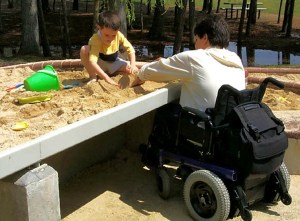
Child-Directed Play

sand2

For a young child, most of their activities are directed by adults: we tell them when they need to eat, sleep, go to the bathroom, listen to stories and so on. Even when they play, sometimes we direct them – telling them how they should play with something, or else we interrogate them – “what color is that car? how many cars are there?”

Just take a moment to imagine what that would be like for you to be told what to do all day long. And then when you finally settle in to some “me time”, someone comes along and asks you question after question. It would drain your energy tanks, right? You might get cranky at that person. You might start to tune out their questions, or resist their suggestions.

Do you have a child who you feel is tuning you out – not listening to you? Do you have a child who is resisting doing what you tell them to do?

Try listening to them. Try letting them tell you what to do for a little while each day. I don’t mean put them in charge of discipline for you! What I mean is spend a little time each day that’s all about play, and even better, is all about your child deciding what to play, and you following along. Let them take the lead for a while and have fun discovering where they’ll lead you.

The Incredible Years program talks about “building up your child’s bank account” of energy, connection, and good will towards you as the parent. If they have a full bank, they’re much more willing to listen to you and do what you ask than if they’re feeling drained.

Many things fill their bank, including: praise, support, love, attention, and special time playing with them one-on-one.

To build a stronger, more positive relationship with your child, try dedicating at least ten minutes a day to a focused session of child-directed play. Here are some tips:

  • Call it “special time” or some other words that cue them that this is the time when they get to decide what happens.
  • Let them choose the activity.
  • Follow their lead. Model cooperation by doing what your child asks you to do.
  • Don’t focus on “the right way” to play, and don’t feel like this needs to be a time when you’re teaching them. This is just about building connections.
  • Praise their initiative and encourage their creativity.
  • Laugh and have fun.
  • Don’t quiz them on academic questions that have a right answer – these questions drain the bank. Either they don’t know the answer, which is stressful, or they (and you) already know the answer, so nothing new is learned by asking the question. Instead, try:
    • Silent observation.
    • Narration – talk about what you see them doing. “You picked up the red car and ran it down the ramp. Now you have the blue car.” Try to use descriptive comments much more often than questions.
    • Notice what they’re interested in and talk about that. That way, they’re setting the agenda, not you.
    • Open-ended questions – questions that you don’t already know the answer to. “What are you planning to do next?” “What would happen if…?”
  • Give just enough help to help them with frustration, but don’t take over the play, and don’t leap in to solve every problem for them.

You can use the Attention Principle while you play. Pay special attention to anything that you like about what they’re doing: “I appreciate that you shared that with me”, “you kept trying even though you were frustrated, and look, you did it!” If they do something annoying or something you don’t want to encourage, just ignore it. (Unless of course it is unsafe or breaks a family rule – you do still need to set reasonable limits.)

You’re modeling for your child what cooperative play looks like, and helping them develop social-emotional skills that will help them also play well with others.

Learn more tips for child-directed play using Greenspan’s Floortime method. https://gooddayswithkids.com/2019/01/15/floortime/

For parent educators and other professionals, here’s a handout on this topic you can share with parents: Child Directed Play handout.

A Tale of Three Potty-Training Experiences

On every online parenting forum, you’ll see parents who post questions about potty-training, and other parents leap in to share their experiences. The wise ones say “here’s how it worked for me, but your experience may be different.” But that message can get drowned out in the over-achievers: “just do it MY way, and it will go great” and the exhausted: “nothing I’m trying is working.”

For a first-time inexperienced parent, it can feel overwhelming. It may feel like “I don’t know what the right answer is!!” And the answer is that there is no one right answer. Like all things with our children, what works depends on: their temperament, our temperament, their motivation to learn and our motivation to teach, plus circumstances in our environment. Disabilities and neurodiversity also play a role.

As a parent educator, I’ve read countless books and articles, and talked to countless parents about this process. I’ve summarized my best advice in this one-page summary. I also address the 20% of kids who refuse to poop in the potty.

In this post, I’ll share stories from my personal experiences of how this can play out. I have three different children, and three different potty-training journeys, so I’m definitely not telling you any “one right answer” here!

Child #1: At a fairly young age (probably around 2), she could keep her diaper dry for hours. She could pee in the potty when I put her there. She could poop in the potty. She had good body awareness, so knew when she was doing something. So, all the skills were in place. But… she lacked motivation. She was a child who was very engaged in her play – she had an incredibly long attention span where she would stay focused on one activity for a very long time. She didn’t like transitioning from her chosen activity to other activities. So, if she was in the middle of something and needed to poop, she’d just do it there in her diaper. She didn’t want to interrupt her play to go to the potty. To you as an adult, hat may seem like a strange choice to make, but remember that toddlers are used to using their diaper and don’t find it uncomfortable or weird.

Sometimes she needed to pee badly enough that she was rocking her bottom back and forth, but if we asked her if she needed to use the potty, she’d just say “I fine. I fine.” In other words “leave me alone – I have more important things to do than go to the potty.” I think we tried some motivational things along the way like stickers, but it wasn’t enough. So, when she was 3, I bought a cool dollhouse and some fabulous big girl underwear. I put them in the closet, showed them to her, and said “whenever you’re ready to start using the potty ALL the time, you can have these. But once you have these, we’re not going back, OK? It will be no more diapers from then on. So, you decide when you’re ready for that.” I closed the closet and walked away. She immediately went to use the potty, and was potty-trained from that moment forward. Now again, remember this was a child who already had all the skills in place to make this move! This was just the final motivation to commit to a new way of toileting, even if that meant interrupting her play.

Child #2: She pretty much trained herself. We were busy and didn’t have a lot of time to worry about it, or nag her about it, but it just happened. She’d follow us into the bathroom and follow her sister into the bathroom, so she knew how it all worked. As she got older, she’d pull down her own clothes and sit on the potty, and was soon peeing into it successfully. We talked about it, and praised her for it, but it wasn’t a big deal. We didn’t require that she use the potty, but she generally chose to do so, and I think she totally gave up diapers at around 2 years 9 months.

I think part of this was having a big sister to watch. But, a big part of it was her temperament. She was (and is) an independent child who likes to be seen as mature and competent and doesn’t like to burden others. She liked taking care of her own needs.

Child #3. When he was 2.5 years old, we thought we were on the verge of potty training. His bladder control was perfect. He could keep his diaper dry for hours until he got to a potty. He was dry overnight. He wasn’t pooping in the potty yet, but we figured that would come soon.

He finally pooped in the potty for the first time a year later at 3.5 years old!

He had one week of doing it consistently. Then he stopped.

The next time he pooped in the potty was a year after that. He was 4.5 years old!

In that full two year period, he had perfect bowel control and predictable bowel patterns. He would choose to poop in his diaper every afternoon, when he was alone for naptime. We enrolled him in a morning preschool that required potty training, and we explained our circumstances. We told them that they would never need to deal with it, and sure enough, he never peed or pooped in his diaper at preschool the whole year. He saved it till he was home for nap time.

Why wouldn’t he poop in the potty? I wish I knew! We tried to figure out if it was fear or aversion or if he’d had a painful poop that scared him or what. We never knew. We tried to motivate him in a lot of ways. We tried offering stickers and candy and so on. But, although he would sit on the potty for us, no poop ever came out. We gave him privacy, we tried to help him feel safe. We tried having him sit on the potty with his diaper on to see if he could poop if the diaper was on. Nothing worked. You just can’t get someone to poop on command. When he reached 4.5 we started having occasional success which we rewarded and praised. We went on a road trip, and were afraid we would lose progress when we were away from home, but instead, that was when he finally potty trained. We did give him rewards for each poop, but I don’t think that was the reason he did it. I think he was just finally ready to do it, and the rewards were a nice perk.

By a few weeks after that, he was pretty much independent. He knew when he needed to pee or poop. If we were out of the house, he’d ask to use the potty. At home, he’d just go use it on his own whenever he needed it. He didn’t wipe himself, so that was still a learning process to go through. But huge progress at the end of a long marathon.

By temperament, he is a child who thrives on routine, and likes to do things the same way every time. So, I think he had a routine for his bowel movements and it was working for him, and it was hard for him to change to a new way of doing things. (When he got older, he was diagnosed with autism. He’s a very bright kid with strong language skills and a fair grasp of social skills, so you might not peg him as autistic, but one of the ways it manifests is that he has a really hard time with change. Here’s some advice I found later on about potty training a child with autism.)

So, we’ve tried child-led potty training, we’ve tried sticker charts, we’ve done gradual, we’ve done “Big Day”, we’ve tried a wide variety of methods. But our success depended not so much on what we did as the parents, but on our individual children and what worked for them. The best recommendation I have for other parents is: collect advice. Try the things that feel like they match your preferences and your child’s personality. If they work, keep doing them. If they don’t work, take a break for a month or so. Try not to stress about it. Try again with a new approach when you feel like you can do it in a non-stressed and supportive manner. Try not to lose faith along the way. You’ll get there eventually!

For more info, read my one-page summary of potty training, or the long version all the options for potty training. Or read about kids who refuse to poop in the potty.

Hands On is Brains On

I recently did a presentation at Kidsquest Children’s Museum in Bellevue, WA on how kids learn, titled Hands On is Brains On.

It combines information on the basics of brain development, ideas about the important of offering a balance of learning opportunities, the benefits of free play, and the parent/teacher’s role in play-based learning.

You can check out the powerpoint handout here, or, if you’re a parent educator, you can download a powerpoint presentation that you could edit and use in your own classroom.

Brain development – how to help your child learn and grow

brain mapThis is a poster I developed for class about the stages of brain development, and what parents can do to create an environment that aids brain growth. Click on the picture for a full screen view.

To learn more about how to help your child’s brain develop to its full potential, check out: https://gooddayswithkids.com/2013/10/29/brain-development/ and at https://gooddayswithkids.com/2015/06/22/hands-on-is-brains-on/

Note: the brain illustration is copyright Macmillan Cancer Support 2012. The text boxes about what part of the brain it is, its sensitive period, and how you can help are my work.

Tinkering

tinkerAt an in-service last week, after seeing this poster, I had a great conversation with one of my class’ teachers about the word “tinkering” and how great it is when parents allow their kids to tinker around, exploring, testing, fixing, breaking, and fixing again. So many skills are learned by this kind of hands-on exploration.

So, what is “tinkering”? Let’s ignore the definitions that say things like “unskillful or clumsy worker.” I like:

Children at play,  discovering new materials, and exploring new uses for familiar materials are Tinkers. People who were allowed to tinker a lot as children often become engineers, or scientists, because of that approach of “what happens if I try this? Oh cool! Now, what if I do that? Ooh, even better!”

People who were allowed to tinker a lot as children also become chefs, woodworkers, architects, computer designers, graphic artists, fashion designers, and builders. Learning early on the joys of building and creating and refining sets a lifelong passion for hands-on work in a variety of fields. (Check out this great post on The Importance of Learning to Make Things.)

How do you encourage your children to tinker? Give them lots of open-ended materials (cardboard boxes, toilet paper tubes, tape, string) and time to experiment. Talk to them about their creations, asking about the process and what they learned along the way. Ask them what they want to do next with their experiment.

I like this post from Kids Stuff World on Ten Powerful Life Lessons from TInkerlab. A couple of her lessons are:

  • The results are not as important as the process.
  • The more exposure you have to a material, the more you will learn what you can do with it.
  • Think of everything as an experiment.

Allowing your child to play, and tinker, and putter around, helps to ensure that as they get older, they meet this definition of Tinker: “somebody good at many tasks: somebody able to do many different kinds of work successfully.” (Bing dictionary)

If you’re in the Seattle area, and want to do some tinkering with your child, join our Family Inventors Lab!