Author Archives: Janelle Durham

Unknown's avatar

About Janelle Durham

I am a parent educator and social worker, and teach music and science to children age 1 - 8.

Positive Discipline: Telling Your Child What TO DO

Many people think of discipline as just limits and consequences, and saying “no” to things the child wants. But a huge part of discipline is saying yes and telling the child what they can do.

We definitely want to set limits with our kids, and we absolutely need to say no sometimes (especially when safety is involved), but if you say no all the time, the word loses its power. If you feel like you spend your whole day saying no, think about ways to say yes. What can you encourage your child to do that will let him burn off energy, try out new skills, explore his world and connect with you?

Ask for the behavior you want to see

It’s important to know that toddlers don’t always understand the word “don’t” very well, so if you say “don’t bite”, they hear the verb in that sentence, and continue to bite.

Also, even if they understand what you don’t want them to do, they might not be able to figure out an alternative on their own for what they could do. So if you just say “don’t pour that on the floor” it doesn’t tell them what to do nearly as effectively as saying “keep the rice in the dish.”

So, when your child is holding something fragile, instead of saying “Don’t drop it!!” say “Hold it very carefully.” Instead of saying “Don’t throw that!” say “when you’re ready to set it down, let me know and I’ll take it from you.” Instead of “Don’t Run”, say “please walk” or “can you tiptoe very slowly?”

Use specific language to explain what you want and why

Instead of just “no”, try “careful”, “gentle”, “soft touch”, “slow feet.” “Hands up, that’s hot.”

“I want you to be safe in the playground. If you lie down on your belly and put your feet down first, that will help keep you safe.” or “I want you to stop banging on that, because it might break and we would have to throw it away. That would make us sad.”

Say what you are seeing and then say what you want to see

“I see you dumping all the toys out of the toy box. I want to see you get out only the things you want to play with. Can I help you find something special?” Or “I see you banging on grandma’s piano with your whole fist. I want to see you playing gently with just one finger.”

Give a bored child something to do

If you’re frustrated when he makes a mess while you’re cooking: give him his own drawer in the kitchen. Fill it with plastic dishes, cups that stack, and pots to bang. Let him play in a sink full of water, or with dried beans for pouring and scooping. Ask for his “help” with what you’re working on.

Create opportunities to say yes

Create spaces where it’s all about yes. Create a play area where everything is age appropriate, where it’s easy for them to keep things tidy…

Have times or activities each day where your child sets the agenda, and gets to play however she wants to, as loud (or quiet) as she wants to.

If not now, then when? If not here, then where?

If they can’t do it now, but it will be ok later, then instead of saying no, you can say “you can have a cookie later, after you eat lunch. first, we’re going to play some more.”

If this is not the time or place for something, tell her when it will be “it’s not OK to climb on the furniture here, but later today we can go to the playground and you can climb there.”

Remove predictable problems

If your child loves to throw, put away the hard plastic toys and metal cars for now. You’ll still work with them on not throwing things that weren’t designed to be thrown, but this lets you avoid injury.

If there’s one environment, or playmate, or circumstance that always brings out the worse in your child, can you avoid it? Or take it on only when your child (and you) are rested, fed, and healthy?

Set your child up to succeed

Schedule: When planning your errands for the day, or when choosing activities for your child, think about the natural rhythm of their day. When are they active and ready for engaging activity? When are they quiet but happy, and content to go along for the ride?

If you need your child to sit still later in the day, can you make sure they get plenty of physical activity early in the day? If your child is always wired up and excited at bedtime, can you adjust the activities to slow down as the end of day nears?

Make sure your child is well fed before taking her into any situation which will be challenging for her.

Predictable routines make everything more manageable. Think about areas where you have discipline challenges. How could you establish a new routine that reinforces the way you want them to behave?

More information:

What to say instead of no: www.regardingbaby.org/2011/11/05/what-to-say-instead-of-no-six-ways-to-gain-your-childs-co-operation/

13 ways to encourage good behavior: www.askdrsears.com/topics/parenting/discipline-behavior/13-ways-encourage-toddler-good-behavior

Here is a printable handout on Saying Yes – Telling Your Child What TO DO . Find more handouts on my Resources for Parent Educators page.
Cheap Dates with Toddlers: Going to the Dog Park

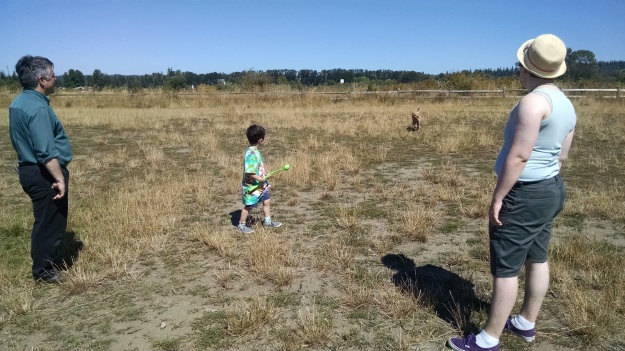
img_20160724_152718837I have an on-going series of easy, cheap or free activities that toddlers love. Here’s one in honor of today’s lovely sunshine…

Off-Leash Dog Areas: If you’re feeling down and lonely in the winter, when the sun comes out (even if it’s cold) head to the dog park, and you’ll find lots of people and lots of very happy dogs, which always lightens my mood! It’s great for exercise, socialization, and learning new things: Dog parks are a great place to teach your child adjectives: big dog, little dog, white dog, fluffy dog, and so on. (As they get older, you can work on memorizing dog breeds – it’s a great way to train their brain to notice distinctions between things, categorize them, and remember those categories.) FYI, you don’t need to have a dog of your own to go to the dog park. Even if you do have a dog, you might find it easier to leave him at home when you take your toddler on her first few outings.

Note: wear boots for puddles, and wear clothes that can get wet and muddy, as you may encounter a dog shaking off, or a friendly dog who jumps with muddy paws.

A few important safety notes: even the friendliest and ‘safest’ dog can bite if circumstances are right. Consider carrying your child in a front pack or back pack that puts them up and away from the dogs. If your child is walking, tell them they need to hold your hand whenever a dog is nearby. Never approach a dog without its owner’s permission, and once you have permission, have your child first hold out a closed hand for the dog to sniff before petting the dog. Here are more tips on teaching your child to be safe around dogs.

For folks on the Eastside of Seattle, here’s where to go:

We love Marymoor Park‘s off-leash area in Redmond, because you can go for a nice long walk. But you’re definitely in the middle of the action when you go for a walk there, and should expect close encounters with 20+ dogs of all sizes and behavior as you walk. If you’d rather view dogs with a little more distance, check out Jasper’s in Kirkland. There is a fenced off-leash area where you can keep your toddler outside the fence where they have a good view of the action, but may feel safer to them. Another option is Robinswood in Bellevue, which is a smaller “corral” where on weekdays, I often find only 2 – 3 dogs and their owners, so it’s a little more low-key.

For more animal fun, check out Pet Stores and Farm Parks. Considering a pet of your own? Find my recommendations on Best Pets for Kids.

Choosing a Preschool – Questions to Ask

After you’ve thought about your goals for a preschool and made a list of local options, you can learn more about those options by looking at their websites, going to open houses and visiting. Here are some things you’ll want to think about as you do that:

What do they teach?

  • They should work on all the “essential skills” areas listed here. If they don’t, you may need to think about how you’ll work on that skill at home or elsewhere.
  • You should see materials and planned activities that help children build: large motor skills (playground, balls, dance), small motor skills (puzzles, craft supplies), critical thinking skills (sorting games, pattern making), life skills (putting on their shoes, hanging a coat in a cubby), social skills (unstructured playtime with others), music, art, literacy (books, story time), math skills, and pretend play (dress-up corner, dolls, kitchen). This reveals a well-rounded attention to the development of the whole child.
  • Some schools also have a specialty focus: nature-based, language immersion, arts, academic, religion. These can be excellent, but may not cover all the essential skill areas. Again, you might think about how to supplement them. For example, if your child attended a very structured academic program each morning, you’d plan time for unstructured self-guided play, and free play with other kids in the afternoon. You might also choose two preschools… my oldest child went to a theatre preschool two days a week which was very focused on storytelling, acting, and singing, and was structured so that they could produce a mini-play at the end of each month. Another two days of the week, he went to a broadly-focused play based cooperative preschool.
  • What is the daily schedule – how is time divided between the subjects taught? Play time? Quiet time? Outdoors? Snack? Children this age have short attention spans for structured activity, so it’s best in short doses, and they need plenty of unstructured time in between to explore and discover. (Note: If children are at a preschool/child care all day, they should have a naptime/quiet time on the schedule. Quiet time for rest helps us to absorb what we learned during class time.)

How do they teach it?

When you start looking at preschools, you discover a whole world of jargon you never knew: play-based, emergent, teacher led, benchmarks, co-op, Waldorf, Reggio Emilia, and so on. It can be overwhelming.

Let’s look at two opposite ends of the spectrum of preschools:

  • Structured / Teacher Led: A teacher-led curriculum (may also be called didactic or standards-based) means the teacher prepares the lessons in advance (it might be their own creation or they may use a curriculum written by someone else) and sticks to it. Children are expected to all be doing the same activity at the same time.
  • A play-based / child-led preschool (may also be called emergent or constructivist) follows the children’s interests. They typically have multiple stations set up and allows children to move between things when they choose, spending as long as they want at an activity. The teacher moves around the room, making suggestions and observations to further the learning. Learn more about play-based preschool and activity stations at a play-based preschool.

Most preschools fall somewhere in the middle. You can get a sense of it by looking at their schedules. If you see lots of transitions, and a schedule that says something like “Morning meeting 9 – 9:20, math 9:20 – 9:40, blocks 9:40 – 10, music 10 – 10:20… “, that’s a very teacher-led plan. If the schedule says “Morning gathering 9 – 9:10, free choice time 9:10 – 10:30…”, that’s a play-based format. You can also get a sense of it by looking at classroom materials – If there is a shelf of matching workbooks, that’s a more standardized curriculum. If there are 10 different books about dinosaurs and trains and kittens, that’s a child-led school. Or you can look at artwork that’s displayed: if you see 18 different pictures of a snowman made of three circles, a top hat, button eyes and a carrot nose, that’s a teacher led project. If you see a crayon drawing of a rainbow next to paper covered with star stickers next to a collage with sequins, tissue paper and pompoms, that’s a play based art process display.

If you want more information on types of preschools like: Montessori, Waldorf, Reggio, forest kindergarten, and more, check out my post on Types of Preschools.

When considering which method you prefer, it’s worth keeping in mind what we know about brain development (see this post): Children learn best through hands-on experiences with tangible materials, through interaction with engaged human beings, and in environments where they feel safe and happy.

Who are the students?

  • How many students are in the class? The number of kids per group matters as much as the student to teacher ratio does. For example, a 12 student school with 2 teachers (6:1 ratio) will feel very different from a 24 student school with 4 teachers (6:1).
  • What is the age range of the class? Some parents prefer that all the kids be as close as possible in age to each other, but many schools tout the benefits of multi-age classrooms. The oldest kids have a change to lead and mentor and may build empathy for the younger ones, and the younger ones benefit by the presence of an older role model.
  • What are the cut-off dates for age? It’s usually August 31 or September 1. If you have a child born in August, they might be the very youngest child in a program for 4 year olds. A September baby would be the very oldest. But if you’re able to find a program for 3.5 – 5 year olds, that would put them more in the middle…
  • Diversity? Are all the kids like your kid? Are all the families like your family? Or different? Which do you prefer?
  • Neighborhood: Do the kids in the program live near you? (This allows for easy play-dates outside of class, and maybe carpooling options. If you commute to a school, it can be harder to arrange play-dates.)
  • Families: If you’re doing drop-off, it may not matter as much to you because you may not interact much with them (except maybe at birthday parties), but if you’re looking at a coop you may ask more and observe more about what kinds of parents participate to see if they feel like a good match for you.

Who are the teachers?

  • Student/teacher ratio. For three year olds, NAEYC recommends a maximum group size of 18, with a student/teacher ratio between 6:1 and 9:1. In general, the smaller the better for individual attention.
  • Training. Do the teachers have degrees in early childhood education? Do they attend continuing education opportunities? Do they read books about child development in their off hours?
  • Teachers should have CPR and first aid training. There should be emergency plans for the facility.
  • Longevity / turnover. Learn how long the teachers have been there. If there are lots of new teachers in and out all the time, not only does that mean your child won’t gain the benefit of experience or consistent caregivers, it also may mean that the teachers don’t enjoy their work there! Generally, the longer the better. (Although on rare occasions, longevity can mean burned out teachers and uninvolved supervisors… That’s why we also watch the teachers to see if they enjoy their work!)
  • Do they enjoy kids? Do they sit on the floor with the kids, smile, and engage with them? Or are they standing on the edges talking to other adults, occasionally calling instructions to a child?

How do they handle discipline? What are their rules and how do they reinforce them? How do they deal with inevitable conflict between kids? How do they respond to hitting and biting? Is their discipline style similar to yours? It’s best if children have consistent experiences between home and school.

What is the learning environment like?

There are many things you can learn about a preschool on the web and over the phone and by asking friends, but really the in-person visit is the best opportunity to really learn what the school feels like.

  • Clean and Safe: Is the environment clean? Safe? Well-lit and ventilated? Are there procedures for cleaning? Policies for sick children? Fire extinguishers? First aid kits? Appropriate child proofing?
  • Materials: Is there a wide range of toys and supplies? Look for things which build large motor skills, small motor skills, imagination, literacy, number skills, social play. It’s OK if everything isn’t shiny and new. But, you do want to see materials in good condition. You want to see “enough” toys, but not so many that it’s cluttered and chaotic.
  • Outdoors space: Do they have a place to play outdoors? How often do they use it? Do they go out when it’s raining? If not, do they have some place for kids to run and move?
  • Look at the art on the walls: If it’s all the same, that tells you a teacher is focused on product more than process and very actively guides the process. If there’s a wide range of art, it shows kids are given creative range. Probably for a three year old class you want more free choice exploration, for a four year old class, you might look for more signs of structured learning.
  • Look at the ratio of desk space to open space. If the room is filled with desks, it’s clear that’s where children are expected to spend their time. If there are areas for children to move around, explore, learn socially and learn independently that shows the school values a wider range of learning experiences.
  • Look for worksheets. I once visited a school that talked a lot about how all children proceeded at their own pace, but then I saw a stack of workbooks and skimmed through. Every child was on the same page.
  • Look at the books on the shelves: non-fiction? Fiction? Personally, I want to see a mixture. Children benefit from learning factual information from non-fiction books, but their imagination and creativity benefit from good story-telling.
  • Vibe:  The most important thing you’re “looking” for is something you can’t see. How does it feel? Is it warm, nurturing, full of exciting learning experiences, and full of happy children and teachers? Or is it cold, institutional, uninvolved? We know from the science of brain development that children learn best when they are happy, so look for a place where they will be happy and engaged.

Making the Choice

After you visit a school, give yourself some time to reflect on what you’ve seen. Sometimes what feels like love at first sight sours on further reflection. And sometimes a school that didn’t seem right at first glance may grow on you. Don’t let yourself be pressured by schools that attempt to create a sense of urgency by using words like “waitlist” and “we can’t promise there will still be space” and “only one space left.” Yes, there’s a chance that a preschool will totally fill up while you’re deciding, but if it does, there are plenty of other good options out there. Assuming you live in an area with multiple good preschools (like Seattle’s Eastside!), you can trust that you’ll find something that works for you.

Often the right answer for your child may be a combination of options. Maybe you choose a two-day-a-week academic preschool and a two-day-a-week play-based. Or maybe you choose a structured five-morning program for your child, but ensure that your afternoons include quiet time at home and unstructured play with friends. Or maybe you “homeschool” on the academic skills, and seek out one-day-a-week dance classes, language classes, and so on. Choose the routine that works for you and the experience you want your child to have. Children benefit emotionally from a predictable routine. And their brains benefit from a wide array of experiences. You’ll have to work to find the balance that is right for your family, and right for your child’s temperament.

Choosing a Preschool: Step 2 is learning about your options

optionsOnce you’ve decided what your needs and goals are for preschool, you’re ready to make a list of local programs.

Get familiar with available options: look at parenting magazines or newspapers or the yellow pages. Do web searches. Find an accredited program: www.naeyc.org/academy/accreditation/search. Search for local child care and preschools, go to www.childcarenet.org/families. Go to preschool fairs.

Ask your friends, families, co-workers and other parents at the playground for recommendations. (As  your child gets older, one of the best sources for recommendations for the next level of schooling is to ask your child’s current teacher(s) or coach for recommendations.)If someone says they LOVE a particular preschool, ask why! It could be that something they love would totally turn you off. Or their family might have different needs or goals than yours. We all have different things we’re looking for.

Once you’ve got a list of interesting options, do more research. Read the school’s website in detail. Call to ask more specific questions. Go to open houses. Most open houses are in January and early February, so start looking early! (Note: if your child is a young toddler, and won’t be old enough for preschool for another year, you’re still welcome to check out open houses early. Sometimes it’s nice to begin checking things out early when there’s no pressure to make a decision.)

Once you’ve narrowed your list to three or four choices, absolutely go visit! They may have an open house (which may or may not allow you to bring your child along). They may have adult-only visits during the school week where you can go and observe part of the session. They might (if you’re lucky) have child visits, where you can bring your child along to spend some time participating in the activities. The in-person visit is the most important part of the process. Sometimes you have a school that sounded great on paper, but when you get there, it just doesn’t feel right…

Check out my next post for questions to ask at open houses and visits.

If you’re in the Seattle / Puget Sound region, we have fabulous cooperative preschools based at each of our local community colleges. Learn more here.

Choosing a Preschool: Step 1 is figuring out your needs and your goals

checkConsider your logistical needs for a preschool

Before you start looking at options, think about your “must haves” for preschool. It’s important to start here, because otherwise you might fall in love with a program and then discover that you can’t possibly make the logistics of it work for your family.

Things to consider:

  • Child care or enrichment:
    • Do you need your child to be cared for several hours a week while you work? If so, you may really be looking for child care. Some child cares offer a preschool component, but if your child is there for 6 hours a day, 5 days a week, you don’t want all structured time. Children this age need a mix of structure and free play and down time over the course of a long day.
    • If you are primarily a stay at home mom, you may only need a few hours of child-free time a week, and may just be looking for a very part-time preschool for enrichment. You may choose a few hours a day, few days a week program.
    • Note: sometimes names are misleading. Some things called “preschool” do not offer learning experiences. They may be a day care that knows parents pay more for the name preschool.
  • Schedule: What do you need/ want?
    • How many days a week? Number of hours per day? Extended care?
    • Drop off or stay? Do you want a drop-off so you have some child-free hours? Or would you like a co-op where some days you stay with your child? Or would you like to do all parent-child programs. (They’re not called preschool, but there’s certainly dance classes, gymnastics classes and so on that you can do together.)
    • Do you have specific days of the week you must do? Absolutely can’t do? Or are you flexible?
    • What time is the earliest you could be there? What time is the latest?
  • Location: How far are you willing to drive two to three days a week? How far is your child willing to be driven? (Some parents find the “perfect” preschool a long drive from home, and only later realize that it’s not so perfect if they have a child who hates to be in the car!) What will you be doing while your child is at preschool, and would it be convenient to get back and forth to there in the time your child is at class? Is the location convenient for other family members / friends who might occasionally do drop-off or pick-up duties?
  • Cost: What’s manageable for your family? (Note: if all you’re finding when you search for preschool is expensive options, think about where you’re looking. If you look for ads in slick expensive looking magazines, you’ll see ads for expensive preschools that can afford expensive ads. Try asking friends, family, neighbors and co-workers what options they know of. There are a lot of preschools hidden in church basements with no advertising budget but great programs!)
  • Potty training requirements: If you’re looking for a preschool that will start several months from now, it can be hard to predict what your child’s needs will be. As a general rule, the majority of 2.5 year olds are not potty trained, so if you want to start preschool young, you may choose a preschool that doesn’t require this. The majority of 3 year old girls are potty trained (though not all), so it might be a safer bet to choose one that requires it. With boys, it’s less likely, so again, you might err on the side of assuming your son won’t be.
  • Parent Involvement: Do you want to volunteer in the classroom? Would you want to visit your child during the school day? Do you want communication from the school about your child’s day? In what form?

What are your goals for enrolling your child in a preschool?

Before you start asking for recommendations or before you start looking at schools just because someone else said it was great, spend some time thinking about your goals. What do you hope your child will get out of preschool? Look at the list of essential skills: where do you think your child most needs to grow? What are the things you feel least confident providing at home? What do you think will engage your child the most?

At every step of my daughters’ schooling, one of my goals was to choose a school that would preserve their love of learning. All babies and toddlers LOVE to learn new things… but sometimes a bad school experience can lead a young child to decide “I hate to learn” or “I’m bad at learning things” and it’s hard to recover from that. Each time my girls moved up to a new school, I wanted (and was lucky enough to find) schools that honored their passion for learning. It was actually the final deciding factor for my oldest in choosing a college – she chose the place where everyone she met on campus was passionate about learning – there were hugely excited about ideas and geeked out about everything from Dr. Who to the physics of musical acoustics.

In evaluating your goals, don’t just think about what you want your child to get out of it. What do you want to get out of it? Do you want to meet other parents? Choose a co-op program. Want to learn more about parenting skills? Choose a program with a parent ed component. Want a few hours a week when you’re not responsible for your child just so you can relax? Choose a drop-off program that has activities you enjoy nearby. Want your child to be exposed to nature but you’re an indoor person? Choose a nature preschool.

Once you’ve done these steps, you’re ready to start researching your options… check out my next post

Note, if you’re having a hard time coming up with goals / reasons to send your child to preschool, you may want to check out this post on whether preschool is necessary for your child.

photo credit: Mufidah Kassalias via photopin cc