Author Archives: Janelle Durham

Unknown's avatar

About Janelle Durham

I am a parent educator and social worker, and teach music and science to children age 1 - 8.

Cheap Dates with Toddlers: Buses and Trains

wp_001450

If you use these all the time, they’re probably not that exciting for you or your child. However, if you don’t regularly use these, you can convince your child that a ride on public transit is almost as special as Disneyland!

Plan a short simple outing at non-peak travel times, and get a transfer when you board – you’ll be able to ride back out for the single fare.

You can choose to take transit to a special destination. (Even something as simple as a shopping center with an ice cream shop.) Or you can just go on a ride, focusing on enjoying the journey, not a destination.

Things to Do on the Trip:

  • Gaze out the window and talk about what you see.
  • Play I-Spy.
  • Do a scavenger hunt or travel bingo, looking for things like stop signs, blinking lights, and so on.
  • for older children who know their alphabet: first find an A (on a sign, license plate, etc.) then a B and so on. See if you can complete the alphabet.
  • Many transit stations feature public art – check it out!
  • This post covers the new light rail on Seattle’s Eastside and fun kid attractions along the way.

Here are lots of train related adventures in the Seattle area. #5 is the monorail, #6 is the Seattle streetcar, 7 is light rail, 8 is the Sounder.

Cheap Dates with Toddlers: Farm Parks

Spring is coming, and the baby animals are appearing at local farms.

A few years ago, I took this picture of a 2 week old calf  at Farrell-McWhirter. He was shorter than my 3 year old! (Sorry that it’s not a great picture… my son was really ready to go have snack, so we only got a really quick look at the calf… but wow he was cute!)

calf

At any time of year, toddlers love outings to meet farm animals. Lots of children’s books, games, and videos feature farm animals, so kids tend to be familiar with them, and get very excited when they can recognize and name the “real thing.” Seeing and hearing (and smelling) the animals in person make the idea much more real. At farm parks, you can check out chickens, sheep, bunnies, cows, pigs, and goats. Some times you’ll get an opportunity to see fresh eggs in the coop, or see a cow or goat being milked.  This is a great outing for a child who has just learned to answer all those vital questions like “What does a cow say?”

For my readers in the Seattle area… here are some free outings:

Farrell McWhirter Park in Redmond. When last I visited (it’s been a while), they had a small pot-bellied pig and a really big pig, bunnies, chickens, 2 goats, a calf and horses. Animals are on view 9 am to 4 pm.  It is not a petting zoon – you  can’t pet or feed the animals – just see them. They do offer farm classes and pony rides. You can register for programs here. Farrell McWhirter is also home to Nature Vision preschool. There are great hiking trails, streams, swings, and tire swings too.

Kelsey Creek Farm Park in Bellevue. They’ve got sheep, pigs, cows, goats, ponies, bunnies, and chickens. (Learn about their animals.) Again, they’re on view, but this is not a petting zoo and you can’t feed them. It’s free to visit – animals are on view every day from 9 am to 3 pm. They also offer horseback riding and farm classes, including a great program for toddlers called Little Farmers. They also have a nice playground and walking trails. Learn about farm tours and farm classes.

Sammamish Animal Sanctuary. They have alpaca, goats, mini horses, mini donkeys, llama, cows, pigs, sheep, chicken, ducks, bunnies and guinea pigs. For a small donation, you can purchase treats to feed the animals, or you can bring your own spinach or carrots. You do have to make reservations. It is free, but they encourage donations to support their work.

Farms with a Fee:

Red Barn Farm in Redmond. They do farm visits on Wednesdays – you need to reserve. Feed the animals and walk around the farm! Price is $25 per car up to 4 guests. Additional guests beyond 4 are $10 each children under 2 free. They have cats, chickens, dogs, donkeys, ducks, goats, pigs and rabbits. (See pictures.)

Fancy Farm in Fall City. By appointment only. (Check their Facebook page for availability.) $10 per person, or $20 for family for a one hour visit. They have emu, goats, pigs, horses, chickens and ducks. Pony ride for an additional fee. I believe they let you hold / pet the animals.

Remlinger Farms Fun Park in Carnation. Opens for the season on Mother’s Day. They haven’t announced 2023 fees yet – a few years ago, they were ~$20 per person (babies under 1 are free). They have horses, pigs, sheep, alpaca, goats,  rabbits and donkeys. They have pony rides for an additional fee. They also have some amusement park style rides, and a train ride. Plus a hay maze and a hay barn to play in.

Woodland Park Zoo in Seattle. Adults $27.00. Kids are $16.50. Under two years is free. By the south entrance, there’s the Family Farm area, which includes a petting zoo where kids can meet goats up close. There’s pigs, goats, sheep, cows, bunnies, chickens, and a donkey. Plus, of course, lots of more exotic animals.

When visiting  farm parks: remember bring a change of clothes and shoes for your child! They can get pretty muddy in any of these places. Please teach your children to be calm around animals and gentle. If you’re at a petting zoo, always remember that these are animals – if you stand behind a horse and spook it, you may get kicked. If you annoy a goat, you may get bit. If you stay calm and quiet around petting zoo animals, you’ll do fine.

Updated March 2023.

Family Meal Time – making it pleasant for everyone

family eating a meal

Meal time is about more than putting food into our bodies. The family meal also offers:

  • Together Time: a chance to talk and connect as a family
  • Social Skills Practice: a place to learn polite manners and the art of conversation
  • Routine and Rituals: grounding in a reassuringly predictable experience
  • Healthy Habits: modelling, practicing and discussing healthy eating

Unfortunately, children don’t come into the world prepared to be pleasant dinner companions. Proper mealtime behavior is a learned skill. There are many steps you can take to start the path to making meals enjoyable and pleasant for everyone. I offer some tips here which most experts recommend, but there is no one right way to parent, so you should do things that work best for your family.

Whose Job Is It?

I find this message from Ellyn Satter about the division of responsibilities is simple but really powerful:

You are responsible for what, when, and where. Your child is responsible for how much and whether.

Your role is to offer healthy food and be a good role model for healthy eating. But, your child will choose whether to eat something and how much to eat. Don’t turn meals into a power struggle. Help them to be a joyful time.

What to Eat

Put out a variety of healthy foods. Let your child serve himself, choosing how much to put on his plate (encourage him to start with small servings – reassuring him he can always have more). Be a good role model in your own food choices and portion sizes.

Involve your child in choosing and preparing the food. They are often more willing to eat a variety of foods if they were involved in making it.

Help your child recognize when she is full – this will decrease the chance of later obesity. Don’t praise children for a clean plate. Reward them with attention, kind words and fun activities, not food.

Don’t restrict certain foods – they may become the “forbidden fruit” and children will overeat them when they can. Offer small amounts of dessert items with the rest of the food – don’t set it aside as the “special” part of the meal.

When to Eat

Newborns have tiny tummies and digest breastmilk or formula quickly so need to be fed often. So parents get used to lots and lots of “meals” every day. As children get older, they no longer have that need, but I feel like many parents continue to use snacking as an anytime activity / distraction for their toddlers and preschoolers. It is better for older children to have a routine such as three meals a day with an afternoon snack and a bedtime snack, and avoid continuous grazing.

Allow plenty of time at the table. At least 20 minutes for a meal. When your child is full, he can leave the table, but let him know that when he leaves the table that means he’s done for that meal – he can’t come and grab bites then run off to play.

Where to Eat

Eat at the dining table or in the kitchen. Not in the play room, or in front of the TV, or in a bedroom. This helps keep the rest of the house cleaner, but also helps us remember to be conscious of what we’re eating and not just eat because we’re bored. (Most experts would say don’t eat in the car, but I have to confess that as a parent, I’m often running late to things so we eat in the car on the way there… I won’t say it’s perfect, but it’s apparently part of our reality.)

More Tips

Ask your child to help prepare for the meal, perhaps by carrying things to the table, setting the table, turning off the TV, or calling other family members in. Clean up together. Involve them in clearing the table, and wiping the table. Don’t present these things as chores that they get punished if they don’t do (if you don’t ____, then ____). Instead present them as just part of the work of the family and let them know that when we get our family work done, we get to have fun together. (“When we’ve cleaned up dinner, then we get to play.”)

A two year old can learn to use a spoon and a fork, drink from a regular cup, and feed herself a wide variety of finger foods. Allow for some mess – children are learning how to eat neatly. Help her use a napkin to wipe her face if needed, but don’t feel like you have to hover over her and clean up after bite. You may need to set limits on mess-making. If she starts throwing food or intentionally dropping it, end the meal. Take her away from the table and clean up the food. (Don’t worry if she didn’t eat “enough”. She won’t starve between now and the next meal, and we want her to get the message not to make a mess.)

During the meal, engage in conversation. Many families have a ritual question, such as “highs and lows” or “what is one thing you learned today” or “what is one thing you were grateful for today.”

Family meals matter: research shows kids who regularly eat with their families do better in school, have better self esteem, make healthier food choices, and are less likely to abuse drugs and alcohol.

More on manners: www.parenting.com/article/ask-dr-sears-table-manners-for-toddlers; https://www.babycenter.com/toddler/development/teaching-table-manners-to-your-toddler_1429019 

Learn more about nutrition recommendations for toddlers. This post from Mott’s Childrens’ Hospital is on picky eaters, but offers lots of great all-purpose mealtime tips, and here’s my post on picky eaters. Also, check out Ellyn Satter’s website.

Nutrition for Toddlers and Preschoolers

photo of child eating wheat bread

When it comes to nutrition and toddlers, the most important thing to remember is: Your job is to decide what food to offer, when to offer, and where the child may eat. Your child’s job is to decide what to eat and how much.

What to Offer

Offer a variety of healthy choices – 2 to 3 items at each meal. Children often prefer foods they can feed to themselves. Many children prefer food as separate items – if the family is eating spaghetti, your child may want plain noodles, sauce on the side, and a meatball on the side. Offer food in unbreakable dishes with utensils the child can hold. Give milk or juice with meals, and offer water between meals.

To encourage your child to try new foods:

Offer a new food with familiar, well-loved foods. Try the food yourself, describing its texture, taste, and smell. Give a small portion to begin with (3 peas, 2 beans) so there’s less waste. Children may need to be offered a new food 10 – 15 times before they’ll try it, and the first few “tries” may be a lick, or a small taste, or holding it in their mouth then spitting it out. Over time, they will eat more of it. Involving your child in choosing and preparing a new food may get them more excited about eating it.

Be a good role model: eat healthy, try a variety of foods yourself, talk about healthy eating. Exercise, and have fun being active together.

When to Offer Food

Most young children eat three meals a day, plus two or three snacks. This helps them keep a stable blood sugar level (and thus a stable mood and energy level) throughout the day. Try not to let your child graze all day long. It is better to eat full meals and let the body rest/digest between meals. If your child whines about this, remind yourself that they won’t starve if they have to wait!

Also, don’t use food as a distraction every time you’re in the car, at the library, and so on. Try to develop other ideas for keeping them busy.

Where Your Child May Eat

Most experts recommend feeding your child only at the dining table or in the kitchen, rather than eating all around the house. They also recommend sitting and talking with your child, both for safety’s sake and as a great opportunity for building communication skills, and strengthening your relationship. Turn off TV’s and other screens and focus on time together.

What Your Child Chooses To Eat

Your child may be eating less than she did just a few months ago. It is normal for a toddler’s appetite to decrease, as their rate of growth slows after age one. You will notice that some days your child barely touches his food, and other days he seems to eat non-stop. This is fine. Look at how much food and how much variety they take in over the course of a week, not just one day.

Don’t force your child to eat. Toddlers are trying to assert their independence, and it is easy for food to become a power struggle.

Supplements: consult with your child’s doctor. If a child has a well-rounded diet, none may be needed. In Seattle’s non-sunny climate, a common recommendation is 400 IU / day of vitamin D. Omega 3 fatty acids are recommended by many naturopaths. If your family is vegetarian, or vegan, pay special attention to vitamins B12, D, riboflavin, calcium, and protein.

Reducing Risk of Choking:

Children should always sit when eating. There should be an adult nearby. Avoid foods that are hard to chew (steak, jerky, stringy celery), small and round (hard candy, popcorn; grapes – cut these in half; carrot slices, hot dogs, chunks of cheese– cut these into thin sticks); spoonfuls of peanut butter (OK to spread thin on things). All parents and child care providers should learn choking rescue, just in case: www.youtube.com/watch?v=kOWwyJEFiPo

How Much Should a Toddler Eat

Here’s a chart that lists recommended daily servings for toddlers of each food group (with definitions of appropriate serving size), total calories needed, and other key info about healthy eating.

Infant and Toddler Forum has a really helpful site showing what a toddler size portion of food looks like, whether that’s 4 French fries, or one-quarter of an apple, or 4 ounces of yogurt.

The Hass Avocado board has a number of helpful tips on teaching nutrition to kids, and hands-on activities to reinforce healthy habits.

Read more about making mealtimes pleasant.

Read about tips for picky eaters and for super picky eaters.

Easter Egg Hunts – They’re Not Just for Holidays Anymore

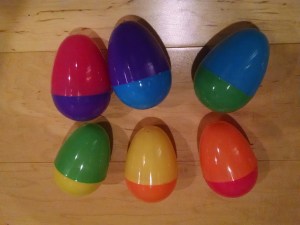
img_20160317_214040151

Kids love hunting for Easter eggs. Why limit the activity to just once a year?

We have a ziplock bag full of 10 plastic eggs. Anytime he wants to, my son asks us to hide them all. We have him sit in a chair in one room while we go to the next room to hide them. I count as I hide each one – he knows he has to wait till I say 10, then he comes running to find them. As he puts each one back into the bag, we count it. He has a great time, and here are some of the things he is learning:

  • Delayed gratification – having to sit and wait for something fun teaches that good things come to those who wait.
  • Counting and math skills – as he finds them, we talk about “You’ve found 7 eggs. How many more do you still need to find?”
  • Observation skills – some of the eggs are very easy to find to build his confidence, some are much more difficult – challenging him to build his skills at observation, understand that things can be present but out of sight (under the towel, behind the clock, etc.)
  • Persistence – sticking to one task until it is complete.
  • Vocabulary – if he’s having a hard time finding something, we tell him to look “under” this, “behind” that, “next to” this, or “between” that. We also talk about what color each egg is, reinforcing his color vocabulary.
  • Prediction – as we hide things in the same room over and over he can guess where some likely hiding places are based on past experience. Of course, we also trick him by moving on to new locations.
  • Approximation skills – usually the last egg is somewhere really hard to find. We help him in his search by telling him when he’s getting “warmer” (closer to the egg) and “colder” (farther away). He’s had a hard time getting this concept and what it means for what direction to go, but he’s getting there.

Developmental note: My son is three years old – if I had a two year old, I might start with 5 eggs instead of 10. And “hiding” them would really mean leaving them in plain view scattered around the room. For older kids, hide more, and make them harder to find.

For more ideas for plastic eggs and other eggs, check out my eggs post on my Inventors of Tomorrow blog, which focuses on STEM activities for kids.

Check out lots of other easy, cheap, fun and education activities for toddlers: https://bellevuetoddlers.wordpress.com/category/child-development/play-and-fun-activities/