Today, I listened to a webinar called Power, Proprioception & Play presentation by Kelsie “Mick” Olds (the Occuplaytional Therapist).
They talked about proprioception and its role in emotional regulation. A key idea was that there are three different types of proprioceptive input, and knowing which one is your child’s/student’s go-to helps give important clues about what they might need to avoid and manage dysregulation. The three types are:
Exertion – using their muscles
Impact – bumping part of their body up against something
Pressure – pushing part of their body against something
For each category below, I’ll list “Problem behaviors” they might demonstrate when “throwing a tantrum” or melting down, then list positive behaviors that meet this need. The positive things are activities you could use proactively to make sure their sensory needs are met (and meltdowns are less likely) or you could use to help a dysregulated child calm down.
Impact
“Problem behaviors”: hitting, kicking, breaking things, bouncing off the walls
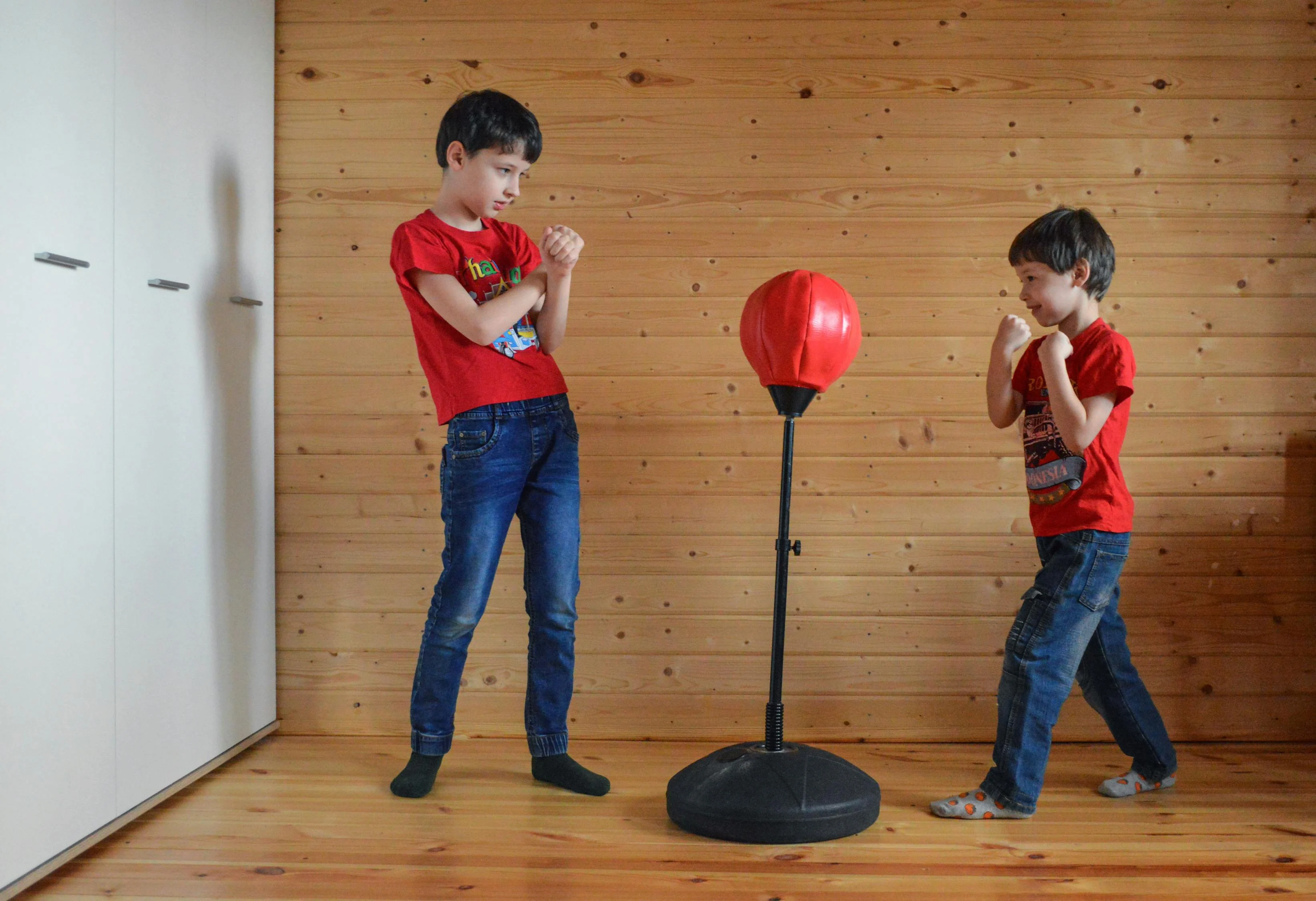
Positive actions: jumping, stomping, clapping, playing catch or tennis, tetherball, dribbling, drumming, trampoline, punching bag
Positive actions: running, dancing, pushing, lifting, “heavy work”, taking a deep breath, rolling out playdough, tearing paper, singing loudly, whisper scream
Pressure
“Problem behaviors”: clinging, climbing on other people, pushing up against others
Positive actions: hugs, leaning against someone or something, massage, weighted blankets and vests, compression clothing
For example, if whenever a child gets dysregulated, they hit or kick, that’s impact that they’re instinctively seeking. Asking them to take a deep breath (exertion) or giving them a hug (pressure) is less likely to be effective than an impact based tool like stomping their feet or banging on a drum. To avoid meltdowns, it might help if they get plenty of opportunity to bounce on a trampoline or playing catch to get the impact input that they need.
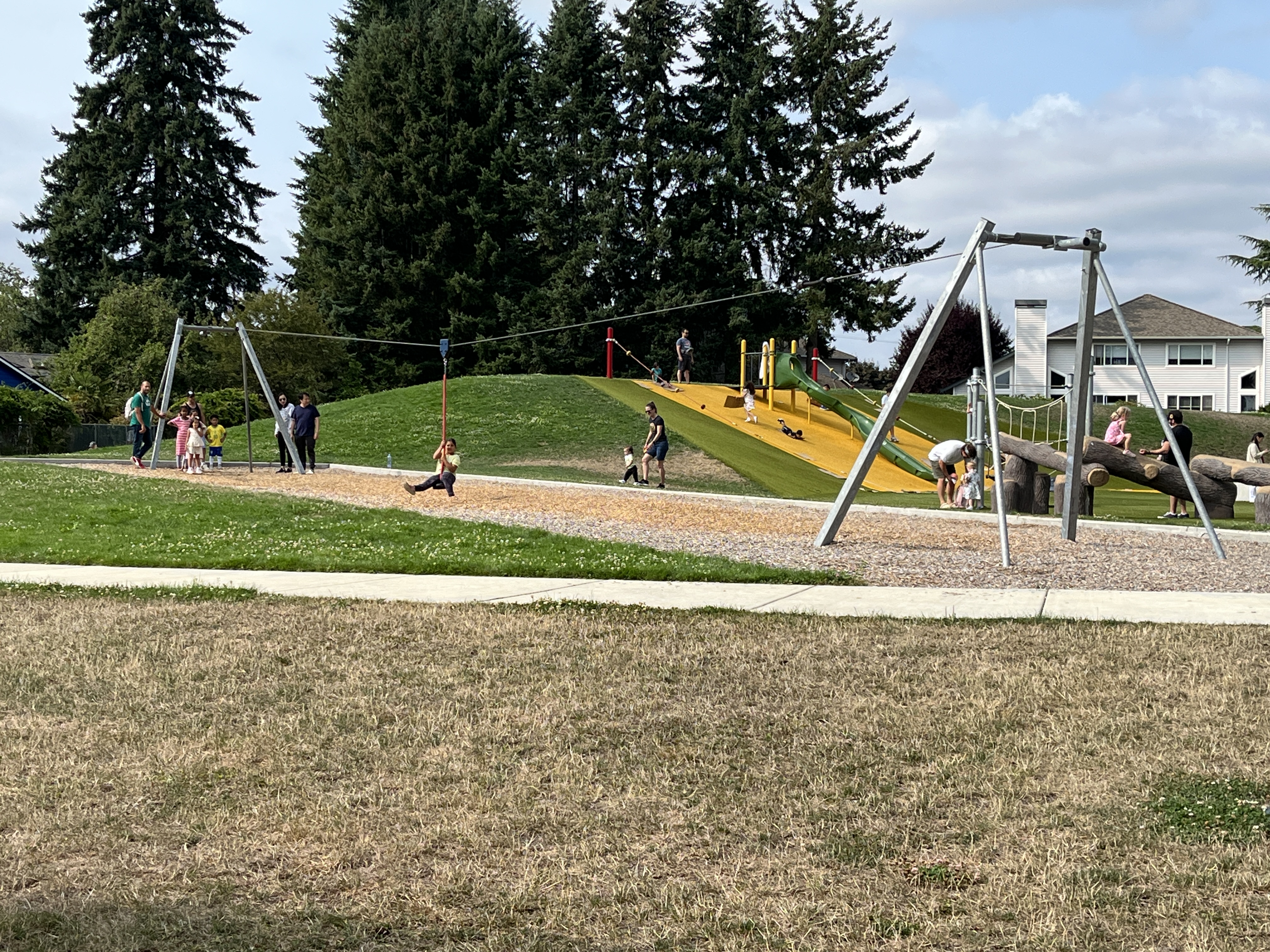
We tried out a new-to-us park recently – 132nd Square Park is located at NE 132nd St and 132nd Ave NE in Kirkland, about a mile east of Evergreen Hospital.
They have a multi-purpose synthetic turf playfield for soccer and more, a smaller grass field for softball or baseball, an all-abilities playground with zipline, year-round restrooms, and three picnic shelters. They also have a walking labyrinth and a reflexology path with raised stones to massage your feet while you do a walking meditation.
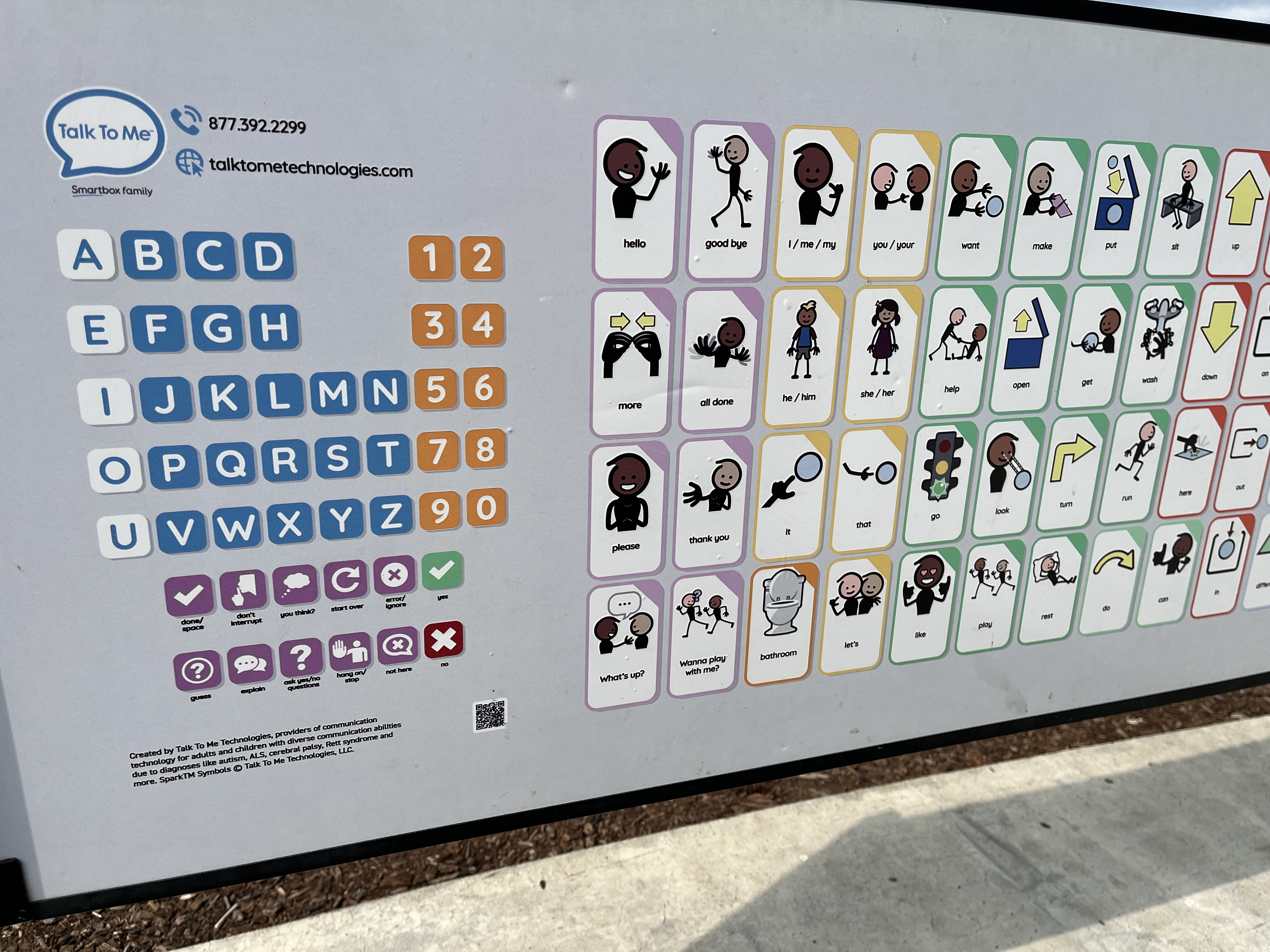
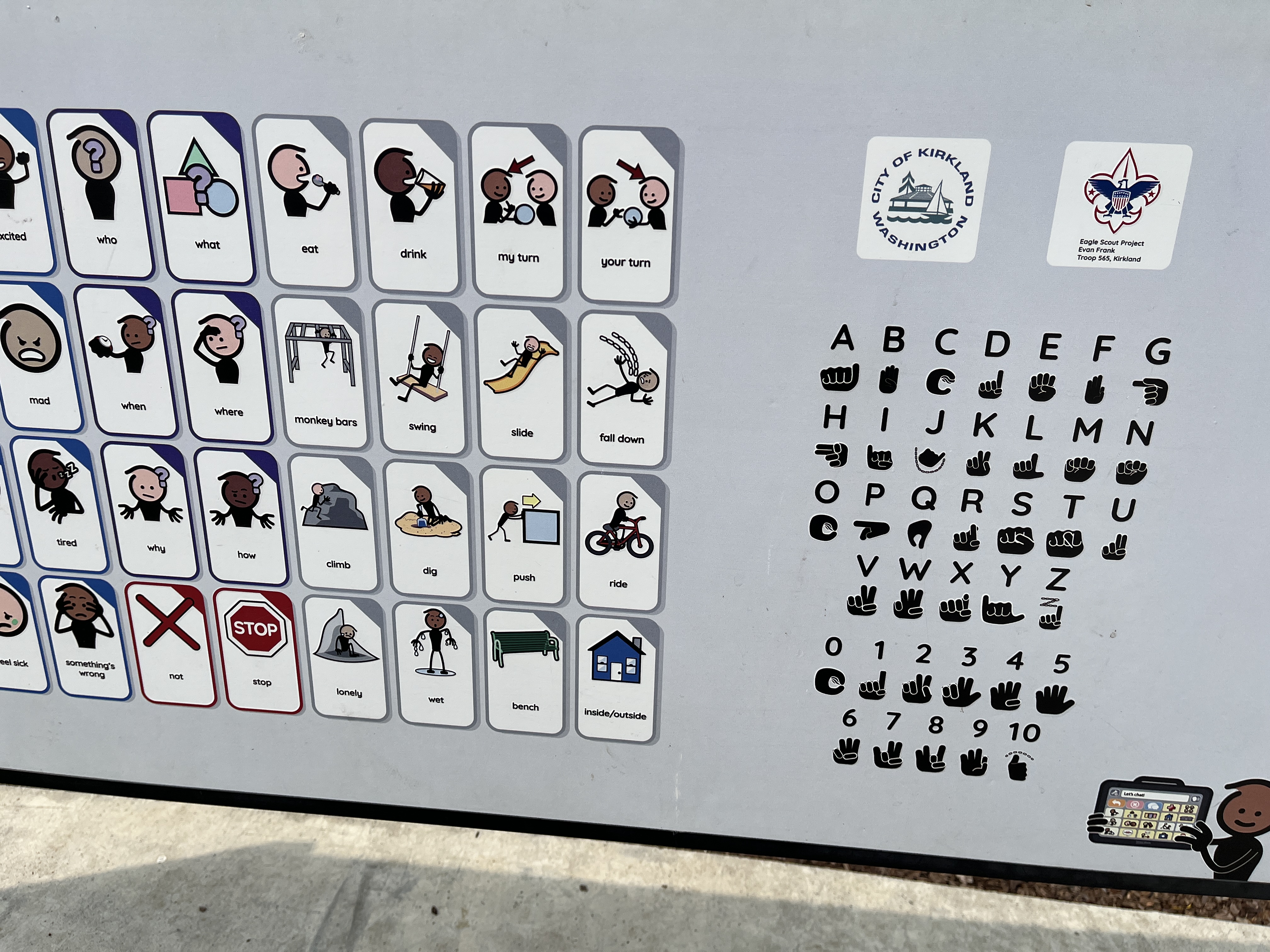
The big yellow hill is a fun and unique thing – bring a big flattened cardboard box to sit on and you can slide down that hill. On the playground there is also a communication board with symbols that a nonverbal person could use to communicate – it’s a nice opportunity to acquaint you and your child with this adaptive tool.
Some parents and pundits question whether we should be talking with young children about gender, and the reality is that we always have been! When I was a young child in the 60’s, pretty much every book I was exposed to taught a particular set of gender roles. I learned what girls were supposed to look like and act like and what activities they were supposed to enjoy. Then as a culture we began to talk a lot more about feminism and equal rights for women, and there started being more children’s stories about “girls can do anything” – they can wear clothes that are easy to move in, they can have any job. Over time, people came to realize that as we’d given our girls permission to wear anything and be anything, our boys were still trapped in “boys can’t cry” and only sissies are dancers” and “why would a man want to be a nurse.” So, again, we began to tell more diverse stories. And now, with increased awareness that at least 1% of people are transgender, children’s stories about gender identity are starting to become available. All of these stories can be “mirrors and windows” for our kids – mirrors when they see characters like them that help them to feel seen, and windows that help them better understand other people’s experiences.
I’ll share some book recommendations here – most are aimed at kid 3 – 5, unless otherwise noted.
Gender Roles
Gender roles refers to the activities that people do, as hobbies, responsibilities, or careers. Here are just a few that look at stepping outside of traditional gender roles, but there are probably hundreds of books on this topic.
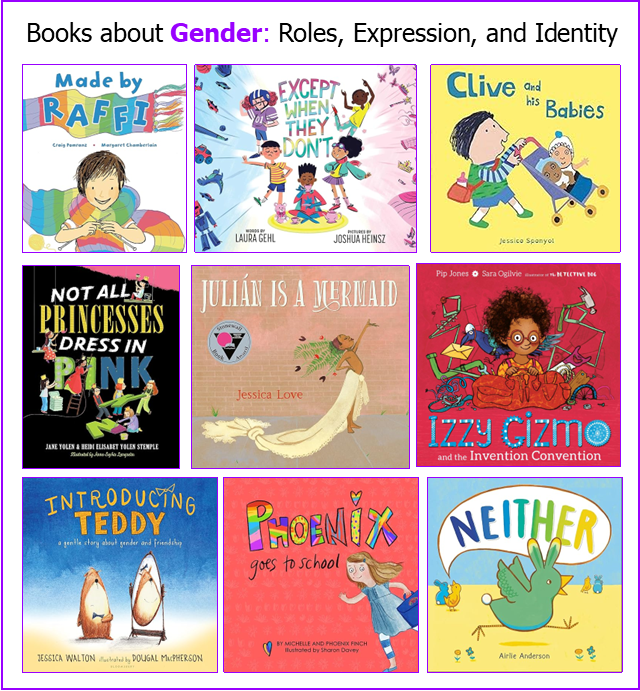
Except When They Don’t by Laura Gehl. Talks about gender role assumptions and the fact that they don’t always apply.
Made by Raffi is about a boy who likes to knit even though others say that’s a girl activity (role).
Paper Bag Princess. (video) For ages 5+. About a princess who saves the prince.
Princesses can be Pirates Too (Video) About a little girl who loves to wear pretty princess dresses AND wants to be a bold brave pirate.
Clive and His Babies (video) Shows a boy playing enthusiastically with his baby dolls. (Age 2 – 4) There’s also Clive and His Hats and Clive and His Art.
Rosa Loves CarsVideo. (age 2 – 4). There’s also Rosa Plays Ball and Rosa Loves Dinos.
William’s Doll (video) For 5+. About a boy who wants a doll. Others tease him or try to change his mind, but Grandma listens.
Gender expression is about how we dress, how we style our hair and makeup, and how we move (e.g. boldly striding along, or hunching shoulders and being small).
Julian is a Mermaid (video) tells the story of a boy who sees people dressed up as mermaids in a parade and tells his grandmother he is a mermaid too – she helps him to dress up.
Gender Identity
This refers to how a person sees themselves. Do they say that they are a girl or boy, and how do they feel when other people label them as one or the other.
Introducing Teddy by Walton. (video) Teddy explains to a friend that in her heart she has always known she was a girl and wishes her name was Tilly.
10,000 Dresses (video) is about Bailey, who wants to wear dresses and identifies as a girl, although others label Bailey as a boy.
In Phoenix Goes to School (Video), we meet a girl and learn about her, then she talks about going to school and worrying that the kids will think she’s a boy. She ends up having a positive and welcoming experience at school.
When Aidan Became a Brother (video) When Aidan was little, people thought he was a girl, but then realized he was a boy. This story is primarily about his family welcoming a new baby.
There are also some books that are metaphorical – they can be read as being about gender identity, but your child may not make the cognitive leap to understand that metaphor. For example, in Red: A Crayon’s Story, a blue crayon mistakenly labeled as “red” suffers an identity crisis and in Bunnybear, Bunnybear identifies as a bunny, and Grizzlybun identifies as a bear. If you’re just looking for books to encourage a general sense of acceptance of diversity and self-identification in your child, these are a great match. But if you want to specifically address gender identity, you will need to help your child see that message: “Remember that book we read, Neither? It was about a creature that was both a bunny and a chick, but not quite a bunny or a chick? That’s sort of like our friend Rex, who told us they are both a boy and a girl, and not quite a boy or a girl? They said that’s called non-binary. And remember how Neither felt sad when nobody accepted them, but felt happy in the Land of All where they were accepted? Can we be a Land of All for our friend Rex?”
This post is focused on elementary age children and questions to reflect on how parenting is different at this age. But first, let’s look at a theoretical approach to the different stages of parenting.
Stages of Parenting
Researcher Ellen Galinsky interviewed 228 parents (of 396 children) with diverse parenting experiences. She found common threads showing six distinct stages of parenting.
Stage One: Image-Making
Before the first baby is born, parents begin to create pictures in their minds of what parenting will be like and what kind of parent they hope to be. They began to adapt their home and their lifestyle to accommodate the child. They observe other parents and reflect on how they were parented to help create their self-image as a parent.
Stage Two: Nurturing
From birth through the first two years. Focused on physical care, soothing, snuggling, and playing. The main goal is to develop a relationship with their child. As the attachmentgrows, parents evaluate their priorities for how much time to spend with the baby versus other aspects of life, including other relationships, and how much of their identity is being a parent.
Stage Three: Authority
From about age 2 to age 5. Parents are more certain of their own identity as parents and of their relationship to their child. They begin to define the family’s rules, decide how strictly to enforce rules and what to do when rules are broken. The main task is deciding how much authority to exert over the child’s behavior versus how much freedom to allow.
Stage Four: Interpretive
The elementary school years. Parents evaluate their own strengths and challenges, and also evaluate their child in comparison to others and to their expectations. The main task is interpreting the child’s experiences as they are increasingly exposed to a world outside their family. Parents answer questions, and determine what behaviors and values to teach. They decide how and where the child spends time and with whom. They decide how involved to be, and when to make the decisions versus when to let a child make choices independently.
Stage Five: Interdependent
In the adolescent years, parents redefine their authority and renegotiate the relationship with their child, who is increasingly making decisions independently, out of the parent’s view. Parents need to trust that they have instilled good values in the child. They don’t allow their adolescent to have complete autonomy, but do allow for more discussion about rules.
Stage Six: Departure
As the child reaches adulthood, parents prepare for the departure, re-evaluate their parenting accomplishments and failures, and re-define their parenting identity and relationships. Parenting becomes less central to their identity and their daily lives.
Parenting in the Interpretive Stage
School and peer relationships assume the central role in the child’s life, and start pulling attention and energy away from the family unit. Parents have much less time with their children than before so need to be more focused on their goals for that time.
Here are decisions parents are making during their child’s elementary school years, as they realize the increasing separation between their identity and the child’s identity.
What kind of life do I want to provide? (And what can I afford to provide?) What do I say yes to in terms of new clothes or toys, and activities to do. What do I say no to? How do I manage the inevitable times when my child says “that’s not fair! All the other parents let their kids _____.”
How should I interpret the world for my child? For example, if they ask questions about race, death, sex, religion, and so on. How do I share my beliefs and values with them to give them an internal compass? (There are resources on how to talk about difficult topics at https://gooddayswithkids.com/better-you-than-youtube/)
How do I want my child to behave? (And have good behavior internalized as self discipline?)
What do I want them to be capable of and responsible for? (e.g. chores, practicing and playing an instrument or a sport) What new privileges / responsibilities will I introduce (for example: allowance, a phone, going places independently.)
How involved do I want to be involved in their life, at home and away from home?
When should I step in to help, and when should I back off and let them make decisions and try things independently?
How do I ensure they have the skills and knowledge to self-manage healthy habits like good nutrition, personal hygiene, and good sleep?
How involved do I want to be with the other significant people in their lives. (Friends, parents of friends, teachers, counselors, sports coaches…)
How do I support them when they’re navigating the emotional ups and downs of peer relationships? How do you monitor friendships while not overly interfering?
How do I hope to define our changing relationship? For example: how much do we hug, hold and cuddle as they get older? How involved are we in bedtime and morning routines? What do we do together for fun and connection?
When they are adults, how do I want them to look back on this time? How am I hoping they’ll remember what kind of parent I was?
I was just writing an end of year email to a parenting class, and wrote down my top ten takeaways from our whole year of learning together. They are also a fair summary of the information you’ll find on this blog:
Children behave better when they know what to expect and what’s expected of them. If a child is not behaving well, ask yourself: What support do they need, what systems would make it easier for them to be successful, what skills do they still need to learn?
With food: parents decide when and where it’s offered and what is offered. Children decide whether to eat and how much to eat. With all choices: Parents decide what options are on the table, children choose amongst those appropriate options.
Kids need time to run, to be loud, to be silly, to explore their world. Make sure there are a lot of “yes” times and places in their day. Taking small and manageable risks builds skills and independence, even if it means an occasional bump or bruise.
We learn from mistakes. Embrace them! Teach your child the Power of Yet: “you can’t do it yet, but someday, if you keep trying, you’ll be so good at it!”
Children learn best when they feel safe and happy, so play-based learning is powerful. Brains develop through novelty – being exposed to new experiences – and repetition – having the chance to do something again and again till they master it. Explore art, the outdoors, large motor play, building things, doing crafts, and more.
There is no one right way to parent. If you, your child, and other family members are happy, healthy, and succeeding at your goals, then all is well. If you’re unhappy or not feeling successful, seek out new ideas and seek out support. (Parenting classes, counseling, support groups or just connecting with other parents!)
You will have good days and bad days as a parent. When you have a bad day and are not the parent you want to be, acknowledge that, forgive yourself and commit to doing better in the future. When you are having more good days than bad, celebrate that! You’re doing a great job.









 More Good Days with Kids