Author Archives: Janelle Durham

Unknown's avatar

About Janelle Durham

I am a parent educator and social worker, and teach music and science to children age 1 - 8.

Encouraging Prevention

The TL; DR summary – If you are hoping to encourage those around you to take more steps to prevent the spread of coronavirus: don’t shame them, do listen with empathy to their concerns, support their efforts at risk reduction, understand that people may make different trade-offs than you would, be intentional about who you interact with, help give other people the tools to have conversations about risk reduction, and model the behavior you would like to see.

Where do we start?

As a parent and a parent educator, I talk a lot to other parents. Many are angry when they see people not wearing masks – they may think “because of people like you, my kid can’t go to school!” They may shake their heads in dismay when they see unmasked teens hanging out in close-knit huddles, inches apart, saying “if that were my kid….”. They express frustration at in-laws who talk about having a lovely time at a party with friends (unmasked) and then want the grandkids to come to their house for a visit. They read social media posts from friends who believe coronavirus is a left-wing conspiracy, and ask me: do you sometimes feel like you want to shake people and say “what the h*%$ is wrong with you?”

But let’s be honest: Do you think that scolding anyone for the choices they make will make them change their ways? No. You know that will just make them dig in their heels more. But what approaches might work to encourage more people to take more steps to prevent coronavirus spread?

We can learn a lot from previous approaches to public health messaging, and approaches to education in general.

Shaming Doesn’t Work

Julia Marcus, an epidemiologist and professor at Harvard Medical School, has been doing some great writing and interviews on this subject. (In The Atlantic, Teen Vogue, and the Harvard Health Blog.) Many of the ideas in this post come from her.

She talks about what we learned from AIDS: “When you shame people as a way to try to get them to avoid risky health behaviors, it doesn’t generally make the behaviors stop — it just makes people want to hide the behaviors…” It’s hard to hide not wearing a mask, so some people may decide to have indoor parties with friends, and then later won’t disclose that to contract tracers. “So rather than shaming, what we can do is try to meet people where they are, understand what is getting in the way of them adopting the protective health behaviors that we want to support, and then try to mitigate those barriers.” (Source)

I teach about positive discipline techniques – when we’re connected to someone, how do we shape their behavior. Although shaming someone doesn’t tend to be effective in the long run, the attention principle does. Pay attention to whatever behavior (no matter how small) that you want to see more of. I have family in Kansas that worries that few people are wearing masks although they do put one on when they talk to her – just saying “I appreciate you brought your mask today” or “what a lovely mask” will do more to encourage them to wear it than saying “why aren’t you wearing it all the time?” Another idea from parenting / education that I find helpful is Ross Greene’s idea of “people do well if they can” – if they’re not doing well, what skills, tools, or support do they need to do better? This post will cover lots of those ideas.

Try Empathy

If you try to start a conversation by sharing all the information you have on why they SHOULD wear a mask, they can get defensive and push back harder. Or if they tell you about a party they went to, and you pull out your data sets, they’ll walk away.

“Instead of telling someone what to do right away, you want to explore why they’re doing it, and what is the reasoning behind their behaviors, in a very unbiased and nonjudgmental way,” says Dr. Michael Richardson. (Source)

70% of Americans believe people should wear masks. (Source) “But just like the well-intended condom on the nightstand that never makes it out of its wrapper, some masks don’t make it onto someone’s face—often for relatable reasons.” (source)

In one neighborhood in Seattle, here’s what people report about their actual behavior. Always wear a mask – 67%; Frequently – 18%, Sometimes – 9%. Rarely – 1%. Never wear a mask: 5%.

So, try asking people what their reasons are – what are their barriers?

Empathize with their experience. Listen to their concerns. Share your own frustrations, and the solutions you have found that work for you, being careful to make I statements not you commands. “I know – I hate how they fog up my glasses! I’ve had better luck with my new mask with the wire, but it is frustrating.” “I know, it’s weird to me to not see people smiling at me and not be able to smile back. I’m trying to figure out body language ways to communicate, like waving or nodding.” “I’m also so overwhelmed by the news that part of me wants to think this is a conspiracy and it can’t really be as bad as they say. But I still wear my mask, because what if I did have it and went out before symptoms developed, and someone I love gets sick because of me.” “I get so hot in the grocery store – I hurry along, reminding myself that the sooner I’m done in the store, the sooner I can get to my car and take my mask off.”

“Acknowledging what people dislike about a public-health strategy enables a connection with them rather than alienating them further. And when the barriers are understood, they become addressable.” (Source)

Risk Reduction Approach

It’s hard for all of us to abstain from social contact. It may be especially hard for young people and extroverts of all ages. Instead of demanding that they abstain from seeing their friends, maybe we need to take lessons from what we’ve learned in a comprehensive review of abstinence only sex education: “Many adolescents who intend to be abstinent fail to do so, and when abstainers do initiate intercourse, many fail to use condoms and contraception to protect themselves.”

“Comprehensive risk reduction (CRR) interventions promote behaviors that prevent or reduce the risks… These interventions may: Suggest a hierarchy of recommended behaviors that identifies abstinence as the best, or preferred method but also provides information about sexual risk reduction strategies.” (Source)

Instead of just talking about what someone can’t do, we could talk about what they can do and how to make that as safe as possible. Instead of saying “you can’t see your friends”, you start with “I get that you want to see your friends.”

Then, we can acknowledge that, from the coronavirus perspective, the safest option is just to stay home and talk on Zoom. But, if they feel they need to see people: then, talk about how to do that with less risk: such as using masks, social distancing, where to do that: meeting people outside, going for walks outdoors with someone, what to do – a bring your own picnic where you sit several feet apart; when to do it (when you’ve had minimal exposures recently) and who to do it with.

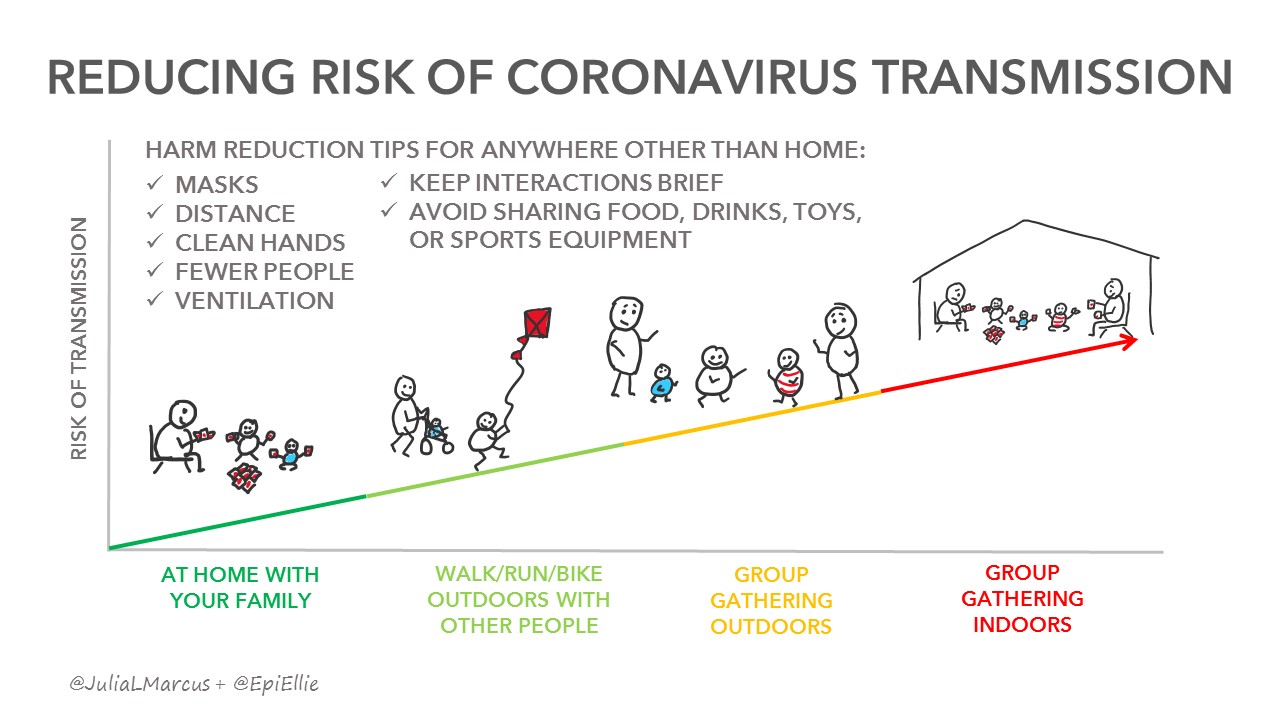
As Mark Levine, chair of the NYC Health Council, says: “If we don’t give people the information to choose low-risk activities, they will choose high-risk ones–like house parties, large gatherings in front of bars… So let’s give people the tools to understand that risk is a spectrum. * Outdoors is less risky than indoors. * Small groups are less risky than large groups. * Simply passing by someone is less risky than sustained contact.” He shared this graphic, which shows staying home with your children has the least coronavirus risk, then going out in the community, then meeting friends outside, and then playdates at a friend’s house, which you might only want to do after very careful consideration.
Image

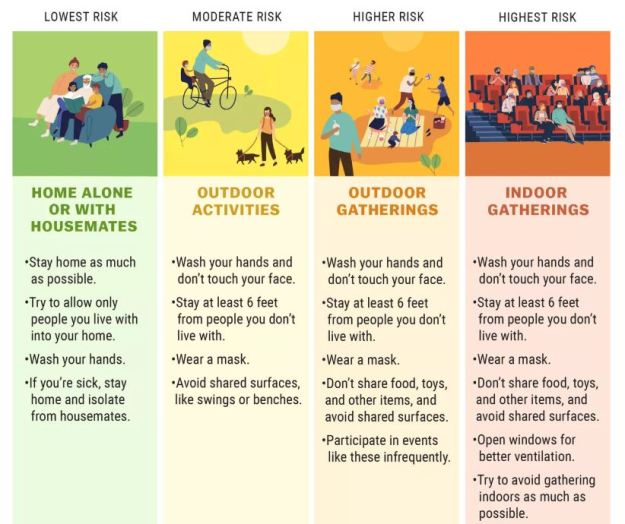
Vox took this idea and adapted it. Helping people understand the different levels of risk and what precautions need to be taken at each level can help them make decisions about the risk reduction methods they think they can follow reliably.
spectrum of risk

Trade-Offs

When we see teens and  young adults hanging out at the park with friends, it’s easy to think they’re foolish and careless: “Young partygoers have become the latest scapegoat for America’s pandemic woes… Risk taking typically peaks during young adulthood, when people are most responsive to the rewards of a risky choice.” However, that may not be the whole story: “The issue isn’t that young people are universally unconcerned about the pandemic; it’s that they realize it’s not the only—or even the greatest—risk they face… [young people are at] lower risk of complications from coronavirus infection than older people—but at far greater risk of psychiatric disorders that can be triggered or worsened by social isolation…” (Source)

For sake of reducing coronavirus risk, the safest thing would be for all of us to stay at home. However, many of us can’t, due to work or other requirements, or lack of a safe home environment. And there are many other reasons we might not want to stay at home. How do we balance the demands and desires to get out of the house with reducing risk of transmission?

I’ve worked with pregnant clients for over 20 years now. When I talk about healthy nutrition, avoiding substances and medications and so on, I have always tried to take the approach of offering the best information we have about what is best for a developing baby, while also acknowledging that babies are surprisingly resilient. I encourage making the healthiest choices, but also say – “if you’re making an unhealthy choice in one area, can you try extra hard in the other areas to balance it out?”

If I tell a smoker about all the evils of smoking and that they should never ever smoke, they might rebel against that – “my friends all smoke and their babies are fine!”, or they might give up – thinking – if I can’t do anything right, why try at all. Instead, I say “we know smoking is harmful, so it’s best to avoid it or reduce it as much as you can – in the meantime, here are some other healthy choices you can focus on.” And typically, they make these other healthy choices and significantly reduce their tobacco use.

We can take some of the same approaches to coronavirus. Balance the risky choices with low risk choices.

We have mostly had our son at home for 4 months now. He’s barely been in other buildings or with other kids. But, next week, he’ll go to an in-person summer camp. We’ve decided that he needs that brief respite from quarantine life at home and that brief chance to engage with other kids and build his social skills (our son is autistic, so this is especially challenging for him). But, in making that decision, we also looked at risk reduction – making sure the camp had good protocols, and at other trade-offs. This week we’ve had minimal contacts to ensure he’s healthy and not bringing something to camp that will affect others, and for ten days after camp, we will be extra careful not to expose others to him (or us) just in case he picks something up. And of course, there will be masks and lots of hand-washing.

So, different people may have different degrees of comfort with exposure risks and how they’re managing them. But each of us can be making our own decisions, and figuring out our own trade-offs.

“Instead of moralizing, harm reduction comes from a place of pragmatism and compassion. It accepts that compromises will happen— for perfectly understandable reasons—and aims to reduce any associated harms as much as possible.” (source)

It helps to have a tool for comparing risks. I really appreciate this risk index infographic from Dr. Ezekiel Emanuel, Dr. Saskia Popescu, and Dr. James P. Phillips, which looks at the risk of various activities, assessing based on 4 factors that increase risk of transmission: Enclosed space, longer duration of interactions, crowds, and forceful exhalation (e.g. singing, shouting, breathing fast while exercising.)
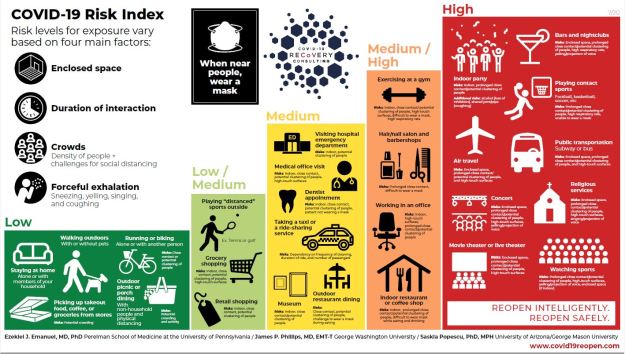
covid-19 risk index

Bubbles and Pods

Many people have chosen to “expand their bubbles” or “create a pod” where a small number of people choose to socialize exclusively with each other as a “quaranteam” without the need for physical distancing. I know of many parents of young children who have made this choice so their kids get a chance to practice and develop social skills (and so the parents get an occasional break from 24/7 child care.) Check out this article on the Dos and Don’ts of Quarantine Pods and CNN’s Guide to Creating a Pandemic Bubble. This article in Slate does a nice job of talking through one person’s experience with this. The point of a pod is to be intentional – rather than having random encounters, you really think through what type of contact you most need, and with whom, and be sure that the people in your pod have a similar risk tolerance and exposure level to you.

Navigate Social Barriers

Bubbles require a lot of awkward conversations and negotiations. When gathering with others, it can be hard to be the one to start the conversation about how to reduce the risk of gathering. Some people, especially teens and younger adults, may find themselves going along with risky behavior because they don’t want to be seen as the wimpy, over-cautious person. They may need somewhere to practice limit setting. We learned with the “Just Say No” approach to substance abuse education that it wasn’t enough.

Just Say No was “essentially a failure at dissuading young people from doing drugs. … teenagers enrolled in the program were just as likely to use drugs as those who did not receive this training. Programs that did make a difference acknowledged the difficulty of just saying no, coaching kids on how to handle social expectation and peer pressure.” (Source)

“[Effective programs] teach students the social skills they need to refuse drugs and give them opportunities to practice these skills with other students — for example, by asking students to play roles on both sides of a conversation about drugs, while instructors coach them about what to say and do. [They] take into account the importance of behavioral norms: they emphasize to students that substance use is not especially common and thereby attempt to counteract the misconception that abstaining from drugs makes a person an oddball.” (Source)

Starting to have conversations about reducing coronavirus risk while still interacting with others can help reduce the overall risks.

Role Modeling

Sometimes the most effective way to make change is to be the change you want to see.

If parents want their kids to wear bike helmets, they should too. If one tween in a group puts on a bike helmet, the others will too.

We started wearing masks to the grocery store before it became common, and once I noticed that someone we passed by then took her mask out of her purse and put it on. She wasn’t quite bold enough to be the “only one” but seeing other people make that choice made it more comfortable for her.

I have also found that if I can talk about my decision-making in a calm, reasoned way, rather than with fear-mongering and scolding, it can create more openness in others for making their own thought-out decisions rather than knee-jerk reactions.

“Unlike abstinence-only messaging, which simply instructs people to stay home, a harm-reduction approach acknowledges that people will take risks for a variety of reasons, including a basic need for pleasure….The abstinence-only and harm-reduction approaches share the same goal of reducing the cumulative burden of severe illness and death. But harm reduction is more likely to achieve that goal by supporting lower-risk—but not zero-risk—activities that can be sustained over time.” (Source)

Vox has a very helpful collection of coronavirus risk reduction tips: 8 ways to go out and stay safe.

McAuliffe Park – Kirkland

20200614_221255502_iOS

After 30 years on the Eastside, and 6 in Kirkland, I had never been to McAuliffe park. I’d driven by on 116th countless times, but from the road, it didn’t look like much, so I never stopped in. But then on the Kirkland Rocks Facebook page, people would often post that they’d hidden beautiful painted rocks at McAuliffe for kids to find. So, finally we went. And this park is a unique gem!

It’s at 10824 NE 116th Street; halfway between Totem Lake and Juanita Village.

It’s 11.6 acres, with lots and lots of wide open lawn, shady orchard trees to throw out a picnic blanket below, a playground, picnic tables, nature trails, a community pea patch with 35 plots, an antique barn, 2 windmills, and lots of ancient rusted farm equipment and old gas station memorabilia to explore.

The community learning garden features permaculture principles, annual vegetables grown with organic practices, a new rain garden, and water and resource conservation. The Tilth Alliance offer classes at the park.

The property was homesteaded in 1877, and only two families owned it between that time and when the Kirkland Parks department acquired it in a series of purchases from the 1990’s through 2017. Read more (and see more pictures) on Active Rain, and in the Master Plan report. (Note: the master plan from 2005 had grand visions for the site, but it does not appear most of them were implemented.

We visited in the midst of coronavirus season, and there were maybe 30 people we saw there, spread out over 12 acres, so easy to socially distance! The playground was closed when we were there, due to quarantine, but people were hard at work in their plots in the community garden, and a few families were relaxing in the shade. It struck me as a great place to take 3 – 8 year old children where the parent(s) could sit and relax and the kids could run quite a ways, and play while still being safely in the parents’ sight. There’s even some nice low climbing trees.

It’s a park well worth visiting when you’re in the mood for a little wandering around and exploring or a little sitting under a tree reading a good book.


Making School-from-Home Work

Like millions of parents around the world right now, I’m learning how to support my child in “attending” public school from home. (Note: I call this school-from-home rather than homeschooling, because  it’s a very different experience for those who are  doing it due to the pandemic, versus those who chose it for a long-term path.) I’ll share here the system that is working for us, in case it is helpful to others, but there is no one right approach that will work for everyone.

What the School Gives Us

My son is in the third grade in the Lake Washington School District (in the suburbs of Seattle). For 3rd grade, they’re supposed to do about 150 minutes a week of reading, 150 minutes of math,  60 minutes of writing, one “library” activity, one music and one PE. Plus, if time, 30 minutes science and 30 minutes social studies. It’s supposed to add up to 1 – 2 hours a day, or about 8 – 10 hours a week. We find it takes about 2 – 2.5 hours a day to complete the assignments.

It is primarily screen-based, with apps and online learning platforms that guide the kids through the activities. They can do the activities at any time. Twice a week, they have a brief class teleconference on Teams where they mostly check-in – sharing what they’ve been up to. Weekly schedules are sent each Monday, and every Thursday teachers check if the kids have done their work.

Here is a sample weekly schedule.

schedule

Do you feel overwhelmed looking at that? I sure do! We haven’t even shown this to our son, because he would overload just from imagining all this work hanging over him.

On Facebook, I’ve seen some parents say they’ve set up a schedule, where they do reading from 9 – 9:30, math from 9:30 – 10, and so on. That would not work with my son. Forcing him to do something when he’s not in the mood is really a battle – if he can choose when to do something, it goes much better. At least most parents built in recess / free play blocks into their schedules, and that would make it better!

Some parents sit down one on one with their kids all day – as a working parent, I can’t manage that.

Our System

Our school system did not offer the online learning in the early weeks of the closure. But we needed to do something… my husband and I work full-time from home right now, and we need ways to keep our son busy! If it were up to him, he would be on video games and YouTube all day long, and barring that, would read all day long. He needed to have more balance than that, so we invented our Suddenly Homeschooling system. When the school district added in distance learning, we adapted our system. It works great for us, as it gives him a lot of flexibility and choices, while also providing a lot of structure and routine (very important to our son, who is autistic) and communicating what our expectations are for him to accomplish.

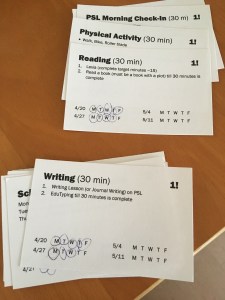
cardsWe have a system of cards, each representing a piece of his work. He has to complete 8 cards a day. When he has completed 4, he earns an hour of screen time. When he has completed 8, he earns a second hour of screen time. Then, he is done with his work for the day, and done with screens for the day.  Each day he has 6 cards that are required (morning check-in, reading, math, writing, science/social studies, and physical activity – he needs to burn off some energy for all our sanity!) The others are flexible – practicing playing recorder, calling his grandparents, helping with extra chores, etc. Click here to see all his: Cards.

We keep the cards on the desk where my husband and I work, and whenever our son finishes a task, he comes over and we check it off, and help him figure out what he wants to work on next. If he needs help, one of us helps him, and then gets back to work. If he wants a snuggle, he sits in our laps and we work around him. We work breakfast and lunch in around the schedule he chooses – he often eats while listening to a read-aloud or watching a video for school. Or he takes a break and we eat socially – it’s up to him.

Having the cards rather than a checklist works really well for us. The tangible nature of being able to sort through the cards, put the completed tasks in one pile, put the next task on the top of the pile, and see the required task pile dwindle as the day goes on feels much more manageable for us than looking at that checklist of all the week’s activities all at once.

Some days, he stays really focused, and he whips through the first 4 points by 10:30 in the morning, and done with all his work by 1:30. Other days, he dinks around, or chooses to read for fun instead of doing his school work, and it takes till late afternoon. When he’s dinking, we remind him of the impact of that choice, but sometimes he decides that’s the way he wants to balance his responsibilities and his relaxation, which we think is good learning, as that’s how things will work in college and much of adult life.

And if he’s done his work, which has allowed us to complete our work, then we have the shared reward of evenings that are relaxed social time for all of us. Movies, walks, and games.

I’m not saying it’s perfect. We have certainly had some big battles! (I feel like i need to post a sign to my neighbors saying “If you hear screaming from the house, don’t worry… it’s just that we said screen time is done for the day.”) But all in all, I feel like we’re on the right track for our family.

* Not One Size Fits All

I want to be really clear that I know different things work for different people -different kids have different skills, temperaments, and challenges in their environments – different parents have different skills, temperaments, and challenges in their environments – there’s never one right answer!

I also totally get that not everyone has the same resources available to them – we are lucky to have the devices we need for online schooling, good internet access, reliable access to food and safe housing, and the ability to work from home and maintain our income, and we’re two parents with one kid (we have two other children, but they are adults and are not living at home), so truly, I have no judgment for other people who are having a hard time making things work.

I think it is a fair and reasonable thing for some parents to choose to opt out of schooling from home. Doing school is mostly a soothing routine for us. If it creates tons of stress for your family, and trying to get through it is feeling stressful or even traumatic for you, you might make other choices. I hear (on Facebook – haven’t verified) that you’re not required to school children under age 8. (And I believe in the power of play-based learning for young kids! So you might be able to create a play-based system that works for you). I suspect that for older kids, you could do some paperwork to transfer over to “homeschooling” which has looser requirements.

Or many parents are just communicating with their schools and teachers and saying “here’s what our family is doing for school” (e.g. ‘schoolwork in morning only – we don’t do any in the afternoon’, or ‘we’re doing the math and the check-in, but we’ll do our own reading and writing lessons’) and there seems to be a lot of flexibility in the responses to that. The LWSD website says “During the mandated school facility closure… teachers will [track] students who are not participating in remote learning or responding to communication. This information will be used to help us reach out to students and families who may need additional support. This information will not be included in students’ official records or used for enrollment or penalties.”

Find the path that works for your family as we move through these unprecedented times.

As a parent educator, when parents ask me “is ____ a problem?” I always come back with: “is it a problem for you or your child, or is it working well for everyone in your family?” If you have found something that works for you, hurray! If not, then hopefully my post gives you some insight into one possible option.

Postscript… LWSD system

This is just for anyone who wants more info about what the programs are that our school is offering.

Starting last week, they are offering remote learning resources, and kids are required to submit schoolwork that will be graded.nThe work is all organized in an online platform called Power School Learning. So, they log in to PSL and most other things are linked from there. (Note: one thing that makes us crazy is that all the different sites have different user names and different log-in info! We’ve created a document in One Note that we can see on all our devices, so it’s easy to look up the passwords anytime / anywhere we need them.)

They have a morning check-in question they can all add a comment to, Wonders vocabulary, Lexia reading, Envision math, Dreambox math, Edutyping, plus materials developed by the teachers: writing activities, science and social studies, listening to a class read-aloud book, and doing activities provided by the music teacher, PE teacher, and counselor. They’re having a Microsoft Teams meeting with their teacher twice a week – these are mostly social check-in times. (Some parents have complained about this, wishing their teachers would teach, but as a teacher myself, I would argue that what the kids need out of this time is the thing that no online app can possibly replicate, and that’s the social-emotional aspects of connecting to their teacher, their classmates – people outside their home.)

For kids who are strong readers, who enjoy screen-based activity, and who don’t need lots of social interaction with peers, it’s a workable program for this public health crisis. But it’s not as good a match for many.

Suddenly Homeschooling

Due to coronavirus, millions of parents across the country (and around the world) are suddenly homeschooling their children. Some may feel prepared (they’re teachers!), some may have all the resources they need at home, but many of us are under-prepared, under-supplied, and also trying to figure out how to manage that along with all of our other responsibilities in this new era. We’re all faking it together and figuring it out on the spur of the moment!

For us, school suddenly disappeared. One afternoon we found out that at the end of the school day, they were closing for two weeks, then the next day that became six weeks. We took a few days off from being responsible. For the first four days, we let our son do whatever he wanted to (well, we limited his screen time to two hours a day, but otherwise he was flexible). But we told him we were just doing that for a few days, and he should expect that on Monday, we’d start homeschooling. That gave me a few days to come up with ideas.

I turned to homeschooling parents for advice, and I’ll share with you here the plan we’ve put together for our nine year old.

But first, let’s say:

Go Easy on Yourself

Don’t put a ton of pressure on yourself! Don’t feel like things have to be perfect!! Don’t worry that this will cause them to fall behind and never catch up. We’re all just going to do the best we can. Luckily, kids are resilient, and they will bounce back from this experience! If some days, you’re exhausted and swamped with your own burdens, don’t feel guilty about using screen time. If you feel like you should be making your child do math homework, but you just need to get the laundry put away, then today becomes Life Skills 101 instead of math, and you teach your child to fold laundry. It’s all OK.

And if you know that trying to homeschool your children would make you miserable, would make them miserable and turn every day into a battle, then don’t do it!! We never want kids to resent “school” so much that they decide they hate learning! I believe that love of learning is the biggest key to success in school and life, so do whatever works for your family to preserve that. Feel free to run with the Free Range philosophy and do whatever whim strikes you for the day, letting your child self guide their learning – reading books all day, doing Lego all day, whatever!

Many parents find that unstructured spontaneity works well for their family, many recommend having a bit more structure than that, so the rest of the post offers some structure and routine in case that is what is helpful to your family, as it is for mine.

Making a Plan

I’ve seen a variety of advice, but this is the one I find the most helpful summary. It’s from Mary Oemig, President Boom Learning (former homeschooler).

Each child should write a plan for the day each morning. Younger kids might need a little help with ideas. Older kids should include open items assigned from teachers.

All kids should include:

1. A reading activity
2. A writing activity
3. A math activity (games are great for younger kids)
4. A science activity (for youngers can be observations about spring during a walk – note changes each day, observe weather, online videos)
5. A social studies activity – history of plagues is relevant, lots of great educational videos on YouTube. 🙂
6. A PE activity – walks and bikes are good. Playing on playground equipment not so much.
7. A plan for playtime/free time.
8. Life skills / chores

Develop a system for family members to communicate to each other “Do Not Disturb” and “Available for Play”. Reinforce respecting whichever system you come up with.
Parents should have a set time during the day to review the plan with each kid to help them learn time management. This is a great opportunity to develop self-management skills.

I suggest that you do not dictate the schedule but rather guide children on developing their own plan.

For those who care: The research source for this approach is Tools of the Mind. They use this method with children as young as pre-school.

The idea of creating categories to complete was really helpful for me. (I’ve been teaching this idea for years when talking about how to choose toys and activities for babies, toddlers, and young children, using the theory of multiple intelligences – read more here.) I decided to build a system of cards for my son.

For each card, he earns either a full point or a half point. He’s not allowed to have any video game screen time before noon, no matter what. After noon, WHEN he has completed 5 points (~2.5 hours) THEN he gets one hour of free choice screen time. He then has to complete 3 more points to earn another hour of screen time, and that’s the maximum for the day.

My husband and I are both working full time from home, so his activities needed to be things he can do mostly independently.

20200317_173352039_iOS

Each card has criteria for what could qualify for completion – sample activities he can choose from. Here are his cards. The first 4 cards are required to complete every day. The others are options to choose from.

  • Reading – 30 minutes. 1 point. Lexia app from school, reading packets from school, or reading a book. To count for school work, it must be a book with a plot. Fiction. Not comics. Paper or ebook is fine. (He loves reading and would read all day, so this is the easy one.)
  • Writing – 20 – 30 minutes. 1 point. Practice on Edutyping app. Journal, write a letter, email, write a book report to share with a family member (we might also start writing Amazon reviews), write reflections on science homework. (He hates writing, so this is our hardest one.)
  • Math – 30 minutes. 1 point. Can use Dreambox or Xtramath – online programs from school district, or complete math packet from school. He can also use apps that drill him on multiplication facts. Sudoku, Numbrix, or other math puzzles. Math heavy board games or card games with parents.
  • Physical Activity – 30 minutes. 1 point. Could walk, bike, roller blade, play catch, etc. (This is a good time to rummage through your garage or closets for that sporting equipment you never use… we’ve got roller blades we hadn’t used in a decade!) He could do Wii sports to count for this, but he must spend a half hour outside every day, so if he does Wii sports, has to plan another outside activity, even if that’s sitting in the sun while reading. (Note: yes, you can still go outside now! Just minimize touching anything others have touched, so no playground time, and keep your distance from others.)
  • Science – 30 minutes. 1 point. Can include an educational video (there’s lots of great science content on video!) or a podcast. Could be a book. Must include something hands-on / active learning. (I teach hands-on science classes, so this one is easy for me… if you’re looking for resources for science learning for kids age 3 – 8, check out my other blog, www.InventorsOfTomorrow.com.)
  • Social Studies – 30 minutes, 1 point. Can include video, podcast, or book. Can cover history, other cultures, social/emotional skills, and so on. (We’re thinking of podcasts like Short and Curly – an ethics / philosophy podcast from Australia, or Dad and I Love History, or Forever Ago. Let us know what else you like!)
  • Call his grandparents. Half point. We haven’t seen them in person for two weeks because we don’t want to risk exposing them to anything (they’re in their 80’s), so it’s nice to connect via Skype. His grandma is teaching him some Spanish as they talk.
  • Play recorder for ten minutes. Or make art. Half point.
  • “Life skills” – like folding laundry, cooking, cleaning. (One of the things we can all do with our coronavirus break is bring back Home Economics and shop / Industrial Arts classes! Whatever work you need to do, have your child do it with you! Half point.
  • Social Time Online – Zoom or Skype calls with friends, family, church members, and so on. Half point.

At the beginning of each morning, we have a stack of cards. He gets to decide what activity to do first. I flip the card over, and write when he started doing that activity. When he reports back, I write what he did so I have a record. I’m not super strict about the 30 minutes – anywhere in the 20 – 45 minute range counts. He can combine some activities: for example, if he plays recorder for his grandma on Skype, that counts for two half point cards. If he draws while he listens to a podcast, that counts for art and social studies. If he writes about science, that could count for both. (He has to ask permission to double count before starting the activity.)

So, you’ll notice that if you add up all those cards, it does not add up to maybe 4-5ish hours, not 6.5 hours, which is how long his school day was. (And if he doubles up activities, it’s less than four hours.) Parents might worry that they’re not doing “enough” if it’s not 6.5 hours of school work. Here’s the deal – at school, they’re not getting 6.5 hours really! They’re eating lunch, having recess, walking down the hall to music class, waiting for their turn with the teacher, and so on. You can get more done in 3 – 4 hours one-on-one. And they (and you) will have time off from worrying about “school.”

Having the flexibility to decide what order he does things in has been super helpful to him. And if he’s enjoying a science show and wants to watch two, he can do that, he just knows it will take longer to get through his points and longer till that screen time, but he can make that choice himself, which he likes.

So, I’ve created the structure and the requirements, but give him a lot of freedom of choice within that structure. So far it’s working well for us… hopefully it continues to.

And if you think it sounds super hard and time consuming, I promise you it’s not! I literally have been working 8 – 10 hours every day and squeezing management of his “school” in and around that, and it’s just some quick check-ins every half hour. And if you think I must have an angel child for this to work, I should say that my son is diagnosed as autistic, and suspected ADHD, and we know the principal at the school very well, and the resource room teacher very well, because he spends a lot of time with them! But, for him having this structure, with the freedom of choice within the structure is exactly what he needs.

If you have advice, suggestions for resources, or questions, just add them to the comments!

Circle Time for Toddlers

music-play-youth-musical-instrument-children-sports-sound-music-group-human-positions-music-garden-995658

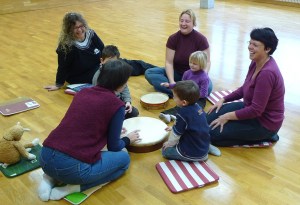
I teach a parent-child class where the toddlers are 12 – 30 months in September. Each week, we do a circle time for music and stories. I tell the parents that not only does music have many benefits for children’s learning, and not only do rhymes and songs help teach language skills, circle time is also a chance for children to begin to practice key skills for kindergarten readiness: the ability to sit still, to listen to a teacher, to notice and do what the other people around them are doing, and to stop doing something when asked. (We do the shaker song every week, “oh you shake and you shake and you shake and you stop” and I talk about how huge this is for practicing impulse control.) My secret agenda is that teaching parents things to do with their children builds connections. Plus, of course, circle time is fun!

At the beginning of the year, I make sure parents know that their children will not yet be good at sitting still and paying attention for the full circle time, but the more we practice, and the more we model that behavior for them and encourage them to try, the better they’ll get. At the beginning of the year, circle time is about 10 minutes long. By the end of the year, it’s 20 – 25 minutes.

I always go in the same order each time, just adding more pieces to each segment as we go along. That way the children learn the ritual, and are better able to participate because they can predict what will happen next.

  1. Greeting Songs – each week we do the “I roll the ball to [name] song” and one other greeting song which uses the child’s name and gives each child a moment in the spotlight.
  2. Lap Songs – when we bounce children in a rhythm, it helps to instill rhythm in them at a fundamental level. It also helps to build their vestibular system. These songs are also super fun, and get lots of giggles going.
  3. Finger Rhymes – these teach a lot of vocabulary, and also teach children to notice patterns… “after dad says ‘with a one step and a two step’, he’s going to tickle me.”
  4. “Theme Activity” – I always have some small toys, puzzle pieces, or decor items tied into the theme gathered in my red gift bag. We sing “what’s in the red bag, the red bag, the red bag…” song. The kids come running over to find out. I give each one an item to take back to their parent – they talk about it together, then we do a few rhymes or songs that are related, then they bring them back to me.
  5. Book (we start these about halfway through the year)
  6. Shakers – we do the shake and stop song, sometimes some other songs, sometimes we turn on recorded music and dance and shake to the music.
  7. Active Songs, with or without parachute. Moving around the room in rhythm to the music is great at building coordination, rhythm, and large muscle skills.

I’ve gathered the ideas for my circle time rhymes and songs from many great sources. I have lots of favorite songs (here are links to lyrics and to videos showing hand motions). I have some favorite toddler books I share.

I have a full year’s worth of circle time plans for my toddler class – it’s organized by theme, and we do each set of songs for about 4 – 6 weeks. Themes include: fall, winter, spring, farm, zoo, stars, transportation, ducks, and beach.

For my science class for 3 – 6 year olds, we do two completely different circle times each week – opening circle teaches a rhythm activity, a discussion of the day’s topic, and a non-fiction book. Closing circle teaches a song, we read a fun imaginative fiction book related to the day’s theme, and we often do a group game to reinforce the day’s learning. You can find about 35 topics worth of circle time plans at www.InventorsOfTomorrow.com.

Do you have any great tips for how to help circle time go well, any favorite songs, or favorite resources for finding more ideas?