At my toddler class and preschool, I have children who speak lots of different languages at home: including Spanish, Russian, Mandarin, Vietnamese, Hindi and diverse Indian dialects. I speak a little Spanish, French and German – enough that I can count to ten, and name some colors and some farm animals. That means that I can sometimes talk with children in their home language. I’m now trying to take on some Mandarin, and feel like I’m way out of my league. But here’s where I’m starting.
First, this helpful video which explains the whole idea of tones and reading pinyin – the romanized version of writing Mandarin that includes pronunciation cues:
This was an a-ha moment for me. Last year, I had a student in class that I asked his mother how his name was pronounced. She said it, I echoed back what I thought I heard, she said no, and said it again – after several attempts I couldn’t get it right and couldn’t hear what I was doing wrong – I worked with my teacher who speaks Mandarin, and she couldn’t explain what I was doing wrong. (There’s research that shows that young babies can hear any tone human mouths can make, but by the time they are toddlers, they have learned to ignore tonal differences that don’t matter in their language – for example, the difference between L and R sounds in English matters, but it doesn’t matter in Japanese.) Because I was raised in an English speaking home, these different vowel tones are just not something my brain easily hears, so I will have to actively teach it to notice these differences. This video helped with that.
I know that music helps us to learn, so, to embark on Mandarin, I’m starting with children’s songs.
Where is My Friend
Lyrics:
yī èr sān sì wǔ liù qī
wǒ de pénɡ you zài nǎ lǐ
zài zhè lǐ zài zhè lǐ
wǒ de pénɡ you zài zhè lǐ
1, 2, 3, 4, 5, 6, 7 / Where is my friend? / Over here, over here / My friend is over here
The song starts with counting to 7, so it’s a great early one to learn. I also like the video from our local library.
This video includes really clear pronunciation on the song, then teaches each of the words. (You’ll also see how she uses the fingers one one hand to count to 10 in the Chinese way rather than the method I’m familiar with which requires both hands.)
There’s also a Bao Bao Learns Chinese video where she really clearly reviews all the pronunciation. The song appears in Ditty Bird volume 1 sound book.
Two Tigers
Liǎng zhī lǎo hǔ, Liǎng zhī lǎo hǔ,
Pǎo de kuài, Pǎo de kuài,
Yī zhǐ méi yǒu yǎnjīng, (or: Yī zhī méiyǒu ěrduo)
Yī zhī méi yǒu wěibā,
Zhēn qí guài, Zhēn qí guài.
Two little tigers, two little tigers / Running fast, running fast / One without eyes (or one has no ears) / One has no tail / it’s very strange, it’s very strange
This uses the same tune as Frere Jacques.
There are additional recordings at Bao Bao, and lots more. Here is a pronunciation guide from Bao Bao Learns Chinese.
The song appears in Ditty Bird Chinese songs volume 1 sound book, and Bao Bao Learns Chinese, volume 1.
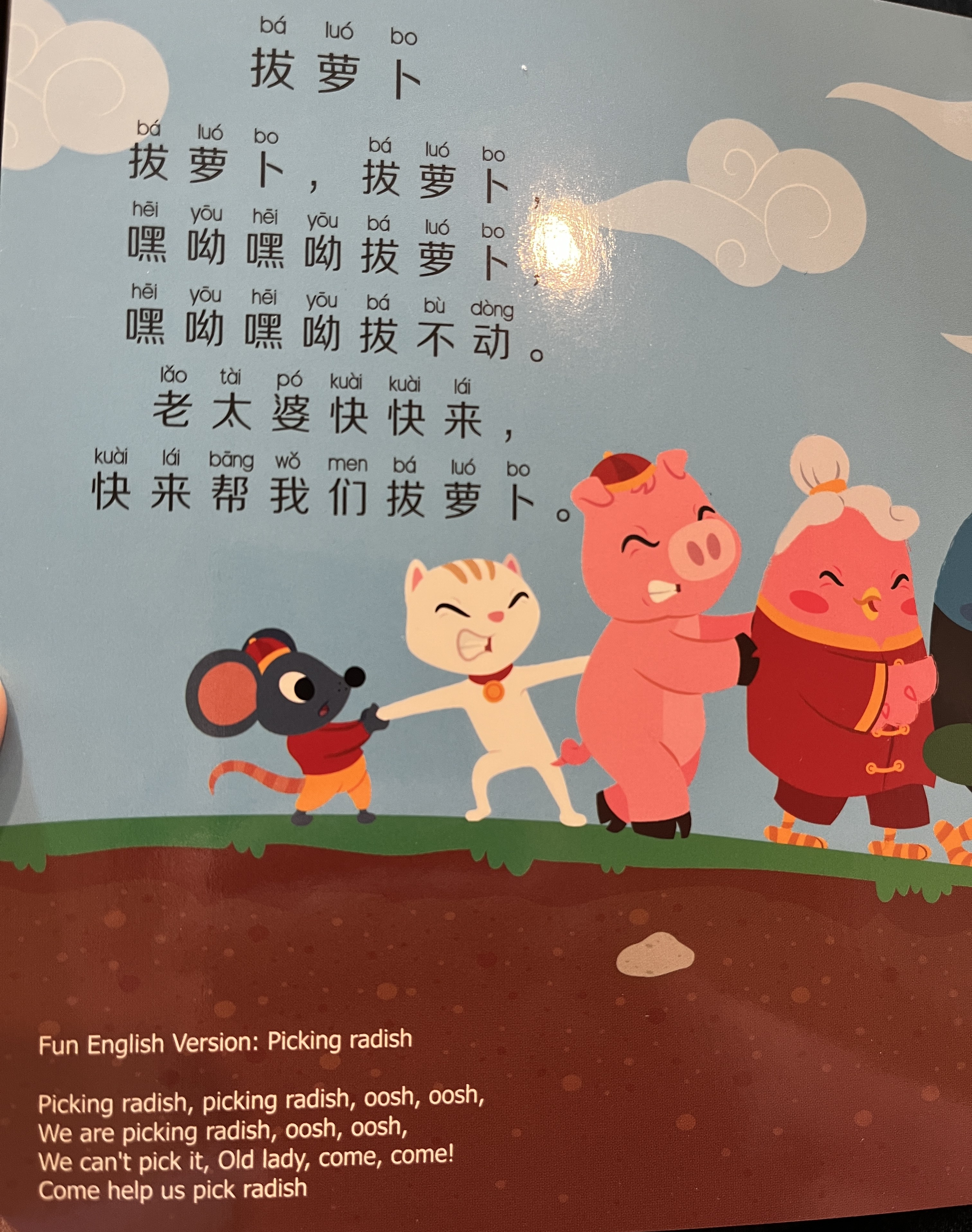
Pulling Carrots (or Picking Radish)
bá luó bo, bá luó bo;
hāi yāo hāi yāo bá luó bo;
hāi yāo hāi yāo bá bū dòng;
lǎo tài pó, kuài kuài lái;
kuài lǎi bāng wǒ men bá luó bo
Pull the radish, pull the radish / hey-o, hey-o, pull the radish. / hey-o, hey-o, we can’t pull / Old lady come, quickly come / Come help us pull up the radish now
This video translates the title as picking carrots, but everything else I’ve seen says radish… In repeat verses, instead of calling the old lady, you could call for little girl, little kitten, little mouse, etc.
Or here is another version – I like this song, because I really like the sound of the hāi yāo hāi yāo bá luó bo refrain. The song appears in Ditty Bird Chinese songs volume 1 sound book.
Row Your Boat – Huá xiăo chuán
I decided to try a Mandarin version of a traditional English children’s song.
Huà huà huà xiǎo chuán
shùn zhe xiǎo hé liú
Kuài lè ba (4X)
Rén shēng shì gè mèng
This one appears in Bao Bao Learns Chinese, volume 1.
There’s another slow version here.
Here’s the pronunciation guide.
Wish me luck on stretching my brain to learn something new!
 More Good Days with Kids
Pingback: Music Books for Kids | More Good Days with Kids