 Children learn through:
- being introduced to new ideas and activities (novelty)
- having the chance to experiment, explore, test & re-test (repetition to achieve mastery)
In play-based learning, a parent or teacher’s role can be to set the stage with new materials, or with familiar materials combined in new ways. Then it’s the child’s role to play: experiment, explore, test and re-test.
“Invitations to play” is one way of approaching these tasks. Parents often say “my child has so many toys that they don’t even play with.” If all the toys are tidily put away in baskets, it’s hard for a child to decide what basket to pull off the shelf. If all the toys are randomly scattered about the floor, it’s hard to decide what to play with first.
We can better engage the child with a little intention. Like instead of just a box of magna-tiles sitting next to a box of toy cars on the shelf, I could set up a magna-tile garage on the table with supplies nearby to build more garages. Instead of just having a toy kitchen with all the things that are there every day, I could create new play ideas by scribbling out a menu for a cat cafe, and place a couple stuffed cats there. Even just setting a puzzle on the table with one piece sitting loose next to the puzzle is more engaging than seeing an assembled puzzle sitting there. When you look at the table, you know what to do!
Read more about invitations to play
- from parents at home, on The Imagination Tree
- at preschool, on Teach Preschool
- about the teacher (or parent’s role) once the play space is set up, on Teacher Tom
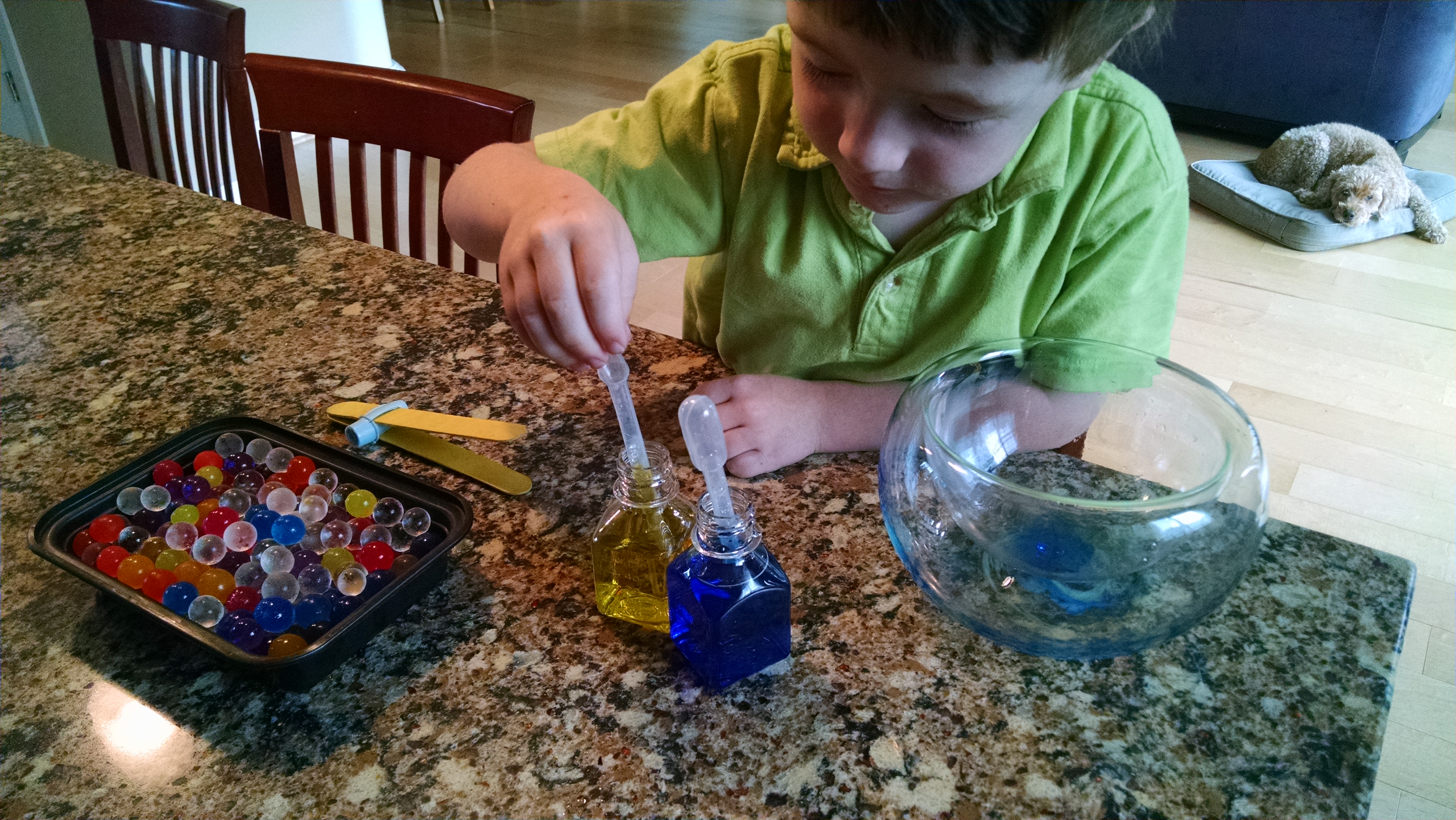
Today, I set up an invitation to play for my 3 year old.(I knew I had a busy day with lots of work to do, so wanted something ready to go that would keep him busy for a while.)
Yesterday, we did “science experiments” with a new set of tools: pipettes

,Today I set out two colors of water, pipettes, and a glass bowl to mix them in, instead of the vase. I had his container of water beads nearby. When he came into the room, he immediately settled into playing with the pipettes and water, which occupied him for quite a while. When his interest started to wane, I pulled over the water beads and tongs. I didn’t even need to say anything. He immediately started adding water beads. After he’d added them all and taken them all back out, he said “I’ll never do that again.” Apparently he prefers his water beads as a separate activity.
When he ran out of yellow water in his container, I said “Well, you put lots of yellow water in the bowl. Let’s just take some yellow back out of the bowl.” When the pipette pulled up green water from the bowl, I said “Hey! Where’s my yellow water!” That then led to a long play time of trying to pull up blue water or yellow water, and him learning that once things are mixed, they often can’t be unmixed.
This activity gave him chances to further explore materials he’s learned about recently, and combine them in new ways, thus deepening his knowledge of all the materials, and gaining a new insight about color mixing. And, it gave me a chance to get some work done…. Wins all around.
 More Good Days with Kids
Pingback: Play-Based Learning | More Good Days - Parenting Blog
Pingback: Finding a Balance of Learning Methods | More Good Days - Parenting Blog
Pingback: Process over Product | More Good Days - Parenting Blog
Pingback: Academic Preschools – Feel Free to Skip Them | More Good Days - Parenting Blog
Pingback: Coop Preschools | More Good Days - Parenting Blog
Pingback: How Many Toys is Enough? | More Good Days - Parenting Blog
Pingback: DIY STEM Summer Camp. Ages 3 – 6 – Inventors of Tomorrow
Pingback: Teaching Engineering to kids age 1 – 6 – Inventors of Tomorrow
Pingback: Gilbert House Children’s Museum – Inventors of Tomorrow
Pingback: Keys to Brain Development | More Good Days – Parenting Blog
Pingback: DIY STEM Summer Camp. Ages 3 – 6 – Inventors of Tomorrow
Pingback: Play-Based Preschool | More Good Days – Parenting Blog