Some parents and pundits question whether we should be talking with young children about gender, and the reality is that we always have been! When I was a young child in the 60’s, pretty much every book I was exposed to taught a particular set of gender roles. I learned what girls were supposed to look like and act like and what activities they were supposed to enjoy. Then as a culture we began to talk a lot more about feminism and equal rights for women, and there started being more children’s stories about “girls can do anything” – they can wear clothes that are easy to move in, they can have any job. Over time, people came to realize that as we’d given our girls permission to wear anything and be anything, our boys were still trapped in “boys can’t cry” and only sissies are dancers” and “why would a man want to be a nurse.” So, again, we began to tell more diverse stories. And now, with increased awareness that at least 1% of people are transgender, children’s stories about gender identity are starting to become available. All of these stories can be “mirrors and windows” for our kids – mirrors when they see characters like them that help them to feel seen, and windows that help them better understand other people’s experiences.
I’ll share some book recommendations here – most are aimed at kid 3 – 5, unless otherwise noted.
Gender Roles
Gender roles refers to the activities that people do, as hobbies, responsibilities, or careers. Here are just a few that look at stepping outside of traditional gender roles, but there are probably hundreds of books on this topic.
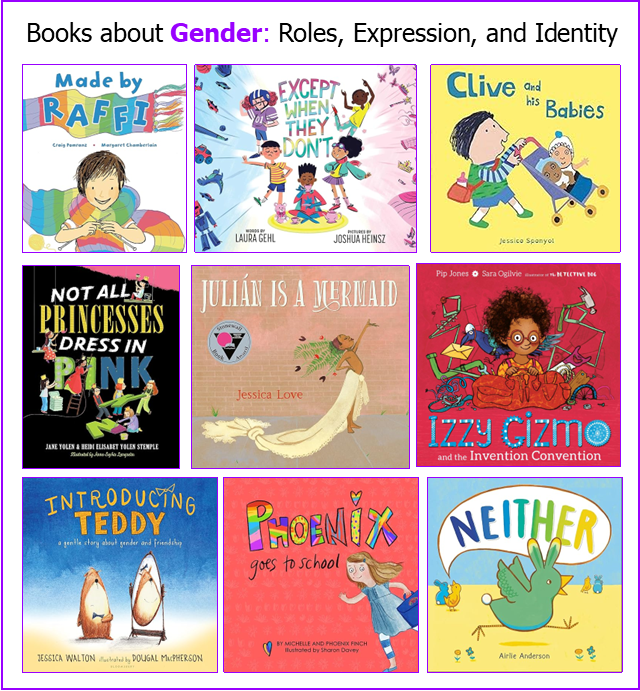
Except When They Don’t by Laura Gehl. Talks about gender role assumptions and the fact that they don’t always apply.
Made by Raffi is about a boy who likes to knit even though others say that’s a girl activity (role).
Not All Princesses Dress in Pink (video) Shows girls doing many things we think of as “boy things.”
Paper Bag Princess. (video) For ages 5+. About a princess who saves the prince.
Princesses can be Pirates Too (Video) About a little girl who loves to wear pretty princess dresses AND wants to be a bold brave pirate.
Clive and His Babies (video) Shows a boy playing enthusiastically with his baby dolls. (Age 2 – 4) There’s also Clive and His Hats and Clive and His Art.
Rosa Loves Cars Video. (age 2 – 4). There’s also Rosa Plays Ball and Rosa Loves Dinos.
William’s Doll (video) For 5+. About a boy who wants a doll. Others tease him or try to change his mind, but Grandma listens.
Izzy Gizmo is just one example of lots of great STEM books about girls who like to invent.
Gender Expression
Gender expression is about how we dress, how we style our hair and makeup, and how we move (e.g. boldly striding along, or hunching shoulders and being small).
For example, Sparkle Boy and Jacob’s New Dress and Morris Micklewhite and the Tangerine Dress (video) are all about boys who like to wear dresses (expression) but appear to still identify as boys.
Julian is a Mermaid (video) tells the story of a boy who sees people dressed up as mermaids in a parade and tells his grandmother he is a mermaid too – she helps him to dress up.
Gender Identity
This refers to how a person sees themselves. Do they say that they are a girl or boy, and how do they feel when other people label them as one or the other.
If I had to choose just one, I’d choose Who Are You? The Kid’s Guide to Gender Identity by Pessin-Whedbee. Age 4 – 8.
Introducing Teddy by Walton. (video) Teddy explains to a friend that in her heart she has always known she was a girl and wishes her name was Tilly.
10,000 Dresses (video) is about Bailey, who wants to wear dresses and identifies as a girl, although others label Bailey as a boy.
In Phoenix Goes to School (Video), we meet a girl and learn about her, then she talks about going to school and worrying that the kids will think she’s a boy. She ends up having a positive and welcoming experience at school.
When Aidan Became a Brother (video) When Aidan was little, people thought he was a girl, but then realized he was a boy. This story is primarily about his family welcoming a new baby.
There are also some books that are metaphorical – they can be read as being about gender identity, but your child may not make the cognitive leap to understand that metaphor. For example, in Red: A Crayon’s Story, a blue crayon mistakenly labeled as “red” suffers an identity crisis and in Bunnybear, Bunnybear identifies as a bunny, and Grizzlybun identifies as a bear. If you’re just looking for books to encourage a general sense of acceptance of diversity and self-identification in your child, these are a great match. But if you want to specifically address gender identity, you will need to help your child see that message: “Remember that book we read, Neither? It was about a creature that was both a bunny and a chick, but not quite a bunny or a chick? That’s sort of like our friend Rex, who told us they are both a boy and a girl, and not quite a boy or a girl? They said that’s called non-binary. And remember how Neither felt sad when nobody accepted them, but felt happy in the Land of All where they were accepted? Can we be a Land of All for our friend Rex?”
Here are recommendations for more options:
- https://booksforlittles.com/gender-spectrum/
- https://assets2.hrc.org/welcoming-schools/documents/WS_Great_Diverse_Books_Transgender_Non-Binary_Children.pdf
- http://www.mothering.com/articles/20-picture-books-strong-girls-sensitive-boys/
- http://gendercreativekids.ca/wp-content/uploads/2016/08/Trans-Kids-Beyond-the-Myths-2016-1.pdf
- https://www.scarymommy.com/books-gender-expression
- https://www.uua.org/files/2021-08/at_home_sex_ed_%20resources_grades-K-6.pdf
And here’s my posts on Talking with Kids about Gender Identity and Are your Programs Gender Inclusive.


 (
(

 More Good Days with Kids