Tag Archives: parenting style

Becoming the Parent you Want to Be

Often as parents we find ourselves making things up as we go along – we think about what we want our kids to do right now, then take actions that give us quick results in the moment. Those actions may or may not be in alignment with our long term goals or visions of yourself as a parent – I’m sure we’ve all had moments of thinking “I can’t believe I just said/did that!!”

One step you can take toward becoming the parent you want to be is to define – in writing – what that means. This can begin with a process of brainstorming your goals and values, maybe even writing a vision and a mission statement. Then as you find yourself muddling through your parenting days, you can occasionally take time to reflect – am I on course toward my goals? What could I do to course correct a bit? You don’t have to be perfect every day if you’re remembering to check in from time to time to make sure you’re still pointed in the right general direction.

Picture1

Brainstorming the Basics

Here are some questions to ask yourself to discover what’s important to you.

  • What are your family’s strengths? What do you do best?
  • What are the most important values you want to pass on to your child?
    • What is the place of education in your family? What value do you place on work?
    • What are your family’s attitudes toward money?
    • How do you view religion/spirituality, and what part does that play in your daily life?
    • How important is it to you to help other people or participate in your community?
  • How would you like to relate to one another?
  • When do you feel most connected to one another?
  • What makes you happy?
  • What makes you fulfilled –brings you satisfaction, leaves you with a sense of completeness?

Answering those questions may be the insight you need to get started.

Figure out what the endpoint looks like

Another approach is “Begin at the end” – think ahead 15 years. What is your vision for:

  • What is your child like as a person?
    • What skills have you nurtured in them: Curiosity? Confidence? Compassion? Determination?
    • What are your child’s core values? (see above)
    • If your child is “successful”, what does that look like?
  • What are the relationships amongst members of your family like?
  • How would you like your child to describe what it was like to grow up with you as a parent?

Creating a Vision Statement

What is a vision statement?

  • It describes what your ideal family life would look like and what you want your family to be someday.
  • It provides inspiration for what you hope to achieve in five, ten, or more years;
  • It functions as the “north star” – helps you understand how your work every day ultimately contributes towards accomplishing over the long term; and,
  • An effective vision statement is inspiring, yet short and simple enough that you could repeat it out loud from memory

Some sample visions from organizations are: “To improve the health and well-being of each person we serve.” (a hospital)  “To inspire students to create a better world.” (a school) “We believe that strong families begin at home and building strong families creates thriving, healthy communities.” (a family support organization)  “To be a vibrant and welcoming community, feeding the human spirit, lighting a. beacon for love and justice.” (a church.)

Write your parenting vision statement. (Try several approaches until you find the one that sings to you.)

Creating a Mission Statement

A Mission statement focuses on a shorter time frame (1 – 3 years). There are lots of possible formats. One format answers three questions

  • WHAT you will do – what specific actions will you take?
  • HOW you will do it – what will be the quality of your actions (this is where you can articulate your values for how you want to interact with your family)
  • WHY – what results or benefits you will see when you look at your kids / your family in a few years?

Here are some sample missions, from the web… I don’t endorse any in particular, they’re just examples.

We are a family who believes that relationships matter most! We value spending time together. We hold each member of our family accountable for responsible behavior. We support each other in our individual pursuits of personal and professional interests. We cheer each other on. We laugh whenever possible. We hold our marital relationship as a top priority because this relationship serves as the foundation of our family. www.everythingmom.com/dynamics/the-family-vision-statement-a-solution-for-challenging-decisions.html

Our home will be a place where are family, friends, and guests find joy, comfort, peace and happiness. We will seek to create a clean and orderly environment that is livable and comfortable. We will exercise wisdom in what we choose to eat, read, see, and do at home. We want to teach our children to love learn, laugh, and to work and develop their unique talents. www.happyfamilyhappylife.com/examples-of-a-family-mission-statement/

Our family mission: To always be kind, respectful, and supportive of each other, To be honest and open with each other, To keep a spiritual feeling in the home, To love each other unconditionally, To be responsible to live a happy, healthy, and fulfilling life, To make this house a place we want to come home to. [also from happy family… cited above]

I choose to raise children who are respectful and believe they are worthy of respect. I choose to raise children who are confident and who know themselves enough to be true to the song in their hearts. I choose to raise children who are kind and caring and see kindness and caring in the world as well. I choose to raise children who are honest and value the power of truth. [in the post, the author gives concrete examples of how their parenting will reflect this mission http://lusaorganics.typepad.com/clean/2011/12/a-peaceful-parenting-mission-statement.html]

Implementing Your Vision & Mission

Write your Vision & Mission down, and post it where you can see it.

Review it on a regular basis and see how you’re doing.

Narrowing the Vision – Action Gap: when the theory of what kind of parent we wish we were meets the reality of how we respond to our child when we’re tired and they’re challenging, it can be easy to get discouraged. Be gentle with yourself – don’t beat yourself up for your mistakes, just use it to help you remember your goals. Ask yourself what you could do differently the next day to move in that direction.

Revise your mission as needed to in order to reflect new values, hopes, and dreams.

More Resources:

On this blog:

  • Here is a free printable worksheet for developing a mission/vision statement.
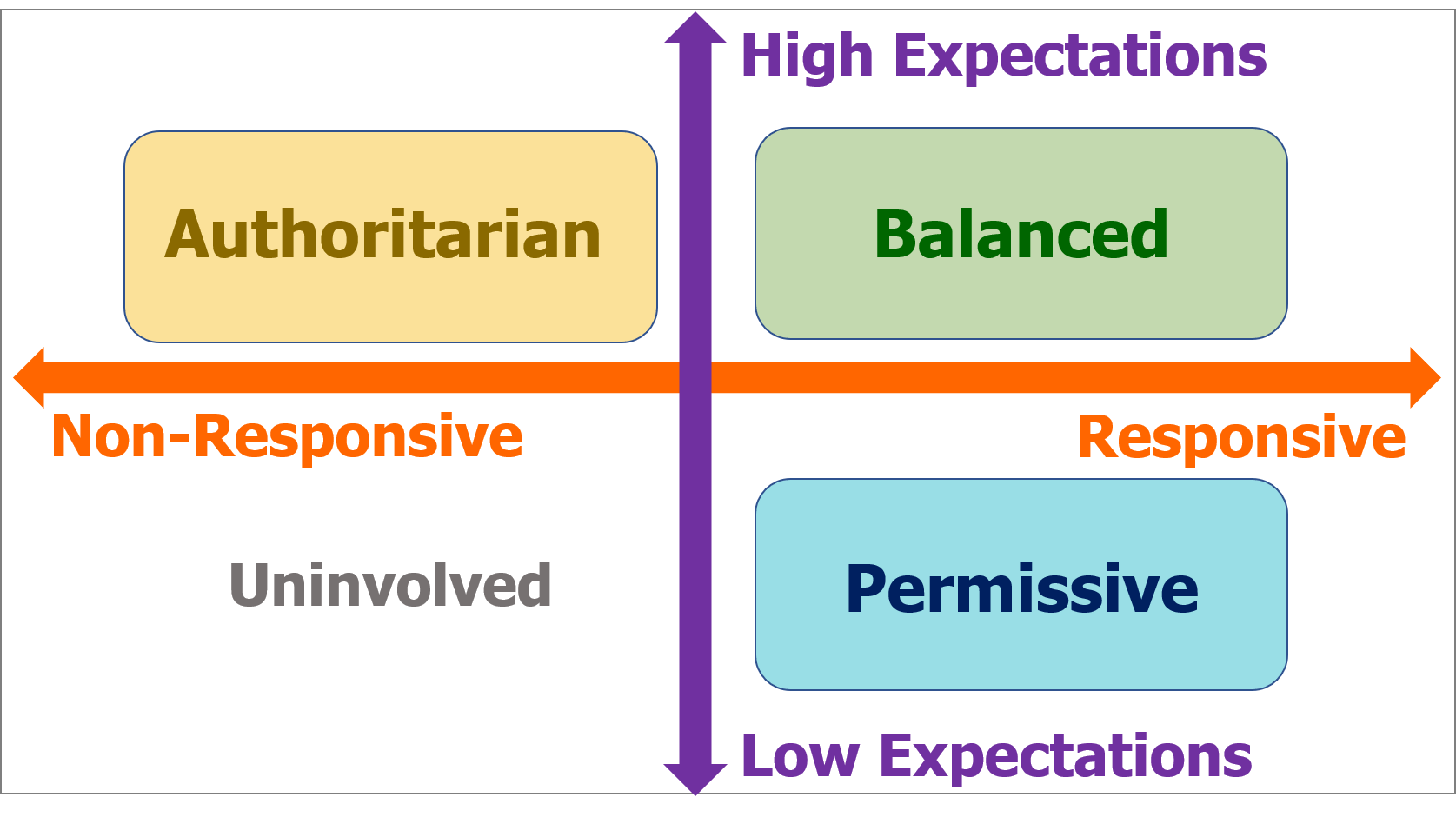
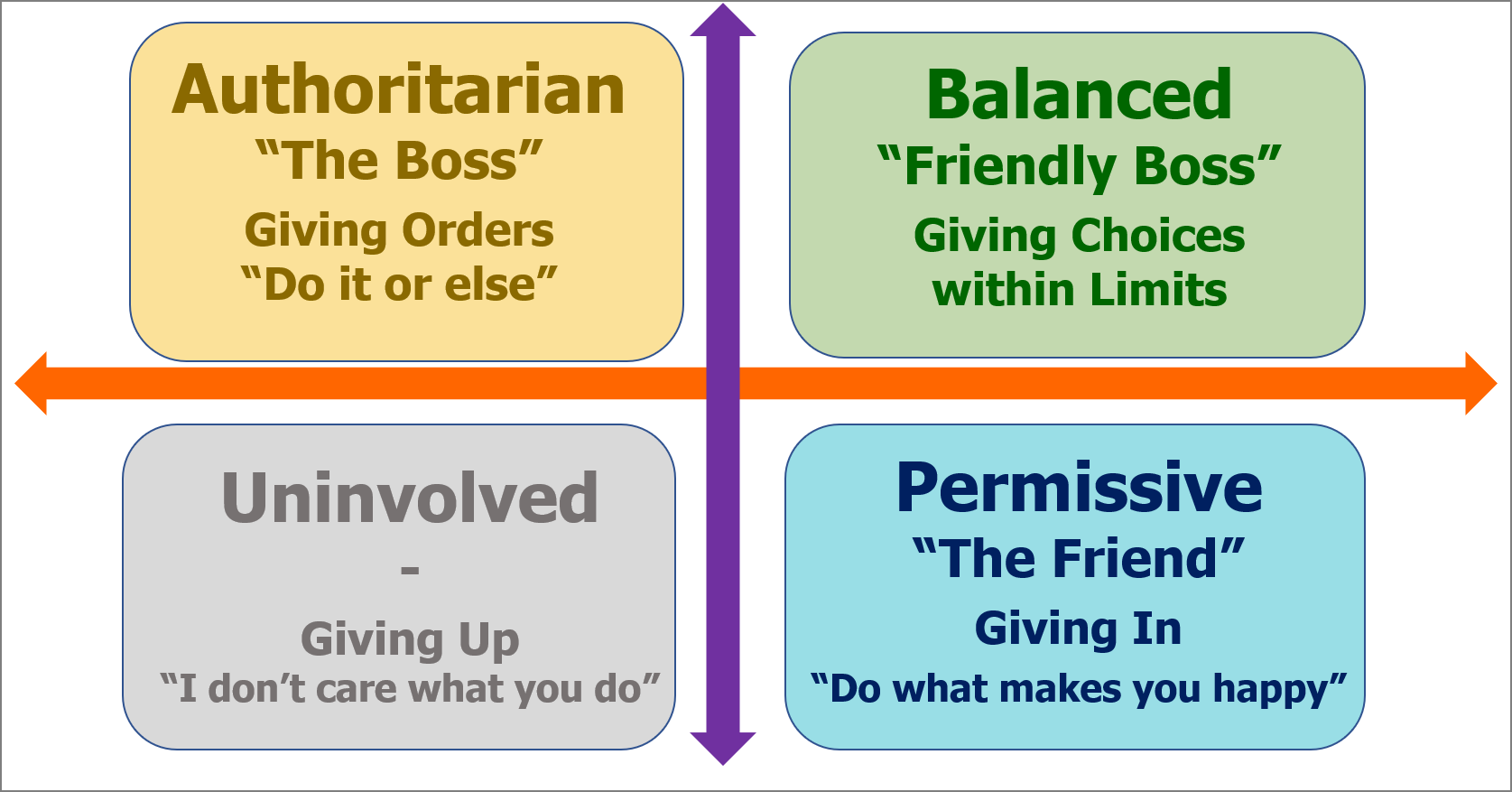
  • Read about Parenting Style: Authoritarian, Permissive, Balanced and Uninvolved are ways to describe the intersection between how high the demands are that you place on your child, and how responsive your rules are to their individual needs and goals. Are you your child’s Boss? their Friend? A Friendly Boss?
  • Read about Connecting Your Child with their Cultural Identity. What traditions and values will you bring in from your cultural background?
  • Think about what rituals you will incorporate – how will you celebrate holidays? What about the tooth fairy? Bedtime routines? It’s often the little things that define our families.

Elsewhere:

Parenting Style

There is no one right way to parent. We all make compromises each day that juggle the concrete short-term needs of the day with long-term goals for our child, balanced with our child’s temperament and our own. Having a vocabulary for talking about our parenting style can help us make more intentional choices that can guide us, over time, to becoming the type of parent that we want to be.

Let’s start with a quiz. For each spectrum, there will be two statements representing two different parenting approaches. If the one on the left describes you perfectly, make a mark on the left end of the spectrum (yellow). If the one on the right is exactly what you would say, make a mark on the right end. If you’re somewhere in between, mark somewhere in between, wherever feels right.

What is your approach to parenting a 6 month old baby?

Parent-Led. Parents create structure by scheduling feedings and naps. They may leave a baby to “cry it out” so the baby learns to self-soothe. Attachment-Style. Parents watch for baby’s cues to decide when to feed or to settle to sleep. Parents always respond to crying.

What is your approach to early learning? (for a 2 – 5 year old)

Structured learning. Parents buy educational toys, sign a child up for classes, and when they play, the parent works to find ways to teach new ideas. Child-Led. They have a variety of toys, go out on adventures to see what child discovers / decides to do. When they play, parent follows child’s lead

What is your approach to supervising at the playground? (for a 5 – 8 year old)

Close Supervision. Parents help children on the swings, remind them about rules, encourage them to try all the activities and play nicely with others. Free Range. Parents sit back and let child explore – it’s OK to climb up the slide. If kids squabble, parents allow them to sort it out on their own.

What is your approach to school and extracurriculars (for a middle schooler)

The Director. To get good at anything you have to work hard. Kids don’t want to work hard, so parents have to push, make choices for them. Unschooled. Parents trust their child’s choices about what to do, when to eat and sleep. Children learn what they’re passionate about.

What do your answers say about your parenting style?

Parenting styles are often talked about as three categories. If you tended to make marks in the yellow zones, you may be an authoritarian style parent. If you tended to mark blue, you may be permissive. If you were always in between, that’s called authoritative (or balanced).

Parenting Style and Choice

One way to think about parenting style is how you handle choices. A permissive parent offers a wide range of options and lets the child make the choices. An authoritative parent offers fewer options and tries to educate and persuade the child about how to make the best choice. An authoritarian parent offers few choices, generally dictating what will be done.

The permissive parent may value independence and imagination, and believe that if they allow the child to follow their passions, they can trust them to do their best. The authoritative parent may value hard work and smart decision-making that balances short term desires with long-term goals. The authoritarian parent may value obedience, and believe that learning to follow the rules and doing their best at their assigned tasks is the path to success.

Balancing Expectations and Choices

Parents are generally attempting to prioritize their child’s long-term well-being and success, and feel that they have wisdom and perspective that helps them to know what’s best for the child. Children generally prioritize their own happiness in the moment, and don’t worry much about the long-term. So, part of parenting style lies in how we negotiate that conflict.

Parents who have high expectations for their child’s success (however the family defines success, whether that’s in academics, athletics, financial, support for the family, etc.) tend to want more control over their child’s choices, so lean authoritarian or authoritative. Permissive parents may place more emphasis on the child’s happiness than on their accomplishments.

Authoritarian parents believe they know what is best for their child, are not responsive to a child’s individual desires, and apply the same rules in all situations. Authoritative and permissive parents are more responsive to the child as an individual, and also adapt to the situation. (For example, if the child has had a rough week, the parent may let them skip an assigned chore.)

Questions to Reflect On:

What style of parent do you WANT to be?

What type of parent are you on a rough day?

Are you the same style as your parenting partner? Or different? How is that going?

Are you the same style of parent that YOUR parents were? Or are you very different? Why?

Also, check out my post on defining your parenting vision / your family’s mission / and imagining – “15 to 20 years from now, what do you hope your family is like??

Learn More

I’ve written before about the four parenting styles, about other parenting labels like helicopter parents, free range, and tiger moms, and how parenting style might affect how we handle choices in our families.

This article on Parenting for Brain has more info on all these types including citations from the research, including a fun bit of trivia that: “In the US, roughly 46% of parents use an authoritative parenting style, 26% authoritarian parenting style, 18% permissive parenting style, and 10% neglectful parenting style…. European-American parents are about 2% more likely to have an authoritative style, while Asian-American parents are 2% more likely to have an authoritarian style.”

Here is a free printable handout of this post’s content on parenting style.

The Economics of Parenting Style

I’ve written before about the four parenting styles, about other parenting labels like helicopter parents, free range, and tiger moms, and how parenting style might affect how we handle choices in our families.

Yesterday, there was an article in the NY Times called Is Education No Longer the Great Equalizer, and it quoted extensively from “The Economics of Parenting,” by Doepke, Sorrenti, and Zilibotti, that is a fascinating way to think about parenting through an economists’ lens. They say the “basic parent-child conflict is that the parent attaches a higher weight to the future utility of the child” versus the child places a higher weight on their “full enjoyment” of the moment.

They say that parenting styles “come down to whether, and how, parents interfere with the child’s choice.” The permissive parent lets the child have their way, and may go out of their way to offer a wide range of choices. The authoritative parent attempts to shape the child’s preferences, by offering choices but also educating about why they believe particular choices are the best ones for the child’s long-term well-being. The authoritarian parent offers few choices, dictating what will be done. Their emphasis is on what children do, not what they think, so there’s no need to persuade them that it’s the right option… it’s the only option.

They also state that permissive parents value either independence or imagination, authoritative parents value hard work, and authoritarian parents value obedience.

Doepke, Sorrenti, and Zillibotti then look at the interaction between the economy and parenting styles. In societies with a wide array of career opportunities and a low degree of income inequality, “the gap between the top and the bottom is small… Parents are less concerned about children’s effort, and thus there is little scope for disagreement between parents and children. Therefore, most parents adopt a permissive parenting style, namely, they keep young children happy and foster their sense of independence so that they can discover what they are good at in their adult life.” If parents believe that their child can be financially successful no matter what, it’s easy to let them pursue their talents and their joys.

In societies where there’s little social mobility, where most children will have the same profession as their parents, the parents have little incentive to be permissive and let their children discover something they’re good at (they may see talent as irrelevant in a world where there aren’t career choices available) and or to be authoritative and convince their child of anything. If the parents’ experience is that you need to do whatever work that is available to survive, they tend to be authoritarian – conveying ideas like “you just have to follow the rules – you don’t have to like it.”

In a society with a high degree of income inequality, the choices a child makes could have a big impact on their economic well-being. The parents know their children have a wide array of job opportunities and want to persuade them to choose the one that will give them the best chance of success. So, a larger share of parents are authoritative. They also tend to be highly involved, ensuring that the child is taking the best advantage of any available opportunity and learning to make “good choices” (as the parent defines them). The authors acknowledge that authoritative parenting requires more effort on the parents’ part than the other options.

The parents’ current economic status also influences parenting style. “richer parents can use monetary rewards to persuade their children to comply with their wishes. Poor parents lack the resources… and may be more likely to resort to authoritarian methods such as corporal punishment.”

Doepke, Sorrenti, and Zillibotti were discussing how this might be see on a country by country basis, but it clearly also comes into play in micro-societies of neighborhoods – for example, a neighborhood with few economic opportunities might tend toward authoritarian values.

For parent educators and others who work with families, I think these ideas add to a deeper understanding of influences on parenting style. Understanding a family’s culture and socioeconomic class, especially if it is different from our own, increases our empathy and ability to communicate.

Parent Educators, here’s a handout you can share to introduce parenting style.

Parenting Style – Offering Choices

TL/DR summary: Giving a child choices (e.g. what to wear, what story to read) can help to build a positive relationship where the child feels valued, empowered, and learns decision-making skills while having fewer power struggles. But if we offer too many choices, the child may feel overwhelmed and the parent may feel out of control. Finding the right balance starts with the parent deciding which options are available (setting limits), then the child choosing between those workable options.

My post on Offering Choices to Children covers the nitty gritty of how to use this discipline tool. This post is more of a philosophical think piece about the long-term impact of how we handle choices in our families. (Note: in this post, I talk a lot about parenting styles. Learn more about the Four Parenting Styles.)

choices grid

Three Approaches to Offering Choices

Several times each day in the life of a parent and a child, there are decisions to be made: what to eat at a meal, what to wear, what to do, which story to read, and on and on. Some parents, who learn toward the authoritarian style of parenting make almost all the choices, telling their child what the required plan is. Some parents who lean toward the permissive style let their children make all the choices. Let’s look at the possible pitfalls of taking either of these approaches to an extreme, then let’s look a more balanced (authoritative) approach.

Giving Orders – The Parent Makes All the Choices

There may be lots of reasons some parents want to make all the decisions. Sometimes it’s just that a parent wants to be in full control (“it’s my way or the highway”), sometimes it just feels faster and easier to make all the decisions rather than waiting on your kid to decide, sometimes it is an parent who has very high expectations for the child and believes they know the best route to achieving those. This has been called Tiger Mom parenting style, named after Amy Chua’s book, in which she describes her choices such as requiring that her children play piano and violin and requiring them to practice, saying “To get good at anything you have to work, and children on their own never want to work, which is why it is crucial to override their preferences… Once a child starts to excel at something… he or she gets praise, admiration and satisfaction. This builds confidence and makes the once not-fun activity fun.”

This parenting style can work well for some parents and for some kids.

But, it can also backfire in a few ways.

  • Some children rebel against this – in the short term, that means lots of power struggles, and in the long-term it can damage the relationship with the parent.
  • Some children feel dis-empowered and discouraged, or some feel that their parent doesn’t care about them.
  • Children raised this way may not learn independent decision-making and initiative.

If you lean toward the more authoritarian style of parenting, it’s import to be aware of these potential pitfalls to help you to avoid them.

Giving In – Parents Let the Kids Make All the Decisions

This style of parenting could also be called permissive or laissez-faire. Dayna Martin, proponent of Radical Unschooling, says ““[This] includes trusting your child in what they choose to learn; you extend that same trust to other areas of your child’s life, like foods, media, television, bedtime. Parenting is supposed to be joyful, and it can be when we learn to connect with, rather than control, our children. The focus of our life is on happiness and pursuing our interests with reckless abandon together.”

Again, this can work well for some parent and for some kids. But, it can backfire.

  • Sometimes children make bad choices, especially if they are given free rein and not much guidance. Like wearing a swimming suit in the winter or eating so much chocolate they get sick. Then parents have to decide whether to let the child live with the consequences of that bad choice – “guess you’ll be cold” – which can be fair or can be cruel depending on how far you take that, or whether to rescue the child from the consequences to keep them happy – which may mean they never learn from their mistakes.
  • I have seen children who don’t do well in school or in peer relationships when they’ve been raised in a very permissive environment and don’t understand limits. The child who takes toys away from others any time she wants them and who eats all the cupcakes on the table will soon alienate their friends.
  • Having to make choices all the time can actually be exhausting and overwhelming for kids. Being asked to make too many choices all the time can lead to meltdowns for little ones. Having choices within limitations can be very calming. Imagine being thirsty and walking into a convenience store in a foreign country where you don’t recognize any of the packaging, and you can’t figure out which of forty options to choose. Wouldn’t it be so much easier and more pleasant if someone said “I know you like juice – here’s the grape juice, the apple juice, and an apple cranberry juice – which one would you prefer?” 
  • Another common backfire for permissive parenting is that the parents may start feeling like they’re out of control. Some parents just end up feeling frazzled all the time, feeling powerless, and not able to see any way to change how things are going with their kids. Other parents, when they start feeling out of control will hit a certain high stress point, then suddenly flip-flop from permissive to strict – going from “you can do whatever you want” to “I’m done, you’re grounded for a month.” This inconsistency is extremely stressful for kids, and can lead to a lot more anxiety in the future over making their own decisions.

Giving Choices – The Balanced Approach

I believe that for most families the optimal approach is the authoritative parenting style. The parent has high expectations for the child and wants them to be successful, so they set clear limits and ensure the child is choosing between options that can be healthy for them (e.g. good nutrition, clothing appropriate to the weather, doing their homework, practicing their chosen sport or instrument). But the parent is also highly responsive to the individual child – ensuring that there are options that the child will enjoy and giving some flexibility for the circumstances of the moment.

Ellyn Satter, author of Child of Mine and How to Get Your Kid to Eat: But Not Too Muchhas some important ideas about the division of responsibility in feeding. The parent is responsible for what, when, and where the child eats. The child is responsible for whether to eat, and how much. The parent puts healthy options on the table, the child makes the decision from there, and the parent can relax, knowing that any choices the child makes can work out OK.

I think a similar approach could apply to almost all decisions, from getting dressed, to choosing a bedtime story, to choosing extracurricular activities to choosing where to go to college and what to major in. The parent first evaluates the possible range of options, and decides what criteria would represent a good option. If they’re working with a young child, the parent might and offer only a limited number of viable options (2 options for a 2 year old, 3 for a 3 year old… “do you want the blue shirt or the red one?”) For an older child, they might say “you can choose amongst any of these options, but here’s our limitations and here’s our criteria. You can only choose things that fit those requirements.” (“It’s cold out today, so choose something warm to wear.”) The parents are the ones “setting the table” with options. The child then is empowered to make the choices within those limits.

I have always told my children “you may be as smart or smarter than I am, but I am wiser than you and will always be wiser than you because wisdom comes from life experience and seeing all the long-term impacts of choices.” So, when I tell them the criteria for a positive choice, that’s coming from all my wisdom. When I let them make the choice, I acknowledge their intelligence and give them decision-making practice for their future.

It’s worth acknowledging that authoritative parenting requires more effort from the parent than authoritarian or permissive parenting does. The authoritarian parent just has to say: here’s the rule – follow it or expect consequences. The permissive parent says: do what you want. The authoritative parent has to say: Here are the options, here’s information on the impact of your choices, let’s talk through how to make the best choice. It’s more work in the short term, but hopefully in the long term yields a child who is capable of making better decisions on their own.

Your Safety Style as a Parent

safetystyleDo you imagine taking your child rock climbing, bungee jumping, and white water rafting? Do you enjoy big bold play like tossing them up in the air and spinning them round? Or do you wish you could keep your child in a soft padded room full of soft padded objects so he need never get hurt?

It is helpful for parents to reflect on their own tolerance for risk as they safety-proof their house, teach their child safety skills, and allow for some risk-taking. Where you strike the balance between protecting your child and allowing exploration is influenced by your gender and theirs, your age and experience and theirs, your temperament and theirs.

Gender: Men lean toward risk-taking, women lean toward being protective. Talk to your partner, and agree what limits you will set, so you can be consistent. Try to understand the value of each others’ views.

Boys tend to be bigger risk-takers than girls, who are a little more likely to look before leaping. If you have a risk-taking boy, you may need to focus on removing most hazards; if you have a cautious girl, you may be able to adopt a wait-and-see approach.

Age & experience: Older first-time parents tend to be more cautious than younger first-timers. Experienced parents of many children tend to be less cautious over little hazards, but stricter about the big rules. If you wonder whether you’re being over-protective, or too lax, try watching other parents (on the playground, at your child’s school, etc.). It’s a good way to “sanity check” yourself. Are you setting about the same kind of limits others are? If not, do you think they’ve got the right idea and you need to adapt? Or does it reinforce with you that what you’re doing is what really feels right to you?

For children – the older they get, the more dangerous situations they are capable of getting themselves into, but hopefully they’ve also started to learn caution and safety behaviors. They need wider boundaries, so you will need to adjust safety rules as they grow. Do you feel like you’re striking the right balance?

Temperament: Some people are inherent risk-takers, some inherently cautious or fearful. Your limits need to balance your temperament, your partner’s, and your child’s. Set limits that are within your comfort zone, and set rules you can enforce consistently even if you’re tired or stressed.

There’s no right or wrong answers here, just things to be learned from self-reflection…


photo credit: safety zone – http://www.freeimages.com/photo/1422766; Jump – *vlad* via photopin cc