Tag Archives: gender

Kids’ Books about Gender

Some parents and pundits question whether we should be talking with young children about gender, and the reality is that we always have been! When I was a young child in the 60’s, pretty much every book I was exposed to taught a particular set of gender roles. I learned what girls were supposed to look like and act like and what activities they were supposed to enjoy. Then as a culture we began to talk a lot more about feminism and equal rights for women, and there started being more children’s stories about “girls can do anything” – they can wear clothes that are easy to move in, they can have any job. Over time, people came to realize that as we’d given our girls permission to wear anything and be anything, our boys were still trapped in “boys can’t cry” and only sissies are dancers” and “why would a man want to be a nurse.” So, again, we began to tell more diverse stories. And now, with increased awareness that at least 1% of people are transgender, children’s stories about gender identity are starting to become available. All of these stories can be “mirrors and windows” for our kids – mirrors when they see characters like them that help them to feel seen, and windows that help them better understand other people’s experiences.

I’ll share some book recommendations here – most are aimed at kid 3 – 5, unless otherwise noted.

Gender Roles

Gender roles refers to the activities that people do, as hobbies, responsibilities, or careers. Here are just a few that look at stepping outside of traditional gender roles, but there are probably hundreds of books on this topic.

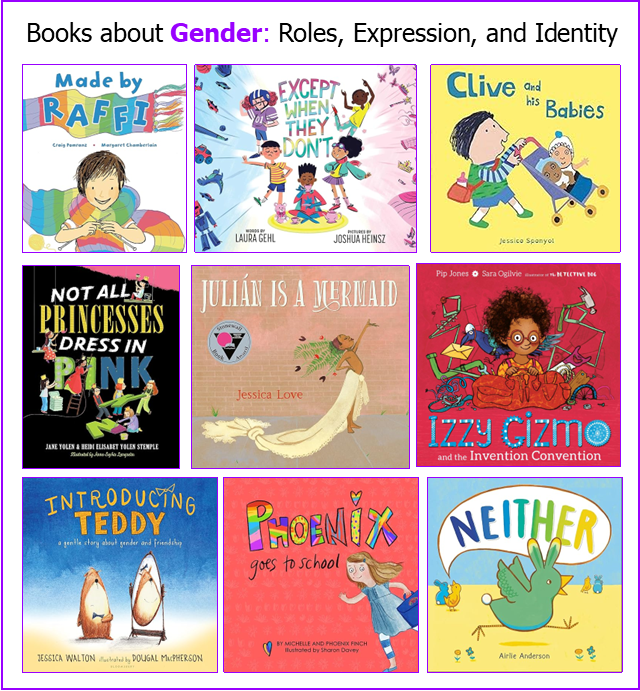
Except When They Don’t by Laura Gehl. Talks about gender role assumptions and the fact that they don’t always apply.

Made by Raffi is about a boy who likes to knit even though others say that’s a girl activity (role).

Not All Princesses Dress in Pink (video) Shows girls doing many things we think of as “boy things.”

Paper Bag Princess. (video) For ages 5+. About a princess who saves the prince.

Princesses can be Pirates Too (Video) About a little girl who loves to wear pretty princess dresses AND wants to be a bold brave pirate.

Clive and His Babies (video) Shows a boy playing enthusiastically with his baby dolls. (Age 2 – 4) There’s also Clive and His Hats and Clive and His Art.

Rosa Loves Cars Video. (age 2 – 4). There’s also Rosa Plays Ball and Rosa Loves Dinos.

William’s Doll (video) For 5+. About a boy who wants a doll. Others tease him or try to change his mind, but Grandma listens.

Izzy Gizmo is just one example of lots of great STEM books about girls who like to invent.

Gender Expression

Gender expression is about how we dress, how we style our hair and makeup, and how we move (e.g. boldly striding along, or hunching shoulders and being small).

For example, Sparkle Boy and Jacob’s New Dress and Morris Micklewhite and the Tangerine Dress (video) are all about boys who like to wear dresses (expression) but appear to still identify as boys.

Julian is a Mermaid (video) tells the story of a boy who sees people dressed up as mermaids in a parade and tells his grandmother he is a mermaid too – she helps him to dress up.

Gender Identity

This refers to how a person sees themselves. Do they say that they are a girl or boy, and how do they feel when other people label them as one or the other.

If I had to choose just one, I’d choose Who Are You? The Kid’s Guide to Gender Identity by Pessin-Whedbee. Age 4 – 8.

Introducing Teddy by Walton. (video) Teddy explains to a friend that in her heart she has always known she was a girl and wishes her name was Tilly.

10,000 Dresses (video) is about Bailey, who wants to wear dresses and identifies as a girl, although others label Bailey as a boy. 

In Phoenix Goes to School (Video), we meet a girl and learn about her, then she talks about going to school and worrying that the kids will think she’s a boy. She ends up having a positive and welcoming experience at school.

When Aidan Became a Brother (video) When Aidan was little, people thought he was a girl, but then realized he was a boy. This story is primarily about his family welcoming a new baby.

There are also some books that are metaphorical – they can be read as being about gender identity, but your child may not make the cognitive leap to understand that metaphor. For example, in Red: A Crayon’s Story, a blue crayon mistakenly labeled as “red” suffers an identity crisis and in Bunnybear, Bunnybear identifies as a bunny, and Grizzlybun identifies as a bear. If you’re just looking for books to encourage a general sense of acceptance of diversity and self-identification in your child, these are a great match. But if you want to specifically address gender identity, you will need to help your child see that message: “Remember that book we read, Neither? It was about a creature that was both a bunny and a chick, but not quite a bunny or a chick? That’s sort of like our friend Rex, who told us they are both a boy and a girl, and not quite a boy or a girl? They said that’s called non-binary. And remember how Neither felt sad when nobody accepted them, but felt happy in the Land of All where they were accepted? Can we be a Land of All for our friend Rex?”

Here are recommendations for more options:

And here’s my posts on Talking with Kids about Gender Identity and Are your Programs Gender Inclusive.

Talking with Children about Gender Identity

Gender is a complicated mix of our biological sex, how we like to dress and wear our hair, our interests, our identities, and what other people expect us to do based on their perception of our gender. In this post, I’ll address:

When do we talk to children about gender identity?

You already have been! We probably started moments after their birth, with the first announcement of “it’s a boy” or “It’s a girl.” By 2 to 3 years, children begin to label themselves as male or female. By 3 – 4 years, they start categorizing things as “boy things” or “girl things”, and by 4, they may say “only boys can do that” or “girls never do that.”

So, young children are very aware of gender. Even if we avoided talking about it, they would absorb lots of messages from their environment. If we talk to them about it, we have the chance to share our own values with them, and to help to shape their understanding.

What is gender?

Let’s start with a few definitions.

Biological Sex: A person’s body parts / hormones. Can be categorized: male, female, intersex.

Gender Identity: A person’s own internal sense of who they are. (No one else gets to define this for them.)

Gender Expression: How a person chooses to dress, wear their hair, and behave.

Gender Roles: How other people expect someone to act, or what they expect them to be interested in, based on their perceptions of that person’s gender.

Those are all separate from sexual orientation. Gender is about who you are. Sexual orientation is about who you are attracted to.

Sometimes all these pieces line up just like cultural and generational stereotypes would predict, but sometimes they don’t. Many people are cisgender – their identity aligns with their biological sex. Some people are transgender – their internal sense of who they are (identity) does not line up with the sex assigned to them at birth. Others may identify as gender non-conforming, non-binary, genderqueer, or other variations. It is estimated that between 1 in 100 and 1 in 400 people are transgender. One way to think about it is that transgender folks may be about as common as redheads.

There are also many people who are cisgender, but don’t fit a stereotypical understanding of gender. In terms of gender expression, some women prefer to wear ‘men’s clothes” and some men like to wear dresses or makeup. In terms of gender roles, we all acknowledge that boys may like dolls and dresses, and girls might like trucks and baseball. We say women can be doctors, and men can be dancers. Yet, there is still surprise in our society when people run across a male preschool teacher or a female heavy equipment operator.

Defining Your Family Values about Gender

Parents are their children’s most important teachers. The way you talk about gender, and your unconscious actions, will shape your child’s early perceptions about gender. So, spend some time reflecting, and talking with the other significant adults in your child’s life (friends, family, faith leaders), to figure out what your family values are about gender identity, expression or roles. Then, pay attention to how you’re manifesting these values. Some things to consider:

  • When buying clothes or toys for your child, or choosing activities to sign them up for, ask yourself: does my kid like things like this, or am I picking it because of gender? Does this choice expand or limit their choices and expectations about gender?
  • If you hear your child (or other people in your child’s presence) make observations like “only girls wear pink” or “boys can’t do that”, ask them questions about why they think that, and talk about stereotypes and alternative views.

For more on gender, see: https://gooddayswithkids.com/wp-content/uploads/2013/12/gender.pdf

What if your child is exploring gender roles or expression?

During preschool and early elementary years, many children explore what it means to be a boy or girl, and they may try out different roles. Especially in pretend play, girls may try out being a dad, boys may try on “girly” clothes. This is a normal part of children’s play, and part of how they learn about their world and their culture. There is no need to discourage this.

Nor do you need to overly encourage it. Just because a boy tried on the fairy wings at school doesn’t mean you need to immediately purchase full princess wardrobes for home. (If, over time, he tells you he really really wants a princess wardrobe, that’s fine… but don’t feel like you need to jump in with both feet immediately. It may have been just a short term exploration.)

Don’t make assumptions about your child’s long-term gender identity or sexual orientation based on short-term interests or activities. Some children outgrow this and move on to gender expressions and roles that line up with their biological sex. Some continue to explore gender expression and gender roles, such as the “tomboy” who dresses and acts (expresses themselves) like a boy but still clearly identifies as a girl, or the teenager who may wear eyeliner and nail polish but identifies as male. Some people who blur these lines call themselves gender expansive or gender creative. However your child wants to express themselves, you can help them to feel safe and loved.

If children want to make non-stereotypical choices, some parents choose to inform them about what reactions they might encounter: “it’s fine to have a sparkly pink backpack, but some kids think that only girls like sparkly pink, so they might tease you.” Then if the child still chooses that, at least they had the information to prepare themselves for the response.

What if your child tells you they are transgender?

Gender identity tends to be firmly established by age 4. If a child occasionally swaps gender roles in pretend play, or tells you “I really like playing with girls’ toys” or tells you once or twice, “I wish I was a boy, so I could do that”, those are likely just short-term explorations.

There’s a big difference between that and a child repeatedly telling you that their biological sex does not match their internal identity. Transgender and gender non-conforming kids are: consistent, insistent, and persistent. They consistently identify as one gender, they don’t waffle back and forth. They are insistent about that identity and get upset when mis-identified. They persist – they identify this way over a long period of time. (Source)

If you are cisgender, you may find it challenging to really understand a transgender person. For me, as a cisgender woman, I have truly never questioned my identity – I’ve always known I was female, always been comfortable with other people treating me as female, and offended if someone mistakenly thought I was a boy. But imagine what it would be like if I felt that way as strongly as I do but I happened to have been born into a body with a penis. Imagine the challenges of that experience!

Transgender people often experience gender dysphoria, a distressing disconnect between the sex assigned them at birth, and their internal identity. Every time they look at their body, it feels wrong to them. Every time someone refers to them by the wrong pronoun, they may squirm inside. For some transgender people, this sensation is mild and manageable, but for many it is not. Transgender girls may talk about a desire to cut their penises off. Transgender boys may begin self-harming as their breasts begin to grow. Many transgender people (41%) attempt suicide, often to escape the pain of dysphoria.

If a child says they are transgender, we don’t need to know whether they will always identify that way. But, in that moment, we can listen to our children tell us about who they are, so we can provide the best possible support. Trying to change a child’s identity, by denial or punishment or whatever, doesn’t work, and can do long-term harm.

Amongst transgender people, rejection by their families can lead to depression and other mental health problems, homelessness, behaviors that put their health at risk, and suicide.

Family acceptance promotes higher self esteem, more social support, improved health, improved mental health, with reduced anxiety and depression, and a huge reduction in suicide attempts.


How you can show your support (for your child or others that you know):

  • Assure your child that they have your unconditional love and support
  • Use the name and pronouns that the child asks that you use (note: I don’t say their “preferred pronouns”. Their pronouns are their pronouns, that’s not like a preference for vanilla ice cream.)
  • Ask that others respect the child’s identity
  • If they ask to transition to a gender expression in line with their identity (e.g. clothes and hairstyle), many parents have followed the path of first trying it out at home, then trying it out on a vacation – what is it like to be out in public with that identity, then transitioning in their home community.
  • If children ask for a medical transition, there are options: adolescents can take hormone blockers to delay puberty – these put on a “pause” button while they make long-term decisions. Taking gender hormones (e.g. testosterone and estrogen) can help to move biological characteristics to line up more with their identity, and most of the effects are reversible if the hormones are stopped. There are gender-affirming surgeries as well. These are not common for youth, but can reduce suicide risk for children experiencing severe dysphoria.

You can find many more resources at: https://www.hrc.org/search?query=transgender+children+and+youth

What if your child asks about someone else’s gender?

Young children are trying to make sense of their world, and one way they do that is by categorizing the people they see. If they think they’ve worked out an understanding of gender, but then see a person who doesn’t fit that understanding, they may ask questions – quietly, or at the top of their lungs. Remember that if your child asks a question about something, they are trying to understand it, and they may also be asking you if you think that it’s OK.  (check out Jacob Tobia’s post on this)

So, your child might say “that boy is wearing makeup!” or “Why is that woman dressed like a man?” If you shush them, or avoid the topic, you imply to your child that what they have seen is bad or is a taboo subject. Try answering the question: “Yes, sometimes boys do wear makeup, and that’s OK.” Or “Yes, some women prefer to dress in men’s clothes. Or, that might be someone who identifies as a man, even though their body might look more like a woman.”

You can find some simple, matter-of-fact things you might say to a child about gender identity at http://muthamagazine.com/2014/01/mama-ella-has-a-penis-marlo-mack-on-how-to-talk-to-your-children-about-gender-identity/; and www.huffingtonpost.com/entry/its-not-that-hard-talking-to-children-about-gender_us_5899f3b0e4b0985224db5a3f

Interacting with a transgender person

Some other things you can do (and model for your child) about how to interact with someone who is (or may be) transgender:

  • Use the language a transgender person uses for themselves. (He, she, they, or whatever.) Sometimes you may just wait till it comes up in conversation with those who know them. Or, if you don’t know what pronouns to use, you can ask – or even better, share your own pronouns. “Hi, my name is Janelle, and I use she/her as my pronouns.” If you make a mistake on pronouns, apologize briefly and move on.
  • Some transgender people choose to medically transition, or change their names, or change their appearance, but some don’t. You (or your child) may be curious. Before asking questions, ask yourself “do I need to know this information to treat them respectfully?” and “Would I be comfortable if they asked me this question, or would I ask that question of any other person?” (So yes, it would help to know their name and pronouns, but there’s no need to know about the status of their private parts.) Some specific questions you would generally avoid: Asking their birth name, or asking to see photos of them from before they transitioned, asking what hormones / surgeries they’ve had, or asking about their sexual relationships.
  • Someone’s transgender identity is their private information. It is not yours to share.
  • Remember that you don’t have to understand their identity to respect it.
  • You can’t necessarily tell if someone is transgender by looking at them. So, many people are working to be gender inclusive at all times. You can encourage this process by sharing observations. For example, if forms you’re filling out have two checkboxes for male and female, encourage the provider to instead ask for gender, and leave a blank space for people to fill in. If there are single stall restrooms at a facility, encourage that facility to replace the Men and Women signs with “Restroom” signs. If you notice a teacher frequently divides a group into “boys” and “girls”, encourage them to consider other options: “everyone wearing jeans”, or “everyone whose birthday is in January – June” or “everyone who likes cats.”

Learn more about how to be a trans ally: https://bolt.straightforequality.org/files/
Straight%20for%20Equality%20Publications/2.guide-to-being-a-trans-ally.pdf  and https://transequality.org/issues/resources/supporting-the-transgender-people-in-your-life-a-guide-to-being-a-good-ally 

Handouts

If you’re an educator who would like information to share with parents, I have created two handouts. Both address the concept of gender identity, defining your own values about gender, kids who explore alternate gender roles and transgender children. Choose between Gender as a Spectrum and Talking with Children about Gender Identity which adds info on how to talk with a child about gender non-conforming people you may encounter, and how to be supportive of transgender people.

Resources for More Information

Overview: www.genderspectrum.org/quick-links/understanding-gender/ 

https://www.healthychildren.org/English/ages-stages/gradeschool/Pages/Gender-Identity-and-Gender-Confusion-In-Children.aspx?_cldee=_Z5zMWUoBxxYF0vKsycYUoE239WE0Wp-snKt7bcHfyAHW-Xtv2akQpq2dAPWO19h&recipientid=contact-7c596d7bef94e51180e63863bb3c5778-6073238fc5ba483dae0346766d86436b&esid=3e8e5381-2f03-ee11-8f6e-6045bd0296a5

How to Talk to Kids:

Transgender Children:

Big list of resources:  www.genderspectrum.org/resources/parenting-and-family-2/  

Recommended Children’s Books about Gender

Note: some of these books are about gender expression, some about gender identity, and some about gender roles. For example, Sparkle Boy and Jacob’s New Dress are both about boys who like to wear dresses (expression) but both still identify as boys. 10,000 Dresses is about Bailey, who wants to wear dresses and identifies as a girl, although others label Bailey as a boy. Made by Raffi is about a boy who likes to knit even though others say that’s a girl activity (role). Decide what topic(s) you’re interested in exploring, and be sure the book lines up with that goal.

Also, lots of books on these feature non-human characters (like Introducing Teddy) and lots of them are metaphorical – they can be read as being about gender identity, but your child may not make the cognitive leap to understand that metaphor. For example, in Red: A Crayon’s Story, a blue crayon mistakenly labeled as “red” suffers an identity crisis and in Bunnybear, Bunnybear identifies as a bunny, and Grizzlybun identifies as a bear. If you’re just looking for books to encourage a general sense of acceptance of diversity and self-identification in your child, these are a great match. But if you want to specifically address gender identity, you will need to help your child see that message: “Remember that book we read, Neither? It was about a creature that was both a bunny and a chick, but not quite a bunny or a chick? That’s sort of like our friend Rex, who told us they are both a boy and a girl, and not quite a boy or a girl? They said that’s called non-binary. And remember how Neither felt sad when nobody accepted them, but felt happy in the Land of All where they were accepted? Can we be a Land of All for our friend Rex?”

If I had to choose just one, I’d choose Who Are You? The Kid’s Guide to Gender Identity by Pessin-Whedbee. Age 4 – 8.

Here are recommendations for more options:
Are your classes gender inclusive?

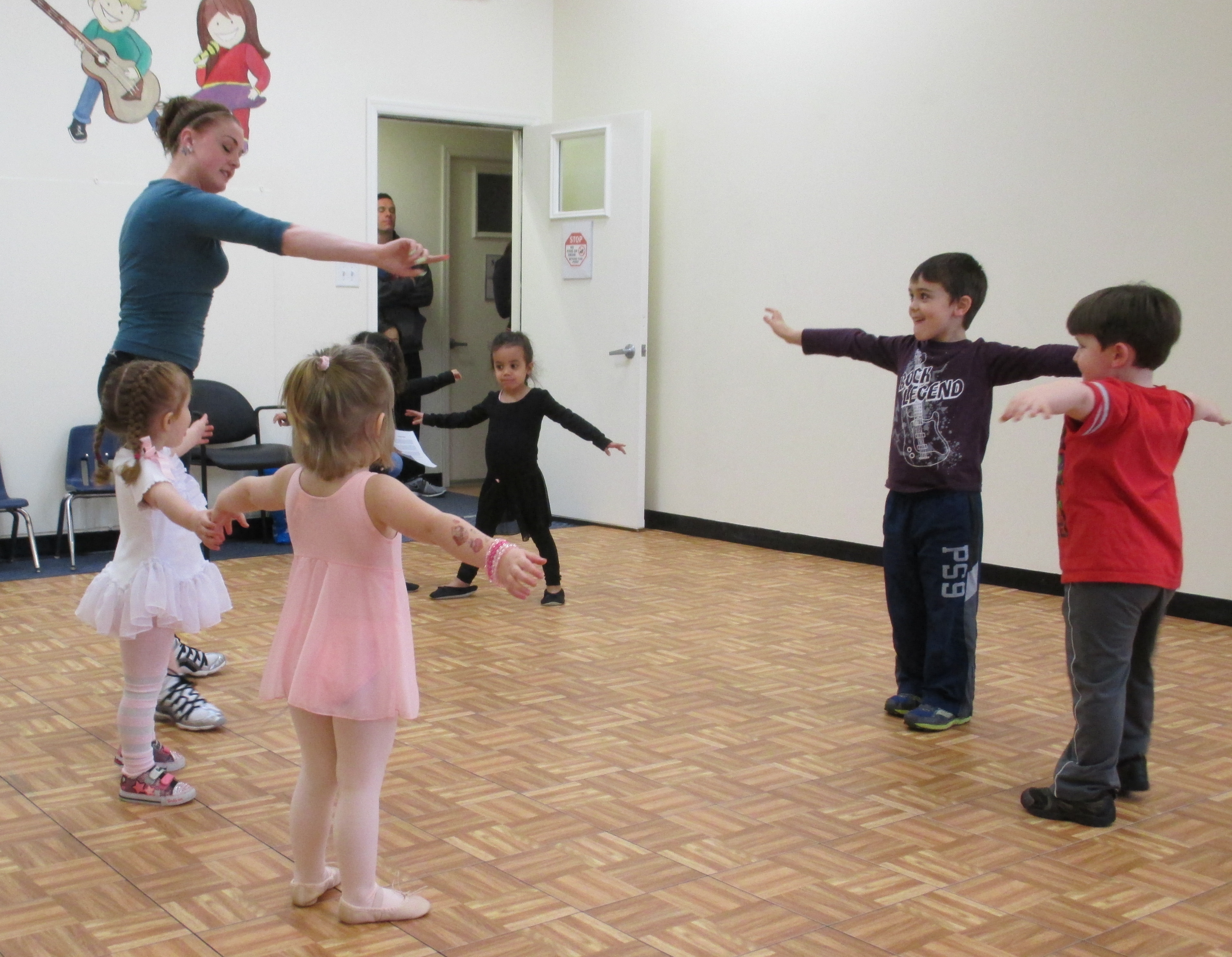
IMG_0671If you teach classes for children, what do you do to ensure that all genders feel welcome?

Many parents have had the experience of taking their child to a class that felt very biased toward girls or toward boys. (Read about my experience in my son’s dance class.) Some parents and kids stick it out even when all the messages say “you don’t belong here.” But many will drop out, looking for somewhere that they feel like they belong. What can teachers and administrators do to welcome all genders**?

Let’s examine some of the ways we can help.

How do you encourage all genders to enroll in your program? Think about:

  • Your class name: If you name your class “toddlers and tutus”, that pretty much implies it’s a girls-only class. If that’s what you intend, that’s fine. Say so. But if you’d like boys to enroll, think about a name change!
  • The words in your marketing: Whether it’s on brochures, posters, website, or social media, when you describe your program, do you talk about boys and girls and state that all are welcome?
  • The pictures in your marketing: Are there boys and girls and gender ambiguous kids? Boys and girls doing things together? If your photos show only girls playing dress-up and only boys climbing on play equipment, it’s easy to infer a gender bias.

How do you make your space welcoming to all genders? Think about:

  • The environment of your classroom: do pictures show both boys and girls doing a wide variety of activities? Are the colors gender neutral or diverse, or is it all pink ribbons or blue cars? Do you cluster all the “boy activities” in one area, and the “girl activities” in another area. (Cars and blocks here, kitchen and dress-up there.)
  • Your bathrooms: If you have single occupant bathrooms, are they labelled “boys” and “girls” (or “men” and “women”)? Why? Can’t you just label them both “restroom” or say explicitly “all gender restroom”?

How do you greet children and families into your classes? Think about:

  • The words you use when talking to parents: I prefer saying “kids” or “children” or “students” which includes everyone. If you want to say “sons” then also say “daughters.” If you say “girls” also say “boys.”
  • The words you use talking to the children: Instead of calling over the “boys and girls” for an activity, can you call them “kids”? Or even better: “dancers” or “artists” or “inventors” or  “everyone ready to play some soccer”? Not only is it gender inclusive, it allows them to take on the identity of a dancer or an artist and so on.
  • The way you react when a person of the less expected gender joins your program: Definitely welcome the person just as you welcome all others. But DON’T go way overboard in welcoming them, like “Oh, it’s so wonderful to have a girl in this class. I really wish more girls would enroll. I’m so delighted to have a girl.” All that tells them that you think it’s weird that they’re there.
  • How do you define which gender a child is? Well, the more gender neutral your practice is, the less this matters. But, when you have to guess, it’s fair to go by name, apparent biological sex, and apparent gender presentation. (For example, if you see someone who looks like a biological male, whose name is John, and who’s wearing a Spiderman t-shirt, you can guess boy.) But, if the child or the child’s family tell you the child’s gender, then honor that, even if it’s different from your initial assumption. If John in the Spiderman shirt says “I’m a girl, please say she and her when talking about me”, then do so! You can also invite parents and children to let you know what name they prefer to use, and what pronouns they use.

How do you make sure that daily life in your classroom is inclusive? Pay attention to:

  • The ways you divide up the group: Do you often go for the “boys on this side” and “girls on this side” way of splitting up the class for small group activities? Try mixing in “kids wearing white here” and “kids wearing blue” or “kids who like dogs best” and “kids who like cats best” and “kids who have birthdays in January through June” and “July through December.” Not only is this gender neutral, it also gets them mixing up a lot more and finding things they have in common with each other. (If we always groups divide into girls and boys, it can become an “us” and “them” mentality where the kids see the differences more than the similarities. We would NEVER divide kids up by race for a game, why is it seen as OK to divide them by gender?)
  • The books you read: Do they show both boys and girls, men and women, and androgynous folks doing a variety of things? In our Family Inventors’ Lab, we try to make sure that we read books about girls inventing, and boys studying animals, and so on. We’ll talk about Thomas Edison and Marie Curie.
  • Pay attention to labels: Use firefighter, not fireman. Flight attendant not stewardess.
  • Minimize stereotyped gender roles: When a group of children is playing house, don’t assume one will be the mother and cook and care for the baby. If children make that assumption, that’s OK but you shouldn’t place that assumption on them. Try not to say “wow – this is a woman astronaut… isn’t it great that women can be astronauts too?” It implies that this is a special case, not an equal opportunity.
  • Help soften their stereotypes. Around 2, children start defining things as “boy toys and girl toys“, around age 3 or 4, children start defining activities as “boys do this and girls do that” and around 4 to 6 they say “only boys can do this and only girls can do that.” (source)  You can remind them that anyone can choose any toy or activity, according to their own personal interests. But, don’t get too distressed by this. Stereotypes and sweeping generalizations is one way that kids make sense of their world.
  • Adjust your expectations of who will do each activity option: I confess that when I set up our classroom, in my head, I think “what’s my boy activity today.” By that, I really mean: I want to make sure I have an activity that will appeal to those kids who are full of physical energy and really need some big motor release. I need to come up with a new term for that, even in my own head. I’ve never said to anyone else “this is our boy activity” but I need to think of it in other terms myself to reduce my bias.
  • The way you react to the activities they choose: I still remember a coop preschool my middle child was in 14 years ago… one little boy in the class LOVED to dress up in pretty dresses and high heels and carry purses, and so on. Almost every parent volunteer who saw him do this tried to entice him either to choose different clothes (the firefighter helmet) or to choose a different activity (blocks or cars.) Although none of them said anything negative to him, there was definitely an undercurrent of “you shouldn’t do that.” In this case, the teacher gently modeled for all the parents that it was OK for the boy to do whatever activities he enjoyed.
  • How do you handle emotions: Are you sympathetic to a girl’s cries, but tell a boy to stop crying? Are you shocked when a girl shows anger, but act as though it’s normal when a boy does? Do you place similar limits on their behavior or do you let boys get away with more, because “boys will be boys.” Do you congratulate both boys and girls for sitting still and paying attention?
  • How you respond to bullying: If a child is being teased or bullied due to gender issues, be clear that it’s unacceptable in your classroom. But, don’t use this as a reason for punishment, instead use it as a reason to teach.

Check out this article on 6 ways to embrace gender differences and this one on 12 easy steps on the way to gender inclusiveness. Also, read my summary of what the research shows on innate gender differences vs. cultural influence, and on how to support both boys and girls in developing their strengths. If you want to learn more about transgender people, here is a nice overview. And here are pointers for Talking with Children about Gender Identity.

What other ideas do you have for welcoming all genders?

** I want to clarify why I’m saying “all genders” rather than “both genders.” In your classes, the majority of your kids may be cisgender: either girl-bodied-who-identify-as-girls or boy-bodied-who-identify-as-boys. But, you may also have transgender or gender queer or intersex children who don’t quite fit those straightforward binary definitions. Some of those kids won’t figure this out till adulthood, but some have the sense from very early in life that their assigned gender doesn’t fit. They and their families are already having a hard time sorting that out. If they go to a very gendered environment, it makes it even harder to know how they fit in and creates even more gender dysphoria (distress caused by the dissonance between how a person feels about their own identity versus how they are perceived / treated by others). If they are in a more gender neutral, gender inclusive environment, it’s easier for them to feel like the person they are is welcome there. Learn more about gender identity: https://gooddayswithkids.com/2018/05/02/gender-identity/

Photo: http://academyofmusicanddancenj.com/fall-2014-registration-dance-classes/

Boys in Dance Class

billyellrevI am working on a post about “how to make sure your classes are gender inclusive.” But first, I thought I’d share my story of why this topic is on my mind right now…

My 4-year-old son has recently started taking a ballet and tap dance class. Note: this is not advertised in any way as a girls’ dance class… in theory, it is open to all. Realistically, I knew Ben was likely to be the only boy. But even knowing that, it’s surprising to me just how girl-centric the class is.

On the first day, the teacher said “we have 10 girls enrolled in this class, so if you would like to move your daughter to a smaller class, you could do the 5:00 class”. Really, the class has 9 girls and one boy. The name Ben on the roster should have been a clue. And referring to our “daughters” when my son was sitting on my lap seemed odd.

Then she said “OK girls, come on over to dance.” And out run the girls in pink leotards and tiaras, and Ben in his blue shorts and Lego Star Wars t-shirt. (The class does not require any particular clothing. The other parents all chose leotards. I chose his favorite regular clothes.)

The teacher put on princess music (it’s all princess music… Little Mermaid, Frozen, etc.) and handed them all pink scarves, and they began to dance around the room. The walls  of the room are decorated with paintings and photos of girls in tutus. Not a single male dancer in sight.

And it’s not just this dance class. My older children took dance for years, and I know it’s pretty systemic. I’ve seen lots of pink leotards and paintings of ballerinas over the year. You can’t even buy boy’s dance shoes in my son’s size – manufacturers don’t make them – so he’s wearing pink ballet shoes and the least girly tap shoes I could order. In all the dance classes my daughters ever took, there was never more than one boy in their class. In recitals, boys are rare, and you can tell the instructor struggled to figure out what a boy costume should look like.

boyAnd it’s not just dance. With my older kids, it was rare to see boys in any of their  gymnastics classes. I’m told it’s the same in the equestrian world. And in all the theater activities my kids have done, the ratio is usually, at best, one-third boys and two-thirds girls. In pretty much any audition they’ve attended, my girls knew that every boy who auditioned would get a part. Some girls would get a girl part, some girls would get a boy part, and some girls would not get cast.

And, if boys do stick with dance as they get older, or do gymnastics or theater, what does our culture assume about their “manliness”, gender identity, and/or sexual orientation? If they’re straight, cisgender boys, then people talk about how “lovely” it is that they’ve stuck with their interest despite stereotypes. But all these attitudes show: They’re not generally viewed as “regular boys.”

The gender divide goes the other way in other extra-curricular activities. The STEM themed preschool-age class I teach tends to be two-thirds boys and one-third girls. I know from experience that the wilderness survival courses, aikido classes, computer programming classes, video gaming sessions and role-playing games (Dungeons & Dragons) that my daughters participated in had way more boys than girls.

And those girls are labeled tomboys, or, as they get older, butch. Or “a girl who excels in science.” The adults around them may be proud of how they are overcoming gender stereotypes. But again, they’re not viewed as “regular girls.”

Why is the gender divide still so clear in what activities are considered “boy things” and what are considered “girl things”?

I think if you asked most of the parents I encounter at these classes about their views on gender issues, they would talk a lot about the importance of equal access to all activities for all genders. I think they would all vehemently defend a boy’s right to take dance classes or a girl’s right to program computers. Many would share dismay over the fact that toy stores and clothing stores are so gendered.

Yet, when these same parents choose classes and camps to enroll their kids into, they perpetuate the gender roles.

Now, I know that the average boy may have different skills and interests than the average girl. The research shows it, as does anecdotal evidence. However, the researcthh shows that those differences are small, and that there is just as much difference between individual boys (the athlete, the brain, the criminal) as there is between an individual boy and an individual girl (the athlete and the princess).

Yes, boys are statistically more likely to like toy trains and cars than girls are. But that doesn’t mean there aren’t plenty of girls who would like trains, and plenty of boys who don’t really care. In choosing toys, I like to offer a variety of options without assuming what the child will like based on their gender. And when choosing activities for young children, I try a wide variety of activities, regardless of whether they are viewed as “boy things” or “girl things.” As  kids get older, they partially follow their inherent interests, but they will also be more likely to pursue activities where they feel like they “belong” and they “fit in.” Those male gymnasts, male ballet dancers, female programmers, and female wilderness guides all deserve some kudos for sticking with a passion even when the culture didn’t welcome them.

We can make it easier on the next generation. Parents can do their part by encouraging their children to try a wide variety of activities, and by not expressing surprise when a child of the “unexpected” gender is enrolled in those activities. Teachers and program administrators can also do a lot to make their classes gender inclusive.

We should all also remain aware that gender is not as clear-cut and binary as we were raised to believe. Any child in a class may not identify as the gender they were assigned at birth. Some transgender people don’t recognize this until adulthood. But some very young children have already figured out that they don’t fit the typical definition of “boy” or “girl.” It’s even harder for them to go into environments where assumptions are made about who belongs there, and who can participate based on gender labels. By making our cultural assumptions about gender more fluid, we make it easier for these children to find their place in the world. (More on gender identity: https://gooddayswithkids.com/2018/05/02/gender-identity/)

Just for the fun of it, I’ll conclude this post with a pointer to a playlist I’ve made on YouTube called Boys Can Dance, which features dances from Billy Elliot, West Side Story, Singing in the Rain, and lots more. https://www.youtube.com/watch?v=iOuZuAGvMRg&list=PLsMLXfBPSxoEF6nPQj13QjvAX-I53Ob2R  Or, if you’d like a little more modern / urban / less Broadway, check out the League of Extraordinary Dancers: https://www.youtube.com/watch?v=qVZyfsaKPS4&list=PLTXGCzZ9AAzPhEM_y-vudz1GbwsMhVL_0

Supporting Boys and Girls

When learning about the differences between genders or temperaments or learning styles and their effect on your child, try not to think of anything as “here’s what’s wrong with my child” but instead focus on:

  • here are things my kid is good at – I should give them plenty of opportunities to do those things so they have a chance to feel competent and successful and
  • here are areas my child may need extra support in developing – what are some ways I can gently challenge and nudge them in that direction on good days without pressuring them (especially not pressuring them on days when everything is already feeling hard)

Here are thoughts for supporting boys and girls:

Helping boys succeed

  • Physical activity is essential: give him active chores, ensure he has plenty of time for big motor play. If he has a shorter attention span, it helps to break big jobs down into smaller tasks, and switch things around when working, alternating activities.
  • While girls learn best with words (spoken or written) as their primary source of information, boys learn better when they can manipulate or view the material.
  • Take advantage of boys’ natural curiosity and desire to fix things by giving problems to solve. Take advantage of his desire to compete by issuing challenges.
  • If you want to connect with a boy, do something physical together. Especially if you want to have a “serious talk” with him: Do it while walking side-by-side, not sitting and looking at him.

Helping girls succeed

  • Encourage physical activity of all kinds. Treat her as a brave, strong, athletic child.
  • Encourage her to practice skills that build spatial intelligence – build with blocks, make and use maps, and play video games that let her “move” through spaces and put pieces together.
  • Play with toys that move – cars, paper airplanes, balls – these help predict motion.

Stress response

  • When boys are stressed, they have an adrenaline-fueled reaction – either moving toward a danger (fight) or running away from danger (flight). These outbursts are hard to miss, and may be seen as disruptive behavior. A stressed boy might do best to get up and move, especially outdoors where he can be loud. But, he can also be taught to take slow deep breaths to calm his response.
  • When girls are stressed, they have an oxytocin-fueled response (the collect-and-protect response, aka “tend-and-befriend”) – they are more likely to turn to other people for support and to help defend from perceived threats. Their stress may be quieter and go un-noticed until they begin to cry. A stressed girl may do best when someone moves in close to her, speaking in a calm, quiet voice, and offering support with problem-solving. source

Learn more on gender https://gooddayswithkids.com/wp-content/uploads/2013/12/gender.pdf and gender identity: https://gooddayswithkids.com/2018/05/02/gender-identity/