The TL;DR summary:
Don’t rush to introduce your child to your favorite book or movie. Why?
- There may be mature content the child is not ready for that might frighten or concern them.
- You’ll all enjoy something more if you wait till they’re old enough to actually get it and enjoy it!
- There’s plenty of fabulous media aimed at young kids. It’s OK to stay in the kiddie pool for a while… I promise, there will be time later on to introduce all the great stories!
My Rationale for Waiting:
As a parent, I’ve had lots of time to reflect on this. As a parent educator, my students ask me about these topics from time to time, but I’d never taken the opportunity to write up my thoughts till now…
Recently, a friend on Facebook asked for recommendations on which novels to read next to her 5 and 6 year old. Some folks recommended Narnia, A Wrinkle in Time, the Percy Jackson books.
And I said no! Wait! Not yet!
Today, on the /Filmcast, a host (Jeff) was talking about when he would first show Star Wars to his kids, saying “I’ve got years before I can show it to them and really have it land… and be meaningful”. He said “even three is probably way too young… 4 or 5 is probably the right age?”
And I thought: No! Wait! 4 or 5 is way too young!
Whatever your favorite movie / book / play / music is, you may be anxiously awaiting the day you can introduce your child to it. But if you really want to “have it land” and be meaningful for your child, it is better to wait till they’re really ready. It’s hard to be patient, but I think it’s more rewarding in the long run. Here’s why:
Mature Themes
An obvious challenge of introducing too early is mature themes. Sometimes there are scenes that might frighten them (For example, although many first graders are plenty literate to read Harry Potter, I think it’s too scary for a 7 year old.) There’s also language, substances, “bad attitudes” and so on. Some of your favorite media may have more of this mature content than your child is ready for… and you may not remember till it’s too late. (I’ve made this mistake plenty of times. For example, watching Footloose with my tweens… I’d remembered all the dancing… I’d forgotten about the underage drinking… and the playing chicken with tractors… and the boyfriend hitting the girlfriend… the dad hitting the daughter… We pressed pause several times during that movie! This ended up being a good opportunity to start some challenging conversations. But it would have been better if I’d done it with a clearer plan!) I have now learned to refresh my memory first by reading the reviews on Common Sense Media, which does a nice job of clearly detailing all the potential issues so you can decide which feel OK to you and which feel problematic. For example, I’m not really troubled by bad language, or by fantasy combat, but I am really uncomfortable with realistic gun violence. Your concerns may be different.
I’m not saying that you should never take in media with your child that tackles challenging issues. I actually recommend that parents read books or watch movies where characters face a variety of challenges, make difficult decisions, and cope with grief (read my posts on how to talk to your child about death, scary topics, sexuality, and more). Reading sad books or watching sad movies with your child and then discussing them helps to build emotional literacy and build decision-making and problem-solving skills (as they watch characters manage situations that they have not yet had to face.) But, do this intentionally, not by accident. And do it with media that is developmentally appropriate for your child.
Will It Land?
My reason to wait isn’t just about avoiding mature themes. It’s also waiting till they’re ready to grok the material. Really ready to engage, enjoy, and get meaning out of it.
When I was a kid, I hung out in the public library and the church library by myself a lot. (Mom must have been in the building somewhere? I don’t really remember… I remember having full access to any book I wanted to read.) I read the Hobbit and LotR, the Chronicles of Narnia, and Wrinkle in Time all around the same time. Probably 8 or 9? Now, my reading skills were totally up to deciphering all the words (and to looking up tesseract in the dictionary). I probably understood all of the Hobbit, and much of Narnia. But there was so much I missed. (Yeah, like that Narnia had any relation to Christianity.) And the thing was, once I’d read them, I didn’t want to go back and re-visit them when I was a little older, because I’d been-there-done-that. I didn’t go back to them till my own kids read them. So, my experience was fine, but it could have been better.
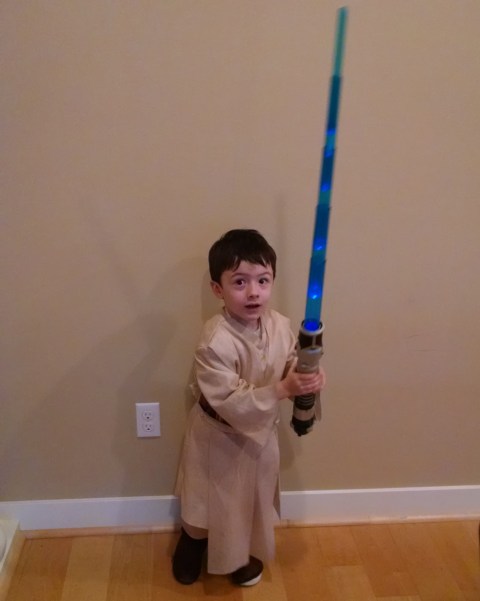
With my kids, we’ve mostly waited… With my youngest, we waited till he was 8 to show him Star Wars. Before that time, he’d read Star Wars themed beginning readers, he’d played Lego Star Wars video games with his dad, and he’d dressed up as Obi Wan. He’d even watched parts of the movies at family parties at his uncle’s house. But when we finally sat down to watch the original trilogy, he was ready to follow it, enjoy it, and understand it much better than he would have been at a younger age.
Spoilers
Spoilers float around in popular culture and discussions, so some parents worry that their child will be spoiled about key plot twists. And they will be. My kid knew who Luke’s father was long before he watched Star Wars! So, no, I didn’t have the opportunity to film his reaction to that revelation. (Yeah, that’s its own genre of YouTube videos.) But instead, I got to see his glee at finally learning the whole story related to that fact, and understanding why it is such a famous plot twist.
Although I had seen all the MCU movies, my son had not. I saw Avengers Endgame on opening night. Then I went on a binge of watching every YouTube video and listening to every podcast about the movie and all the Easter eggs. And my son rides in the car with me, and hangs out in the room while I do my morning workout. So, guess what – he knows ALL the spoilers even though he hasn’t see the movie. Over the past month, we’ve started to introduce him to all the movies (starting with Spider Man Homecoming and Ant Man movies, because those felt like the most kid-appealing choices). At 8.5, he’s actually in a really good sweet spot for these movies. Well… for watching them at home! Where we can talk during the movie when needed to explain something to him, we can answer his questions, and we can pause for a break to process if needed. We’re not going to take him to an MCU movie in a theatre this year or maybe next. Being in a dark room with the sound all the way up and having to be quiet and not able to pause can make a movie feel way more intense to young kids. (And if he asks questions he would disturb others.) We’ve also started pulling old Marvel comics out of the stash in the garage to entertain him till then.
We as adults may dislike spoilers, and like the moments of surprise. I find that children often go the other way. They like knowing information ahead of time because it makes them feel smart and powerful, and they may actually get more excited by the story that leads them to a known destination than they do by watching something when they have no idea where it’s going.
Stay in the World of Children for a little while
Another reason to wait on more “grown up” stories is that if we rush to that, we could miss out on the pure and sweet delight of children’s media.
When my oldest was in kindergarten, he came home from a playdate at a friend’s house singing ‘Hit Me Baby One More Time’ by Britney Spears. And telling me about all the music videos he’d watched. Some people might have been offended by the child’s mother letting the kids watch mature content… I didn’t really care about that. But I was sad at all the things that child might have been missing out on.
At that time, my son was listening to kids’ music – and there is SO MUCH great kids’ music out there! His favorite singers at that point were: Tom Chapin, Tom Paxton , Priscilla Herdman, and Anna Moo. So many delightful songs to sing! We decided ‘Oops I did it again’ could wait.
If I’m showing Star Wars to my four or five year old, we’re not making time for Kipper, Toy Story, Lion King, Iron Giant, Ponyo, and Sid the Science Kid. In rushing toward Harry Potter, let’s not skip over Winnie the Pooh, Dr. Seuss, Henry & Mudge, Frog and Toad. Take the time to do kid stuff while they’re kids. You can always watch everything else later on, but it’s hard to talk your teenager into going back to all this great kid content.
Context Matters
As I’ve hinted above, there’s a difference between watching a loud movie in a dark theater full of strangers vs. at home. What your child might be up to in one context might be too much in another context. We love live theatre, but we start with kid focused shows where we practice our “theatre rules”, then we try outdoor theatre where if the kids move or make noise, it’s no more disruptive than the airplane flying overhead. Then we go to school or amateur productions indoors. We wait on those expensive tickets to the Nutcracker or to Lion King’s national tour till we know they’re ready to get the most out of it!
So, if you can’t wait to introduce a particular story, think about what context it is best to introduce it in. For example, if you’re worried about a movie being too scary, you can read the book together in advance (or tell them the story from a plot synopsis), and show them still pictures from the movie ahead of time so they know more about what to expect? (Yes, it’s spoilers, but remember that’s OK for kids.) Would it work better for you to “serialize” a movie and watch it in lots of short 20 minute segments with time to discuss along the way? Could you just skip scenes or fast forward through some for now? Do what you think is best.
For books, often once a child learns to read independently, the parent stops reading to the child as much, and eventually even bedtime stories fall by the wayside. There are all sorts of benefits to continuing to read to an older child (including building their skills at interpreting what they read, increased empathy, and an entryway into those challenging conversations.) When my older kids were tweens and teens, we would listen to audiobooks in the car and then have common ground for a discussion of something we were all engaged in. So, reading to your child or listening to audio books can be a great way to introduce some of your favorite tales.
It’s In the Water
Some things we don’t wait on. Some things are just part of the water that our families swim in. When I was growing up as the youngest of four kids with a dad who loved science fiction, Star Trek was on the screen in the living room every week when I was a toddler, and then reruns were watched for the rest of my childhood. So, the vision of a future of scientific exploration was just a part of my life. Seeing people of all ethnicities working together, seeing a black female officer – was all normal to me. Not the radical experience that Star Trek TOS may have been to some. And I absorbed lots of other science fiction and fantasy from the rest of the family – I think my sister told me shortened versions of some of her favorite fantasy tales. And I think all our kids absorbed the ethos of “with great power comes great responsibility” long before watching Spider Man. My older kids grew up hanging out in the room while I played roleplaying games with friends, and they joined in as they got old enough. My youngest is just starting to join my oldest and his friends in playing Magic the Gathering. So your favorite stories and characters can’t help but be an on-going part of your family’s life.
But, if you’re asking “When do I let my kid read…” or “When should I show my kid….”, or “is it to early to expose my child…” here are my completely personal biased recommendations for when the right time is for some properties (mostly from the geek universe cuz that’s the way I roll.)
Recommended Ages
(For more details on the kid appropriateness of ALL of these properties, use Common Sense Media to learn more.)
- Chronicles of Narnia – Read to kids (or audiobook) at 8 – 10. Independent read at 10+. The 2005 movie of Lion, the Witch and the Wardrobe is mostly good for ages 6 and up, but there are some scenes that could be frightening for kids under age 10. The 1988 BBC Chronicles of Narnia may work for younger kids, but is very long, so break it up into pieces.
- DC Movies: Shazam should have been a GREAT kids’ movie. And 90% of it is. But the beginning drags, is confusing and scary, and the intense scenes are really INTENSE. I’d say 12+. Wonder Woman is great for 12+ but I wouldn’t go younger – the World War 1 scenes are scenes of warfare. Aquaman is probably fine for 10 and up, though parts of it would hold no interest for them. (Note: I would not show Man of Steel or BvS to anyone under 15, and I opted out of Suicide Squad myself.)
- Dungeons and Dragons (and other table-top roleplaying systems): My older kids could play as the kids in a group of patient supportive adults (with an adult DM) starting at about 9 or 10. I’m guessing groups of kids could play at around 12? We’re trying to start a group of 7 – 9 year olds on a simplified D&D now with an adult DM, and thought it was going well, until today’s character design led to a series of meltdowns – one child due to a lost character sheet, one because they were having a hard time understanding the spell options, and one because his character is not as strong as the others. (Being told that he was smarter and had higher dexterity than the others did not resolve the meltdown.)
- Harry Potter. The series starts on the scary side, and gets much darker as you go along. And for most kids, the movies are scarier than the books.
- My oldest read the first few books when he was 10, then read the last three as they came out, when he was 10, 12, and 14. He recommends this as the appropriate timing. He says movies starting at age 12 or so.
- Another approach: Kids read the book when they’re the same age as Harry is in the book – so book 1 when the child is 11, book 2 when the child is 12… When it’s almost time to read book 2, you could watch movie 1 for a reminder of the general plot of book 1. (Tip: never read the book then IMMEDIATELY watch the movie… I did this for Goblet of Fire, and I was painfully aware of every minor variance from book to movie.)
- Common Sense Media has a helpful Harry Potter Age-by-Age Guide which addresses which books to read and which movies to watch by age, and includes the new properties like the Fantastic Beasts movies.
- In reality though, I know it might be hard to keep these books away from my youngest for that long, as he’s got lots of friends who have read them. He’s already played Lego Harry Potter and put together Harry Potter Legos, and seen the attractions at Universal Studios, so he is familiar with the characters and the broad story lines. I suspect we will start by listening together to all the books on audio – the audio versions are narrated by Jim Dale and are absolutely stellar! Then he can read the books if he wants, then we’ll watch the movies.
- The Hobbit – read to a child at 7 – 9. Child reads independently at 9 or 10. But wait on the rest of the Lord of the Rings books till 12 or so. I’d watch the animated version of the Hobbit from 1977 with a 6 – 8 year old, but I’d wait on the Peter Jackson Hobbit movies till age 10 – 12, and wait on the Peter Jackson Lord of the Rings till 12 or higher. (Partially due to the violence but also I don’t think younger kids would follow the plot well.)
- Magic the Gathering – My oldest is introducing a simplified version to the 8 year old now, and that’s going well.
- Marvel Cinematic Universe. I’d say start at age 8 with careful forethought and the ability to pause and explain. Older for in-theater. And maybe 10 and up if the child is likely to imitate combat behavior. But also pick and choose – some are more appropriate than others for younger kids. (That’s why we started with Spider Man Homecoming and Ant Man / Ant Man and the Wasp, not Iron Man 1 which starts out with some real-world violence.) In other Marvel: X-men movies for tweens. Deadpool – yeah, it’s R rated for a reason – the violence was uncomfortable for me!
- Percy Jackson. I’d say 10 and up for the books. The characters are teens, who tweens could identify with well. I saw the first movie, and I’d go 13 and up on that one – read why.
- Princess Bride. The movie is actually less intense than the book – although the ROUS and the torture scene might be distressing to kids. I would generally say 8 and up, though we took our son to outdoor movies in the park when he was 6 and 7. Scary moments don’t feel too scary when you’re sprawled on a picnic blanket on the grass. The book is probably for 10 and up as independent readers, but the audio book would be great for a 9 – 13 year old on a road trip.
- Star Trek – If you tell your 6 year old “I have a show you’re going to love!” and you turn on Star Trek, they may not think it’s for them. But, if the adults are watching Star Trek and the kids are watching along, they’ll probably like (and role play) many aspects while missing other concepts. All the TV series are probably fine to have playing around younger kids, some of the recent movies might be better around older kids. Of the series, TOS and TNG are more accessible to younger audiences and better to start with. They also have a really nice culture of optimism about the future. DS9 and Enterprise skew older; Discovery has some interesting conundrums for teenagers about when do you obey authority and when do you question it.
- Star Wars
- For this post, 19 dads were asked when to introduce Star Wars. “Conclusion: Fathers answers ranged from “in the womb” to “never”, with an average suggested age of somewhere between 5 and 6. Fathers also cited innumerable variables to take into consideration which were not consistent from child to child, or from family to family. There was consensus among the sampled fathers that exposure should be determined on a child-by-child basis, taking into account that child’s emotional, intellectual and social development, and always under parental supervision.”
- My husband and I lean toward waiting till 7 or 8 because we think they’ll appreciate it more then. (If you’re wondering what order to watch movies in, read Machete Order – Explained.)
- Release dates of new movies may skew your decisions… Someone told me she would have waited till age 8 or 9 to start these movies, but her mom took her to the opening of New Hope when she was 4, and when it turned out Force Awakens was going to come out when her child was 4, she decided to take her. But, they sat in the back row and had a stuffed animal and the iPad so if the child wanted to “opt out” of watching the movie, she could.
- Studio Ghibli Films – I agree with these recommendations: My Neighbor Totoro and Ponyo for age 5 – 7. Cat Returns and Kiki for age 8 – 10. Spirited Away and Howl’s Moving Castle for tweens. (More recommendations here and here.)
- The Martian – for ages 11 – 15. I have a whole post on the Martian… which was also inspired by a Jeff Cannata comment on the /Filmcast…
- Willie Wonka – read the book Charlie and the Chocolate Factory at 6+. Watch the 1971 movie at 7 or so. (There are a few frightening moments of “children in peril.”) I think you can skip the Johnny Depp version.
- Wizard of Oz – read the book to ages 6 and up. Independent read a little older than that – some archaic words. When I was 4 – 6 and watched the movie, I was terrified of the witch and the flying monkeys and hid behind the couch. But my kids all watched around age 6 – 8 and handled it OK – I had prepped them for the fact that it might feel scary and warned them when those parts were coming up.
- Wrinkle in Time – Yeah, I read it at 8 or 9. I’d recommended 10 – 12 to get more out of the book. (Although again, you could read it to them younger than that.) The 2018 movie is appropriate for 10+, but it’s not as good as I wanted it to be.
Note: if you have multiple children, this all gets more complicated. Our older two were 3.5 years apart, so if I say something is good for ten year olds, that probably means we ended up watching it when the older one was 12, and the younger one was not quite 9. It worked for us because the older one was OK with “kiddie things” for longer, and the younger one wanted to be as “mature” as possible and had more tolerance for scary content.
What if they hate it?
And what if you’ve waited and waited for something, and then you show it to them, and they hate it?? Or what if they say “meh – it’s OK but not really that great?” Well, it’s a good lesson that our children are different people than we are, and we can all have different opinions. And maybe someday they’ll like it more… and maybe not.
I LOVE the movie Creator, a truly obscure 1985 romantic comedy with Peter O’Toole. It just makes me happier than almost any other movie I’ve seen. I waited till my older kids were in their late teens… it’s an R rated movie with some shower almost-sex and similar mature content. And I showed it to them, and they said “meh… I mean, I’m sorry Mom, I don’t want to make you feel bad, but maybe it’s just not for me?” And you know what? It was disappointing, but it’s OK. I still love the movie.
I had a dad tell me recently that there’s so many GREAT books he wants to share with his 12 year old daughter, but she’s only interested in YA romances and isn’t interested in any of them. I suggested to him that they listen to audiobooks together and that they take turns. She picks out one of her favorites, and he listens and gives it a fair chance and asks her what it is she loves about it. He may well end up liking it and even if he doesn’t, he gains new insights into her. And if he gave her book a fair chance, then hopefully she’ll give his book a fair chance.
Stephen Thompson, of the Pop Culture Happy Hour podcast, has shared stories about how he’s been trying for years to sell his kids on all the things he thinks are great, and now as teenagers, his daughter is into horror movies, which have never been his thing, but she’s sold him on a few of her favorites, and his son has convinced him that some video games are actually enjoyable to play – even if he’s very bad at them. For both parties in these exchanges, it’s a chance to be exposed to new things, to learn to appreciate each other’s perspectives, and to connect over a shared experience. And that’s the real value in sharing our favorite stories.
Please add comments – agreeing or disagreeing with me… and what properties (books, movies, plays… ) have I forgotten that you have strong opinions on?









 ,
,  More Good Days with Kids