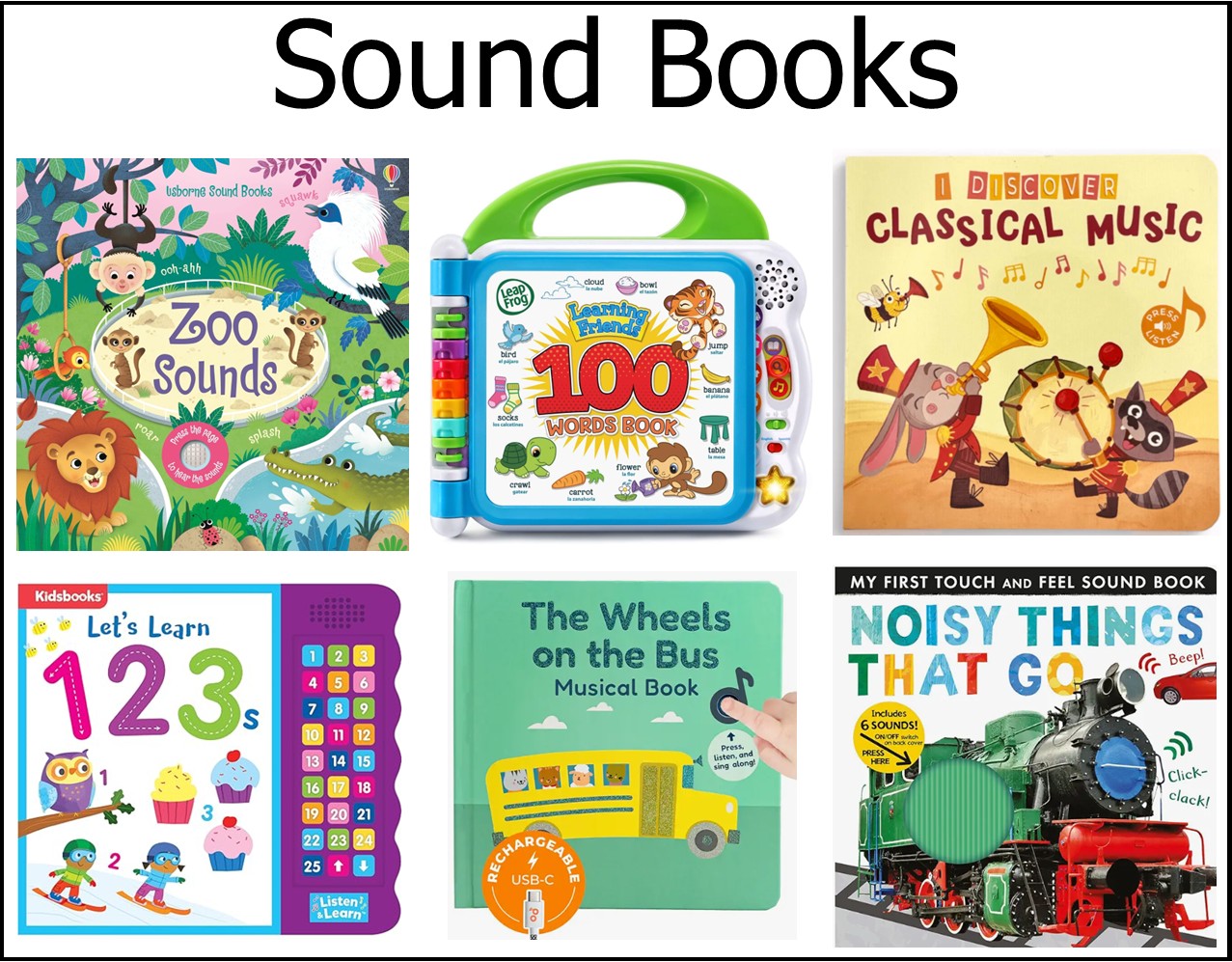
Sound books are interactive picture books aimed at young children. They have buttons you press to hear a sound (like a dinosaur roar, first words in various languages, or farm animal sounds) or a song. There can be anywhere from 3 – 30 buttons per book. They combine a book reading experience with a “press a button to make something happen” toy, so are fun for kids.
Benefits and Uses
Some benefits of sound books: they are interactive learning, they build fine motor skills, the child can interact with them independently, and they are fun! Additional benefits of language-based and music books: they can help reinforce learning for the child (in things like “first word” books where the child sees the word and hears the word), the child speaking or singing along with the book builds language skills, and they encourage focus.
For home use, they can work well to entertain a child while you’re busy, or in the car. Or, for me, each of my kids had a period of time where they had given up naps, but I wanted them to still have “quiet time” in their rooms. If they played with something like this that made noise, I could hear that they were still awake, or if the toy was quiet, assume they had gone to sleep.
At my classes, I don’t use sound toys much in the main classroom, as they can be distracting or overstimulating when added to all the other sounds in there. I have used them in my parent-toddler class, where I have a “quiet room” where parents can take a child if they’re overwhelmed. I have books and puzzles in there, but the sound books are nice there, because they are sound a child can choose and control, which may give them more tolerance for returning to the main classroom with all the noise they can’t control.
What to Look For
Like all press-a-button toys, they have the potential to be annoying for parents if the sounds are too loud, or if the sounds are unpleasant to listen to. So, I would only buy ones where I could listen to what it sounded like before buying. (Either in person, by listening to clips on line (like videos on Amazon listings) or by going to YouTube and searching for “[book title] read aloud” to see if someone has made a video of it. Read reviews to learn about volume if you can’t hear it in person.
Most of these books are board books – a few are paper pages, which is much less durable. The books have a power on/off button – if it’s off, none of the buttons will work. They have batteries, which tend to last a long time. Make sure they can be replaced or re-charged (some have USB chargers).
On most the buttons are fairly easy for little fingers to find and to activate, but some are harder to find or to press on just right to activate the sound. Again, if possible test them in person, or read reviews. Once you find a brand that your child can easily work, you can buy more.
I review five different brands of sound books here: Music Books.
For more recommendations on sound books, check out Sparkling Bookshelf’s Ten Best or Mommy Baby Play recommends 21 options.


 (
( More Good Days with Kids