Are you ready to try learning just a few children’s songs to add to your group time at preschool or your library storytime?
Let’s get started!

This post covers: finding a ukulele, choosing a tuner, how to tune a ukulele, how to hold it, how to strum, how to play a chord, and how to play your first song.
Find a Ukulele
First, you need a ukulele. I recommend a soprano or a concert ukulele (they are tuned to the same pitch, just the concert neck is a little longer which makes playing chords easier for folks with bigger fingers, and means that the instrument has a wider range of notes to play. The concert also has a more resonant, richer tone, because it’s a larger instrument, but I think soprano sounds fine for preschool songs.)
If you look on your local Facebook marketplace or other places used instruments are sold, you’ll find ukuleles in varying quality and price points. Or, ask your friends, maybe someone you know has a ukulele they’re not using. All you really need is a ukulele. You don’t need a strap or a case, though they’re nice to have.
If you’re buying new, it may be best to go to a local shop that sells guitars and ukes and has knowledgeable staff, where you can try things out hands-on. I have ordered mine online. My Kala KA-15S was a fine starter instrument, though with only 12 frets, it will have a limited range as your skills build. It’s currently $99 including a bag, strap and tuner. I think the Enya Carbon Fiber is a better bet. It’s only $49 (with bag and strap, no tuner) but has a really nice sound, has 17 frets, and I am much more convinced that it would survive being stepped on by a preschooler. (This hasn’t happened in my classes yet, but I am certain it will someday!) Those links are Amazon affiliate links, and I do get a referral fee if you click through and purchase something. You can also find lots more recommendations for beginner ukuleles.
In this video, I compare the Enya, described above, with my Kala KA-SCAC-SLNG, which is a long neck soprano, which cost $259.
Choose a Tuner and/or App
There are ukulele specific tuners and chromatic tuners. I like a chromatic tuner. A basic tuner just tells you whether you’re playing a G, C, E, or A since those are the chords on a uke. If you’re tuning for C and you’re not in the range for C, it doesn’t show anything. When you’re getting closer to C, it shows that you’re too high or too low. When you’re in tune, it shows that. Here’s two images from beginner tuner in the Kala app.
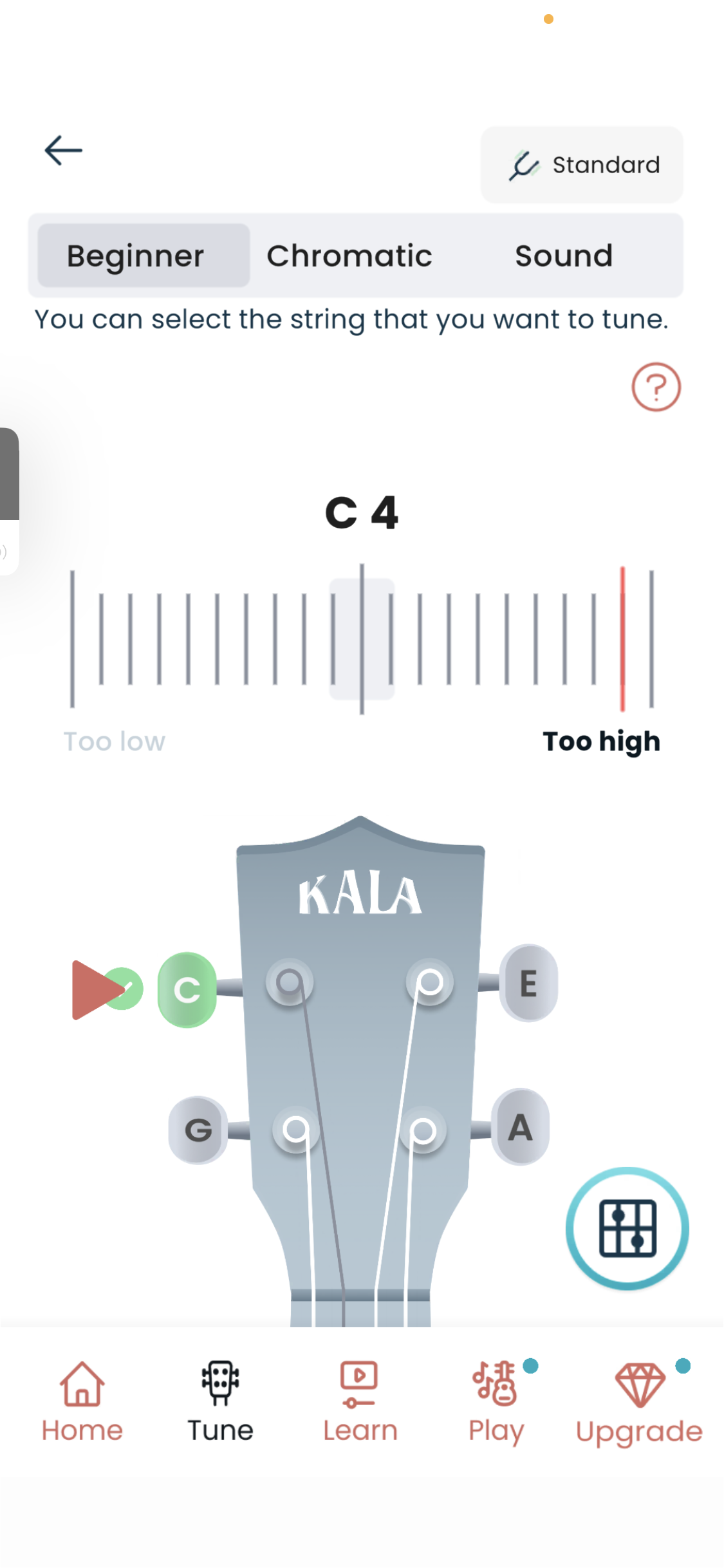
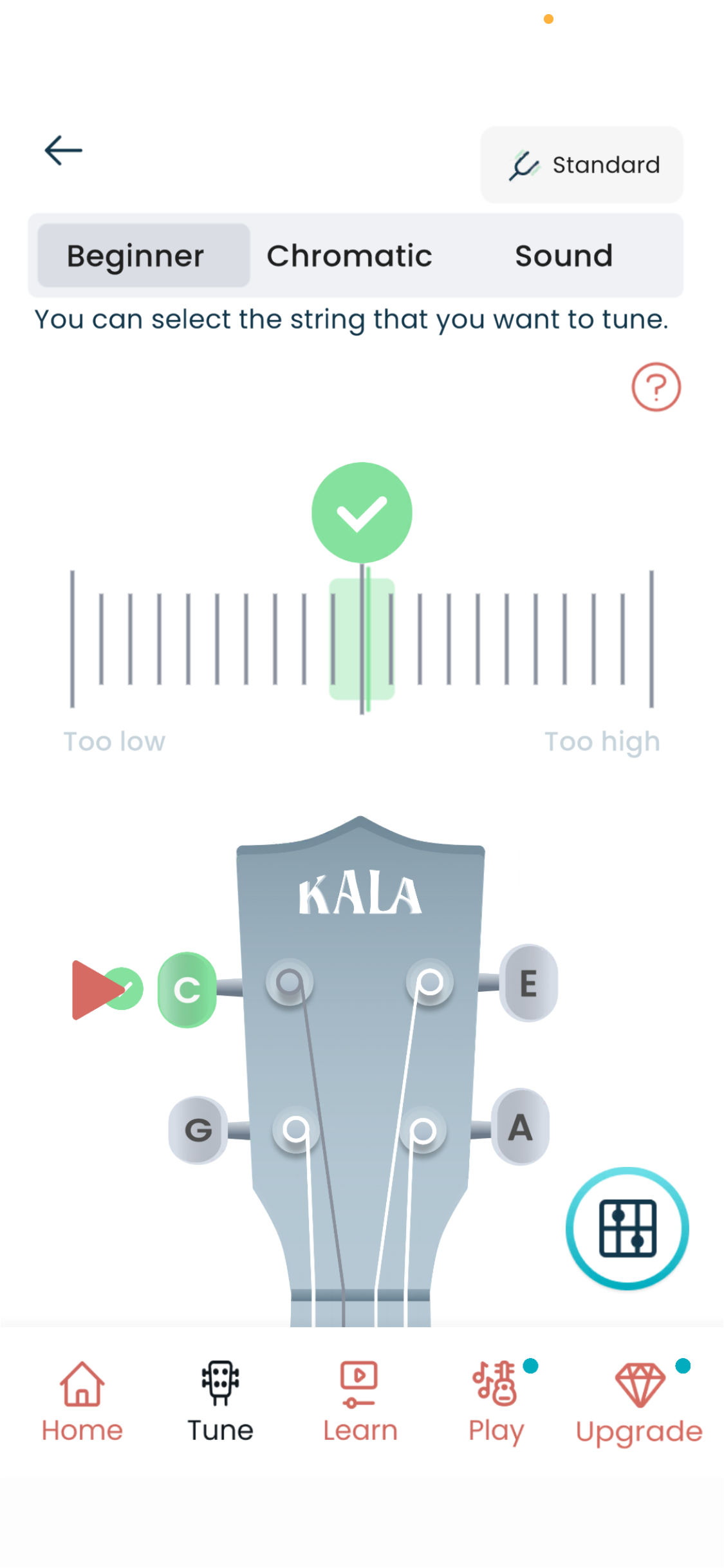
A chromatic tuner tells you what note you’re playing – like that your G string is currently playing F# – and clues you into whether you need to tune up or down to find the correct note. From the insTuner app:
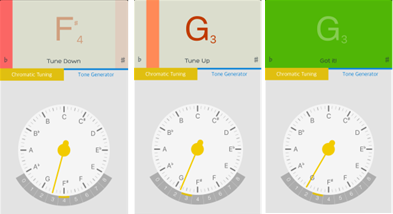
You could buy a clip-on tuner, or one might come with your uke. They probably work better than an app in a loud setting (like say at a preschool after the kids arrive!)
I just use an app on my phone – if you buy a Kala uke, it will give you access to the Kala app, which includes a basic tuner and a chromatic tuner. The YouKeLiLi Tuner app is an OK tuner, but I like that it also offers chord diagrams, for when I need to look up how to play a C6 chord or F#m. The main tuner I’m using now is insTuner, which is an easy to use chromatic tuner. Here’s a very brief video of Instuner in action.
Note: There are several apps which also have video lessons to help you learn ukulele: including the Kala app, the OK Music app. I haven’t used them much, but they’re probably worth checking out while you’re looking at apps.
Learn How to Tune
When you get a new ukulele, it is likely to be out of tune! If it’s a used uke, they do go out of tune over time. New ukes are shipped with the strings loose to avoid damage, and so you have to tune them up when you get them, and keep tuning them a lot in the first few weeks as those new strings stretch out and settle in.
When you’re holding a ukulele with the neck in your left hand, the top string is a G, the next one down is a C, then E, and A is the one at the bottom. To tune, you play a note on the string, check the tuner, and turn the tuning pegs clockwise or counter-clockwise till it’s in tune. The easiest way to learn this is to watch a video! Here’s my favorite on How to Tune a new ukulele fresh out of the box by Bernadette, who is my favorite online ukulele teacher.
Since it sometimes helps to be taught the same skill in a few different ways till you find the one that clicks with your learning style, you may also check out: How to Tune from Katie from One Music School – shows at the beginning how a tuning app works. https://youtu.be/2hZY_WzaS78?t=36; and How to Tune by Andy Guitar – easiest to see tuner as he tunes https://youtu.be/2VOuRBjmzAM?t=45
Learn How to Hold Your Uke
There are some written tutorials online, some with helpful diagrams, such as Zing instruments and the Wikihow.
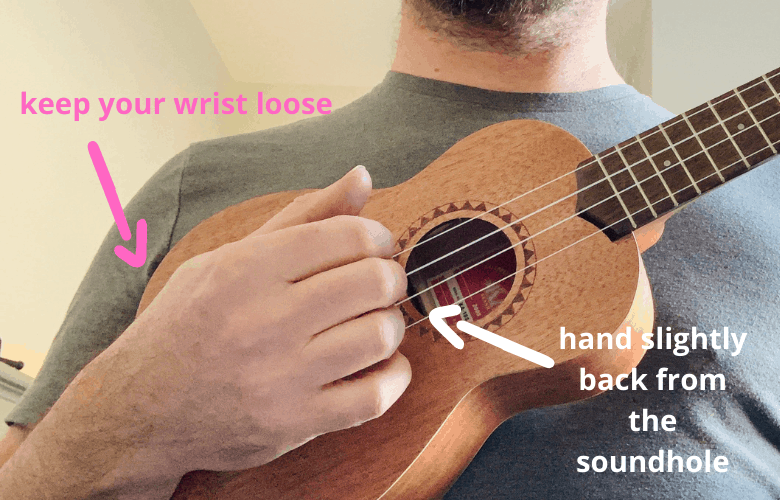
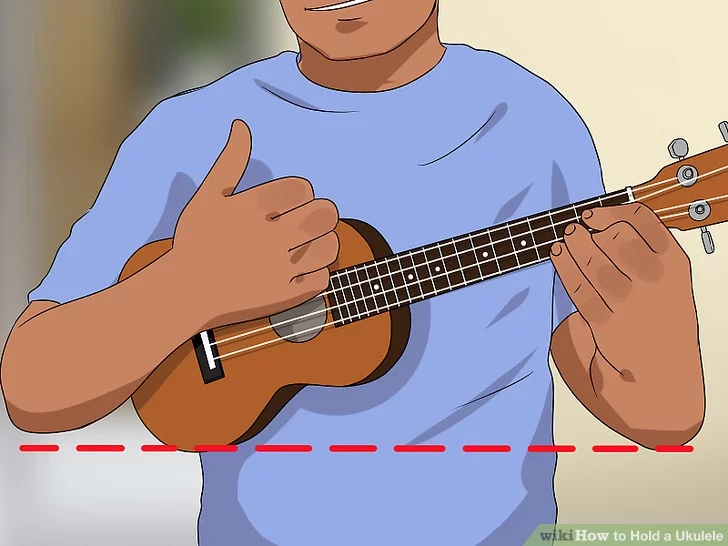
Some key points: hold it so the back of the ukulele is pressed against your belly or chest, and your right forearm is braced against it to hold it in place. The neck is in your left hand – it rests in the space between your thumb and first finger – your thumb is on the back or top of the neck, your fingers are cupped, ready to make chord shapes on the fret board.
Again, it is helpful to learn using a video:
Here’s a couple more that might be helpful: my video, Katie from One Music School – How to Hold and Strum https://youtu.be/jxsntBDrk20?t=27 and Phil Doleman – Adjusting your left hand position: https://youtu.be/SpeggLDic-8?t=105
Learn to Strum with Your Thumb
For your first few strums, let’s try strumming with your thumb. Stick your thumb up like you’re giving someone a thumbs up, then brush it across the strings like you’re brushing a hair off the strings with the side of your thumb. Here’s a video that clearly illustrates this: [note: all my video links are set to go to a specific point in a video, like this one starts at 3:04. That is the most relevant spot in this video, and then I recommend that you watch it up till 5:18. There’s lots of other good stuff in this video, but that’s the section to focus on for now.]
This is just a beginning strum technique – it works best when you just want to strum down once at the beginning of each bar of music. You’ll quickly move on from it to the next one, which is a lot more versatile, especially when we add in down-up strum patterns.
Learn to Strum with Your Index Finger
You can strum with just your index finger, or you can place your thumb against your index finger to give it more strength (and make your strums louder.) Some people use a pick for ukulele, but most do not. This video starts at 3:02 – watch to 5:07 to get the strumming technique.
Again, if you need more tips to help you find the way that works best for you, check out these three takes on strumming, from my video, which covers thumb and index finger strums, from Bernadette – https://youtu.be/VJZg_vxODOY?t=30 and from Phil Doleman – https://youtu.be/CTWCmCKggwg?t=442 – watch to 9:20.
Learn How to Play a Chord
Let’s start with the C chord. You only need to use one finger to make this chord. Just press the tip of your ring finger down on the neck of the uke, in the third fret (the space between the second and third fret markers – learn more about your fret board). First, just strum that one string (the A string, the one lowest down when you’re holding the ukelele.) Does it ring out nicely? Or is there a dull plunking sound? If it’s dull, you’ll need to press down harder, and be sure you’re pressing beteen the fret markers. Getting good pressure on the string can be tricky if your fingernails are long – that’s why most guitar and uke players have short fingernails on their left hand!
Once that note (the C note played on the A string) sounds good, strum all four strings together to make the C chord.
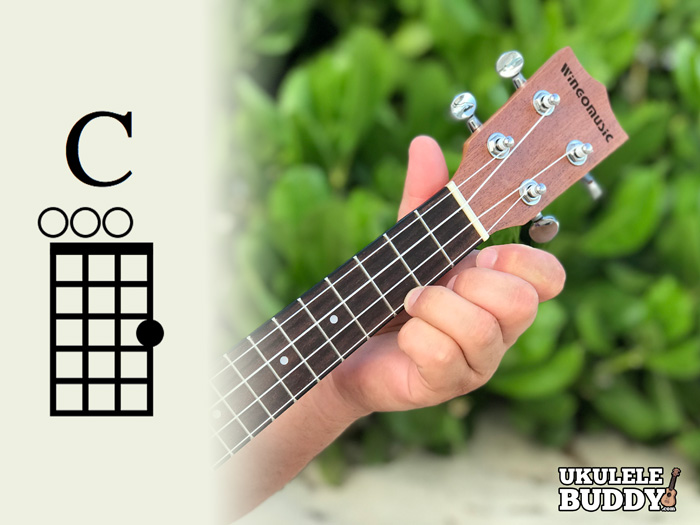
Here’s a clear video:
This video also clearly describes a C: https://www.youtube.com/watch?v=I656wHVIGTk as does mine.
Play Your First Song
This video walks you slowly through how to play Row Your Boat using just a C chord. She shows you how to play it with just one strum per bar, and then gradually, playing it as half notes, quarter notes and eighth notes.
You can also check out her Brother John: https://youtu.be/qkfdz3FzCQc?list=PLa7A-eNabeLZmn_g8RqcHklDQF2ZbQCzW&t=72 or here’s another Brother John: https://youtu.be/bjviMp11C6A?t=207 Or here’s my video with Row Your Boat and Brother John.
Some other songs you can try playing with just the C chord: Itsy Bitsy Spider, Mary Had a Little Lamb, Three Blind Mice, and Old McDonald Had a Farm.
Congratulations, you’ve learned how to play ukulele!!
Next step: play a song using two chords – C and F. Then, playing C7 and F. Or look here for links to all the uke tutorials.
 More Good Days with Kids