Yesterday, my whole day, I was in a mood. The “I don’t want to do that” mood. And in response to everything! Not just work and housework, but for everything I thought of doing, my response was the same. Play ukulele, which I always enjoy? I don’t wanna. Have dinner in the park with friends on a lovely day? I don’t wanna. Go to the family camp that I LOVE next week? I don’t wanna.
This is SO not my usual approach to life.
So, where was it coming from? I think it’s worth exploring, because it gives me insight into my own self care (and perhaps may contain ideas for other busy working parents) but also, because sometimes our kids have a case of the “I don’t wanna’s”, and it’s exhausting – not just trying to force them to get their chores done, but also trying to talk them into doing things we know that they enjoy and having them refuse.
So, what sank me into a “winter of discontent” on a beautiful sunny day?
Not enough sleep. Two nights before I’d had to stay up late to complete some work and get up early. That morning I’d awoken at 5:45 on a day I didn’t need to get up till 7, and no matter what I tried, I couldn’t get back to sleep. So I think part of it was just being tired.
Too many demands. I just have a lot going on this summer, and every time I finish one project instead of getting a break, I have to jump straight into the next one, and I know yet another project is waiting in the wings needing my urgent attention. I want to be clear that I like doing all these things… they’re all projects I would enjoy… it’s just the non-stop nature of them at the moment that is dragging me down.
Not enough down time. Our brains, our bodies, and our souls need a break from time to time. A time to putter around the house, or lay in the hammock, or walk to the park, and rest our thoughts. I think especially in the summer, as it feels like everyone else is taking time off, it’s even more of a drag to feel like you don’t get any breaks.
So, I need to: prioritize sleep till my body catches back up, take on fewer commitments or maybe find ways to “lower my standards” on the projects to get them to the “good enough” point instead of the perfect point, and give myself permission to take some down time when I can.
What does this tell us about when our child is having a case of the “I don’t wanna’s”? It’s likely a good time to reflect on:
Are there too many demands on them? When I say demands, you might just think of chores, or when you ask them to do things they don’t want to do. But honestly, even fun things can place demands on their energy… going to a movie or a restaurant they love requires them to be on their best behavior – controlling your impulses as a young child is hard work. (For kids who really struggle with impulse control, it’s especially challenging.) Playing with friends is fun, but it’s also demanding as you have to keep negotiating social rules, waiting for your turn, being patient and forgiving when other kids aren’t at their best. (For a more introverted child, the social time can especially take a lot of energy.)
Are they getting enough downtime when they’re just left to their own devices and allowed to just putter around and “waste time” doing whatever they want to do? Parents often feel pressured to enterain and educate their child at all times. That’s actually too much for your child’s brain to take! For brain development, we need three things: novelty (new ideas and experiences), repetition (the chance to do something again and again to deepen your understanding and mastery) and down time to process it all. So, when they’re “doing nothing”, what they’re really doing is growing their brain!
Doing art is so important for a child’s development – it builds fine motor skills, observation skills, decision making, and communication skills as well as supporting visual development and creativity. (Learn more about the importance of art for kids in The Art of Creating from Michigan State U, and Why Is Art Important at Preschool from Rasmussen U.)
The only problem with kids doing art is that you end up with a lot of art projects you have to figure out what to do with!
Hang it On the Fridge?
For the first few pieces your child does, you will be excited and proud and stick them to your refrigerator where you can see them every day! And then, a few months later, or a few kids later, you can’t see the front of your fridge any more, and you realize that you just can’t keep every piece of art your child does! You feel guilty just tossing it in the trash though. What are some solutions?
Easel Paintings
Some preschoolers bring home one or more easel paintings EVERY day.
With my older two kids, we had temporary displays for when a new artwork came home. For large two dimensional art (easel paintings) we had one spot in the kitchen where we could hang one piece of art per child. We would later save the very best (see below) and the others became gift wrap or went to the trash.
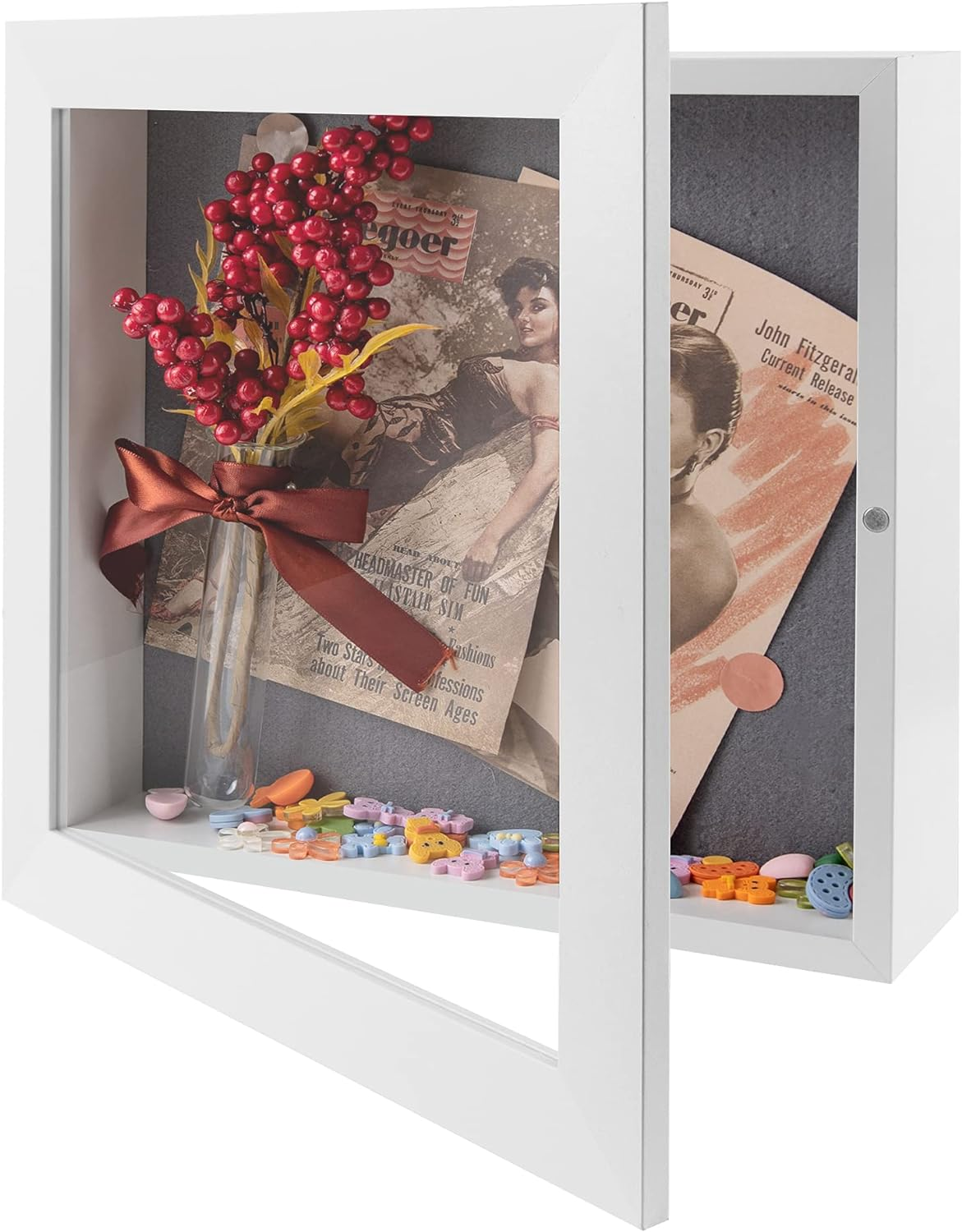
Display 3-D Art in Shadow Boxes
For smaller or three dimensional items, we had wood shadow box frames, which were 2 inches deep. We had four hung together on the wall (they were rectangular so we had two landscape orientation and two were portrait orientation.)
The kids got to decide what went in their shadow boxes. It could be artwork they had created, treasures they had found (dry leaves, sea glass, etc.) or gifts they had been given, or tickets to shows or memorabilia from trips, and they got to decide when to rotate things in and out.
We did not tend to keep 3-D art, so when they decided they were done displaying it, we said goodbye and into the trash it went. See below for what we did for storage of 2D art.
Displaying 2-D Art Work in Storage Frames
I love these frames that didn’t exist when my older kids were little. They are a storage box and a display box. When your child creates a new piece, you tuck the old one in the back part of the box, and add the new one on top for display. The boxes may hold around ~30 pieces of art, so you still won’t be able to keep all your child’s art, but it could be a nice lifelong sampler of favorite pieces.
I have not purchased these but per reviews, the L’il DaVinci looks good for hanging on a wall, and this one from American Flat may be better for setting on a table.
For choosing what size to get: it’s worth remembering that construction paper is 9 x 12, so doesn’t fit in an 8.5 x 11 frame. Easel paper is 18 x 24.
Art Storage for Posterity
When my older kids were in preschool, the school had a fundraiser where they sold cardboard art portfolio boxes that were around 18×24. Over the years, I saved a representative sample of my favorite art that my kids did. Sometimes they’d get too full, and I’d have to sort through all the pictures again to decide on a smaller set of favorites, but it gave me a lovely chance to review the progress of their artwork from preschool to college.
The closest similar product on Amazon is these 18 x 24 boxes, but they come in packs of 50, so while they’d be great for a preschool fundraiser they wouldn’t work for just one person! You could also consider an artists’ portfolio, or this archival box.
Digital Archiving
With my youngest, he just wasn’t the prolific artist the other two were when he was in preschool and elementary, and now as a middle schooler, he primarily does digital art on his computer. While we have displayed his art on the fridge, mostly we take digital photos of it or scan it and then trash / recycle it.
I think I’ve saved a few of his pieces in the boxes with the older kids’ art. (Being the youngest kid is rough sometimes. 🙂 ) What I may do at some point is figure out a way to create an album where we print out images of some of his best art so we have a physical keepsake, because there is something satisfying about flipping through something physical to remind you of your child’s development rather than just looking at images on a screen.
If you have other ideas for art display and storage, please comment!
Note on affiliate links. The product links are Amazon affiliate links. If you click on one and then end up purchasing something on Amazon, I get a small referral bonus at no cost to you.
Last month, we had a guest speaker at my church – Tim Dawes, an author, consultant and TEDx speaker – who offered a powerful approach to conflict based in compassion and respect.
Drop-Shift-Give
When you find yourself in a conflict you can’t see a way out of:
Drop whatever approach is putting you at odds. (Arguing, accusing, making threats, trying to change their mind or change their behavior.)
Shift your focus to the other person’s perspective. What is their experience / how are they feeling?
Give – Acknowledge what they want, validate their experience. You really need to accept and respect that this is their experience. (Note, this is not necessarily saying that they’re “right”, just acknowledging their view.)
This creates a connection between you and the other person. After you do these three steps, it is as if you have set a place at the table for their needs. Then you can bring your needs to the table and can sit down and have a real conversation about how to move forward. You may see new options you didn’t see before, and may be able to quickly negotiate solutions that work for both of you.
If you are feeling wronged or hurt, it can be hard to let go of arguing. If you’re a parent, it’s hard to let go of teaching and correcting. If you have strong opinions, it can be hard to let go of trying to convince someone you’re right and they’re wrong. But arguing, correcting and convincing can prolong an argument.
Examples
My oldest child resisted putting toys away. It was an on-going conflict where I battled him again and again. At one point, I dropped my usual tactics for a moment and asked him to explain things from his perspective. He said that when all the toys were put away, the house looked like a place where no one was allowed to have fun. I acknowledged that this was his truth. Then we sat down and negotiated some compromises we could both live with.
My youngest got into a battle at school today. He was upset at getting tagged out in gaga ball. When someone else tried to get him to calm down by saying “it’s just a game”, that upset him more. Rather than try to convince him that he should relax and that a game is not worth getting upset over, I dropped that approach and shifted to curiosity – asking him to explain his perspective. He shared that games are really important to him, whether that’s gaga ball or video games or a board game, and he doesn’t like that people trivialize them all the time. Spending some time talking about his thoughts on this and validating them “brought him to the table” to where we could have a conversation about how he could have reacted differently today.
I appreciated learning this new tool for approaching conflict and look forward to exploring it more.
Often as parents we find ourselves making things up as we go along – we think about what we want our kids to do right now, then take actions that give us quick results in the moment. Those actions may or may not be in alignment with our long term goals or visions of yourself as a parent – I’m sure we’ve all had moments of thinking “I can’t believe I just said/did that!!”
One step you can take toward becoming the parent you want to be is to define – in writing – what that means. This can begin with a process of brainstorming your goals and values, maybe even writing a vision and a mission statement. Then as you find yourself muddling through your parenting days, you can occasionally take time to reflect – am I on course toward my goals? What could I do to course correct a bit? You don’t have to be perfect every day if you’re remembering to check in from time to time to make sure you’re still pointed in the right general direction.
Brainstorming the Basics
Here are some questions to ask yourself to discover what’s important to you.
What are your family’s strengths? What do you do best?
What are the most important values you want to pass on to your child?
What is the place of education in your family? What value do you place on work?
What are your family’s attitudes toward money?
How do you view religion/spirituality, and what part does that play in your daily life?
How important is it to you to help other people or participate in your community?
How would you like to relate to one another?
When do you feel most connected to one another?
What makes you happy?
What makes you fulfilled –brings you satisfaction, leaves you with a sense of completeness?
Answering those questions may be the insight you need to get started.
Figure out what the endpoint looks like
Another approach is “Begin at the end” – think ahead 15 years. What is your vision for:
What is your child like as a person?
What skills have you nurtured in them: Curiosity? Confidence? Compassion? Determination?
What are your child’s core values? (see above)
If your child is “successful”, what does that look like?
What are the relationships amongst members of your family like?
How would you like your child to describe what it was like to grow up with you as a parent?
Creating a Vision Statement
What is a vision statement?
It describes what your ideal family life would look like and what you want your family to be someday.
It provides inspiration for what you hope to achieve in five, ten, or more years;
It functions as the “north star” – helps you understand how your work every day ultimately contributes towards accomplishing over the long term; and,
An effective vision statement is inspiring, yet short and simple enough that you could repeat it out loud from memory
Some sample visions from organizations are: “To improve the health and well-being of each person we serve.” (a hospital) “To inspire students to create a better world.” (a school) “We believe that strong families begin at home and building strong families creates thriving, healthy communities.” (a family support organization) “To be a vibrant and welcoming community, feeding the human spirit, lighting a. beacon for love and justice.” (a church.)
Write your parenting vision statement. (Try several approaches until you find the one that sings to you.)
Creating a Mission Statement
A Mission statement focuses on a shorter time frame (1 – 3 years). There are lots of possible formats. One format answers three questions
WHAT you will do – what specific actions will you take?
HOW you will do it – what will be the quality of your actions (this is where you can articulate your values for how you want to interact with your family)
WHY – what results or benefits you will see when you look at your kids / your family in a few years?
Here are some sample missions, from the web… I don’t endorse any in particular, they’re just examples.
We are a family who believes that relationships matter most! We value spending time together. We hold each member of our family accountable for responsible behavior. We support each other in our individual pursuits of personal and professional interests. We cheer each other on. We laugh whenever possible. We hold our marital relationship as a top priority because this relationship serves as the foundation of our family.www.everythingmom.com/dynamics/the-family-vision-statement-a-solution-for-challenging-decisions.html
Our home will be a place where are family, friends, and guests find joy, comfort, peace and happiness. We will seek to create a clean and orderly environment that is livable and comfortable. We will exercise wisdom in what we choose to eat, read, see, and do at home. We want to teach our children to love learn, laugh, and to work and develop their unique talents. www.happyfamilyhappylife.com/examples-of-a-family-mission-statement/
Our family mission: To always be kind, respectful, and supportive of each other, To be honest and open with each other, To keep a spiritual feeling in the home, To love each other unconditionally, To be responsible to live a happy, healthy, and fulfilling life, To make this house a place we want to come home to. [also from happy family… cited above]
I choose to raise children who are respectful and believe they are worthy of respect. I choose to raise children who are confident and who know themselves enough to be true to the song in their hearts.I choose to raise children who are kind and caring and see kindness and caring in the world as well.I choose to raise children who are honest and value the power of truth. [in the post, the author gives concrete examples of how their parenting will reflect this mission http://lusaorganics.typepad.com/clean/2011/12/a-peaceful-parenting-mission-statement.html]
Implementing Your Vision & Mission
Write your Vision & Mission down, and post it where you can see it.
Review it on a regular basis and see how you’re doing.
Narrowing the Vision – Action Gap: when the theory of what kind of parent we wish we were meets the reality of how we respond to our child when we’re tired and they’re challenging, it can be easy to get discouraged. Be gentle with yourself – don’t beat yourself up for your mistakes, just use it to help you remember your goals. Ask yourself what you could do differently the next day to move in that direction.
Revise your mission as needed to in order to reflect new values, hopes, and dreams.
More Resources:
On this blog:
Here is a free printable worksheet for developing a mission/vision statement.
Read about Parenting Style: Authoritarian, Permissive, Balanced and Uninvolved are ways to describe the intersection between how high the demands are that you place on your child, and how responsive your rules are to their individual needs and goals. Are you your child’s Boss? their Friend? A Friendly Boss?
Think about what rituals you will incorporate – how will you celebrate holidays? What about the tooth fairy? Bedtime routines? It’s often the little things that define our families.
The identity of a family is wrapped up in its traditions: the daily routines and the annual rituals. As a parent educator, I talk a lot about the power of routines – the ways we move through each day that help us feel like the world is safe and predictable and manageable even in the midst of chaos and change. Rituals are also important – whether it’s how we do the tooth fairy in our family, what we do on the Fourth of July, or how we spend our winter holidays. Rituals honor our cultural heritage. They show our children what we value by what we pay attention to. They make our children feel special and loved. They help to define who we are as a family.
2020 has messed with all our routines, and with all our rituals. We may have found new daily routines that are working for us. But rituals… so many of which revolve around gathering in-person with the people we love and gathering with our communities… may seem out of reach. It’s natural to have a lot of grief over all the things we can’t have this year. (Here are tips for managing the grief.) But we can also work to figure out ways to adapt our traditions to this year’s limitations. We can create new rituals. And we can use this as a year to focus on resilience.
Resilience is often thought of as the ability to bounce back from challenges. Another way to view it is ““being able to continue functioning relatively normally” in adversity.
There are lots of ways we can build resilience in children, but one important one is to tell our children stories of the family’s history that are not just about the family’s successes, but about the ups AND the downs… “we had plenty of hard times, but we made it through together.” It creates a story for the child that “our people” are resilient. (Learn about Marshall Duke’s research on family stories and resilience.) This year is a great year to find a way to incorporate these narratives into your holiday celebrations. I’ll share something I’ve done here, and encourage you to reflect on how you might celebrate resilience through the holidays this year.
Honoring Your Family’s History
At my church, one Sunday in every December, we ask members to share a photo of their family’s holiday traditions, and we gather them into a slide show. Watching those slideshows always brings smiles, and warm cozy feelings. But this year, when I went to find a photo from a previous holiday, it made me very sad. At first, seeing all those photos of large family gatherings just made me grieve all the things that I couldn’t have this year.
Then going into Thanksgiving, I realized that I needed to reclaim those memories, and re-define their meaning for this year. For our family’s Thanksgiving over Zoom, I went through 30 years of photos, and for each year, I found one photo of a family meal or holiday gathering. The first slide read: “Our Family, Gathering Together for the Holidays… The location changes, the guest list changes, loved ones pass away, and new loved ones join us, and through it all, the family goes on.”
We watched it together on Zoom, talking and sharing memories. We talked about the loved ones in the photos that have passed away and shared stories about them. We puzzled over a stranger in one of the photos… who was it? Maybe the nephew’s “holidate” for that year?? We remembered the year my partner and I were divorced, before we got back together again. (We’ve now been back together for 20 years!) We smiled as the babies appeared – including a baby who is now 27 and all those who came after him. We welcomed the new family-in-law members who have joined us over the years. I included a picture from this year, with three of us at one table, and the laptop showing everyone else on Skype. The pandemic reality seems all-encompassing now but it’s helpful to think that someday, 2020 will be just one picture of many, and we’ll chuckle as we remember “the year we all stayed home.” In our holiday pictures, we clearly saw that although the family changes and evolves every year, the love and connection stays constant.
If you look only at this year, it seems so disconnected from all that came before. But it’s not. It’s just the current chapter in a long history of a family. A history that includes good times and bad, that has been through challenges before and still is strong. Taking time to acknowledge that was helpful. It led me to think more broadly of the stories we could tell with this year’s celebrations.
Honoring Your Family’s Traditions in a New Way
Remembering What Connects Us
A Jewish friend of mine said: “Maybe to bridge the separation we are all feeling this year, think as you light candles over Chanukah of the connection you have to Jews all over the planet who are lighting candles with you. There is synergy this year as remembering a holiday that celebrates our perseverance and faith that things will get better.” Your faith traditions can help to link you to the history of your people, and also to others around the world who are walking through this challenging year with you.
Every year, my church ends our Christmas Eve service by holding candles as we sing Silent Night, and passing a flame from candle to candle till all are lit. This year, on Zoom, we’ll share a slide show of all of us holding candles, and we’ll all light our own candles at home as we sing along. Our community still unites even as we are separate.
Gather Around the Virtual Table
Many families have long been gathering on Zoom (or Skype or Messenger or Teams…) for family dinners and celebrations. (If you don’t know how to use Zoom, I have a full guide to Zoom which can take you from beginning to expert.) My own family’s tradition of a family dinner every Sunday for those of us who live in Washington has now evolved into weekly dinner calls including family in Nebraska, New Jersey, Wyoming, and England. This Thanksgiving was the first year EVER where my husband and I saw ALL of our siblings and ALL of our parents on Thanksgiving. Zoom gatherings are not the same as in-person, but they have their own blessings. (If you need ideas for fun interactive things to do on a telechat, check out this post.)
At a holiday gathering on Zoom consider doing a Year in Review. Share the highs and lows of your year, and celebrate the roses you’ve found amongst the thorns of 2020. That celebrates our strength, resilience, and adaptability.
Deck the Halls… or the Yard
Some people are saying “why bother decorating – no one else will see the decorations.” If you always find decorating exhausting, then 2020 is a great excuse to skip it. But if any part of decorating gives you joy, go for it! Do whatever small portion of it has meaning, or go way over the top beyond what you’ve done before. Take pictures and share them on social media! Or decorate the OUTSIDE of your house so neighbors get to enjoy. That outdoor décor can also be helpful if your family gatherings will be outside in the back yard this year.
As a preschool teacher whose classes haven’t met in person in months, I have an overabundance of bubble solution in my life… and I have a bubble machine! So on Christmas Eve, we plan to send bubbles streaming from our deck to anyone passing by. It’s just a small way to connect with a community of neighbors that we value.
How Can We Keep From Singing
Music is important to our family… particularly singing. It’s something we do together as a family. If you miss singing out loud:
can you just crank up the tunes out home and sing along?
can you sing “with others” online? On a Zoom call, one person sings aloud (learn how to make music work on Zoom) and everyone else is on mute, but sings along at home and can see the others singing- it’s more joyful than you might think!
could you go for a Christmas Caroling walk through your neighborhood, belting out the tunes? (Just be sure not to sing when anyone else is within 25 feet or so, because singing does carry a higher risk of transmitting any virus we might have.)
Enjoying singing is claiming your right to find JOY even in these challenging times.
The Nutcracker or A Christmas Carol?
Theater is a big part of our family culture. If your typical holiday season includes viewing live performances and the arts are important to your family, try a “dinner and a show” night at home. Get dressed up, pick up a fancy meal takeout, sit at the table and eat a celebratory meal. Then go sit in your living room with the lights off as if you were in a theater, and watch many of the holiday shows that are available for streaming online via your local arts organizations, Broadway on Demand and Broadway HD. (We did this last night and our son pretended to be our “usher” – he escorted us to our seats, asked if we needed anything to be comfortable and reminded us to silence our cell phones before the show started. We clapped at the end of each number.) After the show, remember to donate to an arts organization that has fed your family’s soul in the past.
Giving To Others
Many experts recommend thinking about gratitude and celebrating all the things your family DOES have this year, and then consider spreading your “wealth” – whatever form that takes – to others. Donating money, or time, or sharing beauty through art, or sharing kindness with others, or donating to food banks and gift drives could all be ways to acknowledge that your family has enough blessings to share.
Letting Go of What Doesn’t Bring Joy
This article from Mental Health America has a good point: “Don’t Romanticize Your Typical Holiday Plans. Remember that while your holiday season may normally be full of excitement and joy, it can also be a time of high stress. Long days of travel, endless to-do lists, and dinners with that one family member you don’t get along with are all part of the holidays too…” This year may be a great chance to free yourself from the stale habits and burdensome obligations, and re-focus on what your true priorities are and what things would actually make your holidays happy.
Talking with Children about New Traditions
If you’re parenting young children this year you may feel like you have to put on a smiling face all the time. I think it’s fair to share with our children when we’re feeling sad – “This year, I miss the fact that we can’t do _____ like we usually do.” For older children, honor that this may make them sad too. (Young children may have no memory of what you “normally” do.) And then we can say (to ourselves and to them) – “But I know our family has many many years we’ll be able to do that exact tradition. The part of that tradition that is important is that it honors ______ because that is something that is important to our family. Here’s how we’re going to honor that this year.”
If you have older children, involve them in planning. Time has helpful tips on adapting holiday traditions for COVID, as does AARP.
I would love to hear ideas for how you are adapting your holiday traditions for your family and how this could tell a story of how “our family is resilient and comes through hard times even stronger than before.” Click on “Leave a Reply” at the top of this post to share your ideas.
“Next year all our troubles will be out of sight… Faithful friends who are dear to us will be near to us once more. Someday soon we all will be together, if the fates allow. Until then we’ll have to muddle through somehow…”
As we admit that we’re muddling through this year, we can also embrace that we are learning how to be resilient, how to adapt, and how to find the light in the darkness.