Category Archives: Parenting

Suddenly Homeschooling

Due to coronavirus, millions of parents across the country (and around the world) are suddenly homeschooling their children. Some may feel prepared (they’re teachers!), some may have all the resources they need at home, but many of us are under-prepared, under-supplied, and also trying to figure out how to manage that along with all of our other responsibilities in this new era. We’re all faking it together and figuring it out on the spur of the moment!

For us, school suddenly disappeared. One afternoon we found out that at the end of the school day, they were closing for two weeks, then the next day that became six weeks. We took a few days off from being responsible. For the first four days, we let our son do whatever he wanted to (well, we limited his screen time to two hours a day, but otherwise he was flexible). But we told him we were just doing that for a few days, and he should expect that on Monday, we’d start homeschooling. That gave me a few days to come up with ideas.

I turned to homeschooling parents for advice, and I’ll share with you here the plan we’ve put together for our nine year old.

But first, let’s say:

Go Easy on Yourself

Don’t put a ton of pressure on yourself! Don’t feel like things have to be perfect!! Don’t worry that this will cause them to fall behind and never catch up. We’re all just going to do the best we can. Luckily, kids are resilient, and they will bounce back from this experience! If some days, you’re exhausted and swamped with your own burdens, don’t feel guilty about using screen time. If you feel like you should be making your child do math homework, but you just need to get the laundry put away, then today becomes Life Skills 101 instead of math, and you teach your child to fold laundry. It’s all OK.

And if you know that trying to homeschool your children would make you miserable, would make them miserable and turn every day into a battle, then don’t do it!! We never want kids to resent “school” so much that they decide they hate learning! I believe that love of learning is the biggest key to success in school and life, so do whatever works for your family to preserve that. Feel free to run with the Free Range philosophy and do whatever whim strikes you for the day, letting your child self guide their learning – reading books all day, doing Lego all day, whatever!

Many parents find that unstructured spontaneity works well for their family, many recommend having a bit more structure than that, so the rest of the post offers some structure and routine in case that is what is helpful to your family, as it is for mine.

Making a Plan

I’ve seen a variety of advice, but this is the one I find the most helpful summary. It’s from Mary Oemig, President Boom Learning (former homeschooler).

Each child should write a plan for the day each morning. Younger kids might need a little help with ideas. Older kids should include open items assigned from teachers.

All kids should include:

1. A reading activity
2. A writing activity
3. A math activity (games are great for younger kids)
4. A science activity (for youngers can be observations about spring during a walk – note changes each day, observe weather, online videos)
5. A social studies activity – history of plagues is relevant, lots of great educational videos on YouTube. 🙂
6. A PE activity – walks and bikes are good. Playing on playground equipment not so much.
7. A plan for playtime/free time.
8. Life skills / chores

Develop a system for family members to communicate to each other “Do Not Disturb” and “Available for Play”. Reinforce respecting whichever system you come up with.
Parents should have a set time during the day to review the plan with each kid to help them learn time management. This is a great opportunity to develop self-management skills.

I suggest that you do not dictate the schedule but rather guide children on developing their own plan.

For those who care: The research source for this approach is Tools of the Mind. They use this method with children as young as pre-school.

The idea of creating categories to complete was really helpful for me. (I’ve been teaching this idea for years when talking about how to choose toys and activities for babies, toddlers, and young children, using the theory of multiple intelligences – read more here.) I decided to build a system of cards for my son.

For each card, he earns either a full point or a half point. He’s not allowed to have any video game screen time before noon, no matter what. After noon, WHEN he has completed 5 points (~2.5 hours) THEN he gets one hour of free choice screen time. He then has to complete 3 more points to earn another hour of screen time, and that’s the maximum for the day.

My husband and I are both working full time from home, so his activities needed to be things he can do mostly independently.

20200317_173352039_iOS

Each card has criteria for what could qualify for completion – sample activities he can choose from. Here are his cards. The first 4 cards are required to complete every day. The others are options to choose from.

  • Reading – 30 minutes. 1 point. Lexia app from school, reading packets from school, or reading a book. To count for school work, it must be a book with a plot. Fiction. Not comics. Paper or ebook is fine. (He loves reading and would read all day, so this is the easy one.)
  • Writing – 20 – 30 minutes. 1 point. Practice on Edutyping app. Journal, write a letter, email, write a book report to share with a family member (we might also start writing Amazon reviews), write reflections on science homework. (He hates writing, so this is our hardest one.)
  • Math – 30 minutes. 1 point. Can use Dreambox or Xtramath – online programs from school district, or complete math packet from school. He can also use apps that drill him on multiplication facts. Sudoku, Numbrix, or other math puzzles. Math heavy board games or card games with parents.
  • Physical Activity – 30 minutes. 1 point. Could walk, bike, roller blade, play catch, etc. (This is a good time to rummage through your garage or closets for that sporting equipment you never use… we’ve got roller blades we hadn’t used in a decade!) He could do Wii sports to count for this, but he must spend a half hour outside every day, so if he does Wii sports, has to plan another outside activity, even if that’s sitting in the sun while reading. (Note: yes, you can still go outside now! Just minimize touching anything others have touched, so no playground time, and keep your distance from others.)
  • Science – 30 minutes. 1 point. Can include an educational video (there’s lots of great science content on video!) or a podcast. Could be a book. Must include something hands-on / active learning. (I teach hands-on science classes, so this one is easy for me… if you’re looking for resources for science learning for kids age 3 – 8, check out my other blog, www.InventorsOfTomorrow.com.)
  • Social Studies – 30 minutes, 1 point. Can include video, podcast, or book. Can cover history, other cultures, social/emotional skills, and so on. (We’re thinking of podcasts like Short and Curly – an ethics / philosophy podcast from Australia, or Dad and I Love History, or Forever Ago. Let us know what else you like!)
  • Call his grandparents. Half point. We haven’t seen them in person for two weeks because we don’t want to risk exposing them to anything (they’re in their 80’s), so it’s nice to connect via Skype. His grandma is teaching him some Spanish as they talk.
  • Play recorder for ten minutes. Or make art. Half point.
  • “Life skills” – like folding laundry, cooking, cleaning. (One of the things we can all do with our coronavirus break is bring back Home Economics and shop / Industrial Arts classes! Whatever work you need to do, have your child do it with you! Half point.
  • Social Time Online – Zoom or Skype calls with friends, family, church members, and so on. Half point.

At the beginning of each morning, we have a stack of cards. He gets to decide what activity to do first. I flip the card over, and write when he started doing that activity. When he reports back, I write what he did so I have a record. I’m not super strict about the 30 minutes – anywhere in the 20 – 45 minute range counts. He can combine some activities: for example, if he plays recorder for his grandma on Skype, that counts for two half point cards. If he draws while he listens to a podcast, that counts for art and social studies. If he writes about science, that could count for both. (He has to ask permission to double count before starting the activity.)

So, you’ll notice that if you add up all those cards, it does not add up to maybe 4-5ish hours, not 6.5 hours, which is how long his school day was. (And if he doubles up activities, it’s less than four hours.) Parents might worry that they’re not doing “enough” if it’s not 6.5 hours of school work. Here’s the deal – at school, they’re not getting 6.5 hours really! They’re eating lunch, having recess, walking down the hall to music class, waiting for their turn with the teacher, and so on. You can get more done in 3 – 4 hours one-on-one. And they (and you) will have time off from worrying about “school.”

Having the flexibility to decide what order he does things in has been super helpful to him. And if he’s enjoying a science show and wants to watch two, he can do that, he just knows it will take longer to get through his points and longer till that screen time, but he can make that choice himself, which he likes.

So, I’ve created the structure and the requirements, but give him a lot of freedom of choice within that structure. So far it’s working well for us… hopefully it continues to.

And if you think it sounds super hard and time consuming, I promise you it’s not! I literally have been working 8 – 10 hours every day and squeezing management of his “school” in and around that, and it’s just some quick check-ins every half hour. And if you think I must have an angel child for this to work, I should say that my son is diagnosed as autistic, and suspected ADHD, and we know the principal at the school very well, and the resource room teacher very well, because he spends a lot of time with them! But, for him having this structure, with the freedom of choice within the structure is exactly what he needs.

If you have advice, suggestions for resources, or questions, just add them to the comments!

Resilience

This is a companion piece for “Building Resilience in Children“. This post offers a deeper look at theories of resilience, and links to some key research in the field.

What is Resilience?

So, what is resilience? And how do you know if you have it?

If you were lucky enough to never face any challenges, you’d never know if you have resilience (and honestly, you probably wouldn’t, because we build resilience by facing and mastering challenges in our lives.)

But, for most of us… challenges come to us on a far too regular basis, right?

Types of Challenges We Might Face

Anytime we face a life transition, or a new developmental stage, that’s a challenge. (These predictable developmental cycles are called “periods of disequilibrium.”) Whether that’s a toddler who falls down many times before they learn to walk, or the new parent who has to cope with all the tantrums that might cause. There’s midlife crises, there’s the challenges of aging… those are “expected challenges” that any developmental psychologist can tell you are typical, but that doesn’t mean they’re not hard for the people going through them.

There’s also all the unexpected challenges – the fall in the mud puddle, the flat tire, the spilled milk, the flu.

And then there’s interpersonal challenges – the boss who makes unfair demands, the girlfriend who says she’s “just not that into you,” or the parent who lets you down.

Challenges just keep on coming.

But… and people in the midst of adversity hate it when you say this…  each of those moments of adversity is a learning experience. Each one offers “opportunities for personal growth.” Each one helps us learn how to stretch and how to bounce back.

Bouncing Back

One way of defining resilience is “doing better than expected in difficult circumstances.” We all have times when it seems like life is trying to knock us down, in small ways or in big ways. The question is: how will we respond? It seems there are three main pathways of response: Will we let adversity pin us down? Or will we bounce back up the status quo? Or end standing stronger and taller than ever before? And how can our family and our community and our beliefs help us to bounce back?

Image showing three responses to adversity - defeat, return to the status quo, and empowerment

Resilience is a really complex issue. There are lots of factors that influence our response to adversity. Several different models have been developed to examine factors. I’ll share a combination of those that shows my best current understanding.

Protective Factors vs. Risk Factors

The reality is that hard things come into everyone’s life at some point. Sometimes they’re expected challenges like a move to a new home, but often adverse circumstances arrive out of the blue – an illness, a home break-in, or a job layoff might appear in our metaphorical inbox. When a challenge hits, we start running with it, and we figure out our response as we go along.

running with it

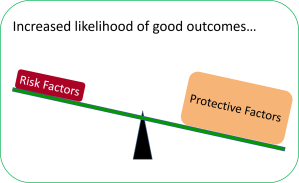
Several things affect our response and whether or not we end up in a good place in the end. The risk factors drag us down. They challenge our ability to cope and to recover from this challenge, and increase the chance of poor outcomes. The protective factors – things that make it easier for us to cope – lift us up and make it more likely we’ll have a positive, empowered result.

risk and protective

What tips the balance for good outcomes is when the protective factors outweigh the risk factors. When we have so many good things going for us that the hard times are easy to overcome.

seesaw

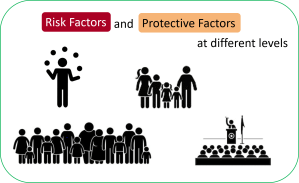
Among the factors that influence our response, some are on the individual level  – specific to that person and the ways they interact with the world, some are found within  their network of family, close friends and communities,  and some are influences from the broader society as a whole.

levels

Individual Factors

Some people are just inherently more resilient than others, no matter what life throws at them. Dr. Thomas Boyce has researched the human stress response for 40 years, and he says some people are dandelions, and some are orchids.

Dandelions are people who can go through almost anything, and be unfazed by it all. Orchids are a lot more sensitive – they’re more vulnerable to stress, and need more support to weather the storms. But given the right nurturing care, they can thrive and become incredibly beautiful.

So what individual factors help to make us more or less resilient?

  • Internal Locus of Control – Developmental psychologist Emmy Werner found that resilient people have a strong internal locus – they believe they are in control of their own destinies. Even if bad things happen to them, they feel they can choose how to let that impact them.
  • Confidence – Resilient people have confidence in their own competence. And they have a growth mindset… instead of thinking of themselves as “not good” at something, they think “I’m not good at it yet. If I just keep working hard, I bet I’ll figure it out.”
  • Temperamentit’s easier to be resilient when you have a sense of humor about life, when you’re naturally easy-going, naturally flexible, and calm.
  • Mental and physical health – Our mental health is influenced by many things beyond our control – genetic, epigenetic, and environmental. Depression can make it supremely hard to bounce back from challenges, and anxiety can mean that even small challenges quickly become overwhelming as you spin into worry about how much worse it might become. Physical illness and disability are challenging circumstances on their own, often creating chronic adversity, and they can also make it harder to bounce back from other challenges. Good mental health and physical health is a huge protective factor.
  • Goals – Having goals you’re working toward helps with resilience – it’s the “eyes on the prize” focus that helps you push through the hard times. Resilient individuals tend to have things outside themselves that give them a reason to get up every day. This can be an interest or passion, such as music or art. This can be big dreams they’re working toward. Or, it can be knowing that other people are counting on them.
  • Perception – According to psychologist George Bonanno, a key individual factor is  how we interpret difficult circumstances. Do we perceive an event as traumatic or as an opportunity to learn and grow? Sometimes even something tragic, while very sad in the short term, might also be a powerful life event that changes someone for the better in the long term. This positive perception… finding meaning in loss… is more likely for people who have a spiritual or religious faith.

Which brings us to the next set of protective factors.

Family and Close Community

Our family of origin, and the close communities that we interact with throughout our lives (like a child’s school, an adult’s workplace, or a church community) have a huge impact on resilience. When these circles are healthy, they provide the key protective factor of a secure base.

From these communities, we learn our values – what does it mean to be a good person? We learn about faith – whether that’s a belief in a higher power, or a belief in a greater good, faith can provide a strong beacon of hope in the darkness of despair. We learn our stories. The most powerful stories are when members of our communities say “we’ve had good times and bad times, but we are a strong, resilient people and we keep moving forward together.”

In these communities, we find our key relationships. Researchers at Harvard found that no matter the source of hardship, the single most common factor for children who develop resilience is at least one stable, committed relationship with a supportive adult. Whether that’s a parent, friend, clergy, teacher or coach. That person offers us emotional support, they help us to see our own strengths, they teach us how to plan and how to cope in healthy ways.

In these communities, we can learn that we are valued, and that we can contribute in meaningful ways. If we have clear roles, we can see that our commitment is essential, and sometimes on our darkest days, what keeps us going is knowing that other people are counting on us, and we have to show up for them.

These communities can also be a source of concrete support – a ride to the doctor’s office after an injury, a bed to crash on when a relationship falls apart, a loan when we can’t pay a bill, someone to watch our kids for us – all these “little things” can help carry us through a hard spot.

Now, the problem is that our families and our communities are not always healthy. And just as a healthy home base can build resilience, an unhealthy family is devastating to our long-term resilience.

There is some really important research in health and mental health called the ACE’s study – where ACE stands for adverse childhood experiences.

Researchers asked people about their childhood – had they experienced things such as abuse, witnessed domestic violence, had parents with mental health issues or addiction or who were incarcerated, or had experienced homelessness. 60% of people have one or more of these experiences in childhood. The more you have, the less resilient you’ll be as an adult. About 12% of people have an ACE score of 4 or higher. With a score of 4 or higher, you’re four times more likely to experience addiction, 3 times more likely to have heart disease, respiratory disease and diabetes, far more likely to experience mental health challenges, and 6 times more likely to say you never feel optimism or hope.

The good news about ACE’s is that they can be overcome.

Knowing about the negative impact of ACE’s and working to mitigate it is the first step. Another key step  is connecting to healthy relationships and healthy communities. The research is really clear that even for kids from very toxic home environments, even just one healthy relationship with one positive mentor in the community is a huge boost on their path to recovery.

Now let’s look at the impact of Society and Resources.

Societal Factors and Resources

We have a strong cultural narrative in America – the cultural narrative that everyone can succeed if they “just try hard enough.”

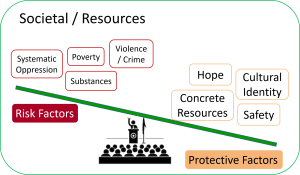
But we don’t have a level playing field in America – we’re not all starting from the same place. A person who is living in poverty, in a crime-ridden neighborhood, where drug use is a common escape from the pain of living just doesn’t have the same resilience resources available to them. Or, even if someone had all the other advantages they could have, if they happen to have dark skin, or happen to be female, or gay, or trans, or disabled, or non-Christian, they have to carry the weight of systematic oppression. click to add That weight makes it harder to magically “bounce back” from challenges.

It is so much easier to be resilient if you happen to have been born into a stable, white, middle class family. If you made it through childhood with an ACE score of 0. If in adulthood, you’ve always had resources… so whatever challenge might arise, you’ve got back-up plans: car insurance, home insurance, health insurance. Flexible hours at work, paid sick leave, and short-term disability pay. Cash in the bank. A safe, warm home. People to take care of you, people to take care of your kids. If you’ve got the skills to research and access any services that you need. If you can speak with educated words and a voice of authority and white skin that afford you respectful treatment by those you encounter. All of these things make it easy to “bounce back” from whatever happens.

So, let’s start talking about how we can build resilience in ourselves and in others.

Building Resilience

At the Societal Level

Let’s first look at this societal level, and what we can do to tip the balance.

societal

We can work to dismantle systematic oppression. Respect and support cultural identities as tools for empowerment. Help increase equitable access to concrete resources and safe communities. Support organizations which work to increase hope in impoverished communities through the arts, access to job opportunities, and tools to help people reach for their dreams.

At the family and community level:

  • Think about the Stories We Tell. Stories can mobilize sources of faith, hope, and cultural traditions. When you’re facing difficult times, it helps to feel like you’re a part of something bigger. There are three types of stories we can tell – 1) our people are always successful (unfortunately, this can bestow a sense of entitlement if you as an individual are successful or a sense of personal failure if you’re not at the moment), 2) our people are never successful and things always get worse for us, or 3) our people have a history of weathering challenge and emerging stronger than before. That third kind is the best for building resilience for future adversity.
  • Build Relationships, and Be a Mentor. Remember, a key factor in resilience for children or for anyone is having a relationship with someone who believes in them, encourages them to be their best possible selves, and helps them keep moving when life seems too hard. You can be one of those people – not just for your friends and family, but for anyone you encounter in the broader community. Any time we interact with anyone in a way that reflects their inherent worth and dignity, we build their resilience.
  • Invite and Value Contributions. Let people know that their presence in the community matters, and that they can make valuable contributions. This is even in the little things. I’ll occasionally ask a child to help me as I set up or tidy – even a three year old can be asked to help carry something. Sometimes kids are surprised to be asked, because we often don’t ask them. But when we do, and we thank them for their help, it increases their sense of efficacy.
  • Concrete Support. Lending a helping hand to a parent with their hands full, offering a ride to someone recovering from an injury, helping someone work on a resume, passing on news about available affordable housing, or accompanying someone to a support group meeting are just some examples of simple things we can do to help people get back on their feet after a challenge. Keep your eyes open for your opportunities.

At the individual level:

  • Build others’ internal locus of control. Support others in viewing themselves as having control over their destiny. You can use a framework of “I have… I am… I can…” that encourages someone facing hardship to think about what resources they have, to tell themselves a positive story of who they are, and to think about concrete steps that they can take to help improve their situation.
  • Support a growth-based mindset. Carol Dweck has researched what she calls “the Growth Based Mindset” which is a belief that we are capable of learning more and doing better. And Angela Duckworth has researched what she calls “Grit” as a vital mechanism in achieving success despite barriers. One way to build these things is to talk about mistakes, failures, and setbacks as normal parts of learning, not as reasons to quit. Remind yourself and those around you that everyone runs up against things they can’t do. The ones who succeed are the ones who pick themselves up and try again.
  • In terms of Temperament – some people are naturally more fearful, and when things seem hard, their anxiety takes over. Researchers at Yale have learned that if we accommodate too much, it actually makes anxiety worse. If we tell someone “I know that’s scary, so you don’t have to do it”, it actually validates that this thing is way too scary and way too powerful. Instead, we can say to ourselves and others “It’s OK to feel scared. We all feel scared. Let’s make a plan for how we can do it anyway.”
  • We know Mental Health and Physical Health are huge protective factors. So, at the societal level, we can be doing public policy advocacy to increase access to health care. But, at the individual level, with ourselves and others, we can think about self care. We can remember that it’s important to prioritize self care – it helps to help recharge our batteries to give us enough energy to face whatever challenges may come.
  • We know that having a goal in mind helps us to keep pushing forward. Ask people to tell you about their dreams. Help them to figure out what the next manageable step is toward achieving that dream. Emphasize that even when challenges seem hard in the short term, we can work to overcome them and not let them block us from that long-term goal.
  • Perception – Learn how to re-frame challenges for yourself, and share with others what you have learned. There are three aspects to re-framing:
    • If you find yourself believing that when bad things happen it’s always your fault, try reframing to “sometimes bad things happen that are beyond my control. What I can control is how I respond to them.”
    • Stay focused on fixing the specific problem rather than thinking it’s a sign of some global problem. For example, if you don’t get a job you were hoping for, remember that it’s not that you are fundamentally unemployable. It’s just that one job that said no…. keep trying till you find the right fit.
    • View problems as impermanent – it will get better in time, and there are steps you can take to help it improve.

In the end, some of the most important protective factors that build resilience and increase positive outcomes  are the stories that we tell ourselves about the challenges that we face, and the stories that we tell those in our community about who we are, and what we’re capable of. If we believe that we are strong, and can overcome anything, the chances are much higher that we will.


Talking to Kids about Earthquakes

Every year on the third Thursday in October, it’s the Great American Shakeout – it’s a good once-a-year reminder to talk with your child about earthquakes and to do an earthquake drill. Focus on how to prepare… not scare.

Earthquake Drills

As a parent or teacher, you need to know what to do in case of an earthquake:

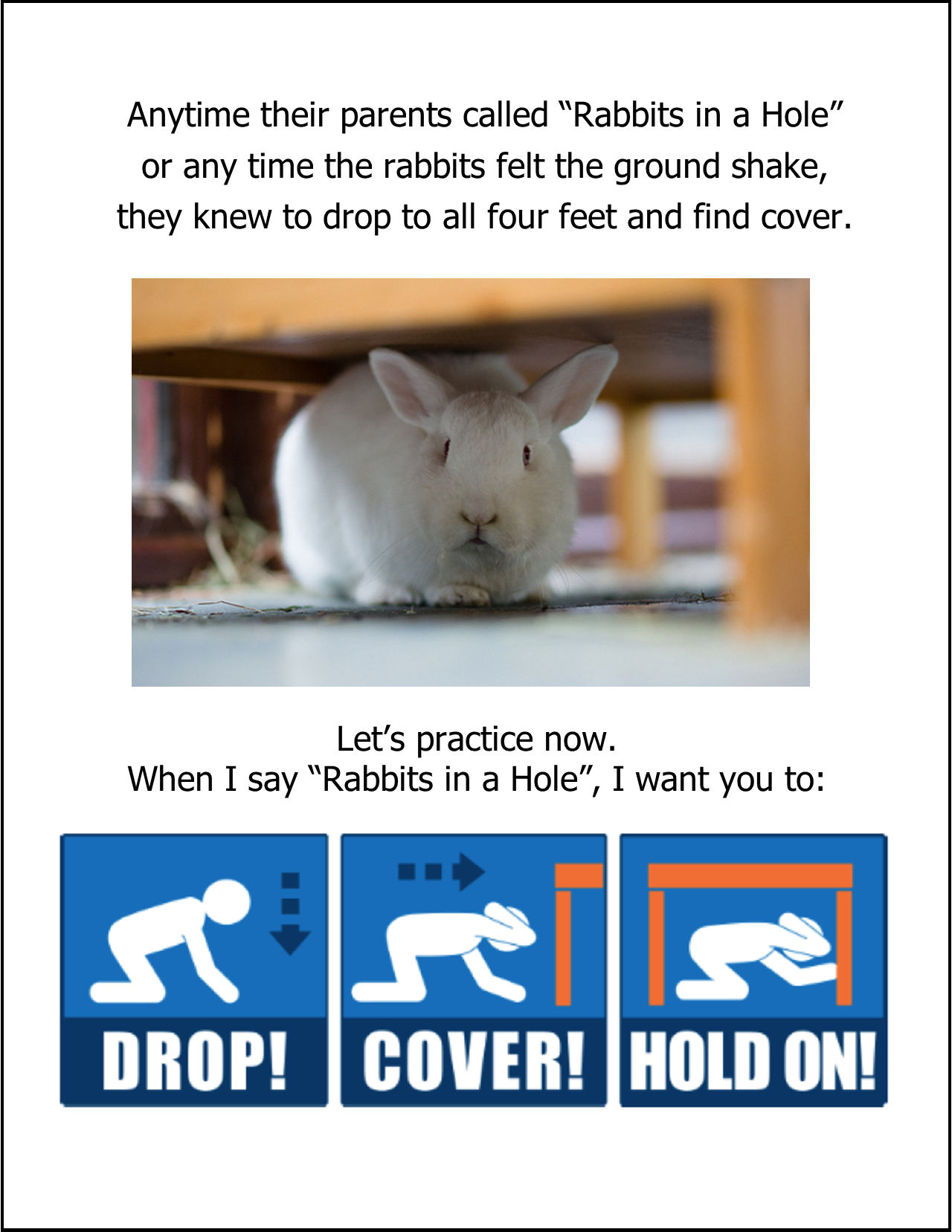
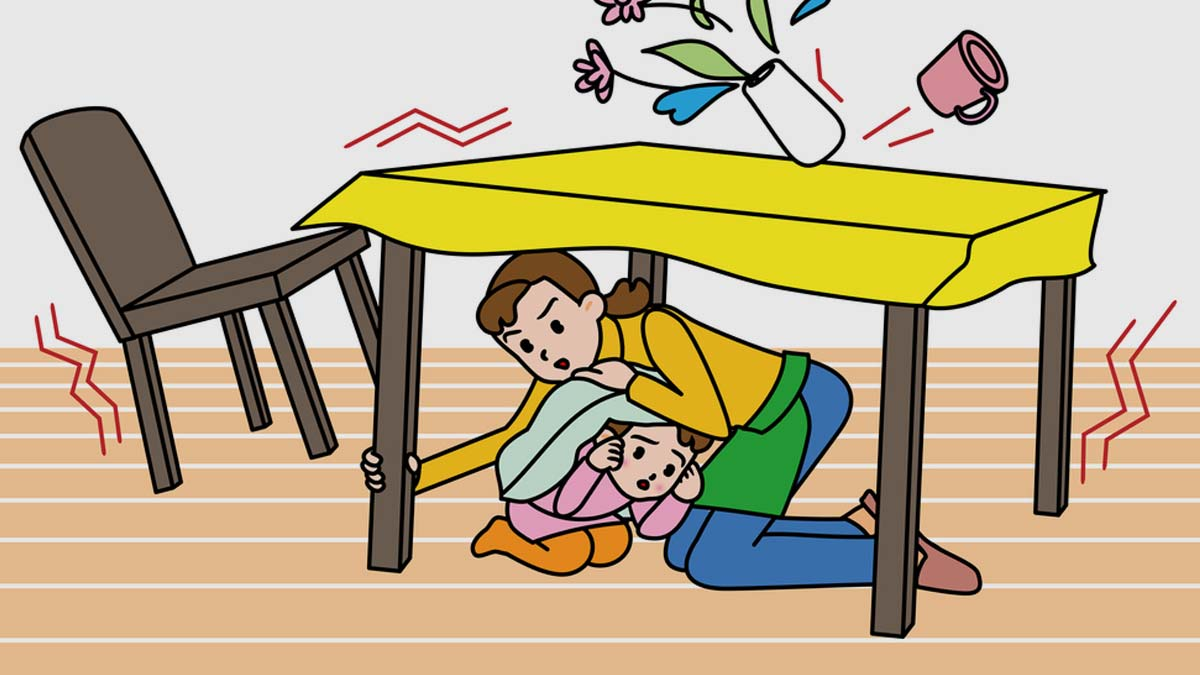
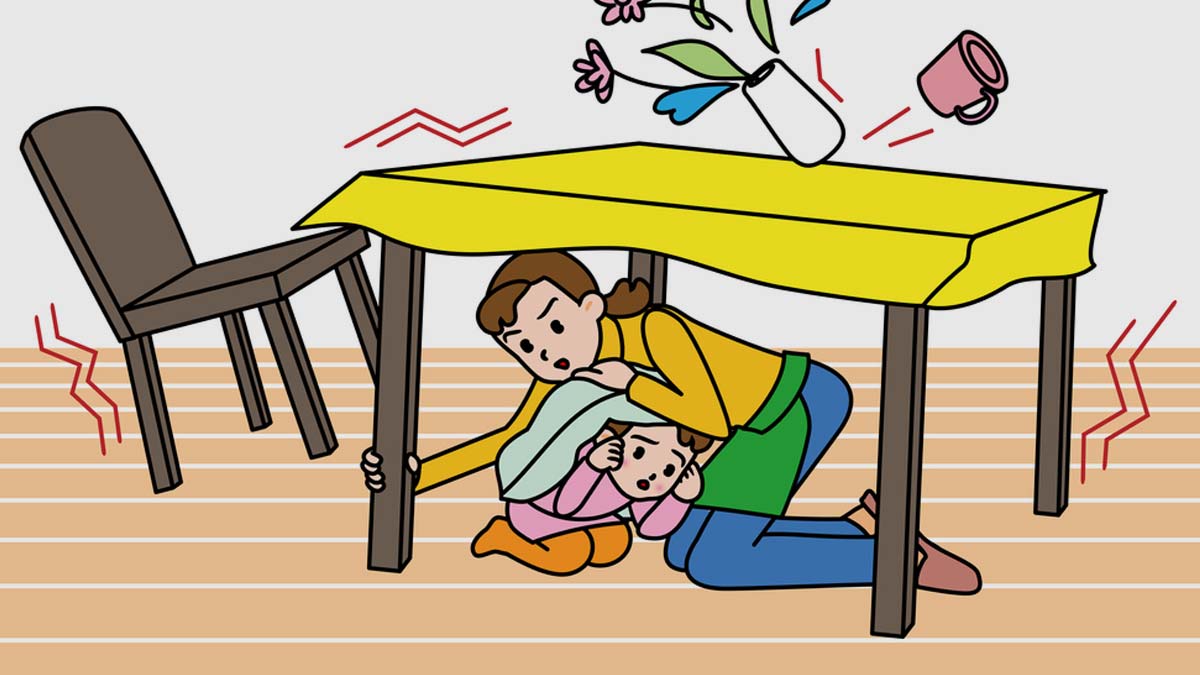
  • DROP down onto your hands and knees (before the earthquake knocks you over). This position protects you from falling but allows you to still move if necessary.
  • COVER your head and neck (entire body if possible) under a sturdy table or desk. Explain “this will help protect you if things are falling down.”
    • If there is no shelter nearby, cover your head and neck with your hands. Crawl away from windows and things that could fall.
  • HOLD ON to your shelter (or continue covering your head and neck) until the shaking stops. Be prepared to move with your shelter if the shaking shifts it around.

If you are with a child, you should drop down, cover the back of your neck with one hand, and then crawl toward the child to cover them with your body.

You can practice this with young children in a playful way.

In my parent-child classes, with one and two year olds, I just practice the positions. I show the child how to crouch low, then tell the parent to crouch over them, then we say the rhyme “jack in the box you sit so still. Won’t you come out now? Yes I will!”

For ages three and up, I read the Rabbits in a Hole book (see below), and then we practice. I chant this rhyme:

Rabbits in a Hole, Stop Now Please! Get down low, on your knees.
Earthquake is Rumbling, Sounds Like Thunder. Cover your head and get safe under.
Earthquake is Over. Everything is Still. Won’t you come out now? Yes I will!

A Children’s Book about Earthquake Response

I’ve written a children’s story book to teach this method: It’s called Rabbits in the Hole: A Story about Earthquake Preparedness, and you can download it by clicking on that link.

Talking about Earthquakes

There may be other times where your child has questions about earthquakes – perhaps they heard about one in the news or in a story, or maybe they recently experienced an earthquake, and they’re working to process it. Here is my general approach when talking about any topic that might be scary for a child:

  • How likely (or unlikely) this thing is to happen.
  • Whether we can do anything to predict it, prevent it, or help ensure it doesn’t become a big problem.
  • How they would know this thing was happening.
  • What they could do if it happened.
  • What the grown-ups would do to make it better.
  • Reassure them that even if bad things happens to people, people are tough and resilient, and pull together and make it through.

So, let’s walk through this with questions your child might have about earthquakes.

How Likely Is an Earthquake?

In many parts of the world, the answer is extremely unlikely. In other regions, it’s quite likely your child will experience many earthquakes over their lifetime. Be honest about your situation. If the likelihood is low, that can be very reassuring for your child. If the likelihood is high, we acknowledge that and then focus on how we prepare and how we learn about earthquakes so we can respond if and when one happens.

Can you predict or prevent an earthquake?

You can’t. And that can feel scary. Say to your child “We can’t do anything to prevent them, and we can’t really predict when one is coming. But we don’t need to worry about them every day, we just make a plan for what we’ll do if or when one happens. And every once in a while, we practice how to respond.”

How will I know if there’s an earthquake?

Many adults leading earthquake drills for kids teach what to do, but never stop to think about whether a child would  know when to do those things. It’s important to describe what an earthquake might feel like, using non-scary descriptions. I’ve said things like “If you’re sitting down, it may feel like someone is holding onto your chair and shaking it back and forth. If you’re standing up, you’d start feeling all wobbly, like you’re in a bounce house and the other kids are bouncing a lot.” If you’re ever in a situation where there’s a similar sensation, point it out: “Wow – when everyone in the stadium stomps their feet, it feels almost like an earthquake.” “The way the bridge at the playground sways back and forth sort of reminds me of an earthquake.”

After one 4.6 earthquake in Seattle, here are some descriptions people shared on social media: “I thought it was the dog bumping against the bed.” “It was like being in one of those coin-operated beds that wiggle and shake.” “I heard dishes rattling.” “My dog started barking just before it happened.” “My cat freaked out and bolted out of the room.” “I thought it was a loud truck driving by.” “There was a big rumbling booming sound like thunder, then my whole house shook for about 20 seconds.” There were also LOTS of people (including my whole family and folks at work) that slept through the quake and never noticed anything!

Sharing descriptions like these will hopefully illustrate to your child what it might feel like so they can recognize it, but do it in a non-frightening way.

What you DON’T want to do: don’t go online with your child sitting next to you and search for photos and videos of earthquakes. This can be frightening out of context. If they’ve already seen scary images, you’ll need to reassure them and remind them that a news station will always search a whole city for the single most scary image to share. For example, in Seattle, we once had a 6.8 quake, and if you looked at the news, they kept showing one collapsed brick building in downtown Seattle.  But that was the only collapsed building in town. They didn’t not show photos like one my partner took of the worst damage at Microsoft campus, which was of the drink cooler that came open and spilled 20 cans of soda down to roll around on the floor. So be honest with your child, and say that yes, bad things can happen in an earthquake. But it is more likely that they won’t than that they will.

Let your children know that sometimes an earthquake only lasts a few seconds, and you’re not even sure you felt it. Other times it may last long enough for you to take action to protect yourself.

Some additional guidance for parents

This is more than you would teach kids, but it’s worth knowing. (Source for recommendations.)

If you are driving: pull over, stay in your car with your seat-belt buckled (and your child buckled in their car seat) until the shaking stops.

If you’re in bed, stay in bed! Lay facedown, cover your head and neck with a pillow and your hands.

What NOT to do:

  • Do NOT stand in doorways. In modern buildings, the doorways are no stronger than other parts of the house. You are safer on your knees and under a table.
  • Do NOT try to run outside or run around inside the building. Although it is safer to be near an interior wall, away from windows, it’s not a big enough benefit to risk running to another room during an earthquake. It’s better to drop, crawl a few feet to the safest space, cover, and hold.

What Will the Grown-Ups Do?

Explain to children that during an earthquake, if a grown-up is nearby, they will help to shelter the child by putting their body over the top of the child. If the grown-up is not nearby, the child should still drop, cover and hold right where they are and trust that as soon as the shaking is over, their caregivers will come to them as quickly as possible.

After the shaking, the grown-ups will help to make sure everything is safe around them, and they can help by staying calm and listening well to what they’re told to do. If there’s anything that could be dangerous or needs to be fixed, the grown-ups will help to figure that out.

Talking about Recovering from a Quake

Don’t expose your young child to pictures of cities devastated by earthquakes. That will only frighten them, and that level of damage is beyond their control and ours. If they have seen those pictures, acknowledge that this is possible and it’s tragic, but it’s not likely to happen to them.

Do talk about (or show pictures of) damage that is challenging but manageable. Good ones might be of a grocery store – there may be big spills and some broken glass that the grown-ups would need to take care of, but soon everything will be set back to right.

If you have a story of someone your kids know who experienced an earthquake but everything turned out OK, that’s a good story to tell. (In general, it’s a helpful lesson for children to hear that challenging things can happen to people, and they can be OK. That actually teaches resilience better than telling your kids that nothing bad will ever happen to them.)

I tell stories about the two biggest earthquakes I’ve been in (a 6.8 and a 5.1): in one, we were at a children’s theatre watching a play about Winnie the Pooh, where they were talking about taking the bounce out of Tigger, then the room started bouncing – we all thought it was a special effect at first! Winnie the Pooh asked us to evacuate the theater after the earthquake, and everyone left calmly, and we went home, so the bummer was that we didn’t get to see the end of the show, but we were all OK, and our families were all OK. The other time, we were at Disneyland watching Fantasmic, and as the pirate ship came around the bend, things started swaying and rumbling. Again, it felt like a special effect. But then they stopped the show, turned up the lights, and asked us to leave the park. So, we didn’t get to see the end of the show, but we did get to calmly evacuate through the back part of the park (the employee areas no one is ever allowed to see) which was super interesting, and we went back the next day and everything was OK. They did have some aftershocks, so after each one, they would close the ride, quickly inspect it, and then go right back to having fun.

Telling a story like this, or any personal story you know, can help to teach that earthquakes can be a big problem, but more often, they are totally manageable if we stay calm and know how to respond.

More Resources

Offering Choices to Children

Picture1

Parents often talk about “offering choices” to children. It can be a very helpful technique for building cooperation with your kids, avoiding power struggles, and helping them learn decision-making skills. But, like all the tools in the discipline toolbox, it helps if you know some basic ideas about how to use a tool in order to get the best results.

What Choices are Available

It is the parent’s job to decide what options are available. Then the child chooses between those options.

On a busy morning when we’re in a hurry to get out of the house, it would be unfair of me to tell my son “pick anything you want to eat for breakfast.” Because if he chose waffles and we ran out yesterday, that’s a bummer. And if then he chose a fruit salad, I’d say “I don’t have time to make that.” If then he said mac and cheese, then I’d say no, and then we have a power struggle on our hands when I describe all the rational reasons these choices are not an option, and he’d say “but you said I could choose anything.”

It’s just setting us up for frustration on both sides. (Or I could just give in and say yes to anything he demanded, but then I’d be cranky and resentful and he’d learn he gets anything he wants if he complains enough.)

Instead, before I offer a choice, I need to decide what acceptable options are. I can’t expect a young child to remember what food we have in the freezer right now, to know how long it would take to prepare food and whether that would make us late to school, or any of those other details I’m taking into consideration. So… first, I think about these things, I think about what options are possible, and then when I say “what do you want for breakfast – cheerios, yogurt, or an apple and peanut butter?” I know that all of these things are possible and that I would be fine with him making any of those choices.

I control what options are on the table, he decides which one of those to choose.

If he then asked for waffles, I could say “sorry buddy, we’re out of waffles – you can choose….” and reiterate the reasonable options. If he said “can I have grapes and string cheese?” I’d say “hmm…. that wasn’t one of my options, so I have to think about that… it is a lot like the apple and peanut butter option, and I know we have those things, so yes, you could choose that.” (Notice, I let him make a choice that wasn’t in the options but I was still the one in control of deciding whether that option was available. I set the limits that would work for us both and gave him some insight into my decision-making.)

How Many Choices to Offer

Some parents make the mistake of offering too many options, which can be overwhelming for a little one. Too many overwhelming choices in one day will lead to meltdowns. A good rule of thumb for little ones is to offer just one decision at a time, and for that decision, offer as many options as the child is years old. A 2 year old chooses between the red shirt and the blue shirt. (And you just put a pair of pants on them without them having to also make that decision.) A 3 year old chooses between cereal, toast, or yogurt. (You decide what dish to use, and where they sit.) A 4 year old has four bedtime stories to choose between. (You decide that they’ll brush teeth before you read the story.)

With More Choices, Offer More Guidance

As the child gets older, you may offer more choices, but give them criteria you would use to help make a good decision. For example, an 8 year old can go to a full closet of options and choose all their clothes (pants, shirt, socks, underwear), but the parent might offer guidance. “I know yesterday was super warm and you wore shorts, but today will be much cooler, so you’ll probably want to choose long pants. And you may want to wear your flannel hoodie this morning till it warms up.” Or “I know you want to play with Legos today. The other two things you need to do before dinner are bring in the trash bins and do your homework. You can choose what order to do them in, but they all need to be done. I’d probably do the trash bins first because it’s quick and easy and you’ve still got your shoes and coat on.”

Talking through this decision-making process helps them build the skills to do this independently later on.

When To Offer Choices (and when not to)

Don’t offer choices to a child in the middle of a huge meltdown. At that point, they’re in their “downstairs brain” and not capable of having a rational discussion and making decisions. I was once in the mall parking lot, and a child was having a massive meltdown, and the mom kept saying “You can’t run in the parking lot. You have three choices – you can ride in your stroller or I can carry you or you can hold my hand while we walk.” This was a kid in full meltdown – he wasn’t processing anything she was saying, even though she said it over and over. It would have been better to say “it’s not safe for you to be here, so I need to carry you” and when the child starts to calm down, then offer the other options.

An even better approach was to offer the choices before the situation and long before the meltdown. While the child was still buckled in his car seat and calm, she could say “Remember in the parking lot, it’s not safe for you to run off. You have three choices….” (Or actually, I would have offered two choices – three is a lot at that age, even when the child is calm.

Don’t offer choices to bribe your child out of a tantrum. Imagine you’re in a store and your child asks you to buy an expensive toy, and you say no, and they meltdown, and then you say “OK, fine – you can have one of these cheap toys – do you want the dog or the monkey?” Your child has now learned an effective technique to bully you into getting them something. Instead, if you’re willing to buy a cheap toy, say that going in. “In the store, if you can behave well while I do my shopping, then I will let you choose one toy. But it has to be something little and it has to cost less than _____.” If you’re not willing, don’t offer. Say “We have to buy a birthday present for your friend today, but we’re not buying anything for you. But if you can behave well, and we can do this quickly, then we’ll be able to play in the playground for a little while when we’re done shopping.”

Again, you’re in control of what options are on the table. They choose between those options.

Let Them Make Bad Choices

Now, we obviously can’t control everything our kids do. And we wouldn’t want to. They need to have plenty of times where they’re making their own decisions (in environments that are reasonably safe for them to do this in.) And when given freedom, sometimes children do dumb things. They make bad choices. You gotta let them do that sometimes. You can’t protect them from all dumb things and from the consequences of all bad choices.

If you rescue them from the consequences, they never learn to make better choices. So, some times, you should let them suffer some consequences. I empathize, but I don’t immediately rescue. (But I do have a plan for how we’ll move out of this.)

For example, my child wanted to wear her slippers to play outdoors. I would say “it’s wet out there – your slippers aren’t waterproof. Your feet will get wet.” One day she begged and begged to wear the slippers to the park before story time. Her feet got wet. I said “I’m sorry, I know you hate wet feet.” But I didn’t fix it. We played in the park with wet feet and she hated it. When it came time for story time, I said “I brought shoes and dry socks along for story time – would you like to change into those now?” Her slippers were too wet to wear when we got back home, so she had to go without the, for a day. After that, she knew not to wear her slippers outside.

Learn more about natural consequences and about other tools in the discipline toolbox.

Picky Eaters

photo of child who doesn't want plate of vegetables

When I teach about nutrition for toddlers and preschoolers, I include a few tips about introducing new foods. Then parents  say “But I’ve got a really picky eater.” About 30 – 50% of parents of preschoolers describe their child as a picky eater!

So, this post will talk about how that may be just a normal toddler phase, plus lots of steps we can take to work on those challenges.

Start with Empathy

Parents will say “Will they ever not be so picky?”

I don’t think anyone necessarily outgrows being a picky eater.

I want to turn this question around on you. Look at the list below. It’s all things that many people like to eat. How many of them will you eat? Are there things on this list that you won’t eat? Why? If you went to a dinner party, and they served you that food and pushed you to eat it, how would you feel?

139878521_10158284021969132_5404283092143392600_n

This image was a meme on Facebook, where people were asked to comment with their score of how many of those things they won’t eat. There were a few zeroes – totally flexible eaters who will eat anything. But otherwise, I saw scores ranging from a handful of no’s up to 27. But it seems pretty normal that most adults have some things they do not like to eat. It could be because they don’t like the texture, or the taste, or the smell. It could be because they feel icky after they eat it or their digestive system is unhappy the next day. We all have good reasons for what we do and do not choose to eat.

You could eat lots and lots of meals with me and never notice the ways in which I’m a picky eater. We could sit at many breakfasts and I would happily drink my tea or cran-apple juice, and happily eat pancakes, waffles, eggs. You might never notice that I NEVER drink coffee or orange juice and I virtually never eat bacon or sausage. And I never eat the really weird foods – my husband will try anything in any foreign country, but not me! We all have our preferences. But because I manage my own food choices, my friends don’t need to know or care about my preferences. But for our kids, since we’re making all their food choices for them, and we feel responsible for their diet, we keep bumping up against their preferences. It can be frustrating, but it’s also important to acknowledge that we may not be able to change them quickly.

Everyone can learn to be more flexible, more adventurous, and can learn accommodations. But let’s start from this place of empathy and figure out how we can offer and encourage without pressuring or forcing the issue.

Relax a Little

Although we all benefit in the long run from a diet featuring a wide variety of foods, if your child goes through a picky stretch where they only want a limited selection, it will be OK.

Toddlers are figuring out independence and control, and are ripe for power struggles. If you turn food into a battle ground, no one wins! If you force a child to eat, they will eat less. Watch this video to learn more about why toddlers may refuse foods.

Know how much they need to eat

Babies grow so fast in the first year that they have very high caloric requirements. But then that growth slows down, so your toddler’s appetite will decrease. It is helpful to know how much they need to take in per day – often parents are worried, then discover their child is actually eating plenty.

A child age 1 to 3 needs about 40 calories per inch tall. (source) Another way to think about it is to think of serving sizes as one tablespoon per year of age. (source) At at one meal, a 3 year old might get 3 tablespoons each of peas, noodles, and chicken.

If your child is gaining weight well and has plenty of energy, that’s a good sign that they’re getting enough food.

How much variety do they need

Well, all of us would benefit from a widely varied diet of healthy foods. But, young children may naturally have a more limited range than adults. As long as they’re eating some protein, some calcium sources, and some good sources of fiber and healthy fats, they should be fine.

I had a nutritionist tell me informally that if a kid eats more than five types of food, she’s not too worried. If you’re concerned, ask your child’s doctor.

Get them Involved

Take your child grocery shopping with you, or to a farmer’s market. Let them choose the things they want to try. Let your child help you to prepare the food (scrub vegetables, stir the fruit salad) or set the table for a meal. If there’s a meal where you want them to try something new, let them choose their favorite familiar foods to accompany that new option. Offer choices – not “do you want a vegetable at this meal?” but “do you want broccoli or carrots at this meal?”

Role Model / Communal Meal

Make meal times relaxed and social. Serve the same food to everyone as much as possible. Eat your own food and talk about what you like about your food. If there’s something you are OK with eating, but don’t love, you can say that “I don’t love this, but I know it’s good for me, so I’ll eat some of it, then I’ll eat the other things that I like better.” Don’t talk to your child a lot about foods you don’t like or model picky eating.

Introducing the New Food

Give them a very small taster serving – like a single pea, or a shred of cheese. Allow them to touch it, sniff it, lick it – do whatever they need to do to feel comfortable trying it out. Respond positively to any attempts they make, but don’t pressure them into eating it all. If they choose not to eat it, say “OK, we’ll try again at another meal.” Wait several days before trying again. Plan to offer a new food several times before it’s fully embraced. The first few times, offer just one bite. Over time you can give them a full serving.

Use food bridges – think of something they already like – what new food is like that? Try that one before you try something that’s unlike any of their favorite foods. Think about textures, colors, and tastes. If they like mushy foods, they’ll prefer mashed potatoes to french fries. If they like crisp things, try kale chips and apple slices. If they don’t like green food, try carrots, cauliflower, sweet potato, jicama.

Many parents go for the technique of “hiding” vegetables – blending lots of veggies into spaghetti sauce or dip, or mixing grated carrots into other things. Some nutritionists recommend this, some say it’s better to teach them to like the whole food. If you have a super-picky eater, I wouldn’t recommend this – if your child doesn’t “trust” foods, this will just reinforce that.

It may help to try new foods at snack time when they’re hungry, and not at a mealtime when you’re hoping for the whole family to have a relaxing time together.

Make New Foods Fun

Make trying new foods a fun activity by documenting what faces your child makes when they try a new food. Try adding a dip – many kids will eat anything they can dip. Do taste tests, crunch tests, cut food into fun shapes, go on a food field tip to learn where it’s grown. (ideas here)

Stick to the Familiar in Unfamiliar Environments

When your child is on vacation, or otherwise outside of their normal routine, they may need familiar foods to calm and reassure them. When my daughter was in a picky phase, we took a vacation where she carried a small container of Kraft parmesan cheese to every meal, and if nothing else on the menu seemed OK to her, we’d just order noodles with butter and she’d sprinkle on her cheese, and everyone was happy. When we got back home, we worked on broadening her diet.

Sometimes Foods

If you make any food a “forbidden fruit” that only increases its appeal. Go ahead and have fast food, or ice cream, or candy, or whatever. But do it in moderation, and explain that it’s a ‘sometimes food.’ (We don’t keep ice cream in the house, where it would be tempting to have it more often, but we do go out to ice cream as a special family treat.) A friend of mine has the ‘strong food’ policy – if you’ve eaten some of the food that keeps you strong and healthy, then you can have treat foods. (But don’t sell the treat as the reward for eating the healthy food – that could imply the healthy food is the icky stuff you have to slog through to get to the good stuff.)

But do remember that snack foods are scientifically designed to push kids’ pleasure buttons with salty, sweet, fatty goodness. It’s hard for healthy foods to be as appealing. So, realize that it can be hard to go back from junk food to healthy food. (And I say this as a parent whose kid is addicted to Cheez-Its!)

Keep Trying

Kids tend to be pickier about new foods from age 2 to 5, an age when they may cling to familiar routines. As they get older, they make get more flexible. So once your child starts elementary school, try re-introducing some things they may have rejected in their toddler years. They may be more flexible now. As they move toward their tweens and teens, they may try anything their friends eat!

Beyond Picky

So, my first child ate everything easily. Of course he went through periods of having preferences, and he didn’t always love vegetables, but he was always pretty flexible. My second child was a typical “picky eater” kid and we used all the tips included here to get her to eat. She was especially picky about protein sources, so we had to be especially creative there. As she got older, she was able to articulate that lots of proteins upset her stomach, so now at 22, she’s a soy free vegan and eating an otherwise very diverse diet.

My third child… well, he’s a whole different level of picky eater. I’d been a parent for 17 years when he was born, and I was a parent educator, so I knew all this stuff about picky eaters and how to work with them, and believe me, I tried all these tips. And his diet is still very limited. So, if you’ve tried all these ideas and are feeling like you’re at the end of your rope, check out my other post on super tricky eaters.

Sources for more info: