Children always do best when they know what to expect and what’s expected of them. It is easier for them to stay calm and behave well when they know this than when they are surprised by things or when we throw them into a new situation where they just don’t know what the rules are or how things work.
If you’ll be taking your child to a doctor’s appointment, or they’ll be having medical tests done, or getting a vaccine, it’s worth taking the time to prepare them well. Here are some helpful tips:
This article on preparing for a doctor visit includes specific tips, like what positions to hold your child in for their comfort, children’s books and videos about going to the doctor, details on preparing for a blood draw and Flash cards that illustrate medical equipment and procedures. Some of it is presented as for autistic children but I believe most children benefit from this sort of preparation
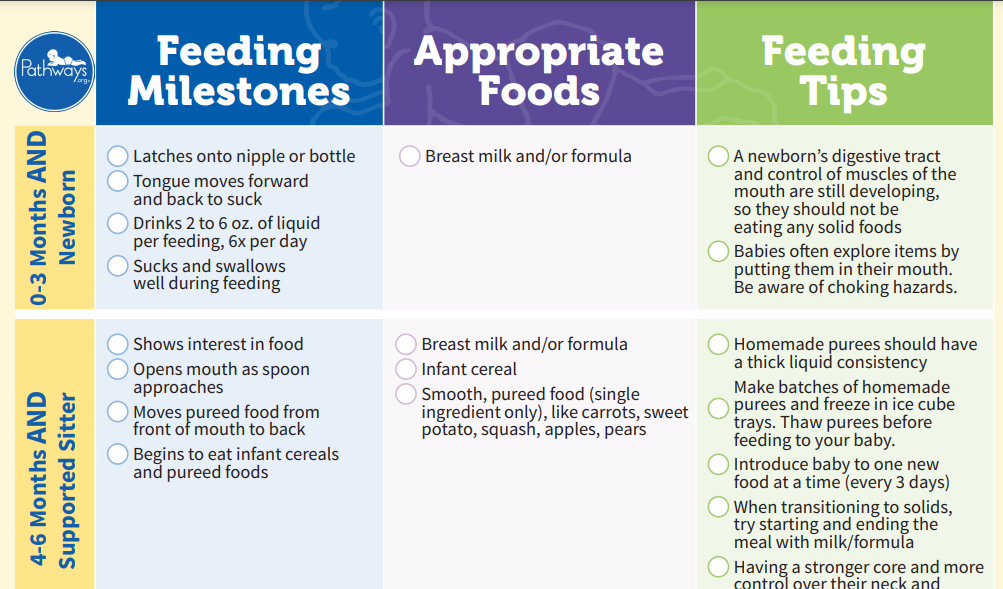
I discovered a helpful tool for infant feeding from birth to 12 months. Pathway’s Feeding Checklist. In the “feeding milestones” column it lists milestones to look for to see whether your child is ready for the next stage of feeding – these milestones are a better guide for when to start solids than age is. Then it suggests appropriate foods and offers other tips. Check it out!
Routines are very powerful tools for kids – although you may not think of them as a discipline tool, they absolutely are. When kids know what to expect and what’s expected of them, it is so much easier for them to do well! Routines are especially important around the big transitions in the day – getting up and out the door in the morning, mealtimes, and bedtime.
This post is about one sample bedtime routine. It’s not meant as the “Single Best Bedtime Routine for All Children Every Where.” Because there is no such thing, because every child is different and every family circumstance is different. But it may give you some insight with where to start building your routine.
Where to Start
Maybe you already have a bedtime routine that’s working for you and your family, but you’re not sure if you’re “doing it right.” Or, if you searched for a post on bedtime routines, it’s more likely that your current bedtime routine is not working for you.
How would you know if you have a sleep problem?
Don’t listen to outsiders on this one: it doesn’t matter what your friend, neighbor, or mother-in-law thinks. It doesn’t matter if what you do is different than the advice you read on some website or in some book. It matters how you feel! If your routine is working for you, your partner, and your child, then NO, you don’t have a sleep problem. If, however, you, your partner, or your child are miserable, stressed out, sleep-deprived, frequently ill, resentful or just tired of the situation, then take steps to fix the problem!
Assessing the Current Situation
If your routine is working, don’t expect that you can make a simple switch and overnight everything will be magically fixed. It takes a while to adjust to new habits.
It helps to start off by thinking about where you are now and where you want to get to.
Spend a few days keeping a journal of what you are currently doing, and see what the patterns are. Then write down what your ideal schedule would be. How are those different? Make a one-step-at-a-time plan for how to move in that direction. (For example, if your child stays up till 9:00 or 9:15 every night, you can’t declare that “starting tomorrow, you must go to sleep at 7:30.” But, you could do bedtime at 9:00 one night, 8:50 the next, 8:40 the next, and so on.)
One thing to watch for during these journaling days: when does your child show tired cues? As they near the end of their day, do they have a quiet time, where maybe they get bleary-eyed, rub their eyes, yawn, snuggle down and rest a lot? If you settle them down when they’re in this state, it can go easily. If you miss this “magic window of opportunity”, then often they get a wave of energy. I’ve worked with many parents who say their child is full of energy – wild and wired and running around crashing into things at 10:00. That doesn’t mean they “want” to stay up till 10:00. That might mean that you missed the tired cues they showed at 7:00 and their adrenaline kicked in to keep them going.
Figure out when your child’s internal clock hits its sleepy time in the evening. Try to start your wind-down time before that so you’re ready for the bedtime routine when it hits. Lots of kids will go from tired-but-not-yawning to yawning to overtired-wild-child if you wait too long.
Once you know your current routines, start working on taking steps toward a new one. Here are some ideas to get there.
Create a sleep-supporting environment
It’s worth putting thought into what best helps your child sleep. Don’t feel like you have to spend a ton of money to get these things, but think about how to best re-purpose what you have or can find cheaply.
A comfy bed and pillow
The right sheets and blankets. Our whole family loves flannel sheets year round. We discovered when my son was a toddler that sleeps much more deeply with a fleecy blanket than with a puffy bedspread. We discovered when he was 5 or 6 that he sleeps even better with a weighted blanket in a fleecy cover. (He’s autistic and finds the weight to be comforting.) Your child might be different – they might overheat at night and love their jersey knit sheets and lightweight duvet.
White noise? Music? Many children sleep better with a white noise machine (or a fan running) or with quiet music playing at bedtime.
Nightlights? My oldest child could sleep without a nightlight but Mr. Turtle made him happy so we used it off and on. Then when my daughter was little, I remember seeing research that showed use of night lights was linked to early puberty (and now they say blue light from screens on devices might be as well), so we avoided night lights. Now as an adult, she has a hard time falling asleep when there’s any light in her vicinity. My youngest likes the light on in the hallway. And he had a period at age 10 where he was having a lot of night-time anxiety that was stopping him from sleeping. I asked him what would help and he said a disco light! I thought that sounded crazy – but it turned out it worked great. Watching the swirly lights distracted his anxious ADHD brain just enough that he could settle down.
Stuffed animals and toys? For a baby under 1 year old there should be no soft items in the crib. But for older children, you can make the choices that work best for you and them.
So yes, do think about creating the best sleep environment. Think about having multiple sleep “cues” that help cue your child to settle down. However, don’t let anything become a sleep “crutch” without which they can’t sleep! For example, your child might usually have: bedtime music, bedtime story, pajamas, a favorite stuffed animal and snuggles with you. But not always all of them… that way if one night you can’t find the stuffed animal they can still sleep. Or if you’re travelling, and forgot pajamas, they’re still able to fall asleep in their clothes. Or if you leave them with a babysitter they’re still able to fall asleep. We practice rotating out items so that none of them are absolutely essential.
Wind down routine
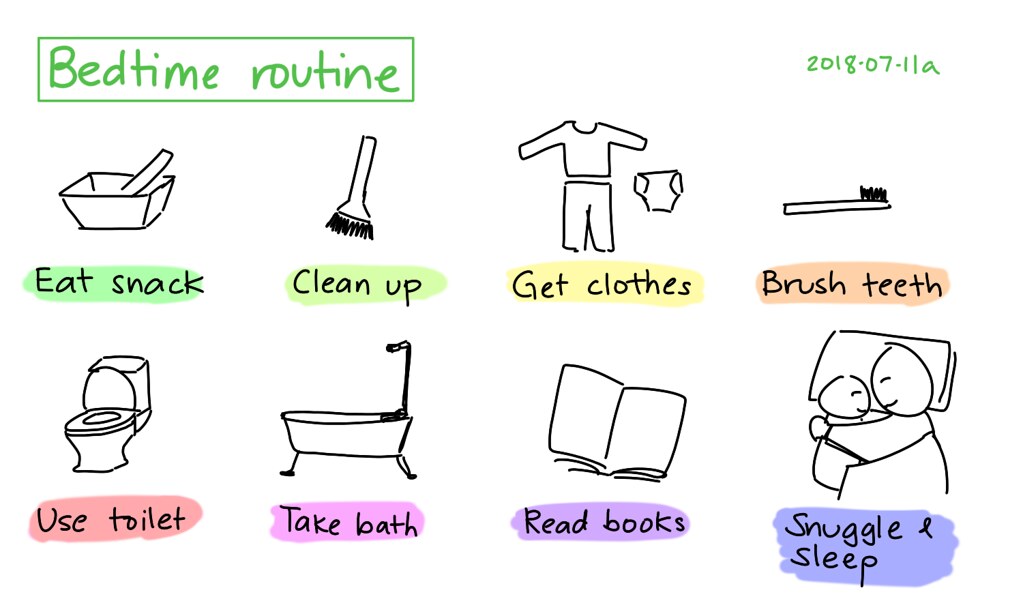
The original version of the illustration at the top of this post had 8 steps in it. That’s too many steps for a bedtime routine, I like separating thing into two chunks. Wind down may take 30 – 45 minutes. The bedtime routine might take 10 – 15.
For wind-down time: turn off screens (videos, video games) or at least switch to blue shade, turn down the lights in the room, turn down the heat (cooling down signals the body that it’s time to sleep), and turn down the activity level. (No rough-housing or big physical activity right before bed.) Consider an evening snack or bath time, whatever best helps them and you let go of daytime energy and settle down.
Bedtime Routine
I like to have a four or five step routine that I teach to my child. I might make a poster with pictures of the steps on it as a visual signal. I reinforce the routine by talking about “this is how we always do things. Remember, we always have four things we do before bed. What are they?” A preschooler should be able to recite the four steps.
I will sometimes give a last chance alert before we start that routine: “it’s almost bedtime – is there anything you need to do before we start our routine.” That gives them that last chance to have a snack or find a toy or finish something up – that way they can’t ask for that later because you already gave them this chance. But set a time limit on this option… like “I’m going to start the timer and in five minutes you need to walk away from the Legos even if it’s not done.” Or, if my son asked for a snack at his five minute notice, he couldn’t choose a snack that takes a long time to eat or prepare. He could choose what we jokingly called the “suck it down” snacks: yogurt tube, applesauce packet or a cheese stick.
In our family, when my son was in preschool, our steps were: going to the bathroom, brushing your teeth, bedtime math and two stories, music on / lights out. The process takes 10 to 15 minutes and then we’re done and out of other options for the day. If they’re dawdling, use a when / then: “when you’ve brushed your teeth, we get to read stories and I’m really looking forward to that.” If they continue to resist, use an if / then: “if you don’t finish in the next two minutes, then I can only read one book, and that would make us both sad.”
Whatever your routine, you gotta stick to it! Clear limits are really important. For example, we always read two bedtime stories. NEVER more. If kids learn some nights you’ll read 5 stories, they’ll ask for 5 every night!
If they learn that every time you turn off the light and walk away all they have to do is ask for a snack you’ll come back, they’ll ask every night.
How to Respond When They Get Back Up
Now, just because you set up this plan for a routine doesn’t mean it magically works the first time. It takes a while and a lot of consistency on your part to make it stick.
After the bedtime routine, your child may try to “escape” from bed. Don’t let them, because if you let them escape once they’ll try every night… Instead, every time they get up, calmly and gently pick them up, stating simply “It’s now your bedtime, you need to be in bed. I will see you in the morning.” And place them back in bed. No long lectures, no anger, just a matter-of-fact unbreakable rule. Use a when/then: “when you do a good job at bedtime, then we get to do [something fun] tomorrow.” If they continue to escape, use logical consequences: “if you get up again, then….”
We just stick with it till it sticks. So, make sure you’ve set a bedtime plan that is something you can stick with reliably, even if you yourself are tired or sick or busy or whatever. Consistency is key. Over time it will become how things work in your family.
I do need to caution that even once your bedtime routine is well established, it doesn’t mean there won’t be days when it fails. (We expect sleep regressions around big developmental changes (periods of disequilibrium) daylight savings time, or the night before a big event when they’re excited, or on trips or other changes to the routine.) When those changes happen, the best way to get back on track is to ground yourself in the routine. It will evolve and adapt as your child grows, but it’s a reliable and comforting thing to return to for both of you.
As a parent of a young child, you may be actively seeking parenting advice – looking at books and blogs, listening to podcasts or searching on YouTube at midnight or taking parenting classes. Or even if you didn’t seek out advice, it comes to you in the form of unsolicited comments from people at the grocery store, your friends, or your own parents.
It can be overwhelming, especially when the advice is conflicting. When one person say “you always have to do X” and someone else says “you should never do X because…”
I’ve always said that if you get ten pieces of parenting advice, you’ll eliminate one or two right off because you think “whoo, that sounds like a ton of work! I just don’t have the time / energy / money for that.” You might hear one that you think “oh, that just doesn’t seem smart / safe…” But that still leaves a bunch of ideas that seem do-able but you’re not sure which to try first.
Here are some questions to get you thinking critically about the advice you hear, and figuring out whether the advice is a good fit for your family at this time:
What is the source of the information:
What is their training? Professional experience?
Have they had their own children? Have they worked directly with lots of babies in day-to-day life (i.e. not just in a clinic setting)?
Is the advice based on research? (Do they cite their sources?) Or is it based on real-world experience? Or a combination of the two?
What is their motivation for sharing this advice – will they profit or benefit in some way if you take that advice? (For example, do they say the only way to solve a problem is to buy their product?)
Do they share some of your social identities (e.g. race, religion, sexuality, class) or are they speaking from a very different life history?
Is it relevant?
Does the advice apply to your child’s current age / developmental stage?
Does the information fit (or can it be adapted) to your lifestyle, economic means, work patterns and other practical considerations?
Does the advice align with your cultural values or religious practices?
How does the advice make you feel?
Is it it respectful – do you feel that the author / speaker respects that you have your own wisdom or do you feel that they’re talking down to / patronizing you?
Is it fear-based? Lots of people trying to sell parents something (whether that’s a product, a service, or just their ideas) use fear as the motivator – “if you don’t do X, then your child will never _____.” (FYI, children are remarkably resilient, and there are few things which are actually this critical.)
Or does it over promise? “If you do this, we guarantee your child will sleep through the night and will never throw a tantrum again.” (Nothing is that magical!)
Does it feel do-able – you can imagine actually doing it and being successful at it?
Is it flexible?
In my experience as a parent and as a parent educator, we are always needing to adapt and accommodate. We may be traveling or have visitors or our child might be in the middle of a growth spurt or we’ve got a stomach bug or what worked for our child last week doesn’t work this week or…
Any advice that is very rigid and implies that there is only one right way to do something and you can never vary it in any way just doesn’t seem realistic to me, and I never quite trust that the speaker has much experience with children if they don’t know everything has to be adapted to the unique needs of the moment.
Does it fit?
Really, the final question is: does the advice feel like a good fit for you? Does it seem like something you can imagine doing and doing consistently? If so, give the idea a try. If not, continue to seek ideas from other reputable sources till you find the answers that feel right for your family’s unique needs.
Unsolicited Advice
I just want to end with a comment on unsolicited advice. Someone told me that in their mind anytime someone gives them advice, it’s really meant as criticism that they’re not doing a good job. Someone else says that all unsolicited advice feels like “mansplaining” or like the speaker is condescending, assuming that they know everything and you know nothing.
I will grant that some people do these things.
However, I think that most people giving parenting advice mean well. In many cases, they have lived through their own parenting challenges, just like you – they often felt incompetent and overwhelmed, and then they found something that worked for them!! They were so excited and relieved by that experience that they now ‘spread the gospel’ about the idea to random parents they see on the street.
My approach is I listen to all advice I’m given and I evaluate it. Some is sheer nonsense that I shrug off. Some may not be useful to me at that time but I imagine someday it could be, so I store it away for future reference. And sometimes… that unsolicited advice is exactly what I need to solve a challenge I am currently facing, and I’m so glad the person decided to share it. It’s always worth having new ideas.
For decades, parents and educators taught the idea of stranger danger. There are several flaws to this message:
It creates a culture of fear. It can be frightening to a child to be out in public when they’ve been told that all the strangers around them are people to be feared.
Talking about “bad people” means that our children are on the lookout for people who look and act evil: the mustache-twirling, black-clad villain. Most people who perpetrate crimes against children are nice looking and quite charming.
Talking about “odd looking” or “dangerous looking” people or “people who don’t look like us” can lead to racial profiling and prejudiced attitudes.
Creating fear of strangers might mean that our children are afraid to seek help from unfamiliar adults when needed – such as a lost child who is too frightened to approach a security guard to help find their parents, or a lost child who evades rescuers because they are strangers to him.
Crimes against children are relatively rare. When they do happen, it is much more likely that they are committed by someone the child knows than by a stranger.
For child sexual abuse, only 10% of perpetrators are strangers, 60% are non-family members who are known to the child and family, 30% are family members. Source. In 23% of reported cases the perpetrator was under the age of 18. (Stats for Canada here.)
We tend to worry about the stereotypical kidnapping where a stranger abducts a child. However, there are only about 105 of those a year in the US. That might seem like a lot (and certainly, it’s tragic to those affected), but remember that there are 17 million children – so millions of children are never affected by this.
In 90% of kidnapping cases, the kidnappers are family members, usually non-custodial parents. Source. If our children have been taught that strangers are always bad, but that the people they know are always “safe”, then we have not protected them.
I don’t want my children to be frightened of all the new people they encounter. I want my children, and the children I work with, to feel safe in their world. Children are happiest and learn best when they feel safe. I tell children, through my words, my body language, and my interactions, that the vast majority of people are good people. Even a stranger who looks very different from the people I interact with every day is most likely a good person.
But, when children are around three years old is a good time to start talking about behaviors of “tricky people.” Tricky people are not a certain kind of people (like strangers, or like people whose skin is a different color from my own) but they are any person who displays certain odd behaviors. Those behaviors should raise red flags for a child, and let them know they should check in with a trusted adult for advice on how to respond.
What are Tricky People behaviors?
Here are some things to tell your child to watch out for. Tricky people may:
ask kids for help (such as help finding a lost puppy)
If safe grown-ups really need help, they’ll ask other grown-ups (or at minimum, ask the child to find another grown-up to help). Your child should know that if an adult asks them for help, they should go speak to a trusted adult.
tells the child “there’s an emergency. You need to come with me right now.” Note: For children over 5, it can be a good idea to establish a password (see below).
try to arrange for alone time with a child
Let your child know not to go somewhere alone with one adult unless a trusted adult has told them it’s OK.
try to make one particular kid feel special, lavishing praise and gifts (grooming)
Tell your child if someone unexpectedly offers to give them something (candy, money, a kitten), they shouldn’t take it and say they need to ask their parents if that is OK.
ask kids to do something that breaks the family rules, or just doesn’t feel right
Teach your child to think about whether an interaction feels fine or whether it gives them an uncomfortable “uh-oh” feeling. Encourage them to trust their instincts.
ask kids to keep a secret from their parents or their teacher, or threatens something like “if you tell, you’ll be in big trouble”
Any time this happens, a child should tell their parent or a teacher.
touches a child a lot (tickling, wrestling, asking for hugs), especially if they get angry if the child says no to the touch
touches a child in a private area, asks a child to touch their private parts, asks to see a child’s private areas, asks to take pictures of private area, or shows a child their private areas
Here are some things we can do to help our kids be safe:
For a toddler
Teach them their name and their parents’ name(s)
Tell them they need to stay near you when you’re out in public, set boundaries – tell them where it’s OK to go and what’s not OK. If they step outside those limits, or refuse to hold your hand in a parking lot, or whatever guidelines you have set, then there should be consequences (e.g. you need to leave the park, or you need to carry them in the parking lot.)
When going anyplace busy where you might become separated, put your contact info somewhere on them (e.g. on a card in their pocket, on a bracelet, etc.). Also, take a picture of them that day with your phone so if you become separated you have a photo of what they look like and they are wearing.
Teach healthy touch: high fives and fist bumps, patting on the back, brief hugs, etc. Don’t force your child to give a hug to someone if they are not comfortable.
Teach them names for their body parts, including private parts. It is best to use commonly used terms (e.g. penis or vagina), not family euphemisms. Feeling comfortable with these words makes it possible for a child to explain if something inappropriate were to happen. (Learn more.)
Under three years old, I don’t talk about “tricky people” or “bad people.” But, if I am in a situation where I feel uncomfortable, I show it with my body language, and I tell my child “I don’t like being here… I don’t feel safe right now. We’re going to leave.” Even at this age, I want to start teaching them to trust their instincts.
For a child age 3 and up
Everything listed above, plus:
Be sure they know their parents’ names, and parents’ phone numbers.
Help them know what adults you trust. Tell them: “if you ever feel scared or need help, then ____ and _____ are adults you can talk to.”
Talk to them about how to find a trustworthy stranger if they somehow become separated from you and need help. Some parents teach to look for a police officer, but they’re not always around. So, I tell my children to look for a person who is working there – I help them identify workers – they’re standing behind the check-out counter, or they’re wearing a uniform. I also tell them they could go to another parent – someone who has a child with them. From time to time, we practice this – I ask my child to look around and identify two people who they could ask for help if needed. Also, point out “safe spots” – the places they are most likely to find helpful people.
Talk to them about “tricky people” and what behaviors are red flags. Don’t try to cover it all in one big “talk” – it should be an on-going dialogue.
If your child is uncomfortable around someone and wants to avoid that person, don’t dismiss this. Respect your child’s instincts.
If you go somewhere you might get separated (the zoo, an amusement park, a large event), talk to them on the way there about the importance of staying close to you the whole time. Tell them that if they look around and can’t find you, they should stop where they are and you will find them.
By the time they are three, teach them that the parts of their body that are covered by a swimsuit are private. They should be kept covered around other people, and other people should not touch them there, except for parents or caregivers who are briefly helping to clean them, or a doctor, when the parents are in the room.
Don’t label your child’s clothes or backpacks with their name in big, visible letters. “Tricky” adults often use a child’s name to convince the child they are safe.
As your child gets older, and more independent:
Everything listed above, plus
They should know their address, and know contact info for multiple trusted adults, and have a plan for how they could contact them. (For a younger child who doesn’t have a cell phone, they should know how to seek adult help. For older kids with phones, they need plans for what to do if their phone battery dies.)
If going someplace you may get separated, have a plan in advance for where you would meet up again. Make sure they can describe it to you, and from time to time, ask them “do you remember where our meet-up place is? Can you point to where it is?”
A responsible adult should always know where they are. Set boundaries on where they can go, ask that they check in with you from time to time, and require that they check in if their plans change.
In the places they frequent, they should be able to list “safe spots” where they could go for help if they were feeling worried – for example, if someone at the park was making them uncomfortable, they could go into the nearby convenience store. They should also know to avoid unsafe spots – isolated areas with no one around.
They should know how and in what circumstances to call 9-1-1.
They should know never to answer the door when they are home alone.
They should know never to approach a stranger’s car. If someone calls them over to a car, they should not go.
When out and about, they should use the buddy system, not go places alone.
If someone offers them money, or an easy job, they should be wary.
Consider a family password so that if you ever could need to send an unexpected adult to pick them up in case of emergency, your child could ask that adult for the password to be sure it’s really someone you sent. You could also use that code word or another one for your child to communicate to you “I’m feeling unsafe and I need your help.”
Tell them to trust their instincts. If they’re worried about something, they should talk to you or another trusted adult who can help them problem-solve. If they’re very frightened, they should call 9-1-1 or shout for help. Tell them it is better to seek help and find out that everything is actually OK than it is to not seek help when things really are bad.
Give kids examples of “tricky behavior”; have them describe how they would respond.
Don’t talk about “bad touch” because sometimes sexual touch can feel good or can “tickle.” Instead, talk about “secret touch” that the other person wants you to hide from people, or touch that makes them feel wrong after it happened. Let children know that if anyone ever touches them in an inappropriate way (or makes the child touch them), that it’s not the child’s fault and they will not be in trouble with you. Perpetrators may first involve children by showing them pornography – let your child know that if someone shows them pictures of someone’s private parts, they should let you know, and tell them they won’t get in trouble for it.
Explain that you’re teaching safety rules because they are more mature and ready to be responsible. You want to give them more freedom, but you also need to be reassured that they know how to stay safe.
Letting Your Children Out of Your Sight
Here’s an example of how this could play out: My six year old wanted to be able to sit on the front porch and read while I was inside making dinner. We set boundaries: “you can sit on the porch swing. You may not leave the porch or step onto the driveway or the path to the sidewalk.” We reminded him of tricky people ideas: “we have lots of people walk by the house. Remember, that most people are good people. If they wave or say hi, you can say hi back. However, if they ask you to leave the porch, they’re being tricky and you need to come inside and get us. If they step off the sidewalk onto our driveway or path, you need to come in right away. Even if it’s someone you know from church or school, I would still want you to come inside and get me.” We let him know that as long as he could follow the rules, he could have porch-sitting privileges. But if he ever violated those rules, he would lose those privileges.
Deciding to let a child play outside unsupervised, or let an older child go places without you, requires a leap of faith on your part. It can be scary to take that risk. But remember that keeping them at home and in sight at all times also creates risks – it limits their potential to be active, independent, decision-making people.
Part of parenting is teaching our kids the skills they need to know so that later on, they don’t need us so much any more. This is just one of many things that we do to prepare them to be out in the world on their own.
Handouts: If you’re a parent educator who would like to share this information with families, I’ve created a 4 page handout and 2 page handout of this information.




 More Good Days with Kids