Sometimes I hear parents and teachers say “no thank you” to children to correct misbehavior – like when a child is shoving or making too much noise and the adult just says “no thank you” in the child’s general direction.
Not only do I find this odd (in my mind I would say “no thank you” to a child who offered me something I didn’t want, like a bite of their soggy cracker), it’s ineffective, because it does not explain to them what they should do instead. Children are left to deduce what might be wrong about what they’re doing and then make the jump to abstract thinking to figure out what else to do. That’s a big leap for three and four year olds!
It’s so much more effective to be explicit with your corrections. If a child is shoving into line, instead of no thank you, say “Jack, please go to the end of the line.” If they’re banging on the table, instead of no thank you, say “Kim, please stop banging, that hurts my ears.” It’s so much easier for a child to behave well when they’re told what that means. I really recommend this approach for adults.
Should kids use “no thank you” in this way?
I know a preschool teacher who taught her students to say “no thank you” when the other children did things they didn’t like. I think that could be appropriate for three year olds who do know when they don’t like something but may have a hard time articulating exactly what it is they don’t like or what they wish the other child would do instead. Saying no thank you is certainly better than shoving the other child. But by four years old, I like to work with kids on more clearly expressing themselves. I might say “Jeff, you look uncomfortable. Can you tell Kira ‘please don’t lean on me during group time – I like to have my own space.’” Or “Shri, you can say to Olga ‘please stop pushing me.’” It’s polite, assertive, and clearly expresses their preferences.
Routines are very powerful tools for kids – although you may not think of them as a discipline tool, they absolutely are. When kids know what to expect and what’s expected of them, it is so much easier for them to do well! Routines are especially important around the big transitions in the day – getting up and out the door in the morning, mealtimes, and bedtime.
This post is about one sample bedtime routine. It’s not meant as the “Single Best Bedtime Routine for All Children Every Where.” Because there is no such thing, because every child is different and every family circumstance is different. But it may give you some insight with where to start building your routine.
Where to Start
Maybe you already have a bedtime routine that’s working for you and your family, but you’re not sure if you’re “doing it right.” Or, if you searched for a post on bedtime routines, it’s more likely that your current bedtime routine is not working for you.
How would you know if you have a sleep problem?
Don’t listen to outsiders on this one: it doesn’t matter what your friend, neighbor, or mother-in-law thinks. It doesn’t matter if what you do is different than the advice you read on some website or in some book. It matters how you feel! If your routine is working for you, your partner, and your child, then NO, you don’t have a sleep problem. If, however, you, your partner, or your child are miserable, stressed out, sleep-deprived, frequently ill, resentful or just tired of the situation, then take steps to fix the problem!
Assessing the Current Situation
If your routine is working, don’t expect that you can make a simple switch and overnight everything will be magically fixed. It takes a while to adjust to new habits.
It helps to start off by thinking about where you are now and where you want to get to.
Spend a few days keeping a journal of what you are currently doing, and see what the patterns are. Then write down what your ideal schedule would be. How are those different? Make a one-step-at-a-time plan for how to move in that direction. (For example, if your child stays up till 9:00 or 9:15 every night, you can’t declare that “starting tomorrow, you must go to sleep at 7:30.” But, you could do bedtime at 9:00 one night, 8:50 the next, 8:40 the next, and so on.)
One thing to watch for during these journaling days: when does your child show tired cues? As they near the end of their day, do they have a quiet time, where maybe they get bleary-eyed, rub their eyes, yawn, snuggle down and rest a lot? If you settle them down when they’re in this state, it can go easily. If you miss this “magic window of opportunity”, then often they get a wave of energy. I’ve worked with many parents who say their child is full of energy – wild and wired and running around crashing into things at 10:00. That doesn’t mean they “want” to stay up till 10:00. That might mean that you missed the tired cues they showed at 7:00 and their adrenaline kicked in to keep them going.
Figure out when your child’s internal clock hits its sleepy time in the evening. Try to start your wind-down time before that so you’re ready for the bedtime routine when it hits. Lots of kids will go from tired-but-not-yawning to yawning to overtired-wild-child if you wait too long.
Once you know your current routines, start working on taking steps toward a new one. Here are some ideas to get there.
Create a sleep-supporting environment
It’s worth putting thought into what best helps your child sleep. Don’t feel like you have to spend a ton of money to get these things, but think about how to best re-purpose what you have or can find cheaply.
A comfy bed and pillow
The right sheets and blankets. Our whole family loves flannel sheets year round. We discovered when my son was a toddler that sleeps much more deeply with a fleecy blanket than with a puffy bedspread. We discovered when he was 5 or 6 that he sleeps even better with a weighted blanket in a fleecy cover. (He’s autistic and finds the weight to be comforting.) Your child might be different – they might overheat at night and love their jersey knit sheets and lightweight duvet.
White noise? Music? Many children sleep better with a white noise machine (or a fan running) or with quiet music playing at bedtime.
Nightlights? My oldest child could sleep without a nightlight but Mr. Turtle made him happy so we used it off and on. Then when my daughter was little, I remember seeing research that showed use of night lights was linked to early puberty (and now they say blue light from screens on devices might be as well), so we avoided night lights. Now as an adult, she has a hard time falling asleep when there’s any light in her vicinity. My youngest likes the light on in the hallway. And he had a period at age 10 where he was having a lot of night-time anxiety that was stopping him from sleeping. I asked him what would help and he said a disco light! I thought that sounded crazy – but it turned out it worked great. Watching the swirly lights distracted his anxious ADHD brain just enough that he could settle down.
Stuffed animals and toys? For a baby under 1 year old there should be no soft items in the crib. But for older children, you can make the choices that work best for you and them.
So yes, do think about creating the best sleep environment. Think about having multiple sleep “cues” that help cue your child to settle down. However, don’t let anything become a sleep “crutch” without which they can’t sleep! For example, your child might usually have: bedtime music, bedtime story, pajamas, a favorite stuffed animal and snuggles with you. But not always all of them… that way if one night you can’t find the stuffed animal they can still sleep. Or if you’re travelling, and forgot pajamas, they’re still able to fall asleep in their clothes. Or if you leave them with a babysitter they’re still able to fall asleep. We practice rotating out items so that none of them are absolutely essential.
Wind down routine
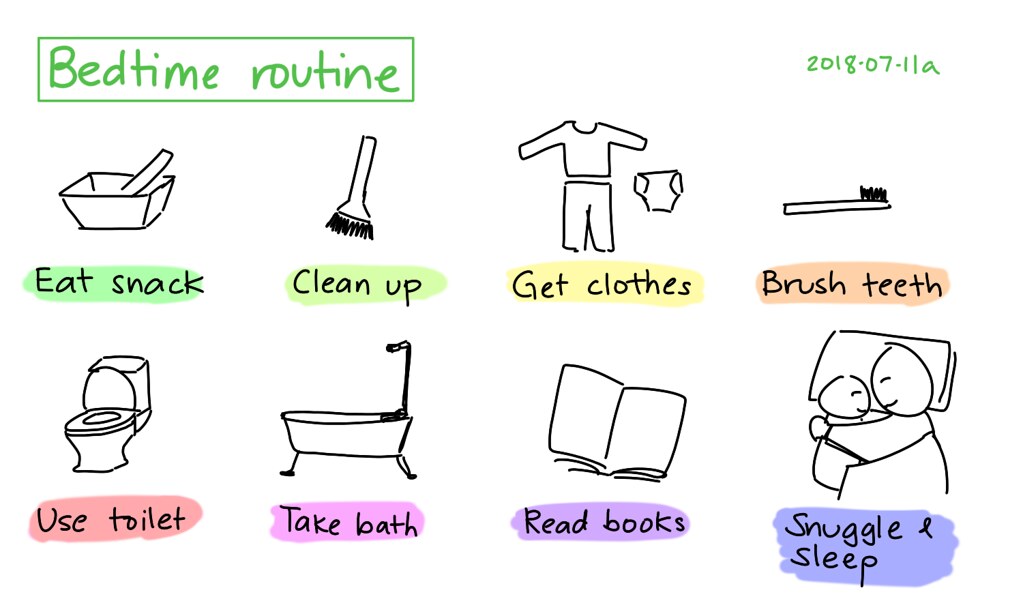
The original version of the illustration at the top of this post had 8 steps in it. That’s too many steps for a bedtime routine, I like separating thing into two chunks. Wind down may take 30 – 45 minutes. The bedtime routine might take 10 – 15.
For wind-down time: turn off screens (videos, video games) or at least switch to blue shade, turn down the lights in the room, turn down the heat (cooling down signals the body that it’s time to sleep), and turn down the activity level. (No rough-housing or big physical activity right before bed.) Consider an evening snack or bath time, whatever best helps them and you let go of daytime energy and settle down.
Bedtime Routine
I like to have a four or five step routine that I teach to my child. I might make a poster with pictures of the steps on it as a visual signal. I reinforce the routine by talking about “this is how we always do things. Remember, we always have four things we do before bed. What are they?” A preschooler should be able to recite the four steps.
I will sometimes give a last chance alert before we start that routine: “it’s almost bedtime – is there anything you need to do before we start our routine.” That gives them that last chance to have a snack or find a toy or finish something up – that way they can’t ask for that later because you already gave them this chance. But set a time limit on this option… like “I’m going to start the timer and in five minutes you need to walk away from the Legos even if it’s not done.” Or, if my son asked for a snack at his five minute notice, he couldn’t choose a snack that takes a long time to eat or prepare. He could choose what we jokingly called the “suck it down” snacks: yogurt tube, applesauce packet or a cheese stick.
In our family, when my son was in preschool, our steps were: going to the bathroom, brushing your teeth, bedtime math and two stories, music on / lights out. The process takes 10 to 15 minutes and then we’re done and out of other options for the day. If they’re dawdling, use a when / then: “when you’ve brushed your teeth, we get to read stories and I’m really looking forward to that.” If they continue to resist, use an if / then: “if you don’t finish in the next two minutes, then I can only read one book, and that would make us both sad.”
Whatever your routine, you gotta stick to it! Clear limits are really important. For example, we always read two bedtime stories. NEVER more. If kids learn some nights you’ll read 5 stories, they’ll ask for 5 every night!
If they learn that every time you turn off the light and walk away all they have to do is ask for a snack you’ll come back, they’ll ask every night.
How to Respond When They Get Back Up
Now, just because you set up this plan for a routine doesn’t mean it magically works the first time. It takes a while and a lot of consistency on your part to make it stick.
After the bedtime routine, your child may try to “escape” from bed. Don’t let them, because if you let them escape once they’ll try every night… Instead, every time they get up, calmly and gently pick them up, stating simply “It’s now your bedtime, you need to be in bed. I will see you in the morning.” And place them back in bed. No long lectures, no anger, just a matter-of-fact unbreakable rule. Use a when/then: “when you do a good job at bedtime, then we get to do [something fun] tomorrow.” If they continue to escape, use logical consequences: “if you get up again, then….”
We just stick with it till it sticks. So, make sure you’ve set a bedtime plan that is something you can stick with reliably, even if you yourself are tired or sick or busy or whatever. Consistency is key. Over time it will become how things work in your family.
I do need to caution that even once your bedtime routine is well established, it doesn’t mean there won’t be days when it fails. (We expect sleep regressions around big developmental changes (periods of disequilibrium) daylight savings time, or the night before a big event when they’re excited, or on trips or other changes to the routine.) When those changes happen, the best way to get back on track is to ground yourself in the routine. It will evolve and adapt as your child grows, but it’s a reliable and comforting thing to return to for both of you.
There are several sections of this page – here’s what you’ll find:
Making Life Easier: tip sheets on how to turn events that are often challenging for parents into something more manageable or even enjoyable. Covers: Bedtime / Naptime, Diaper Changes, Going to the Doctor / Dentist, Holidays, and Errands.
Visual Schedules: how to use this powerful tool for teaching routines and expected behaviors: first you do this, then we’ll do that.
Backpack Connection Series: a way for teachers and parents/caregivers to work together to help young children develop social emotional skills and reduce challenging behavior. Handouts on four topics:
Teaching Emotions – Anger, Fear, Frustration, etc.
Routines and Schedules – and how they reduce family challenges
Social Skills, Sharing, Taking Turns, Appropriate ways to get attention
Family Articles – Making the Most of Playtime, Teaching your child about feelings (from birth to age 2), Teaching Independence with Daily Routines
Scripted Stories – I like Tucker Turtle Takes Time to Think. The “turtle technique” is a really helpful skill for my kid who struggles with emotional regulation.
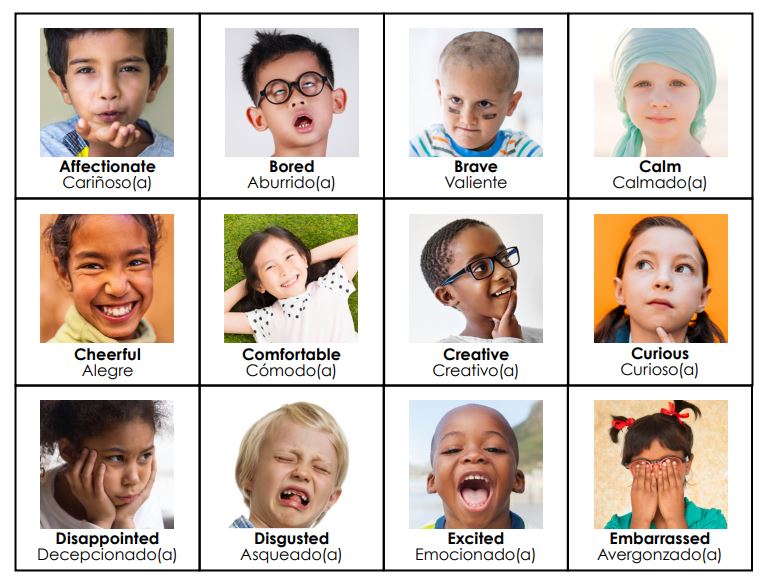
Teaching Social Emotional Skills – includes graphics for a feelings chart (see picture above) and problem solving steps.
Parents often talk about “offering choices” to children. It can be a very helpful technique for building cooperation with your kids, avoiding power struggles, and helping them learn decision-making skills. But, like all the tools in the discipline toolbox, it helps if you know some basic ideas about how to use a tool in order to get the best results.
What Choices are Available
It is the parent’s job to decide what options are available. Then the child chooses between those options.
On a busy morning when we’re in a hurry to get out of the house, it would be unfair of me to tell my son “pick anything you want to eat for breakfast.” Because if he chose waffles and we ran out yesterday, that’s a bummer. And if then he chose a fruit salad, I’d say “I don’t have time to make that.” If then he said mac and cheese, then I’d say no, and then we have a power struggle on our hands when I describe all the rational reasons these choices are not an option, and he’d say “but you said I could choose anything.”
It’s just setting us up for frustration on both sides. (Or I could just give in and say yes to anything he demanded, but then I’d be cranky and resentful and he’d learn he gets anything he wants if he complains enough.)
Instead, before I offer a choice, I need to decide what acceptable options are. I can’t expect a young child to remember what food we have in the freezer right now, to know how long it would take to prepare food and whether that would make us late to school, or any of those other details I’m taking into consideration. So… first, I think about these things, I think about what options are possible, and then when I say “what do you want for breakfast – cheerios, yogurt, or an apple and peanut butter?” I know that all of these things are possible and that I would be fine with him making any of those choices.
I control what options are on the table, he decides which one of those to choose.
If he then asked for waffles, I could say “sorry buddy, we’re out of waffles – you can choose….” and reiterate the reasonable options. If he said “can I have grapes and string cheese?” I’d say “hmm…. that wasn’t one of my options, so I have to think about that… it is a lot like the apple and peanut butter option, and I know we have those things, so yes, you could choose that.” (Notice, I let him make a choice that wasn’t in the options but I was still the one in control of deciding whether that option was available. I set the limits that would work for us both and gave him some insight into my decision-making.)
How Many Choices to Offer
Some parents make the mistake of offering too many options, which can be overwhelming for a little one. Too many overwhelming choices in one day will lead to meltdowns. A good rule of thumb for little ones is to offer just one decision at a time, and for that decision, offer as many options as the child is years old. A 2 year old chooses between the red shirt and the blue shirt. (And you just put a pair of pants on them without them having to also make that decision.) A 3 year old chooses between cereal, toast, or yogurt. (You decide what dish to use, and where they sit.) A 4 year old has four bedtime stories to choose between. (You decide that they’ll brush teeth before you read the story.)
With More Choices, Offer More Guidance
As the child gets older, you may offer more choices, but give them criteria you would use to help make a good decision. For example, an 8 year old can go to a full closet of options and choose all their clothes (pants, shirt, socks, underwear), but the parent might offer guidance. “I know yesterday was super warm and you wore shorts, but today will be much cooler, so you’ll probably want to choose long pants. And you may want to wear your flannel hoodie this morning till it warms up.” Or “I know you want to play with Legos today. The other two things you need to do before dinner are bring in the trash bins and do your homework. You can choose what order to do them in, but they all need to be done. I’d probably do the trash bins first because it’s quick and easy and you’ve still got your shoes and coat on.”
Talking through this decision-making process helps them build the skills to do this independently later on.
When To Offer Choices (and when not to)
Don’t offer choices to a child in the middle of a huge meltdown. At that point, they’re in their “downstairs brain” and not capable of having a rational discussion and making decisions. I was once in the mall parking lot, and a child was having a massive meltdown, and the mom kept saying “You can’t run in the parking lot. You have three choices – you can ride in your stroller or I can carry you or you can hold my hand while we walk.” This was a kid in full meltdown – he wasn’t processing anything she was saying, even though she said it over and over. It would have been better to say “it’s not safe for you to be here, so I need to carry you” and when the child starts to calm down, then offer the other options.
An even better approach was to offer the choices before the situation and long before the meltdown. While the child was still buckled in his car seat and calm, she could say “Remember in the parking lot, it’s not safe for you to run off. You have three choices….” (Or actually, I would have offered two choices – three is a lot at that age, even when the child is calm.
Don’t offer choices to bribe your child out of a tantrum. Imagine you’re in a store and your child asks you to buy an expensive toy, and you say no, and they meltdown, and then you say “OK, fine – you can have one of these cheap toys – do you want the dog or the monkey?” Your child has now learned an effective technique to bully you into getting them something. Instead, if you’re willing to buy a cheap toy, say that going in. “In the store, if you can behave well while I do my shopping, then I will let you choose one toy. But it has to be something little and it has to cost less than _____.” If you’re not willing, don’t offer. Say “We have to buy a birthday present for your friend today, but we’re not buying anything for you. But if you can behave well, and we can do this quickly, then we’ll be able to play in the playground for a little while when we’re done shopping.”
Again, you’re in control of what options are on the table. They choose between those options.
Let Them Make Bad Choices
Now, we obviously can’t control everything our kids do. And we wouldn’t want to. They need to have plenty of times where they’re making their own decisions (in environments that are reasonably safe for them to do this in.) And when given freedom, sometimes children do dumb things. They make bad choices. You gotta let them do that sometimes. You can’t protect them from all dumb things and from the consequences of all bad choices.
If you rescue them from the consequences, they never learn to make better choices. So, some times, you should let them suffer some consequences. I empathize, but I don’t immediately rescue. (But I do have a plan for how we’ll move out of this.)
For example, my child wanted to wear her slippers to play outdoors. I would say “it’s wet out there – your slippers aren’t waterproof. Your feet will get wet.” One day she begged and begged to wear the slippers to the park before story time. Her feet got wet. I said “I’m sorry, I know you hate wet feet.” But I didn’t fix it. We played in the park with wet feet and she hated it. When it came time for story time, I said “I brought shoes and dry socks along for story time – would you like to change into those now?” Her slippers were too wet to wear when we got back home, so she had to go without the, for a day. After that, she knew not to wear her slippers outside.
We recently did an exercise in a parenting class that I teach, where I talked with parents about discipline and ways to speak with our kids to increase the chance that they will do what they are supposed to do. How you talk to your kids and what you say effect the chances that they’ll listen.
Here are some ineffective communications techniques and ways to turn them around to make them more effective:
Vague Commands
What you may be saying: Be good. Behave better. Be nice. You better behave well at the restaurant.
Why this may not be working for you: Saying “be good” implies they are bad. And, these vague commands require them to guess what it is that you want them to do. (What does “be good” look like?)
Alternative approaches that may be more effective: Set clear expectations in advance about what good behavior is in that context. “At lunch, you’ll need to sit in your chair or my lap and use a quiet voice.” If issues arise, give very clear, concrete instructions for what they should do. “Please sit on your chair now or you can sit in my lap.”
Try re-writing these sentences: “Be good at the movie.” “Be nice to her.”
Broken Record
What you may be saying: We’re late, let’s go. Come on, we’re late. Can you just put your shoes on? We’re late, we need to go. Come on!
Why this may not be working for you: If you feel like you’re saying the same thing over and over, you should ask yourself: can they hear you? Do they understand what you want them to do? Do they have the skill to do that? What’s stopping them from doing it?
Alternative approaches that may be more effective: Connect to Correct. Make sure you have their attention first, then tell them what the behavior issue is. Go near them, get down to their level, establish eye contact, and use a calm voice. Once you have their attention, then offer clear guidance – say it once – loud and clear!
Try re-writing this sentence: “Stop jumping on the couch. Cut it out. No jumping. You know you’re not supposed to jump on the couch. Stop it.”
Only telling them what NOT to do
What you may be doing: Don’t throw that / spill that / hit the dog / slam the door
Why this may not be working: If you just say what not to do, they have to first stop their impulse, then figure out what they can do instead. Both are hard for young kids to do!
Alternative approaches: Tell them what to do: “Carefully hand that to me. Move your milk so it doesn’t spill. Pet the dog softly. Close the door gently.”
Try re-writing: “Don’t throw your Legos.” “I hate it when you slam the door.”
Dismissing their Feelings
What you may be doing: I don’t care if you’re mad – we don’t break things…. You know we need to leave the park now – crying won’t change that… I know you’re excited, but you need to sit down.
Why this may not be working: Dismisses their feelings as unimportant. Until the emotion is acknowledged, it may be hard to move past it. Saying “I know you have this feeling, BUT…” doesn’t count as validating, because that “but” implies you don’t care about their feelings.
Alternative approaches: Validate emotions first, then address the behavior or re-state limits. “I know you’re mad. It’s not OK to break things.” “I can see that makes you sad. I get that – I’m sad too. And… it’s still time to leave the park.” “I know you’re excited and it’s hard to stay still. It’s important to sit down so other people can see.”
Try re-writing: “Don’t cry. You know I won’t give you more candy.” “I know you’re mad that he took your toy, but you can’t hit him.”
Over-using If / Then Threats
What you may be doing: If you don’t brush your teeth right now, then no bedtime story.
Why this may not be working: Could imply you expect they’ll do the bad thing. (Kids are good at living up to expectations!) Could imply you’re looking forward to punishing.
Alternative approaches: When / then – When you do [this good thing], then we get to do [something mutually enjoyable] together. “When you’re done brushing your teeth, we get to read a bedtime story. If you’re fast enough we get to read two!”
Try re-writing: “If you don’t help me clean, then you don’t get to go to the park.”
What you may do: Would you please stop yelling? Are you ready to sit in your car seat?
Why this may not be working: If you ask it as a question, that implies they can say no, or opt out of what you’re asking them to do.
Alternative approaches: If you’re really offering a choice, make sure they know they can choose either option. If you don’t mean to offer a choice, then give a command not a question. “Use a quiet voice.” “You need to sit in your car seat now.”
Try re-writing: “Do you want to put on your boots now?”
Do Try This At Home
Sometime in the next week, test this out! When you find an opportunity to change your communication from your normal style to trying out a new communication strategy from above, then seize the moment and test this out.
Then reflect on these questions
What happened as a result of using this new communication strategy?
What did you notice about how it felt?
What happened with your child?
How might this support a relationship with your child?



 More Good Days with Kids