Category Archives: Early Learning

Choosing Books for Your Child

We know that children learn through novelty and repetition. Through being exposed to new experiences and new ideas and by being given the chance to do those activities and explore those ideas over and over again. Books are one place this can play out. When my children were young, we always read two books at bedtime. My child gets to choose one and I choose the other. Children will often have a favorite of the moment, and that’s great! Reading that same book over and over gives them the learning benefits of repetition. I can then make sure we’re reading one new book each night to balance that with novelty. Or, if they’re always seeking new books because they’re “bored” of the old ones, I can return to one we’ve read before, reading it slowly and finding new things to point out in it and new things to talk about, teaching the depth of understanding that can come through literature at all ages.

We read a few hundred kids’ books a year at that rate. And yet… our family only owns about 20 children’s books, carefully curated from those hundreds I’ve read. We only buy and keep the most special of them all. This is better for our budget, better for the environment, and also helps to avoid the overstimulation of a house full of too much stuff. So, how do we access all those great books?

Your Local Library

We make extensive use of our local library. When my kids are little, we always have ten library books in the house per kid. We go to the library once a week – we take back any books we’re done with, but keep the ones that we still want to read. Some weeks we bring back ten and take home our ten for novelty. Other weeks, only one or two books exchange as we keep reading and re-reading the current favorites. We are blessed with one of the best library systems in the country, where we can peruse the library catalog online, choose our favorite books and put them on hold – within a few days, the books are delivered to our local branch for a quick pickup. But even in a small library system, there’s plenty of children’s books to read! Also, ask your librarian about interlibrary loan – they may be able to access books from other libraries, such as the Diverse Book library.

Online Library Resources

There are several libraries of online children’s e-books. We can access Libby, Hoopla, Tumble Book Library and BookFlix for free through our library (For King County folks, learn how at: https://kcls.org/resources-types/ebooks-format/). And we can access Sora through our public school system. Check with your local library and local schools to see if you can do that. Or, some apps also have paid options, covered on their sites.

Hoopla is a digital media service offered by public libraries that allows users to borrow movies, music, audiobooks, ebooks, comics and TV shows to stream or download for free. Over 1500 library systems in the US and Canada subscribe to Hoopla. Go to www.hoopladigital.com and click on “get started” to find out if your library offers it. Here’s some of the STEM resources on Hoopla. I like that you can set Hoopla to “kids’ mode” on your computer so it only offers kid-appropriate materials.

Epic Books

This is a subscription service – $9.99 per month for a library of 40,000 e-books, including picture books, read-to-me and audio books. I have not explored it, but it looks good.

Online Reviews and Samples

When I’m looking for a new book to read for a class, I make extensive use of online reviews, such as those on Amazon, GoodReads, and Barnes and Noble. As with all online reviews, I take them with a grain of sand. Sometimes something that troubles one reviewer is a plus for me. And sometimes a book they say didn’t appeal to their child for a particular reason might lead me to think it’s the perfect book for my kid! But reviews give you a good sense of what to expect.

On Amazon, many books have a “look inside” feature that lets you check out a few pages. I find this especially helpful for assessing reading level. Sometimes their age guidelines say one thing, and then I look at the sample text, and I think it’s better for a different developmental level than they suggest.

YouTube

If there’s a book you want to try out, search for it on YouTube. For example, search of “The Very Hungry Caterpillar read-aloud”. You’ll find LOTS of videos of people reading the book aloud and showing the pictures. Some of these videos are excellent quality. Some are not – sometimes it’s hard to see the pictures well, some folks are not enjoyable narrators to listen to. But it’s a good way to check out a book to see if you like it enough to get your own copy. I have also used these videos when teaching online classes – I mute the audio track and read along, using my own voice.

I think it’s important to note that while some publishers and authors have given permission for the use of their books in this way, many of these videos are a violation of the copyright of the author. Please do support authors by buying the best of these books.

Where to Buy

If you’re looking for just any kids’ books, you can often find them cheap at garage sales, thrift shops, and used book stores. Or, check to see if you have a local Buy Nothing group or similar group on Facebook in your area.

When you are looking to purchase a specific book new, consider purchasing through your local, independent bookstore. You can often call and place an order and they’ll have it waiting for you when you arrive. If they don’t have it in stock, they can order it for you. You can also check out Book Riot’s list of independent bookstores around the country, many of which will ship books anywhere, or check out IndieBound, where you can choose to shop directly from them but some of the proceeds are sent to independent bookstores, or you can choose “shop local” to be transferred to your local store’s website to complete the purchase. Shopping locally benefits your local community, reduces the environmental impact of shipping, and supports jobs in your community.

If you do choose to purchase at Amazon, consider either:

  1. Use Amazon Smile where a portion of the profits are donated to a charity of your choice – at no extra cost to you.
  2. Follow an affiliate link. Many bloggers (like me) use affiliate links in their book recommendation lists. If you follow that link, then purchase any product on Amazon, that blogger gets a small referral fee – at no extra cost to you. It’s a good way to support people whose work you find helpful. So, pick your favorite blog that uses affiliate links, and bookmark it, and anytime you want to shop at Amazon, go through that link.

Recommended Books

I include lots of book recommendations on my blogs! Here are links to several of those resources:

Can Online Preschool Work?

pexels-photo-3975663

Lots of early childhood programs are moving online for fall of 2020. When parents hear that toddler classes or preschools are meeting online, they may have questions about whether it could be an effective method for learning. It is definitely not the same as in-person learning, and we would rather be in-person, hands-on, with lots of happy children interacting in the same room. However, there are lots of great benefits still to be gained in an online preschool or toddler program.

  • Routines: having a predictable activity in your weekly schedule helps to keep them (and you) oriented to external schedules even in coronavirus haze. It provides an event to look forward to and reflect on.
  • Other Faces and Voices: seeing other children and a teacher can be delightful, your child will learn by observing their peers, class can also expose them to diversity and broaden their world, plus we know that children learn language better when they hear a wide variety of adult speakers.
  • A Listening Ear: for classes where they offer sharing time, children will have someone else to share their exciting ideas with, and will have a chance to practice their expressive language skills
  • A Chance to Practice Manners and Classroom Skills: one of the important aspects of an early childhood experience, whether that’s story time at the library, Sunday school at church, or preschool is that children get to practice sitting still, listening to someone else, participating in a group activity, and taking turns – they can practice all these things in an interactive call on Zoom.
  • Learning New Things: whatever the content of the class – music, stories, dance, art, or science, your child can easily learn new ideas from an online teacher, and if you’re listening in, you can reinforce the learning much more effectively than you could have reinforced what they were taught at a drop-off preschool.
  • New Inspiration: your child will get new ideas and you will get new ideas for things to try out at home and explore and learn from – you don’t have to feel responsible for coming up with all the learning ideas on your own.

Here is a handout where I offer lots of tips on help child succeed on Zoom and get the most benefit from an online program.

Teaching Language is Not Just About Saying More Words

The Oto Monitor

There is a new product called Oto – “the First Monitor for Your Baby’s Healthy Brain Development”. (Learn about it at https://www.oyalabs.com/)

They’re  electronic monitors you place around your home. The website says they use AI and Natural Language Processing to tally how many words a child hears, how many engaged, back-and-forth exchanges you have with your child, and the quality of your language including the ratio of positive to negative words.

If this were an academic study that I’d been asked to participate in with my child, I would absolutely say yes, because it would be fascinating to participate and see the research results!

But I’m a little troubled by the marketing of the device. It says “These indicators are proven to be critical for their IQ and emotional development.” The implication is that this device is essential for helping you ensure your child reaches their full potential. They also say “The number of words you speak to your child daily is a core metric – the more language, the better child’s outcomes.”

I worry that the parents who purchase this device would then become anxious, feel guilty when they weren’t talking, and become overly focused on talking and talking and talking to their child. This onslaught of words would be exhausting for me to produce as a parent and exhausting for a child to hear and may totally miss the point of how children most effectively learn language.

Bronson and Merryman (source) say “For years, the advice has been that the way to kick-start a child’s language learning was to simply expose kids to massive amounts of language. However, as we explain in our book NurtureShock, the newest science has concluded that the central role of the parent is not to push massive amounts of language into the child’s ears. Rather, the central role of the parent is to notice what’s coming from the child and respond accordingly.”
Let’s look more at what we know about language learning.

Can there be too little language in a child’s world?

capture

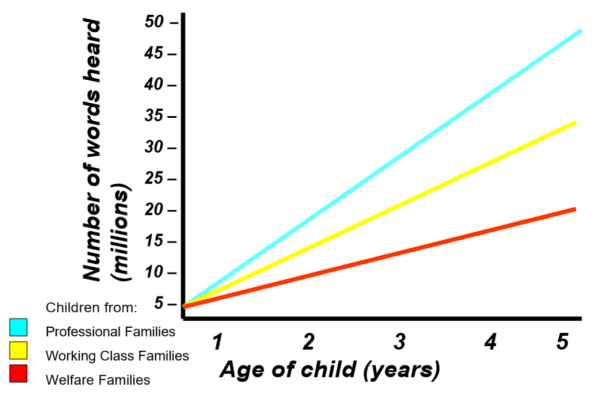
There are definitely “linguistically poor” households, and this can absolutely lead to significant “vocabulary gaps.” In general, children from households with lower income and lower family education know fewer words. (source of chart above) Some examples from research:

  • A child in a low income home will hear an average of 616 words in an hour, a child in an average professional home will hear 2153. (source)
  • In one year, children from poor families hear 250,000 utterances at home, while children from wealthy families hear 4,000,000.  (source)
  • By age four, middle and upper class children hear 15 million more words than in working-class families, and 30 million more than in families on welfare. (source)
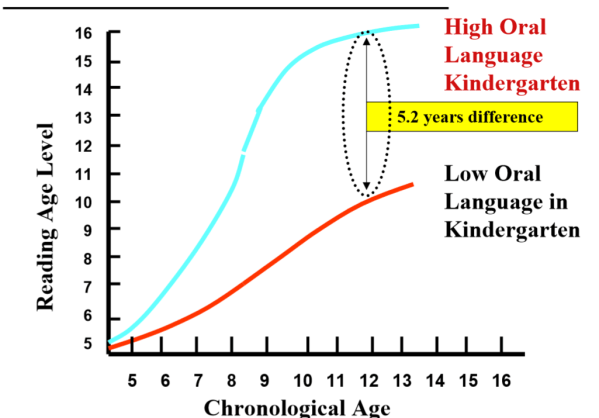
  • By second grade, a middle income child will know ~6020 words. A low income child will know ~4168. (source)
  • By 18 months, toddlers from disadvantaged families are already several months behind more advantaged children in language proficiency. (source)
  • 5-year-old children of lower SES score two years behind on language tests. (source)
  • When 18 month olds were shown two objects, then one was named aloud, higher SES toddlers could identify the right object in 750 milliseconds, lower SES toddlers were 200 milliseconds slower to respond. That slower mental processing speed means they have a harder time keeping up with teacher’s words. (source)

Not only are there fewer words spoken in a lower income household, the discussions that do happen are likely to be focused on daily life, such as what to eat, work schedule, and other practical topics. They are less likely to have wide-ranging discussions around the dinner table on a variety of topics. The parents may also work multiple jobs, which means less opportunity for reading bedtime stories. This may lead to the same words being used a lot, and fewer novel words that broaden the child’s vocabulary.

Also, in single parent households or homes where one partner is away at work, it may be more likely that the television is on in the background much of the time, which leads to less engagement and conversation between parent and child. (Source)

A child who understands fewer words and has slower processing speed  when they begin school will not just start behind – they’ll stay behind. As the teacher talks and some kids understand all the words and all the concepts, and some kids can’t even understand the words used, they get lost before reaching the concepts. (source for graph below)

capture 2

So yes, if there are too few words being used in a child’s environment, that child can be word poor. And yes, that will create academic challenges. But, that doesn’t necessarily mean the answer is to just talk a lot more…

What Is Responsive Language?

Imagine two scenes.

  • A toddler is sitting and poking at her cheerios and poking at her spoon so it rattles on the table. The parent, wanting to be sure the child is receiving mental stimulation, talks about their day: “As soon as you’re done with your breakfast, we’re going to put your new red shoes on and we’re going to go for a walk, and maybe we’ll see some butterflies again. Remember, the last time we went to the bakery to buy bread and we saw two blue butterflies?” The child keeps poking at her food as the parent talks. “I’m going to get a book now – we can read it together.”
  • As the toddler pokes, she looks up at the parent for their reaction. The parent sits with the child and says “you’re poking your cheerios with your finger. You pushed them all into a big pile on that side of your dish.” As the parent speaks, they point at the big pile. The child pushes a few more cheerios into the pile. “Now there are five more cheerios in the pile.” Then the child pats the spoon. “You’re using your hand to pat the spoon. The spoon makes a fun noise, doesn’t it?” The parent pats the spoon and says “It’s going rattle, rattle.” The toddler rattles the spoon some more, parent says “rattle, rattle” again. Then the child holds up the spoon to show it to the parent. “You picked up the spoon – can you use it to pick up some cheerios?”

In the first example, the parent’s voice is mostly background noise for the child whose attention is focused on the cereal and the spoon. There is also the chance of “criss-cross labeling” where if every time the child touches the spoon, the parent happens to talk about butterflies, the child could get confused about whether the thing they’re touching is called butterfly.

In the second example, the parent closely observed the child’s actions and where the child’s attention was focused, then talked about that. This gives the child the words for what they are experiencing in the moment with all their senses. This builds a much stronger connection between the words and their meaning. When you talk about a spoon later, the child can remember this moment and remember what the spoon felt like in their hand and the noise it made on the table.

To some parents, it may seem like talking about cheerios and a spoon is boring. They may feel like they need to jazz up the child’s learning with talking about bigger ideas. But slowing down to your toddler’s pace and tuning in to what they are in the process of exploring offers a meaningful connection for their learning.

There are three characteristics of responsive language: it’s prompt (happens within seconds of the child’s behavior, it’s contingent (related to the behavior) and it’s appropriate (parent responds in a positive and meaningful way). (source)

So, if a child showed a parent a ball, the parent would quickly respond, “Oh, you have a  ball in your hand!” If the child said “ba”, the parent would say “Ball. Yes, it’s a green ball.”

Does responsive language increase learning?

  • One study showed that when parents were more responsive, their children would reach all these milestones sooner: imitating parent’s words, first words, speaking 50 words, combining words to make a “sentence” and talking about the past.
  • A parenting style that includes parental warmth, high expectations and clear routines is associated not just with language ability but also better memory and higher achievement. When parents use a lot of negative strategies, their children have more limited language skills. (Source)
  • Children who hear more child-directed speech – not just overheard speech – process language faster and learn words more quickly. (source)

Here is a summary of other research:

In the second year, when infants begin to understand and produce words and simple phrases, responsiveness predicts the sizes of infants’ vocabularies… the diversity of infants’ communications… and the timing of language milestones… Infants of high-responsive mothers (90th percentile) … achieved language milestones such as first words, vocabulary spurt, and combinatorial speech, 4 to 6 months earlier than infants of low-responsive mothers… Toddlers of low-responsive fathers were 5 times more likely to display cognitive delays than were toddlers of high-responsive fathers… fathers’ responsiveness to their 2- and 3-year-olds predicted toddlers’ cognitive and language abilities within and across time… (source – includes citations for all studies)

How can you use responsive language?

Dr. Dana Suskind, author of Thirty Million Words recommends three steps for parents and caregivers to expand a child’s vocabulary:

  1. Tune In by paying attention to what your child is focused on
  2. Talk More with your child using lots of descriptive words
  3. Take Turns with your child by engaging in his or her conversation. (source)

Additional recommendations:

  • The Hanen Centre says that step 1 is OWL: “Observe Wait Listen. The parent needs to give the child the opportunity to take that first turn, so that the parent has something to respond to.”  (Learn more about OWL – Observe, Wait, Listen.)
  • Their next step is follow the child’s lead: imitate what the child says, interpret (what the child would say if they had the words), comment (giving the child words to describe what they are doing) or join in child-directed play. (Learn more.)
  • Use parentese – that sing song higher voice parents use to talk to babies.
  • Use motion – point to things as you talk about them, touch them, shake them. All this helps the child focus their attention while you label the objects.
  • Talk about what they want to talk about (what they are doing or are paying attention to in the moment). Don’t change topics quickly.
  • Don’t interrupt their attempts to communicate with you. Wait for them to get their thought out. Look at their face to show you are listening.
  • Children also benefit from hearing lots of different people speak – at different pitches, tempos, and with different accents and facial expressions. So take them out in the world, so they have an opportunity to interact with diverse people.
  • Reading to your child is also a huge influence on language learning. Learn about how to read to a child and lots of other literacy topics.

Don’t feel like you have to talk all the time

For brain development in general, children need three things: novelty (new experiences), repetition (the chance to explore something over and over to learn about it in depth from all angles), and down time (restful periods without lots of input when they can process all that they’ve seen and heard). This is true of language too.

Children need new words, they need to hear the same ones over and over in different contexts, and they also need quiet time for their inner thoughts to unfold. It is fine to have long periods of silence at home too. Even if you choose to have an Oto monitor listening in.

Learn more about responsive language:

Child-Directed Play: Floortime

floortime

Child-directed play is an intentional practice where you sit and play with a child, allowing them to guide the play, as  you follow along. The Greenspan Floortime approach describes this as:

  • Follow your child’s lead, i.e. enter the child’s world and join in their emotional flow;
  • Challenge her to be creative and spontaneous; and
  • Expand the action and interaction to include all or most of her senses and motor skills as well as different emotions

Floortime was created by Dr. Stanley Greenspan for children on the autism spectrum and those with developmental delays. It can also be used with typically developing children. It is helpful for any parent or caregiver who wants new ways to interact and have fun with a child, wants to feel more engaged with and connected to a child, and wants to know how best to interact with a child to foster communication skills, social-emotional development and cognitive learning.

How Floortime works:

Set the Stage

  • Find a time when you can focus on play, when you and your child are both well-rested and fed.
  • Be present – set aside your mobile devices and other distractions, relax, and stay focused on the interaction.
  • Gather items that interest your child and have them available, but not so many that it’s overwhelming.
  • Your position is important. Be in front of them – that’s better for connecting than it is to be side by side or for you to be behind them. Get down to their level – typically on the floor. Your physical nearness, affectionate touch, and eye contact help them to stay engaged.

Follow their Lead

  • Let them choose the activity. Offer toys that they love. It doesn’t matter what you play, it matters how you play.
  • Join in their play. Match their level of play – if they’re low key, you are too. If they’re very energetic, match that (without escalating up to wild.)
  • Don’t feel like you have to teach them. Just let them explore and discover. Copy the way that they play. If they signal that they want your help doing something, then help them, but don’t just jump in and do things they haven’t asked for.
  • Measuring intent. Watch their gaze, expressions and body language. Where is their attention? Let them know it’s OK to take initiative and start an activity.
  • If they are motivated, don’t change the activity. It’s OK to do the same thing over and over again.
  • Be playful! Find joy in your interaction. Their current interest may not be inherently interesting to you. But tune into how it gives them joy.
  • Look for the gleam in their eye. That’s a great sign that it’s working.

If it’s not working: Are you trying to control the play too much – do you need to step back? Are you being too passive and aimlessly following them around – how can you join them in interactive play? (Learn more about following their lead.)

Here is a video sample of child-directed play:

Narration

If you feel tempted to ask a lot of questions, or do a lot of teaching, or you’re just over-talking, try observing silently, or responding to their play with simple reactions “uh oh!”, “what’s that?”, “hurray”.

If you want to talk, try narrating what they are doing. “You’re putting the toys in the basket. You noticed there’s only one toy left on the floor. Whoa, you dumped all the toys back on the floor so you can do it again!”

This narration tells them that you’re paying attention and that what they’re doing is important to you. You’re also building their language skills by giving them words to describe the things they do.

Use Emotional Expression and Responses to Engage

  • Expression – Use your eyes, facial expression, tone of voice and body language to connect and communicate. Your emotions (especially anticipation, surprise, and delight) help to attract their attention and keep them engaged. When you pair your words with emotional expression, it gives your child a better understanding of both the words and the emotions.
  • Observation and Response – Can you read their emotional cues? Do your expressions engage them more? If so, keep it up. If they’re seeming overwhelmed by you, back down a little – you’re following their lead.

Circles of communication

When Floortime is working well, it’s like a game of volleyball or ping pong. You know your child’s interests, so you “serve” by offering a toy. They “bounce back” to you by taking the toy. You talk to them about the toy. This back and forth interaction is where all the magic learning takes place. A young toddler, or a child with autism or delays, may only be able to go back and forth a few times before disconnecting. The older they are and the more play experience they have, the better they’ll get at this. The goal of Floortime is to build persistence – more of these circles of connection.

Once it’s working well, you settle into a flow of play – Floortime calls this “getting it cooking.”

If it’s not working: Are you waiting long enough for them to respond? Are they overwhelmed – are you talking too much or moving too fast? Are you following their interests and joining them where they are? (Watch for any expression, sound, or gesture that might invite you into their play.)

Stretch the Play

Once you’re “cooking” – you’re connected and have a nice back-and-forth pattern established, then you can work to take their play up a level.

Expand the play by adding in some new toy or new aspect of play, or offering some choices. For example, if they’ve been using blocks to make a stable for their toy horses, you can put a “roof” on one of the “stalls.” If they’ve served you the toy pizza over and over, ask for a drink to go with it. If you were playing peek a boo, drop the scarf and pretend to have a hard time finding it.

Expand just enough, but not too much. Your goal is sustained engagement – we want to keep out back-and-forth exchange going as long as we can. So, if your new extension keeps them engaged, and you’ve got that gleam, keep it up. If you lose their attention, back up a little.

If it’s not working: Some parents try to intervene too much. Some are too passive and don’t help child stretch.  Try to find the balance between following their lead and challenging them to interact, communicate, and think.

Tailoring to the Individual Child

Some children have sensory preferences – they really respond to sounds or to touch or to movement. Some children are easily overwhelmed by certain kinds of stimulation – sound or touch or smell might be too intense for them. Children may also prefer different speed of interaction – some like things to move slowly, some like fast moving play. This worksheet may be helpful if you feel like there are sensory or timing issues involved.

Benefits of Floortime

Some parents wonder – if I’m just playing the same simple game over and over, is my child actually learning anything? According to Autism Speaks, the back and forth play of Floortime “builds the foundation for shared attention, engagement and problem solving. Parents and therapists help the child maintain focus to sharpen interactions and abstract, logical thinking.” They also note these key aims: self-regulation, engagement in relationships, communication skills, and emotional learning.

Learn more

Learn more about tips for Floortime sessions, and see videos of parents and caregivers demonstrating these skills:

Teaching Math Skills

See the source image

Let’s talk about math…

When we talk about which skills kids need to succeed in school or in the work world, reading and math are always at the top of the list of “most important things to know about.”

If you ask parents what they do to teach their kids to read, they will say: we do bedtime stories every night, we go to the library, we practice reading signs, menus, and labels – they have a whole list of ideas. If you ask them what they do to teach their child math, many parents draw a blank or they protest that they don’t know how to teach math, and they’re counting on preschool and school to do that.

Can we instead think about easy ways to incorporate math into everyday interactions and play just as easily as we do reading? I(‘m not talking math drills and flash cards and pushing academics here! I’m talking about playing with numbers like we “play” with words and stories.)

Here are some opportunities and resources (click on the links to learn more):

Hands-On Activities to Teach Core Math Skills

  • Counting / Number Sense
    • You can count almost anything – how many blocks in your tower, how many goldfish crackers on your plate, how many books do we get at the library
    • You can ask: who has more? Divide objects into two piles – which is bigger?
    • Set the table – each person gets one plate, one spoon, five berries, etc.
    • Count money – it’s trickier to get the different values of different coins.
  • Representation – recognizing that the numeral 5 and the letter f-i-v-e can be used as symbols to represent how many physical objects you have
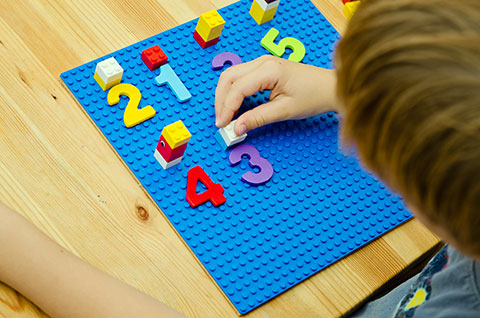
    • Play with magnetic numbers, assemble puzzles with pieces shaped like numbers, make numbers with play-dough, draw numbers in the sand
    • Do connect the dot puzzles, do physical games where they have to jump from the paper numbered one to two to three
    • Make number cards with the numeral and word written on them. When you count physical objects, have them find the card the shows the total.
  • Shapes and Spatial Relationships
    • Play with shape sorters, puzzles, nesting cups, blocks, building toys. Make crafts.
    • Talk about (and play games with) positional words: under, next to, between…
  • Measurement
    • Cook together, using a recipe.
    • Compare things: line up in order by size.
    • Measure with standard units (8 inches) and non-standard (12 paper clips long)
  • Patterns
    • Help them notice sequence: first we do X, then Y. After ____, we always _____.
    • Sort laundry and pair the socks. Separate M&M’s by color, then make a pattern.
    • Build patterns: red bead, yellow bead, red…  Clap rhythm patterns.

For lots more hands-on ideas, just search pinterest for preschool math activities! Or go to https://childcare.extension.org/young-childrens-developing-math-skills/

Sing Counting Songs and Read Counting Books

  • Math Songs. Counting songs like 5 Little Monkeys jumping on a bed, or 10 Little Indians, or 5 Little Ducks are all great teaching tools, especially if you have props. A bath-time game with 5 rubber ducks can teach one-to-one correspondence plus the concept of zero (no little ducks came back…) You can find a huge collection of math songs for all ages at www.songsforteaching.com/numberscounting.htm

Turn (almost) any conversation into a math conversation: Check out the blog http://talkingmathwithkids.com/ It has examples of math concepts into conversations with kids in an engaging way. More ideas: https://bstockus.wordpress.com/talking-math-with-kids/ and http://prek-math-te.stanford.edu/overview/math-thinking-conversations.

Bedtime Math: Every night, before or after the bedtime story, add in a math story problem.

You could make up your own. They could be based on your day (“Today at dinner, there were 8 slices of pizza. You ate two, and I ate three. How many did Dad eat?”). They could be based on the book you just read. (“The Cat in the Hat is holding a book, an umbrella and a fish bowl. How many things is that?” “How many pieces of fruit did the Very Hungry Caterpillar eat?”

Or, you can download the Bedtime Math app (it’s free!) or buy a Bedtime Math book if you prefer a screen free option. They offer a new kid-friendly story problem every day, with questions appropriate for three different levels of math skills, for kids age 3 – 9.

Sports are a fabulous way to practice math skills. For younger kids, keep the score simple – one basket equals one point. For older kids, make the scoring more challenging: “if you can sink the sock in the laundry basket from here, it’s 1 point, but if you can do it from this line, it’s 3 points.” When watching sports in person or on TV, have your child keep a written score tally.

Restaurant Games: When waiting for your food, try these games. Hide 2 – 5 sugar packets behind your menu. Lift the menu to briefly show them the items, put it back down, and ask how many they saw. Tap on the table 1 – 6 times, and have them set out that many packets. “There are four blackberry jams, two strawberries, and a marmalade – how many total?”

Board games are my favorite math skill builder. They’re so much fun that kids don’t notice their learning math. Research shows that the more board games that a kid played and the more different settings he played games in, the better his performance in four math tasks.

Let them see you using math. Point out to your child when you use math – to calculate a tip, compare the cost of two items, figure out how long it will take to drive somewhere, or to help them decide what to buy with their allowance. (For a discussion of financial literacy for kids and how to handle allowance: https://gooddayswithkids.com/2016/02/09/financial-literacy/)

What Not to Do:

  • Don’t feel like you need to get flash cards, math apps and workbooks and drill basic math facts over and over. Let math be fun at home, not a terrible bore.
  • Don’t try to push kids along faster – push them deeper – rather than moving on to the next step on the math skills checklist as fast as you can, make sure you’ve really explored each step in depth first. For example, some parents want to toddler to count to 20, so they push them fast. It takes a long time for a toddler to really truly understand the difference between one and more than one. And then to understand the difference between one and two, and more than two. Let them stay there till they really get it, and then they’ll be able to master more complicated ideas in the future. But rush this one, and everything is confusing from there on out!

My other blog, Inventors Of Tomorrow, is about teaching STEM skills to kids. I have more details there. Start with the post on developmental stages of math learning.