This is a collection of all my favorite resources for understanding developmental milestones, and enhancing your child’s development at any stage.
Checklists and Activities, Tailored to the Age of Your Child:
Just in Time Parenting from eXtension. 8 page newsletters, which include sections on milestones (how I talk, how I understand, how I move), activities parents can do to enhance development, and tips for managing the predictable challenges of each phase. Issues are available in 2 month intervals (e.g. 19 – 20 months; 21 – 22 months, etc. Up to 5 years.) You can subscribe to receive free automatic email updates every two months, or you can download any newsletter issue here.
Pathways. https://pathways.org/ Age groups are: 0-3 mo, 4-6 mo, 7-9, 10-12, 13-18, 19-24; 2-3 years, 4- 6 years. Each section includes an overview, articles on how to support learning, videos of key ideas, and abilities checklists for: play and social skills, coordination milestones, ability to manage daily activities, and self-expression.
Zero to Three. Healthy Minds, Nurturing Your Child’s Development: Each 2 page handout includes a summary of what your child is capable of, ideas for activities you can do to enhance development, and questions to ask yourself about your child. Toddler handouts for 12 – 18 months, 18 – 24 months, and 24 – 36 months. www.zerotothree.org/about-us/areas-of-expertise/free-parent-brochures-and-guides/age-based-handouts.html
Screening Tool
Ages and Stages Questionnaire: http://asqoregon.com/. This questionnaire takes about 15 minutes to complete online. It will ask 6 questions in each of 5 areas of development: small motor skills, large motor, communication, problem-solving, and personal-social. If your child is developing normally, you will see that you will mark some of the skills as “yes, my child has mastered this”, some as “my child can sometimes do this” and some as “not yet.” After you complete the questionnaire, you will receive a brief summary of the results. Learn more about the ASQ and interpreting your results. Up to 6 years. (Note, this screening is also available at www.easterseals.com/mtffc/asq/)
For each age, ideas to enhance learning in creative arts, language, literacy, math, science, emotional growth. Up to age 8. www.pbs.org/parents/child-development/
Any early childhood educator can tell you that some children leap with both feet into any new situation, trying new things, chatting easily with strangers, and rolling with any new experience that comes their way. Other children will enter the classroom slowly, hover on the edges (or behind their parents’ legs), gaze around with big eyes, duck their head when someone talks to them, and be hesitant to try new activities. These children get labeled as shy or timid or resistant, and the implication is often that there’s something wrong with the child or some problem they need to outgrow.
Let’s instead think of these kids as the slow to warm up kids. They need time to observe a situation, time to figure out how things work, space to decide whether they feel comfortable with someone, and respect for their right to move at their own speed. If they feel pressured to change, then they can turn into shy kids… shyness often is based in a fear of being judged negatively.
Instead, we can accept that this cautious approach may be a core part of their temperament, respect that introverts have many important strengths, give them plenty of time to flourish in their comfort zones, and also give them concrete tools that help them when they need to take on new experiences.
Understanding Temperament
Temperament is used to describe a child’s in-born personality. Researchers talk about 9 different temperament traits, and then how they cluster to form personality types. The slow to warm up child may be: cautious of new situations, slow to adapt to change, sensitive to things like noise and bright colors/lights, serious, and low activity level. Some also have very intense reactions to challenges.
There is no temperament type that is the best or the worst – they’re just different. Whether a child’s temperament is easy to work with or challenging often depends on “goodness of fit” with their environment and with the people in that environment. If a parent is an extroverted athletic person, and their child is as well, and they are running and shouting on the playground together, that’s a good fit. That child and parent may not fit as well at library story time. Or if that parent has another child who is slow moving, hesitant to try new things, and likes quiet places, that’s not as good of a fit.
For all children, no matter their temperament, it is helpful to them to have plenty of time in “good fit” settings – if they are in places they feel comfortable, with people they are comfortable with, and doing things they enjoy, they will really thrive. The science of brain development shows us that when children feel safe, their oxytocin flows and their brains have a high degree of neuroplasticity – they are open to learning and growing. When children are stressed and anxious, it is harder for them to learn. So prioritize finding safe spaces for them where they can relax and learn.
And… all children also need to learn how to stretch – how to push outside their comfort zone and cope with settings that aren’t as easy, and work with people who might not do things in the ways they would be most comfortable with. So, caregivers can give slow-to-warm up children challenges that help them work out their adaptability muscles. We can and should have them try things that are hard for them. But when we do that, a little extra support from their parents and teachers can help them to be successful.
Could it be more than just temperament?
Some parents with a slow to warm up kid wonder – could this be autism?
There are some common characteristics. A slow to warm up kid may not like sudden loud noises, and that can look like sensory processing issues that are common amongst autistic children. A slow to warm up kid may avoid eye contact, as does an autistic child. Autism is a spectrum disorder – some children display intense behaviors that are unmistakable. Others are more subtle and could be hard to tell apart from a slow to warm temperament.
A key question could be: once your child has warmed up and is comfortable somewhere, do they engage in play and learning in ways that are similar to most other children? If they continue to act in ways that seem different from other neurotypical children, you might choose to learn more about autism and about assessment and see if that feels like the right description for your child. Keep in mind that about 15% of children are slow to warm up and about 2% of children are autistic.
Either way, here are a bunch of ideas for how to help a slow to warm child be successful.
Set the Stage
Sometimes you’ll choose things that are way outside their comfort zone. But let’s make sure they have practice also with things that are “proximate” to their comfort zone, where there’s only so many challenges to manage once.
Are they more comfortable at home than elsewhere? Then host playdates on your own turf before trying the other child’s house.
Choose the time of day when your child is most relaxed and flexible for any new activities.
Pair a new activity with a familiar activity. “After we try the new music class, we’ll go to the library and pick up some books to read.” (Just be careful not to set it up as a punishment/reward that comes off as “after you do this thing you’ll probably hate, then you get to do something you like” – present them both as positive experiences.)
Is your child sensitive to noise and crowds? Then visit places at the least popular times so there are fewer people. (One parent’s child was invited to a Saturday party with all their classmates at a trampoline gym. They went to the gym by themselves on Tuesday morning to get familiar with it before the big party.)
Will your child be expected to wear unusual clothes (a gi, a leotard)? Let them wear them at home before the class.
Consider choosing parent-child classes or co-op preschool where you volunteer in the classroom rather than drop-off programs for a while till your child is more comfortable with new people.
Choose long-lasting programs. When my oldest child was little, we’d do a 4 week gymnastics class, then a 5 week art class, then we’d go to story time a couple times, then we’d try music class. He never got to settle in anywhere. With my other kids, I tended to choose things like play-based preschools that included tumbling, art, story time and music all in that one familiar setting we could attend with the same families for months.
Have a babysitter come to your house and watch the children while you’re still at home but busy so your child gets familiar with them and enjoys their attention before you leave them together for the first time.
Preparing – What to Expect
Slow to warm kids do better when things are predictable – they know what to expect and what is expected of them. You can help with this by:
Showing them pictures or videos of the activity you’ll do or the place you’re going
If possible, visit the location before the event you’ll be attending – you may want to try observing a class before joining the class
Review what the schedule will be – what activities will happen and what will be expected of them. Don’t leave out things just because they’re obvious to you… it might be obvious to you that before you go swimming you’ll go into a locker room and change into swimsuits – but if your child doesn’t expect this, it could be one more challenge for them
If you can meet the teacher before a class, or meet some of the other kids before an event, that can help
Try reading books or watching videos about similar experiences
Do pretend play to practice what the activity will be like
Getting Things Off to a Good Start
Make sure the first day goes as well as possible!
Allow plenty of time to get there so you’re relaxed, not rushed.
Arrive early so you and your child can be some of the first to enter the space. That will be so much better for them than arriving in a classroom that is already full of strangers.
Let your child come in gradually, and engage slowly when they’re ready. You may sit together on a bench at a playground for a while before they decide to play.
If the teacher greets your child, don’t push your child to respond. If the teacher asks a question, give your child time to respond – don’t jump in too quick to answer for them. If they are clearly not ready to respond, answer the question for them. (But don’t apologize for them! If a child always hears their parent say “sorry – he’s shy”, that creates a self-fulfilling prophecy. You can talk to the teacher at another time, out of your child’s earshot, to let them know that your child is slow to warm and give suggestions on what seems to help.)
Many young children do best in a new setting if the parent sits down on the floor and lets the child sit down on their lap and observe for a while. Let them decide when they’re ready to move away – don’t push them before they’re ready. Every time you push them forward one step, they’ll retreat two.
If your child needs to make decisions, give them time to think through their options. Let them know they can change their minds later.
For drop-off programs, have a goodbye ritual you do each and every time: help your child plan what they’ll do next (“go sit with your teacher so you can hear the story” or “as soon as I go, you can try out the play-dough table”), say your goodbye and walk away as if you’re totally confident that they’ll do fine without you.
Your Parenting Style
Slow to warm up kids can be frustrating for parents. It can seem like they are stubborn, and you may feel like you should be pushing them more. But try to be flexible. If you push, they may get even more resistant.
Slow to warm up kids who worry a lot can cause parents to worry a lot. If you take the sink or swim approach, they may be even more frightened of future challenges. Try to be patient. Empathize with their worries but also convey confidence that they can be OK and they can take on any challenge with the right support.
Never shame your child for their temperament or compare them unfavorably to others. (“Why can’t you be more like _____?”)
Let your child know that you love and accept them. When you ask them to try new things or face their fears, you’re not trying to change them or fix them. You just want to help them grow so they have more opportunities.
Help them Understand their Own Temperament
We want to be careful not to overly label a child and define them as only one thing. Both positive labels and negative labels can limit a child… a child who is labeled a graceful dancer may be hesitant to try sports, a child who is labeled as wild tends to stay that way.
However, thinking about categories can help people understand themselves and help them to feel seen and understood. So, as a child moves into their elementary school years, you don’t want to say “you’re so shy, it’s so hard for you to go into new settings.” But you can say “I’ve noticed that when you go somewhere new, it takes you a little while to warm up. Some things I’ve tried that seemed helpful to you were…” Or “you’ve noticed that some other kids seem to have an easy time trying new things and making new friends, and it feels harder for you. I know you just need a little more time to settle in. But I also know you get there eventually. Remember when…”
The Strengths of Slow to Warm Up Kids
Slow-to-warm kids tend to be great observers, noticing details others don’t. They tend to have good impulse control and think before they act. They may not have a lot of friends, but can be very loyal to those they do connect with. They can be very empathetic. When they are comfortable somewhere, they can be just as happy and just as adventurous as any child.
Look for Role Models
Find friends, family members or others who have that cautious personality. Ask them to talk to your child about what helps them and how they’ve learned by stepping outside of their comfort zones.
You can also choose videos that have shyer, quieter characters like Daniel Tiger in the original Mr. Rogers, not just loud and bold characters. Help them see the strengths of all personality types.
Resources
Here are helpful resources where you can learn more about how to support a slow-to-warm child.
I remember very early in my parenting career (in the mid-90’s) looking at a parenting book and feeling uncomfortable about the advice I found there – perhaps it was advocating for cry it out as a response to sleep problems or perhaps it was saying to not immediately respond to your child’s cries because it might spoil them. Those types of advice did not feel right to me as a parent at a gut level. Then I found other books that did feel right – (the Baby Book, Becoming the Parent You Want to Be, and Our Babies, Ourselves) and I found parent education classes as well. Those resources offered me the opportunity to learn that there are lots of different ways to parent children and no one-right-way-that-fits-all.
All parenting book authors are sharing ideas that worked for them as parents, and worked for their children or maybe that worked for their clients. If their methods work for you and your child, that’s great. But if not, that doesn’t mean you’re a bad parent or you have bad kids, it just means you need to find different advice. And you especially need to find advice and support that is strengths-based and responsive – instead of things that say or imply “if you do it this way it will always work, and if it doesn’t work then you’re a failure”, seek out things that say “here are some ideas that work well for many families. If they don’t work for you, here are other resources you could try.”
After 32 years of parenting and 30 years as a parent educator, I believe that even more strongly. And, as the parent of children who are “thrice exceptional” – gifted and autistic and ADD/ ADHD, I especially know it’s true. Different children need different parenting styles, and neurodiverse children may need different parenting approaches than neurotypical children.
For example, let’s talk about “picky eaters.” I’d say that about 30 – 50% of parents will say their preschool-aged children are picky eaters. If that many kids are “picky”, maybe that’s just normal for this age! I work with parents to re-frame some of their assumptions about what eating patterns are typical, and to see things from their child’s perspective, and I give them lots of great tips I’ve gleaned over years in this work. But then someone says “but my kid is really picky – I’ve tried all those tips, and they still won’t eat!” And I say “I know… I’m right there with you.” Because my first child was a flexible, easy kid with food. My second was picky – turns out she has lots of allergies and intolerances and she knew some foods made her feel icky. And my third child is a whole other realm of picky eater – he has a VERY limited set of food he’ll eat. He is autistic with sensory issues, and has a hard time trusting food. So, I have another collection of tips for those super picky eaters, and I have a lot of empathy (and no judgment!) for the parents who are managing that.
And toilet learning… well, based both on all the reading I’ve done and classes I’ve taken, plus my own experiences with my 3 kids, I’ve got one set of standard issue recommendations on potty training, and then advanced tips for children who resist toileting. For parents whose children are refusing to poop in the potty or are having on-going bedwetting, it just doesn”t help to hear advice that “it’s easy – just do this and it will work” just makes them feel worse about themselves as parents. It is so much more helpful when someone says “sometimes all the usual fixes don’t work – let’s work together to find other options.”
Sometimes these challenges and delays will work themselves out if we just wait for it. Sometimes it may be helpful to seek professional support or testing to figure out if our child has particular challenges that need extra intervention. And as you’re working on challenges, it helps to find books, websites, educators, and/or other parents who offer advice that is helpful and relevant to you and to your unique child.
Today, I was reading advice on a parenting site, and I found something that troubled me. (I am not going to share the source, because otherwise the advice on the site was excellent, and I do not wish to criticize their whole approach.) Here’s what it says:
These signs – things they say show you it’s time to set a limit – almost perfectly duplicate any list you can find of common symptoms of autism. I showed this to my 23 year old, who is autistic, and she said “it’s like they cut and pasted in the wrong list… these are all things that are normal for an autistic kid. They aren’t signs that ‘truly difficult behavior’ is coming… unless you try to force this kid to act neurotypical, and then yeah, you’re going to see some misbehavior!”
I do agree with the overall message of that parenting site – the idea that connection is important for discipline. When our children feel connected to us and valued by us, they want to behave well, and are responsive to our guidance.
But connection and disconnection can look different for different kids. For example, for some children, eye contact shows they’re feeling connected and avoiding eye contact says they know they’re in trouble. However, many (not all) autistic people are uncomfortable with eye contact, and in many cultures, direct eye contact is a sign of disrespect. Demanding eye contact could set off behavioral problems rather than serving as a path to resolve them. For some children, placing your hand on theirs and talking about what is happening will calm them. For other children, when they’re already on the verge of a meltdown, uninvited touch or being asked to talk it through may overwhelm them.
Another issue with parenting advice is that the vast majority of it is written by white, middle class folks, raised in the United States. (And yes, that description includes me, and I know it creates unintentional biases in my work, so feel free to call me on them!) And the research it is based on was primarily done with white, middle class folks in the United States. (Read this article on why that matters – as they say “the research, and the parenting advice based on it, might not apply to everyone who receives it.”) Thus, advice might be unintentionally racist, or classist, or may simply not be relevant to your life circumstances.
Based on their cultural backgrounds, parents may have different goals for their children, in areas such as independence, individualism vs. collectivism, self-esteem, and behavior, and thus may have different approaches to achieving those goals, such as differences in warmth / affection, responsiveness, and discipline. For example, physical punishment may be more common in some cultures than others, but to understand its function in a family, it helps to understand it in a broader cultural context. While co-sleeping with an infant may be viewed as unusual to some, bed-sharing is common in many cultures around the world, and education related to safer sleep practices should inform parents of how to minimize the risks, rather than condemning the practice. The best advice is responsive to cultural and socioeconomic differences, and acknowledges challenges, and build on strengths. If you feel like what you’re hearing and reading doesn’t suit your cultural values, seek out materials from those who share your cultural background. It is easier to find diverse view in the days of the internet than it was when all publishing was managed by white, middle class folks.
When you seek out parenting advice, I do encourage parents to check out a wide variety of sources to stimulate your thinking – I get really good ideas even from reading things I fundamentally disagree with. They broaden my perspective and cause me to further examine my own parenting choices to be sure they reflect my values and goals, and are helping my child reach their potential. They help me to notice differences between my parenting style and those of others in my community which helps me better explain and interpret what my child and I might see in their classmates’ experiences. And they help me double-check myself to be sure I’m not making any big mistakes. So, do read things outside your comfort zone for the sake of mind expansion.
But, when you’re struggling with a parenting challenge, and feeling discouraged about your parenting skills or your worthiness as a parent, or when you’re feeling really frustrated at your child, seek out the parenting advice that speaks to your soul. Advice that includes methods you can see yourself doing and doing consistently. Advice that seems like it could work for your unique child with their unique personality, strengths and challenges. And seek out the people whose advice acknowledges your strengths at the same time it supports you as you work to overcome your challenges.
On developmental screenings, the categories of development are communication, gross motor, fine motor, personal/social and problem-solving. I think many parents feel like they have ideas on how to teach the other categories, but aren’t sure how to get started on teaching problem-solving. The best way to learn anything is by doing, so one of the best ways to teach problem-solving is to let your child have problems.
When challenges arise for your child, don’t always leap to their rescue. Sometimes it’s best to sit back for a few minutes to see if they can figure it out on their own. If your child is a little cranky and frustrated about a problem, that’s OK. Frustration can push us forward till we have a break-through to a solution. (Note: However, if frustration is turning into misery, that’s no longer helpful, so step in BEFORE that switches over to meltdown. Or, if they’ve totally flipped their lid and it’s too late to help with problem solving, then check out these tips for managing a meltdown. AFTER they’re calm, you can go back to solving the problem.)
If your child is still fairly calm, but needs some support with a problem, don’t just jump in and fix it for them. They won’t learn anything from that. (And we all know from tech support how frustrating it is when we’ve struggled and struggled with an issue, and someone else steps in, presses a button and fixes it. We’re glad it’s fixed, but we may also feel embarrassed and feel incompetent at fixing future challenges.) Instead, help guide them to finding a solution.
Here are some steps to walk through.
Step One – Define the Problem
Clarify what is the problem they’re trying to solve? Start off with a little empathy, and listening to their concerns. “Hey buddy, you seem really frustrated. What are you trying to do right now?”
Sometimes they can tell you exactly the problem (“I can’t find the puzzle piece!”) and it’s something you can see several clear solutions to. Sometimes they tell you a problem that you can see is unsolvable (“I want the broken glass to be unbroken”) – you may need to help them re-frame this into a problem that is solvable. Sometimes they’re not even certain what’s wrong – sometimes they’re just having a rough day and just need a cuddle.
And… honestly, sometimes you have to re-define what the problem is. They may say “the problem is that Bobby has the toy and I need to make him give it to me.” You might change the problem definition: “I know you want that toy Bobby has… since you can’t have it right now, let’s think about what else you could do.”
Step Two – Brainstorm Solutions
If you’ve got a child who is five or older, they may be able to come up with lots of possible solutions with just a little guidance. After your child has some brainstormed options, you can help them figure out if those solutions are a) actually possible now, and b) if they would actually solve the problem. Sometimes you can defuse the tension around problem-solving by suggesting some crazy wacky solutions that make them laugh.
For a 3 – 5 year old, you could help them build a repertoire of possible solutions in advance so they have ideas to draw from. For example, if you’re working on challenges playing nicely with other children, you could offer a solution kit like the ones from Headstart, or Center on Social and Emotional Foundations. You could teach these as part of a curriculum, then when the child is having challenges, you pull the cards out and ask them which tools might be helpful at that moment.
If your child is 2, you won’t really ask them to brainstorm. They won’t be good at this kind of abstract thinking. You’ll likely have to just suggest 2 – 3 options to them as choices they could make.
Step 3 – Try Out a Solution
I teach an engineering class for kids. We talk a lot about tinkering – trying out different ideas, and tweaking – making minor adjustments, then testing to see if it’s better. That applies to any kind of problem solving for kids. Sometimes the first solution works perfectly to solve the problem. Sometimes it “almost” works and we just need to tweak it a little. Sometimes it fails completely and you need to start all over again.
Once you’ve got a couple brainstormed options, help the child plan for what they’ll try first, and then what they’ll do next if the first idea doesn’t work. (Sometimes the best thing to tell them to do next is to come back and check in with you for new ideas.)
Although you don’t have to jump in every time to help a child problem-solve, it is good to keep an eye and ear on them when they’re testing out solutions. My child once set down a stick he was playing with, and another child picked it up. My son tried to use his words and his manners to get it back. He asked nicely for the stick – once, twice, three times… When saying please didn’t work, he gave up. And tried out biting!
Step 4 – Reflection
If your child solves a problem, give them lots of praise and positive attention. Don’t just praise the result (the solved problem) but also praise the process: “you worked really hard to come up with a solution!”
If they tried, but failed, still give positive attention: “I really like that you came up with some ideas and tested them out. I’m sorry it didn’t work – sometimes problems are just really tricky to solve.”
At bedtime that night, or some other time, reflect back on lessons learned. Keep it positive, and use a growth mindset approach – “you haven’t figured it out YET, but if you keep trying, I know we’ll get there.”
When / How to Teach Skills
You can certainly teach problem-solving skills in the moment when problems arise. (But remember – timing matters! Don’t intervene too soon or they’ll never know if they could have solved it on their own. Don’t wait too long until they’re in meltdown or until they’re making bad choices you’ll have to impose consequences for.)
You can also build a repertoire of skills they can apply when needed:
Whenever we’re teaching any challenging skills, whether that’s cutting with scissors, putting a puzzle together, riding a bike, throwing a basket, and so on, we can teach skills they may need to solve problems in the future. You can also teach when playing side-by-side with them. For example, you could build a tower that’s really shaky and ask them for ideas for how to make it stronger, then model for them some ideas you have. You could accidentally mix up two paint colors by putting the wrong brush in a cup, then talk with them about possible solutions. You’re giving them tools they can use for future problem-solving, and also modeling how to stay calm in the face of challenges.
You can use dramatic play to teach: puppet shows and role plays. When reading books, if a problem comes up, pause your reading and ask them: what’s the problem? what are some possible solutions? what do you think the character will try?
Our goals with teaching problem-solving are to build independence, to build good decision-making skills (though remember, due to the stages of brain development, consistently good judgment and decision-making skills may not arise till their late teens!), and to create flexible thinkers (fluid intelligence) who can respond to a wide variety of life circumstances with resilience.
Resource for Learning More
The Early Childhood Learning and Knowledge Center has a great webinar for Head Start teachers, which is also helpful for parents, called: “It’s a Big Problem: Teaching Children Problem-Solving Skills.” It’s a video, or you can read the transcript if you prefer, and also be sure to check out the additional resources page they link to for follow-up.
They have helpful suggestions. Like when defining a problem, you can ask the child whether it’s a mouse sized problem they can solve or an elephant size problem they need help solving. For older children (age 4 and up), you could ask them to evaluate possible solutions by asking themselves these questions: Would it be safe? Would it be fair? How would everyone feel?
If you like acronyms to remember an idea, try this one: STEP = State the problem, Think of multiple solutions, Explore the pros and cons, and Pick a solution to try.
There are several sections of this page – here’s what you’ll find:
Making Life Easier: tip sheets on how to turn events that are often challenging for parents into something more manageable or even enjoyable. Covers: Bedtime / Naptime, Diaper Changes, Going to the Doctor / Dentist, Holidays, and Errands.
Visual Schedules: how to use this powerful tool for teaching routines and expected behaviors: first you do this, then we’ll do that.
Backpack Connection Series: a way for teachers and parents/caregivers to work together to help young children develop social emotional skills and reduce challenging behavior. Handouts on four topics:
Teaching Emotions – Anger, Fear, Frustration, etc.
Routines and Schedules – and how they reduce family challenges
Social Skills, Sharing, Taking Turns, Appropriate ways to get attention
Family Articles – Making the Most of Playtime, Teaching your child about feelings (from birth to age 2), Teaching Independence with Daily Routines
Scripted Stories – I like Tucker Turtle Takes Time to Think. The “turtle technique” is a really helpful skill for my kid who struggles with emotional regulation.
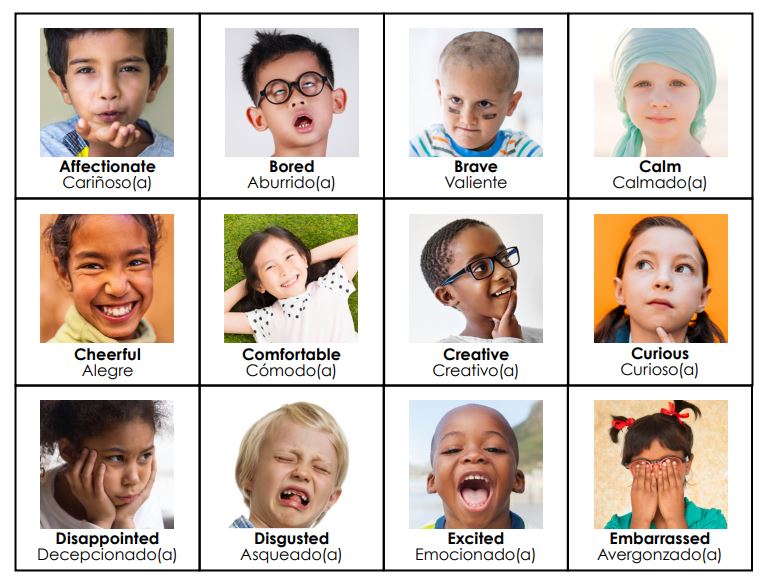
Teaching Social Emotional Skills – includes graphics for a feelings chart (see picture above) and problem solving steps.




 More Good Days with Kids