Category Archives: Books and Resources

Music Books for Kids

Check out my recent post on sound books for the big picture on interactive books where kids press a button to play a sound. This post focuses on some great music-themed sound books. (Pressing a button starts a song, pressing it again stops the song.)

At the bottom of the post, I have a video, where you can hear a sample of what each of these books sounds like.
Disclaimer: Pirouette Kids sent me two of their books to review. This post includes my unbiased review of those books, and info on books from other publishers for comparison.

Pirouette Kids

Their focus in on “music beyond nursery rhymes”. They have four books at this time, the two I review below, plus World Music and Classical Music.

Some overall impressions: I like the size of the books – easy to pack, easy for small hands to hold. The pages are sturdy. The buttons to activate the music can be a little tricky for a child to spot for the first time, and activating them requires pressing precisely on them (a fine motor skill builder) but they work reliably. The speaker is on the back – so, if it’s laying flat on a surface, it is much quieter than if held upright. (That can be an advantage if you’re holding the book as you can adjust the volume a bit. If the child is using it lying flat on carpet, it’s pretty quiet.)

The books can be purchased on Pirouette’s website for $18.99 each.

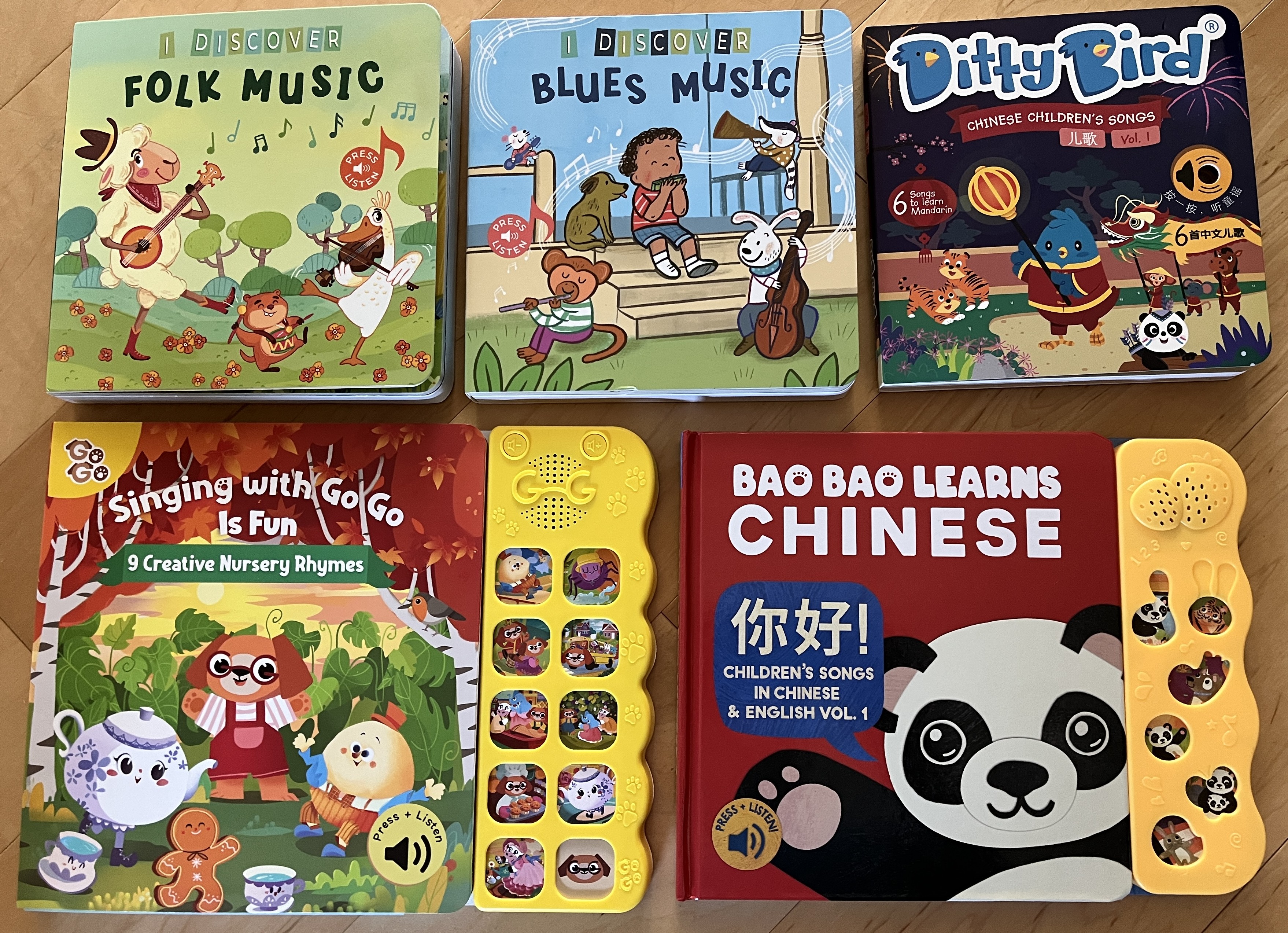
Pirouette’s I Discover Folk Music

This board book has snippets of 6 folk music tunes (Oh Susanna, This Land, Little Liza Jane, Sarasponda, Home on the Range, This Little Light). Each page has the lyrics for 3 or 4 lines of the song, and a button that plays a 15 second clip. They are all performed by the same musician – Daria, who is pleasant to listen to and not cutesy / chirpy as many performers are when doing children’s songs. The illustrations by Margarita Fomenko, which feature animals doing human things, are pretty cute.
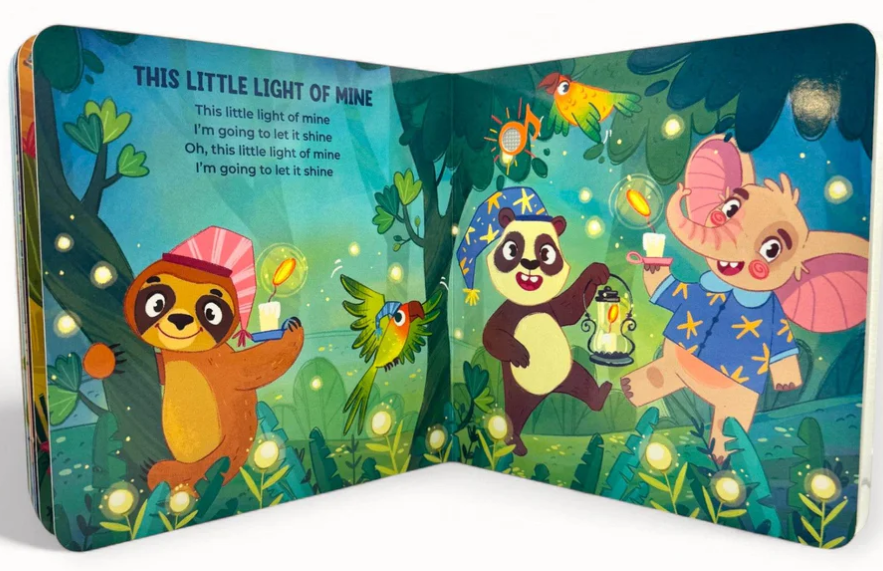
I like the choice of songs – it expands outside the typical kid songs repertoire but still all quite accessible. The 15 seconds is really short. It works OK on some songs, like Little Liza Jane feels complete on its own, but many feel like a song is just getting started then gets cut off abruptly. (They do have full versions of each song available on Spotify and there’s a QR code on the back of the book that takes you there.) For me as an adult who knows these songs well, they leave me feeling a little incomplete, and I wish they could wrap up a full verse or chorus. But that likely won’t trouble a child who is new to these songs.

Overall, it’s a cute book with nice tunes you might not find elsewhere, and I would recommend it.

Pirouette’s I Discover Blues Music

This book has snippets of 6 blues songs – recordings by original artists. There are 3 vocal tracks: Goodnight Irene by Jerry Lee Lewis and his band (1958), Careless Love by Big Joe Turner (1958), See See Rider by Louis Armstrong and Velma Middleton, and 3 instrumental: John Henry Blues by Erskine Hawkins and his Orchestra (1950), Old Stack O’Lee Blues by Sydney Bechet and Nicholas Blue Five (1949), Jumping at the Woodside by Buddy Tate and his Celebrity Orchestra. I love that they included the “real” versions of these songs, and chose songs that children are unlikely to be exposed to elsewhere (a few of these are even new to me, and I thought I had listened to a lot of old blues!) I love the John Henry Blues especially.

Illustrations by Sakshi Mangal are cute, and show animals doing human things. Since many of the songs are instrumental, instead of having lyrics on the page, they have information about the tune, and questions to ask a child. Here are two examples.
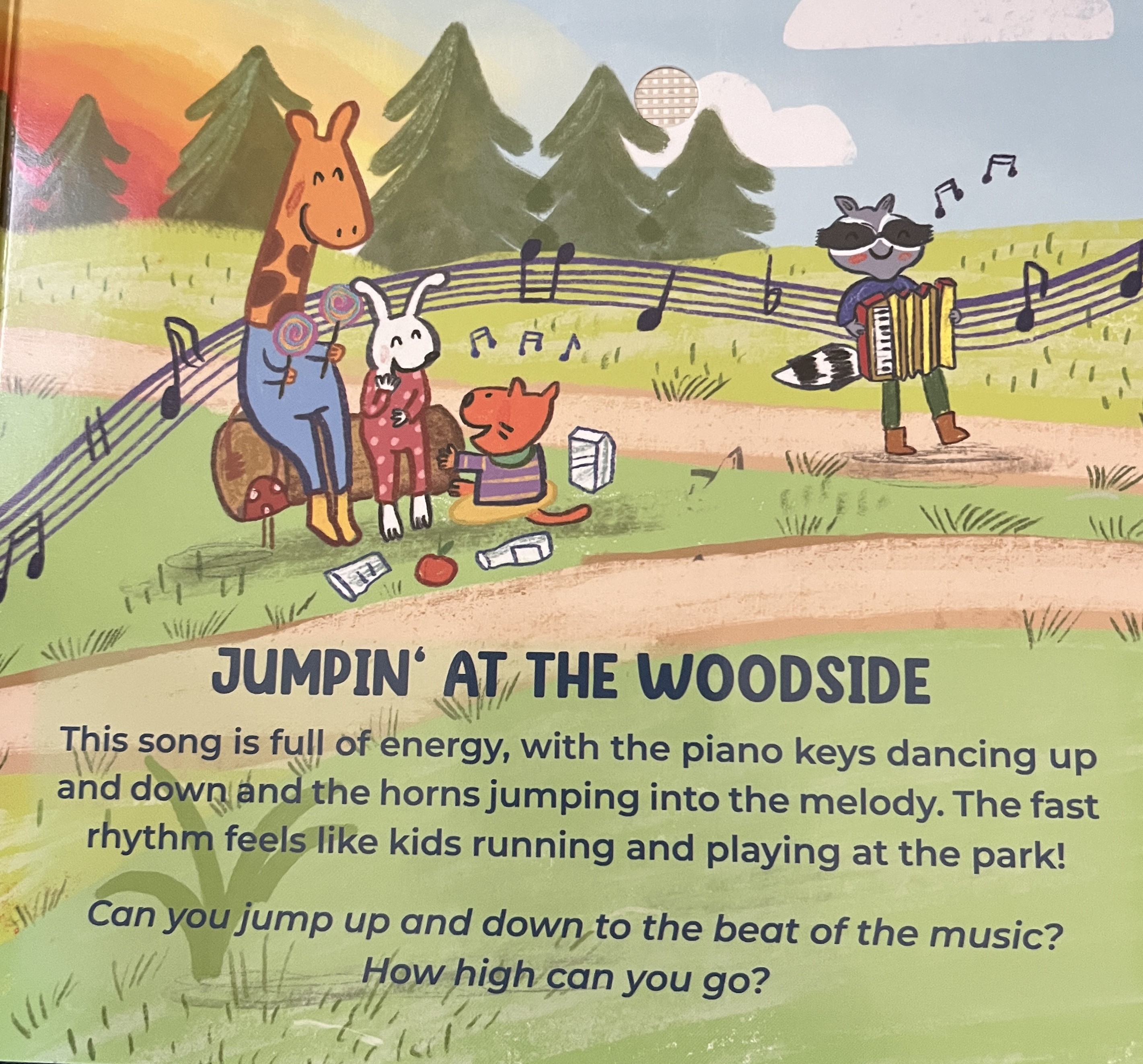
and
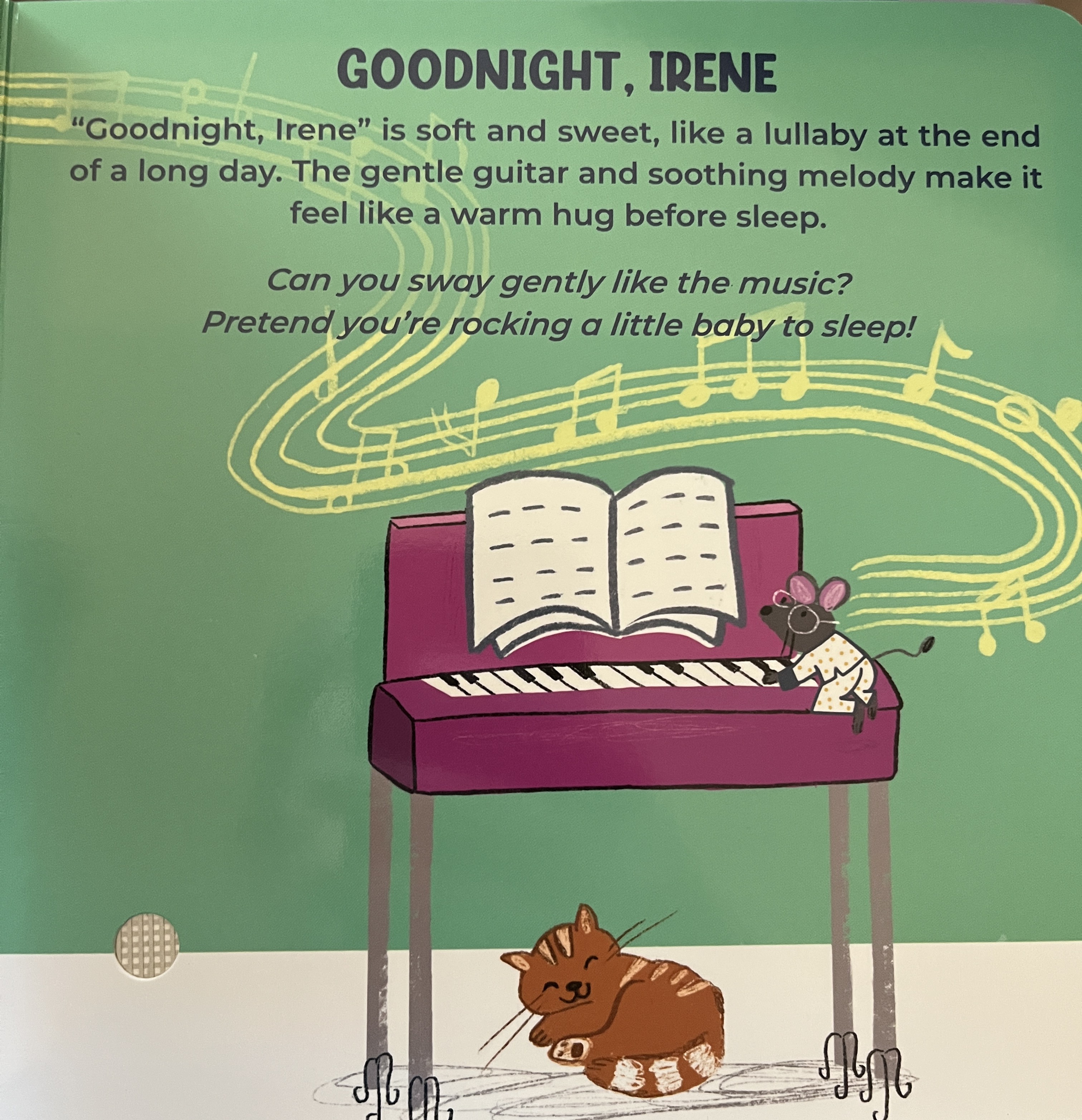
On Pirouette’s website, they have links to where you can find full versions on Spotify. (Though there’s not a QR code on the book to point you to this page.) A caution though: these are blues songs, so some of the lyrics in the full vocal performance aren’t kid friendly, for example, See See Rider says “I’m gonna buy me a pistol, Just as long as I am tall… Kill my man.” But you can also find instrumental only versions of the tunes. For Good Night Irene, there are kid friendly versions of the lyrics.

These song clips are again only 15 second snippets, but it doesn’t bother me on these like it did on the folk music one… since I know they’re long songs it makes sense that it’s only a sample vs with the folk songs, sometimes I felt like if they’d just had one more line of the chorus it would have felt more complete.

I definitely appreciate the way this book helps to stretch our repertoire of “fun music for kids to listen to.” I recommend it.

Ditty Bird’s Chinese Children’s Songs

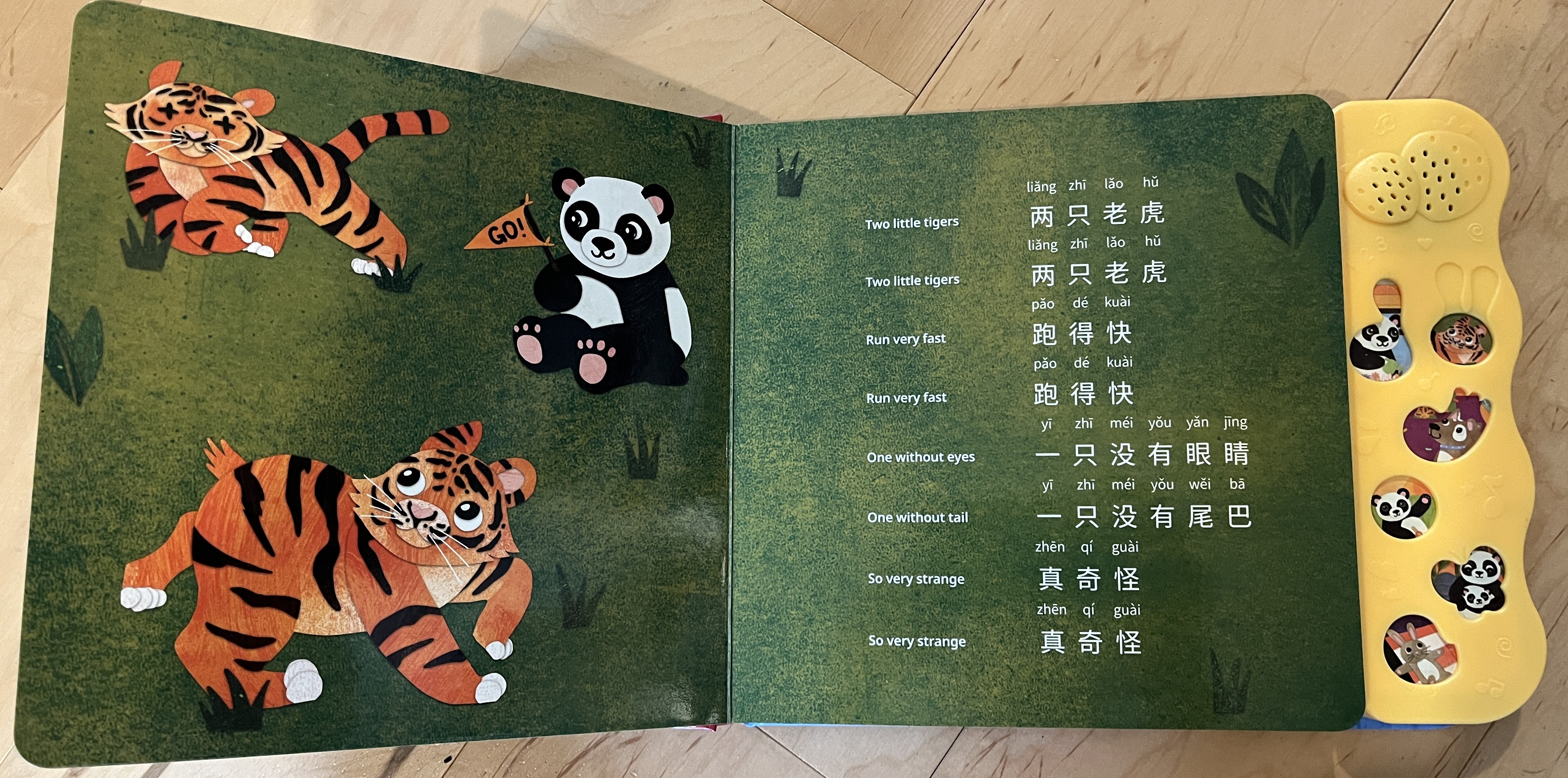
Ditty Bird has LOTS of books. Sounds, Songs, Bilingual… the one I reviewed was Chinese Childen’s Songs Volume 1 It includes 6 songs: Two Tigers, Where’s Spring, Little Donkey, Picking Radish, Good Little Rabbit, Where’s My Friend. I love that these are traditional Chinese songs. I do not speak Mandarin but the reviews say the pronunciation is good and that traditional Chinese instruments are used. The recordings are pleasant to listen to. They are as long as they need to be for the complete song, so 12 – 25 seconds.

They include the lyrics, in pinyin and traditional characters, and an English translation. (Unfortunately the English words don’t seem to scan to the tune.) I wish the lyrics were printed in a larger font for all of us who are over 40 to read! The illustrations are cute, showing animals in Chinese settings, wearing both traditional and modern clothing.
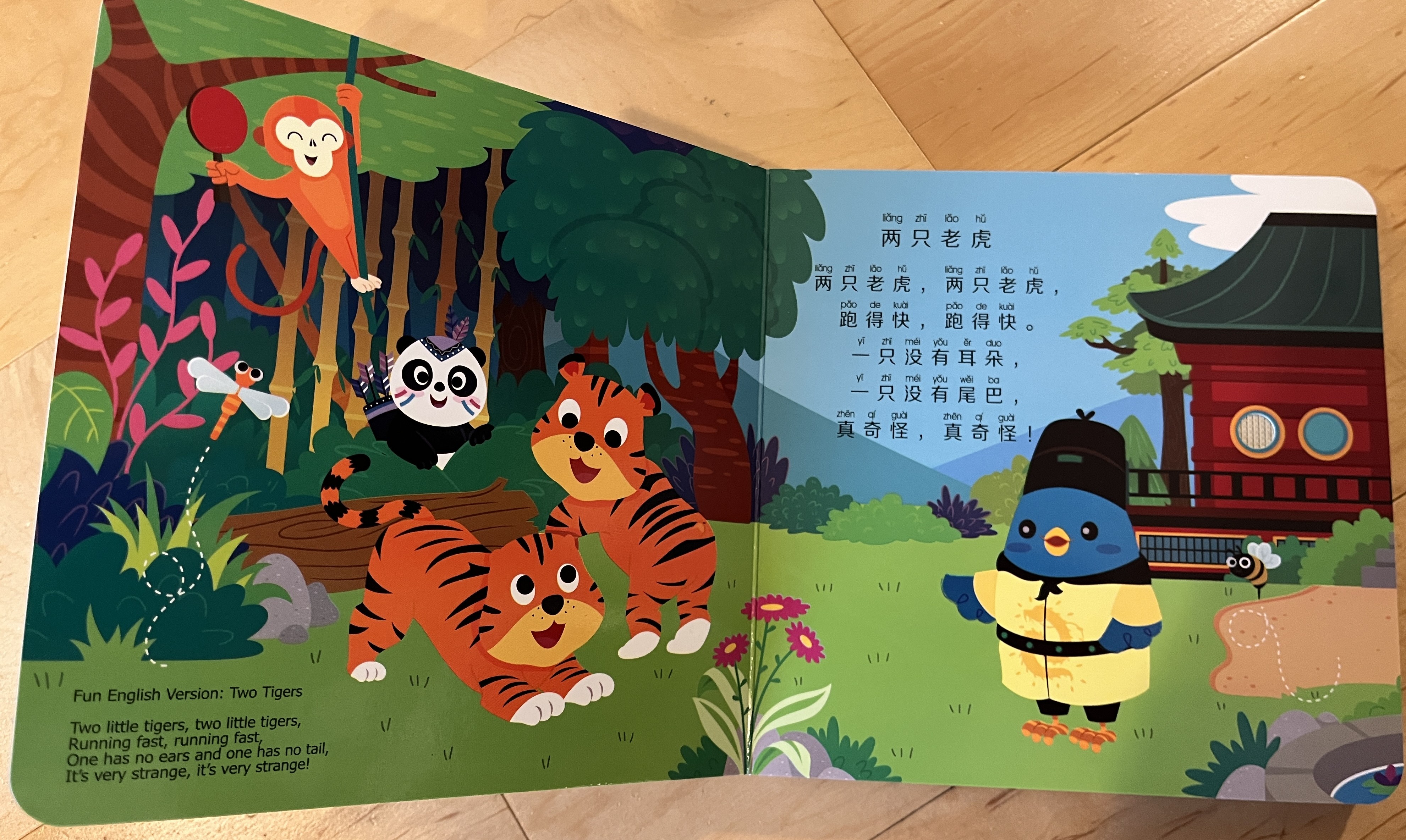
Like the Pirouette books, this is a nice small, sturdy board book, with the speaker on the back. The music buttons seem to be the same technology – so they work well, though do require a child to put their finger in a specific place. It is $19.99 on Amazon. (affiliate link). Reviews on Amazon say that durability can be an issue, with some reviewers reporting the buttons stopped working.

I purchased this book because I mean to learn some children’s songs in Mandarin, and although there are many YouTube videos and other resources online, I have not been remembering to use them. Having a physical book on the table reminds me to listen.

I recommend this book too.

Bao Bao Learns Chinese

This company has 3 Chinese books, plus similar books in: Tagalog, French, Spanish, Korean and English. I reviewed their Chinese Volume 1 which includes 6 songs – some traditional Chinese – Two Tigers, FInd a Friend, and Mama is the Best in the World, and some traditional English – Itsy Bitsy Spider, Row Your Boat, and Twinkle Twinkle. It includes lyrics in English, pinyin, and Mandarin. (In a larger font than Ditty Bird.) The Mandarin words do line up with the English tunes. But I can’t make the English words scan well to the tunes for the Chinese songs.
This is a bigger book – a little harder for little hands to hold. The soundbox is to the side of the pages. It does have two volume settings to choose from. Since the buttons are off to the side, a child has to figure out which one to press to get the song that matches that page – the image on the button is just some small portion of the image that’s on the page, so I’m not sure it’s obvious to kids which image goes with which page. (And the soundbox has random shaped openings for the buttons that don’t really line up with the illustrations.)
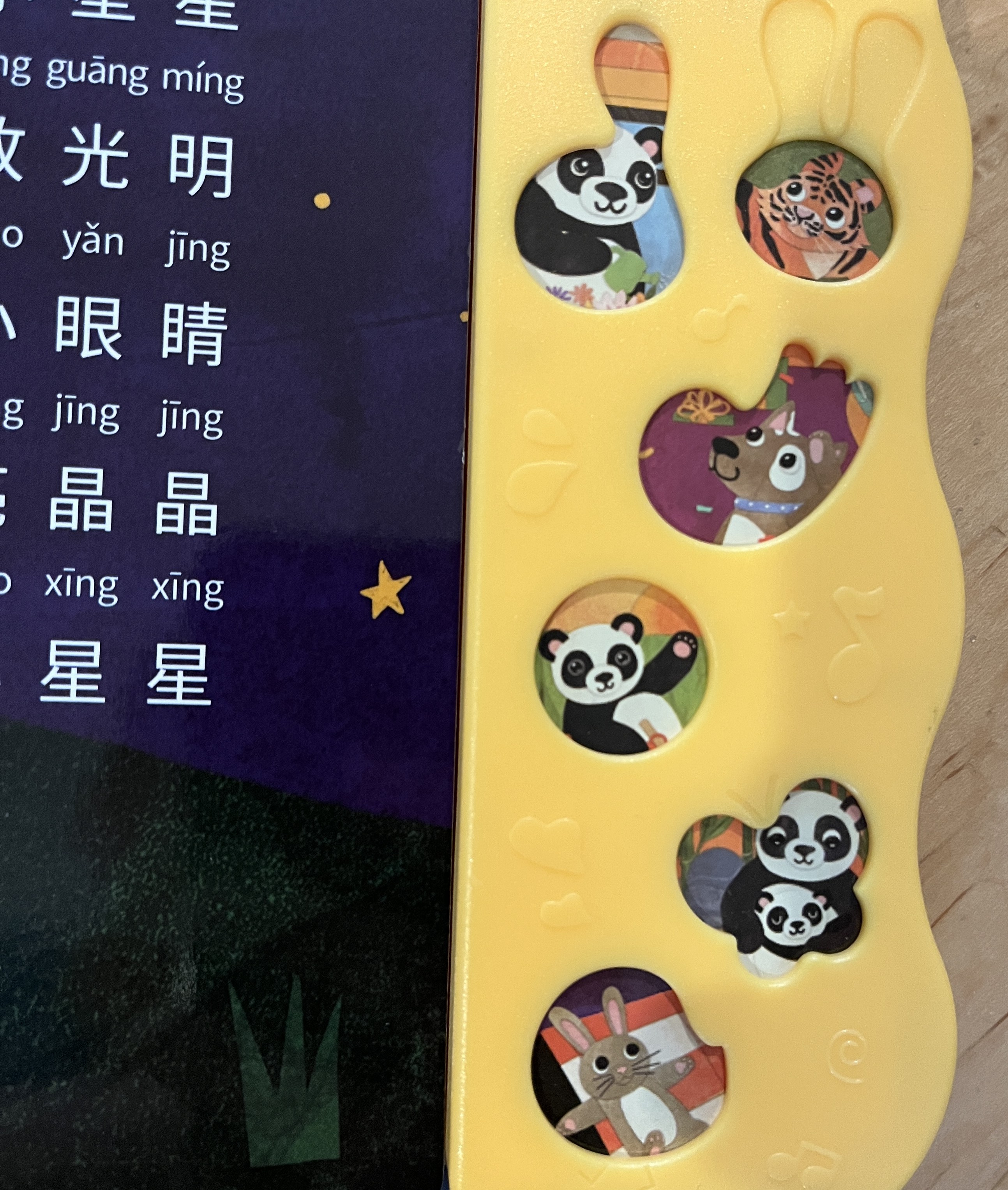
Songs repeat twice so recordings range from around 30 seconds to 85 seconds. The repetition helps with learning. They’re nice recordings and very pleasant to listen to. They offer super helpful resources on their webpage, like information on how to pronounce Mandarin words, and videos where they talk you through the lyrics of each song, clearly enunciated so you can get the pronunciation right. (I wish they had a QR code on the back that would take me right to that page.) $28.99 on Amazon.

For learning Mandarin songs, if I had to choose just one of Bao Bao or Ditty Bird, I would choose Bao Bao, but am happy to have both.

Singing with Go Go is Fun

There are LOTS of Go-Go books. Including English, Spanish, Mandarin and a Christian themed line. They are $29.99 each. I have the “9 Creative Nursery Rhymes” volume. (I’d swear that what I put in my Amazon cart was one of the Go Go Mandarin books, but this is what Amazon says I ordered and what they sent….) It has 9 songs – Humpty Dumpty, Itsy Bitsy Spider, Jack and Jill, Wheels on the Bus, London Bridge, Mulberry Bush, Muffin Man, I’m a Little Teapot, and Mary Quite Contrary. Many of the songs are pretty traditional, but on Itsy Bitsy and Jack and Jill, they added a little riff at the end, and the Wheels on the Bus became “the Go Go Bus goes round and round.”
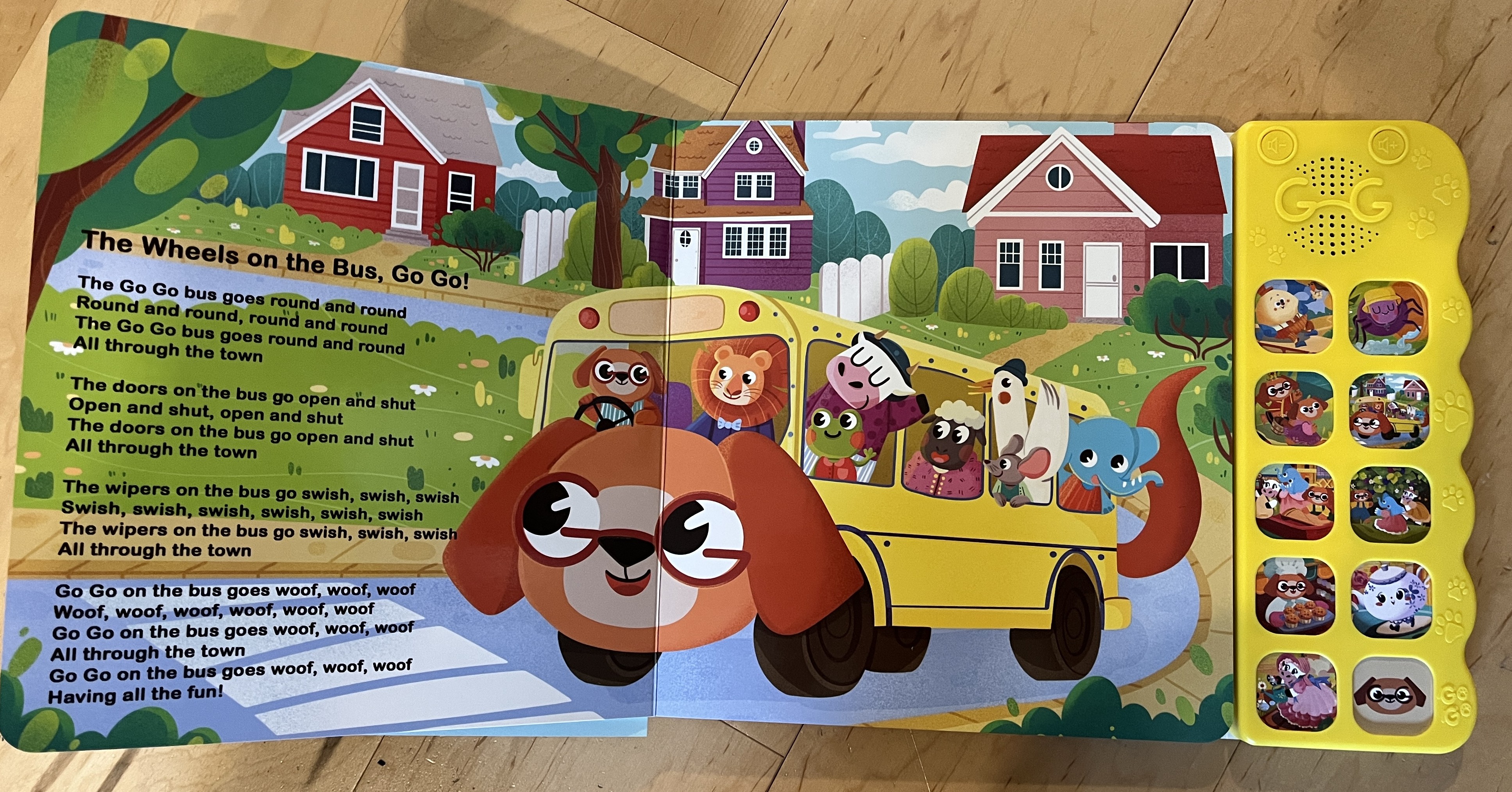
This is another large board book, with the controls on buttons off to the right side. There are two volume settings, controlled on that side panel. The child needs to figure out which of the 9 buttons matches the song for the page they’re on (the 10th button is just announcing the name of the book). Songs are up to 60 or so seconds.

Personally, I don’t like the style of these recordings. They’re like Barney the Dinosaur vibe – just a little too enthusiastic / peppy with kiddie pronunciation. I’m not a fan.

Hear samples from every book:
Sound Books

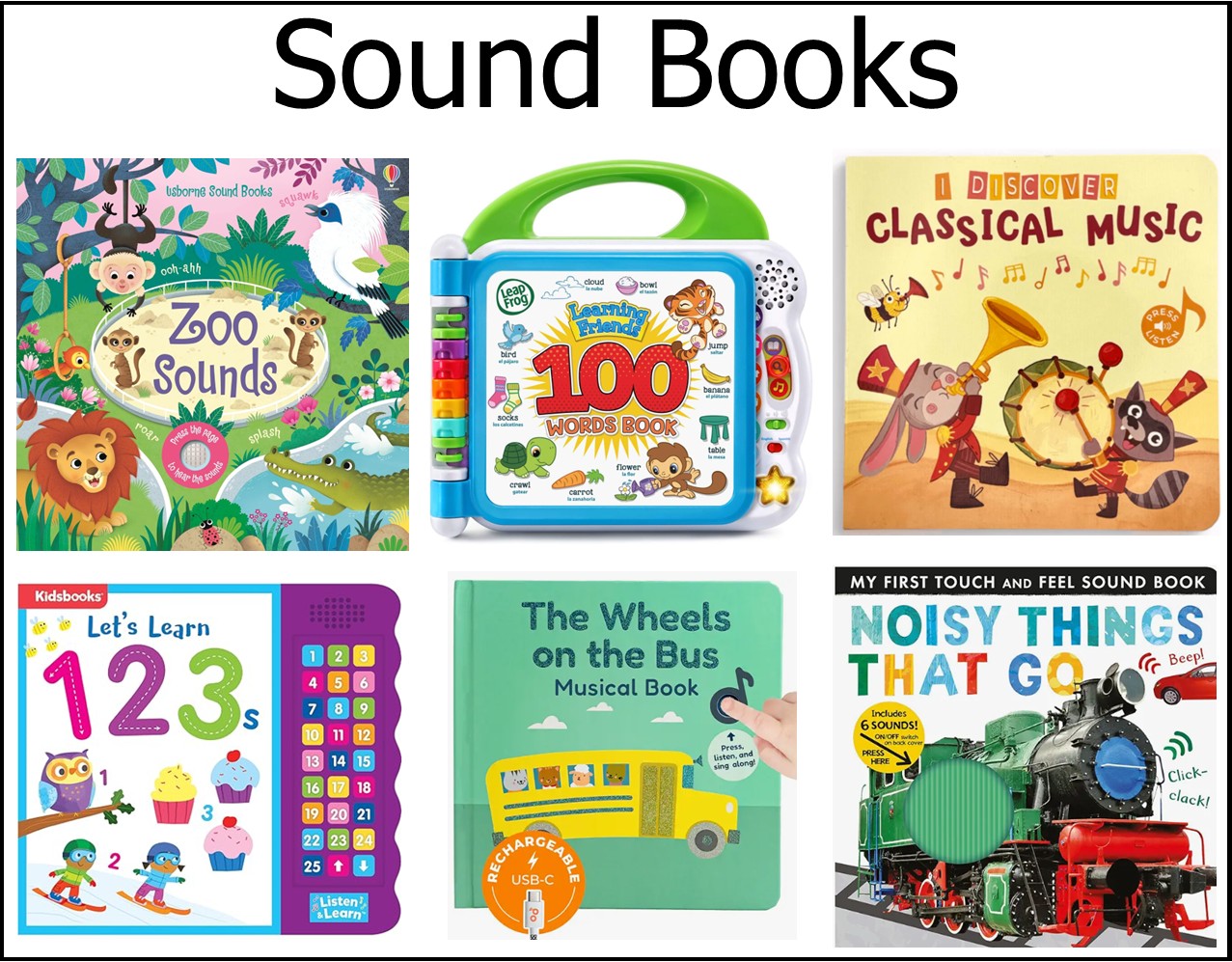
Sound books are interactive picture books aimed at young children. They have buttons you press to hear a sound (like a dinosaur roar, first words in various languages, or farm animal sounds) or a song. There can be anywhere from 3 – 30 buttons per book. They combine a book reading experience with a “press a button to make something happen” toy, so are fun for kids.

Benefits and Uses

Some benefits of sound books: they are interactive learning, they build fine motor skills, the child can interact with them independently, and they are fun! Additional benefits of language-based and music books: they can help reinforce learning for the child (in things like “first word” books where the child sees the word and hears the word), the child speaking or singing along with the book builds language skills, and they encourage focus.

For home use, they can work well to entertain a child while you’re busy, or in the car. Or, for me, each of my kids had a period of time where they had given up naps, but I wanted them to still have “quiet time” in their rooms. If they played with something like this that made noise, I could hear that they were still awake, or if the toy was quiet, assume they had gone to sleep.

At my classes, I don’t use sound toys much in the main classroom, as they can be distracting or overstimulating when added to all the other sounds in there. I have used them in my parent-toddler class, where I have a “quiet room” where parents can take a child if they’re overwhelmed. I have books and puzzles in there, but the sound books are nice there, because they are sound a child can choose and control, which may give them more tolerance for returning to the main classroom with all the noise they can’t control.

What to Look For

Like all press-a-button toys, they have the potential to be annoying for parents if the sounds are too loud, or if the sounds are unpleasant to listen to. So, I would only buy ones where I could listen to what it sounded like before buying. (Either in person, by listening to clips on line (like videos on Amazon listings) or by going to YouTube and searching for “[book title] read aloud” to see if someone has made a video of it. Read reviews to learn about volume if you can’t hear it in person.

Most of these books are board books – a few are paper pages, which is much less durable. The books have a power on/off button – if it’s off, none of the buttons will work. They have batteries, which tend to last a long time. Make sure they can be replaced or re-charged (some have USB chargers).

On most the buttons are fairly easy for little fingers to find and to activate, but some are harder to find or to press on just right to activate the sound. Again, if possible test them in person, or read reviews. Once you find a brand that your child can easily work, you can buy more.

I review five different brands of sound books here: Music Books.

For more recommendations on sound books, check out Sparkling Bookshelf’s Ten Best or Mommy Baby Play recommends 21 options.

Kids’ Books about Gender

Some parents and pundits question whether we should be talking with young children about gender, and the reality is that we always have been! When I was a young child in the 60’s, pretty much every book I was exposed to taught a particular set of gender roles. I learned what girls were supposed to look like and act like and what activities they were supposed to enjoy. Then as a culture we began to talk a lot more about feminism and equal rights for women, and there started being more children’s stories about “girls can do anything” – they can wear clothes that are easy to move in, they can have any job. Over time, people came to realize that as we’d given our girls permission to wear anything and be anything, our boys were still trapped in “boys can’t cry” and only sissies are dancers” and “why would a man want to be a nurse.” So, again, we began to tell more diverse stories. And now, with increased awareness that at least 1% of people are transgender, children’s stories about gender identity are starting to become available. All of these stories can be “mirrors and windows” for our kids – mirrors when they see characters like them that help them to feel seen, and windows that help them better understand other people’s experiences.

I’ll share some book recommendations here – most are aimed at kid 3 – 5, unless otherwise noted.

Gender Roles

Gender roles refers to the activities that people do, as hobbies, responsibilities, or careers. Here are just a few that look at stepping outside of traditional gender roles, but there are probably hundreds of books on this topic.

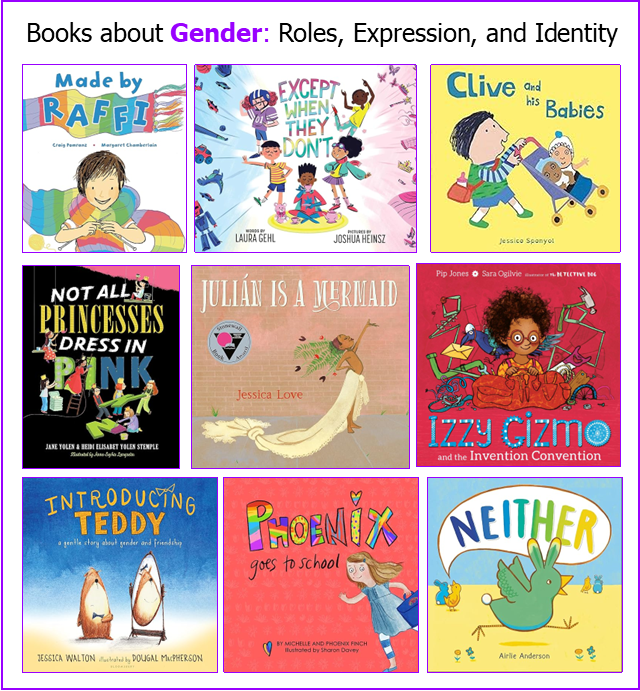
Except When They Don’t by Laura Gehl. Talks about gender role assumptions and the fact that they don’t always apply.

Made by Raffi is about a boy who likes to knit even though others say that’s a girl activity (role).

Not All Princesses Dress in Pink (video) Shows girls doing many things we think of as “boy things.”

Paper Bag Princess. (video) For ages 5+. About a princess who saves the prince.

Princesses can be Pirates Too (Video) About a little girl who loves to wear pretty princess dresses AND wants to be a bold brave pirate.

Clive and His Babies (video) Shows a boy playing enthusiastically with his baby dolls. (Age 2 – 4) There’s also Clive and His Hats and Clive and His Art.

Rosa Loves Cars Video. (age 2 – 4). There’s also Rosa Plays Ball and Rosa Loves Dinos.

William’s Doll (video) For 5+. About a boy who wants a doll. Others tease him or try to change his mind, but Grandma listens.

Izzy Gizmo is just one example of lots of great STEM books about girls who like to invent.

Gender Expression

Gender expression is about how we dress, how we style our hair and makeup, and how we move (e.g. boldly striding along, or hunching shoulders and being small).

For example, Sparkle Boy and Jacob’s New Dress and Morris Micklewhite and the Tangerine Dress (video) are all about boys who like to wear dresses (expression) but appear to still identify as boys.

Julian is a Mermaid (video) tells the story of a boy who sees people dressed up as mermaids in a parade and tells his grandmother he is a mermaid too – she helps him to dress up.

Gender Identity

This refers to how a person sees themselves. Do they say that they are a girl or boy, and how do they feel when other people label them as one or the other.

If I had to choose just one, I’d choose Who Are You? The Kid’s Guide to Gender Identity by Pessin-Whedbee. Age 4 – 8.

Introducing Teddy by Walton. (video) Teddy explains to a friend that in her heart she has always known she was a girl and wishes her name was Tilly.

10,000 Dresses (video) is about Bailey, who wants to wear dresses and identifies as a girl, although others label Bailey as a boy. 

In Phoenix Goes to School (Video), we meet a girl and learn about her, then she talks about going to school and worrying that the kids will think she’s a boy. She ends up having a positive and welcoming experience at school.

When Aidan Became a Brother (video) When Aidan was little, people thought he was a girl, but then realized he was a boy. This story is primarily about his family welcoming a new baby.

There are also some books that are metaphorical – they can be read as being about gender identity, but your child may not make the cognitive leap to understand that metaphor. For example, in Red: A Crayon’s Story, a blue crayon mistakenly labeled as “red” suffers an identity crisis and in Bunnybear, Bunnybear identifies as a bunny, and Grizzlybun identifies as a bear. If you’re just looking for books to encourage a general sense of acceptance of diversity and self-identification in your child, these are a great match. But if you want to specifically address gender identity, you will need to help your child see that message: “Remember that book we read, Neither? It was about a creature that was both a bunny and a chick, but not quite a bunny or a chick? That’s sort of like our friend Rex, who told us they are both a boy and a girl, and not quite a boy or a girl? They said that’s called non-binary. And remember how Neither felt sad when nobody accepted them, but felt happy in the Land of All where they were accepted? Can we be a Land of All for our friend Rex?”

Here are recommendations for more options:

And here’s my posts on Talking with Kids about Gender Identity and Are your Programs Gender Inclusive.

Kids’ Books on Resilience and Growth Mindset

In my parent ed classes, I present a session called “Raising Bold Kids” where we talk about grit, the growth based mindset, independence, teaching children to problem solve, and resilience. This year, someone asked if I had books I would recommend reading to children to help teach these sorts of skills. Here’s a list!

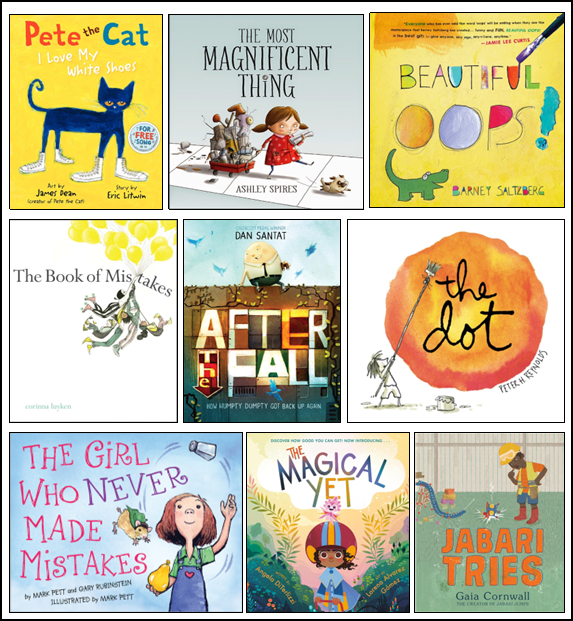
The Girl Who Never Made Mistakes by Pett and Rubinstein. (Video) This tells of Beatrice, famed far and wide for never making mistakes. One day she slips and almost makes a mistake. She worries about that all that day. She watches friends ice skating but is afraid to join them because she doesn’t want to risk falling. At the talent show: “for the first time in as long as anyone could remember, Beatrice made a mistake. And it was a big one!” She ends up laughing about it, then starts taking more risks, and trying things like ice skating – where yes, she falls down a lot, but she also has lots of fun. Great read-aloud for age 4 – 7.

The Most Magnificent Thing  by Spires. (Video.) A little girl wants to make the most MAGNIFICENT thing. She draws it out, and knows exactly how it will work. But when she tries to make it she fails again and again and gets very discouraged. But then she looks at all the things she made, finds the best thing about each, tries again and succeeds. People love all her “failed” experiments and take them home to use. Great read-aloud for ages 3 – 7. I appreciate that it really shows her emotions and how she deals with them, and lets kids know it’s OK to make mistakes.

Rosie Revere, Engineer by Beaty. (Video) Rosie dreams of being an engineer, and builds cool stuff out of trash, but then her uncle laughs at her and she stops inventing till Aunt Rose (Rosie the Riveter in her later years) comes to visit. They build a heli-o-cheese-copter. It only flies for a moment and Rosie is discouraged, till Aunt Rose says “it’s the perfect first try! This great flop is over, it’s time for the next”. They keep building together. Ages 3 – 7.

Jabari Tries by Gaia Cornwall. (video) Jabari wants to build a flying machine to fly across the back yard but it keeps crashing. He reluctantly lets his little sister help, and in the end, gets inspiration from her that leads to success. Nice story with a Black family that includes being inspired by Black inventors and engineers and also shows Dad encouraging a frustrated child to take a break, take a deep breath and try again. For more inventor themed books, check out Izzy Gizmo and Audrey the Amazing Inventor.

After the Fall (How Humpty Dumpty Got Back Up Again) by Santat. (video) Humpty loves sitting atop the wall, looking at birds. But after he falls and is put back together again, he develops a fear of heights and lives a sad life dreaming of flying. In the end he overcomes his fears and learns to soar.

Pete the Cat – I love my white shoes by Litwin and Dean. (video) Although I find many of the 60+ Pete the Cat books to be disappointing, this first one is magic. Pete’s walking along, singing his song, steps in a pile of strawberries, blueberries, and so on. Does Pete cry? Goodness no, he just keeps walking along singing his song.

All of those books model the Growth Based Mindset. If you’re looking for a book that is more explicitly about the mindset, you might also like:

The Magical Yet by DiTerlizzi and Gomez. (video) Talks about how failing at something (riding a bike) can be disappointing and make you want to quit trying. Then talks about the importance of keeping trying till you succeed. Protagonist is a person of color.

Growth Mindset Ninja by Nhin. (Video) “What you do is add the “yet” to everything. Then wait for the magic to happen in your brain.” And also check out: Your Fantastic Elastic Brain (Video)

Here are three art-specific books to choose from:

Beautiful Oops – Saltzberg (video) is a fun lift the flap which shows how to turn things like an accidental drip of paint, or a stain from a spill, into art. Ends with this message: “When you think you have made a mistake, think of it as an opportunity to make something beautiful.”

Book of Mistakes – Luyken (video). Shows illustrations in progress as the artist keeps making adjustments: “It started with one mistake… making the other eye even bigger was a bigger mistake… but the glasses – they were a good idea.”

The Dot and Ish by Reynolds – this is a two pack of books. In the Dot (video), a child named Vashti is afraid to try drawing. She makes one dot on the paper. The teacher frames it! Vashti decides she can paint a better dot, and makes dots of all sizes and colors. Then she encourages others to try. In the Ish (video), Ramon loves to draw anytime, anywhere. After his brother makes fun of one of his drawings, he gets self-conscious and crumples all of his artwork. Then he discovers his sister has been saving and hanging his art. He learns he doesn’t have to draw the perfect house – something that’s house-ish is just fine. He starts experimenting with drawing-ish, poems-ish, and so on, just enjoying creating.

Note: the book links are Amazon affilate links – I do get a small bonus (at no cost to you) if you click on these links and then purchase anything on Amazon. The videos are on YouTube – I encourage you to use them to preview but then purchase a legitimate copy of the book or get it from your library. It’s important to support authors and artists!

Find more book recommendations.

Examples of Diverse Books

I’ve written before about the importance of consdering “mirrors and windows” when choosing media for your child. “Mirrors” are books that tell stories about people like them who have similar life experiences – seeing yourself reflected lets you know that you are valued and that you belong. “Windows” are stories about people who look different than you, or live differently than you live – that gives children a window into the beauty and richness of diverse identities and builds empathy for others.

This post is to help you get started on finding great stories… If you’re looking for recommended books about any identity, such as “Jewish families”, then find that category below and click on it, and it will take you to a whole list of recommended books. AND for each category, I offer an example of one great book about that identity. These books are for preschool or early elementary age children.

Diverse Faiths:

Diverse Cultures:

Disabilities:

  • Wheelchair Users: I Will Dance (video) by Flood about a dance class for people of all abilities.
  • Amputee: What Happened to You by Catchpole (video) A child with one leg is playing on the playground and wishes other kids would stop asking what happened and start playing with him. (Note: as a leg amputee myself, I can say that this book is an example of how any one book on diversity never tells the story of everyone who has that identity. I do not mind when people ask me about my leg…)
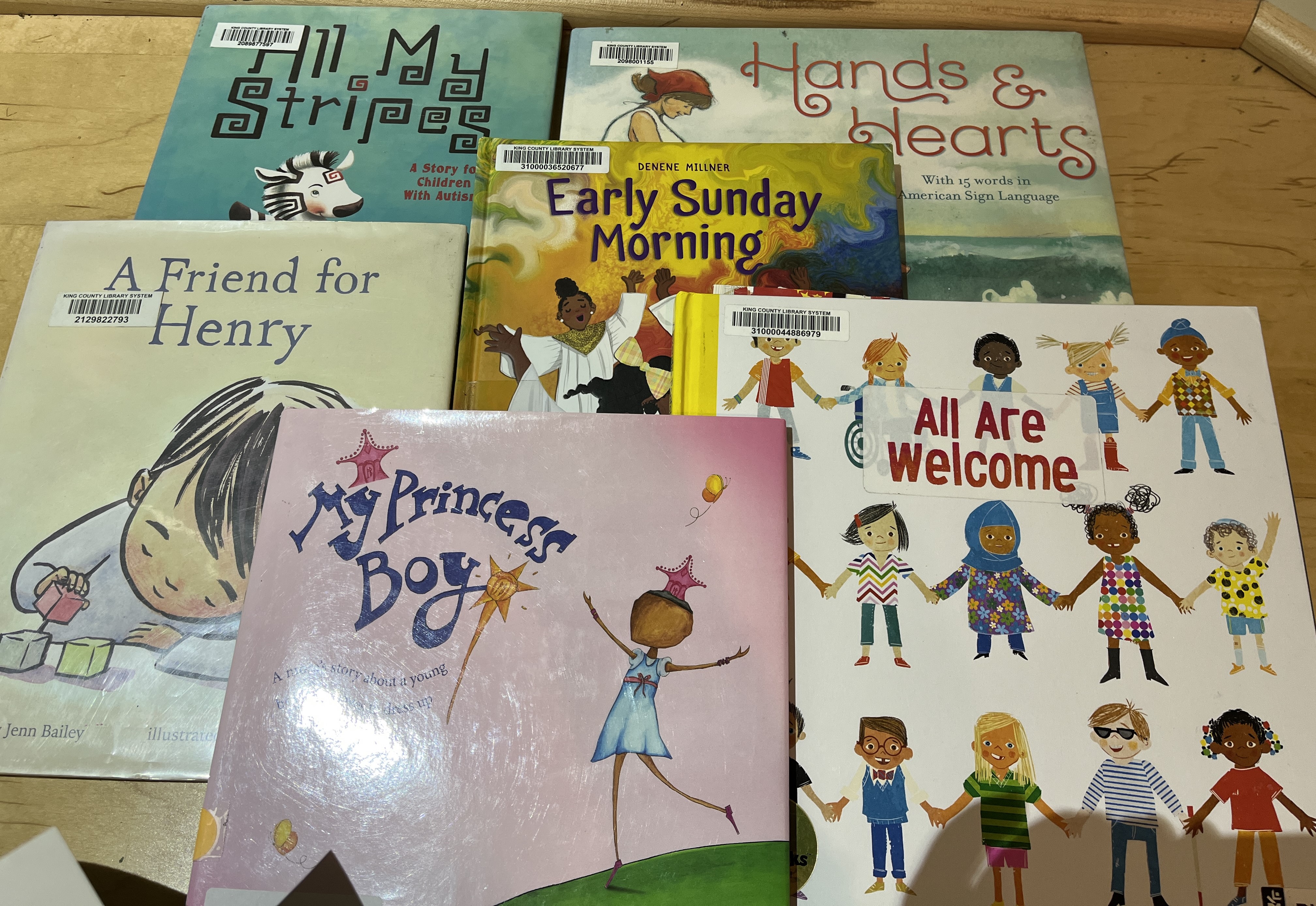
  • Autism: All My Stripes by Rudolph. (video) Features Zane the zebra and illustrates some things autistic children may find challenging and some things that make him wonderfully unique.
  • Blind: My City Speaks by LeBeuf. (video) A visually impaired child who uses a white cane explores her city with her father and performs in a concert on her violin.
  • Deaf: Hands and Hearts by Napoli. (video) A child and her mother spend a lovely day at the beach, communicating in sign language. The book teaches 15 signs.

Families who are Separated

  • Military Families: Lily Hates Goodbyes by Marler, illus Stoltenberg. (video) Alternatives include: Night Catch and I Miss You!: A Military Kid’s Book About Deployment. These all address sadness related to deployment and coping tools for managing it.
  • Children with a parent in jail: Visiting Day by Woodson (video). About a child and their grandmother taking the monthly bus trip to visit the child’s father in prison. Alternatives: Far Apart Close in Heart by Birtha (video) and the Night My Dad Went to Jail by Higgins.
  • Divorced Families: Two Homes by Masurel. (video) A child talks about their two homes – one with Dad by the water, and one with Mom in the city.

Gender / Sexual Orientation

  • Gender Roles: Except When They Don’t by Laura Gehl. Talks about gender role assumptions and the fact that they don’t always apply.
  • Gender Identity: Introducing Teddy by Walton. (video) Teddy explains to a friend that in her heart she has always known she was a girl and wishes her name was Tilly.
  • Gender Expression: Jacob’s New Dress; My Princess Boy – both about boys who love to wear dresses and how their family / teachers support that.
  • Gay or Lesbian Parents: Stella Brings the Family by Miriam B. Schiffer (video) about a child who brings her two dads to the Mother’s Day party. Or Families Families Families! by Lang. (video) covers all sorts of family configurations (though it uses animal characters rather than humans so it may be more abstract for your child to understand humans also have diverse families.)

Here are a few additional posts I’ve written with recommended books for children: books for shy kids, books about new babies in the family, books about starting preschool, books about big feelings, books for children about sexuality and touch, and kids books about STEM topics.

You may also like this post on choosing books for your child (includes info on where to find books, including libraries, online books and free videos of books read aloud), and if you’re in King County Washington, tips on using our library.

Book titles are linked to listings on Amazon – as an affiliate, I do get a financial bonus from Amazon if you purchase something after clicking on the link. But I encourage you to check your local library for the books – and recommend that they purchase them if they don’t already have them!

The videos are to read alouds on YouTube. Some of these are approved by the creators of the book, but others may be copyright violations – I encourage you to seek out and purchase books written by diverse authors to support their work.