Author Archives: Janelle Durham

Unknown's avatar

About Janelle Durham

I am a parent educator and social worker, and teach music and science to children age 1 - 8.

When I Play I am Learning (What your Child is Learning when s/he is “just playing”)

When I play with blocks, I am learning…

  • Sizes and shapes, and how to create and repeat patterns: essential math skills
  • Spatial awareness, stacking and balancing: the basics of physics
  • Problem solving and logical consequences

When I play with water (and other items in the sensory table), I am learning…

  • Eye-hand coordination as I learn to pour, fill, scoop
  • To use tools to accomplish a task – funnels, cups, scoops
  • Concepts of empty and full, volume and weight, relevant to mathematics
  • Properties of solids and liquids in motion, that some things sink and some things float (science!)

When I play with dolls or stuffed animals, I am learning…

  • To use my imagination
  • To treat others with tender, loving care
  • To imitate the parenting behaviors I see in my life

When I play with puzzles, shape sorters, and stacking cups, I am learning…

  • About the relationships of parts to the whole… a basic math concept
  • Concepts of shape, relative sizes (big, bigger, smaller), and color
  • Eye-hand coordination, small motor skills, problem solving
  • Vocabulary related to the subject of the puzzle

When I look at books, and when you read them to me, I am learning…

  • That learning to read is important and enjoyable
  • That letters on a page represent words – talk written down
  • To interpret pictures to represent ideas
  • To follow the development of thoughts and ideas in the plot of a story

When I play outdoors and in the big motor play area, I am learning…

  • Physical strength, coordination and balance
  • To jump, slide, run, swing, roll, and climb
  • To take some risks and to learn when to be cautious
  • To watch out for other people before moving, to move around others carefully

When I play in the kitchen area with the food and the dolls, I am learning…

  • To use my imagination, to try on different adult roles
  • To cooperate with others when involved in some dramatic play
  • To express myself in sentences
  • To solve problems, especially socially, through negotiation with friends
  • To improvise and use things in a symbolic way to represent something else…abstract thinking.

When I play with cars and trains, I am learning…

  • To see myself from a different perspective, that of a giant
  • How wheeled vehicles move through the world and what happens when they crash
  • How things need to be pushed up hills, but going downhill, they go fast on their own (physics!)

When I play with Playdough, I am learning…

  • To express feelings, squeezing and pounding
  • When I cut out a shape with a cookie cutter, I am learning about negative & positive space, seeing something against its background (helps with reading)
  • That the amount of a substance remains the same, even when the shape changes.

When I sort things, I am learning…

  • To notice details and similarities and differences in objects; concepts of color, size and shape
  • To form categories, essential concepts for reading and mathematics
  • Logical reasoning

When I paint, scribble, or draw, I am learning…

  • To develop my imagination and creativity
  • To hold a paintbrush or pencil
  • The names of colors and how to make new colors
  • To distinguish shapes, and purposely create shapes
  • To express my feelings and ideas, and that my ideas have value
  • Concepts of symmetry, balance and design

When I choose to have a snack, I am learning…

  • To choose and try new foods
  • How to sit at a table with others for snack
  • How to drink from a cup (and logical consequence – when you make a mistake, you get wet!)

When I play independently when my parent has left the room for parent education, I learn…

  • That my parent can leave for a while to tend to his/her own needs, but s/he is still available if needed, and s/he always comes back
  • That I can ask other adults for help, and that I need to listen to other adults’ guidance
  • Independence and Self-Confidence

When I participate in circle time activities, I am learning…

  • The names of others in the group: an essential skill for building relationships
  • To listen, sit still and understand spoken language: important for school readiness
  • To wait when others are talking, To cooperate and be considerate of the needs of others
  • New vocabulary connected with the topic of discussion
  • To remember the words of songs and poems: helps to build memory skills

Toddler’s brains are developing at an incredibly fast rate. They are born with a lifetime supply of neurons (brain cells), but they only develop synaptic connections (the essential wiring that connects those neurons and helps our brains function quickly and effectively) through hands-on experience with the world. Through play! Learn more about brain development here.

Original concept (and some of the text) for this article is from http://88thservices.com/pdf/learning.pdf, by Karen Miller. Additional concepts by Janelle Durham

Also check out this resource which talks specifically about what math skills your toddler is learning while they play: for example “dumping a bucket of blocks and putting all the blue ones into a pile” ties to “Infants and toddlers look for exact matches when classifying objects… Classification will one day be used for the mathematical content areas of measurement, patterning/algebra, and geometry/spatial sense.”
Link

During our first week of toddler class, we are pretty informal, mostly letting the children just explore the new environment in unguided free play. Sometimes parents feel the pressure to be actively “teaching” their children all the time, and may not see the value in free play, thinking of it as “wasted time”.

Here’s a link to one great article which addresses some of the ways that children learn through play: www.parentingcounts.org/professionals/parenting-handouts/information-for-parents-play.pdf


Cheap Dates with Toddlers: Construction Theatre

construction

[This series features “toddler date” ideas for something fun, simple, and cheap to do with your toddler.]

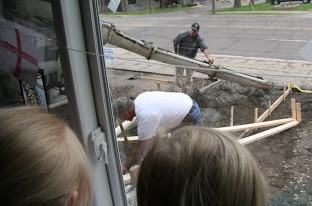
Construction Sites and other Big Equipment: Kids LOVE watching construction vehicles at work. They also like watching trash pickups, cars being loaded onto tow trucks, cranes at the port lifting and placing containers on ships, street sweepers, and more. (The luckiest days for a toddler parent is when you find a cozy warm coffee shop to hang out in that’s next door to a construction site. You relax while they’re entertained!) Last week, my son was captivated by a landscape worker and his leaf blower outside the library. Take advantage of those moments when you run across people at work, and stop and watch. Talk about the different types of equipment, the colors, the shapes – what the workers are doing.

Here are some fun building themed activities your child might enjoy and some great ideas for a construction themed birthday party.

Building the Young Brain

I recently attended a presentation by Dr. Sarah Roseberry Lytle, Director of Outreach for I-LABS, the Institute for Learning and Brain Sciences at University of Washington. They conduct research into brain development during the first five years of life. She presented about the Importance of Everyday Experiences to Building the Young Brain.

I’ll share with you my [incomplete] notes from the presentation.

Why early learning is important: She had a great graphic about brain development (similar to this one from http://doctorcare4u.com/images/brain-skull.jpg) that showed that at birth, the baby’s brain is just 25% of the size of the adult brain, but by 5 years old, it’s 92% of the size. That’s a huge amount of development in baby’s first 2000 days.


So, what can we as parents due to aid in that brain development? Expose our child to a variety of in-person life experiences.

Research has show that fewer life experiences lead to less brain development: children raised in households with lower socio-economic status and less opportunity have less specialized brain function at the age of 5.

On the question of nature vs. nurture, or whether a child’s learning is a result of biological potential or of life experience, she offered the analogy of a cookie recipe: biology is the ingredients and experience is the recipe. If I want to make pancakes, I use flour, sugar, salt, baking powder, eggs, and oil or butter. If I wanted to make cookies, I might use those exact same ingredients, but in different proportions, and with different methods, and come up with a very different result. So, your child comes with certain innate factors, but there’s a lot we can do with the experiences to affect the results.

What types of interaction best aid in a child’s learning? Here’s some of the things research tells us.

  • Children learn best “in the moment” – you can’t necessarily plan ahead what they will learn when, but you can seize the moments of everyday learning opportunities (i.e. there’s no point in talking to a toddler about the rain when it’s sunny out, but when you’re out in the rain, talk about “we’re getting wet… there is water falling from the sky right now. That’s called rain.”
  • Children learn better from live interaction than from the TV. (Here’s an article talking about how DVD’s do not appear to be effective at teaching language. However, interestingly, interactive discussions with a live human being via Skype do appear to aid in language learning – responsiveness and turn taking seem key.)
  • Children learn better from their mothers than they do from unfamiliar research assistants. Or, taken more broadly, children learn best from people they have personal relationships with.
  • Children learn language better when parents use ‘infant-directed speech’ (a.k.a. Parentese) – the sing-songy, highly animated, lots of facial expressions style speaking adults use when interacting with small children.
  • Children learn better when a researcher first established eye contact with the child and then looked at the object – the child would follow their gaze. This was more effective than the researcher just looking at something and talking abut it without first inviting the child along through eye contact. So, engage with eye contact and then teach. [Note. I have also read elsewhere that children learn language better when following child’s lead. In other words, if your child is looking at the light on the ceiling, you don’t say: “look at that teddy bear over there on the floor. The teddy bear is brown.” None of that would feel relevant to the child. If instead, you follow his gaze and say “You’re looking at the light. The light is bright,” that will be relevant, and worth remembering.]

Language Learning

Babies have “sensitive periods” when they are most open to learning certain skills. In language learning, we see that at age 6 months, babies are ‘universalists’ – they are capable of hearing any sound the human voice can make. But, by 11 months, they have become ‘specialists’ in their native language. (For example, in the Japanese language, there’s not an important distinction between the sound ra and la. A 6 month old Japanese baby can differentiate between those sounds just as well as an American baby. But, by 11 months, the Japanese baby has learned that the difference between those sounds doesn’t matter in their native language, and they no longer ‘hear’ it.) If a baby is raised bilingual – with significant adults speaking two different languages around him, he will remain a ‘universalist’ for longer – at 11 months he can still recognize all human sounds, by 14 months he is a ‘specialist’ in both of his languages, but has lost the ability to hear sounds differences that are not important to either language.

Cognitive Control / Self regulation

A key ingredient to a child’s success in school is self regulating: being able to change modes. For example, if you’re outside running and playing at recess, can you calm yourself down when you return to the classroom?

Simon Says game is a great way to practice this. When you say “simon says touch your elbow” that’s easy for a child to follow. But when you say “touch your elbow” without first saying Simon says, then the child has to work hard to not follow the directions they’ve just heard.

At the toddler level one way to practice this “activate and inhibit skill” is sorting. When you ask them to sort all the trucks into one pile and all the cars into another, they don’t care what color the vehicles are. But when you then ask them to put all the green vehicles into one pile and all the red vehicles into another pile, they have to actively ignore what type of vehicle it is so they can focus on the important attribute of color.

Dr. Lytle shared brief information about a few other studies with us, including one about a researcher who had put signs in a grocery store suggesting things parents could talk to their kids about while shopping, and yielded a big increase in the amount of talking and interacting by parents.

Her summary point was that the little everyday things that parents do with their kids matter. Diverse life experiences, with the companionship of an engaged caring adult, helps our babies to learn and grow.

Link

Back in 2002, the U.S. Departments of Agriculture, Education, and Health & Human Services put together some nice booklets – one for each month from birth to twelve months. Here’s the 12 month guide: http://www2.ed.gov/parents/earlychild/ready/healthystart/twelvemonth.pdf

It’s an overview of all the basic info parents of toddlers need: nutrition, health and safety, baby games, routines, developmental stages, guidance, and parenting styles. Check it out.