Toddlers enjoy learning about all sorts of animals, including those that can be found at a zoo, or in a jungle. Here are some fun activities about wild animals.
To the tune of Wheels on the Bus: “The lions at the zoo say roar roar roar, roar roar roar, roar roar roar. The lions at the zoo say roar roar roar all day long.” Repeat with any animal sound you want.
Rhymes to Say
Five Little Monkeys jumping on a bed (video of motions)
Five little monkeys jumping on the bed.
One fell off and bumped his head.
Mama called the doctor and the doctor said:
“No more monkeys jumping on the bed”.
Four little… three…
Five little monkeys (in a tree) – video
Five little monkeys sitting in a tree,
Teasing Mr. Crocodile: “You can’t catch me!”
Along comes Mr. Crocodile
As quiet as can be and…SNAP!
Four little monkeys sitting in a tree… three… two…. one
… Along comes Mr. Crocodile
As quiet as can be and SNAP! One little monkey says “Ha Ha! Missed Me!
The Funky Spunky Monkey(tune Itsy Bitsy)
The funky spunky monkey climbed up the coconut tree.
Down came a coconut and bopped him on the knee.
Out came a lion a shaking his mighty mane.
And the funky spunky monkey climbed up the tree again. OR
The funky spunky monkey climbed up the coconut tree.
Down came a coconut and bopped him on the knee.
Along came his mama who hugged away the pain.
And the funky spunky monkey climbed up the tree again.
Alligator, Alligator
Alligator, alligator, long and green (hold out arm: 4 fingers, thumb below)
Alligator, alligator, teeth so mean (open and close fingers and thumb)
Snapping at a fly, snapping at a bee,(snap with fingers and thumb)
Snapping at a frog, but you can’t catch me! (arms slap together, then shake head)
Building Projects
Build a Zoo: Take out blocks or Duplos and toy animals. Build a zoo with your child.
Outdoor Play: Build a habitat for plastic animals with rocks, sticks, and plants.
Games / Activities
Pretend to be an Animal: Make cards or dice that have pictures of animals, or put plastic animals in a bag. The child rolls (or draws a toy from the bag). Then you both pretend to be that animal – moving like it or making the sound.
Habitat Sorting: Put out plastic animals or pictures of animals, plus pictures of habitats. Talk with them about which animals live on farms, which live in jungles, in the ocean, or in the desert.
Hoof and Paw Prints: If you have toy animals, check out their feet. Find ones who’ll make different shapes of tracks. Set out paint, paper, and animals, and make tracks. (You could also make tracks in play-dough.)
Paper Plate Snake: Decorate a plate, then cut it into a spiral snake. (see photo at top) Add eyes.
Books to Read
Dear Zoo by Campbell. Fabulous lift the flap. “I wrote to the zoo to send me a pet…” See what they send!
Good Night, Gorillaby Rathmann. A charming wordless book about a gorilla escaping its cage.
Second hand sales are a fabulous resource for parents. They offer clothes, kid equipment (like cribs, strollers and baby carriers), kids’ books and toys that are lightly used for a fraction of their original cost. Over 29 years of parenting, almost all my kids’ clothes have come from consignment shops. I like them not just for the cost savings, but because it’s better for the environment, more efficient for me, and helps me be a more relaxed parent.
There are lots of options for second hand items, including consignment shops, thrift stores, and online exchanges, so I include tips below for each.
Why buy used?
Save Money
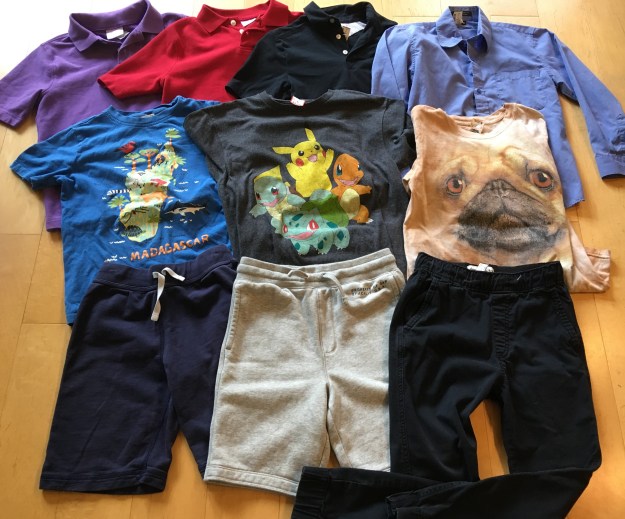
Here’s what I bought in June 2022 at at a local consignment shop (Small Threads in Kirkland): a dress shirt, three polos, three t-shirts, two pairs of shorts, and a pair of pants for $72.56. (Disclaimer – my 11 year old chose the pug t-shirt, not me! But it was cheap enough that I could say yes to his whim.) They’re all used, of course, but in fine shape.
Brands I saw at the shop included: Abercrombie Kids, Gap, Old Navy, Gymboree, Oshkosh, Carter’s, Eddie Bauer, Lands’ End Janie & Jack, Tommy Hilfiger, Calvin Klein. At my local consignment shops, the prices are typically $3.00 – 10.00 per item for children’s pants and shirts. Cost savings is similar on coats, shoes, toys, and more. (At thrift stores, the cost might range $2 – 5.)
Pre-Vetted for Durability
I find that children’s clothes range a great deal in quality. Some will last through many children and countless washes, and others look awful after their first time through the laundry – they get “pills” all over them, or their colors run, or they have knees that tear out at the first tumble, or collars or cuffs that get all squashed up never to go flat again. At a consignment store, everything is still in good shape after being used, so I know my kid can’t do much worse to them.
The photo at the top of this post is what I bought a couple years ago at Small Threads in Issaquah, WA. I got 6 shirts, and four pairs of pants for $36.23. All of them were in his regular rotation until he outgrew them and we passed them on to the next owner.
Children’s toys have a similar pattern – some are junk that break after one use. If it lasted long enough to be at a consignment shop, you know it’s likely to survive your child’s use. (Note: second hand toys are sometimes missing something from the original set… if that’s a set of six dolls that’s missing one, that’s probably OK. If it’s a puzzle that’s missing some pieces, that can be disappointing for some kids.)
Better for the Environment
Most kids’ clothes are made from cotton. Cotton is terrible for the environment – it takes about 2500 liters of water – 660 gallons – to produce enough cotton for one shirt! Cotton is just 2.4% of the world’s crops, but of the pesticides used on the planet each year, 16% are used in the production of cotton. Let’s get as much use as we can out of every cotton shirt! For toys, we are producing a HUGE amount of plastic toys every day. For most of them, a child is done playing with them long before they show any signs of wear and tear, so it’s great if they can be passed on to new users instead of the landfill.
More Efficient Shopping Experience
I don’t enjoy shopping. I especially don’t enjoy shopping when I have to take a small child with me to the store! As a working mom, I have limited time, and there’s other things I’d far rather do with it. If I walk into a kids’ clothing store, they have one rack that has a couple styles of shirt, then I walk to another rack with a couple more and another rack with a couple more. If I walk all around the store, they might have a dozen different shirt styles. And they might not all be available in a size 6. If I want more options, I have to walk through the mall till the next viable store.
At the consignment shop, I can walk to the size 6 boys rack, and flip through about 40 different shirts and 30 pairs of pants, all in size 6. I am able to pick out 6 shirts and 4 pants in about 15 minutes. (And unlike mall clothing stores, most consignment shops have some consignment toys stationed around the clothing racks so kids can play while their parent shops.)
Makes me a Better Parent
I still remember 20-some years ago, when I bought my kids two really special matching outfits from Gymboree for a portrait session that were pretty pricey for my budget at the time. Even after the photos were taken, I was protective of those clothes… my preschooler and toddler really wanted to wear them but when they did, I’d spend the day saying “no, you can’t play with that, it’s too messy” and “no, you can’t eat / drink that – I don’t want you to spill it on your clothes.” I didn’t like being that fretful parent.
When my kids wear cheap consignment clothes, I’m a relaxed parent. I let them finger-paint, play in the mud, eat nachos, and more. I don’t worry about stains and just let them be kids.
Stain tip: There’s a lot of good stain removers out there – I personally find Shout works great for us. But here’s the key with stains… never ever put stained clothes in a dryer. The heat will set the stain forever!! So, I spray a stain – wash it. If the stain didn’t come out, I spray it again and wash it again the next time I do laundry. It doesn’t go in the dryer till the stain is gone. It’s very rare when I end up with a permanent stain.
The Sell them Back option
I donate my kids’ clothes and their toys when we’re done with them or I give them away on my Buy Nothing group. However, you can re-sell them to someone else by bringing them back to the consignment shop. You can get cash for the these items, or you can get a larger payment with store credit that you then roll into supplies for the next age group. Here’s tips on how to make money selling consignment, and more tips.
What about Teenagers?
My oldest child wasn’t that picky about clothes and was happy to wear whatever appeared in the drawer. But my second child was very picky about her clothes. By the time she was about 12, she was doing all her own shopping. I would give her a budget at the start of the school year, and she could decide how to spend it. Usually I’d talk her into consignment stores. But one year, she decided she really wanted the brand new designer pants. So she blew her whole budget on one new pair of pants, and otherwise had to wear all the clothes she already owned, whether or not they fit her current style. In all the future years, she’d go to consignment shops, and buy 6 – 8 new items – mostly by the designers she’d want to wear – but for a fraction of what they would have cost new.
What is a second hand seller?
There are multiple types of second-hand sellers that sell used items. They include:
Consignment stores / pawn shops.
In a consignment shop, people have asked the shop to sell their stuff for them – if it sells, the store gets part of the money and gives the other part to the seller. If it doesn’t sell in a set amount of time, they ask the seller to pick it up. Most towns have a consignment shop – search online. Some are huge with lots of stock, some are small and you’re less likely to find what you need.
In a pawn shop model, the seller brings items to the store – the store buys what they want – if they think they can re-sell an item for $10, they’ll give the seller $5. Half Price Books and Plato’s Closet follow a pawn shop model. (Learn the difference between these models from the seller’s point of view.)
Everything in a consignment shop had to meet the shop’s standards for quality, so in general, it’s all in quite good shape and fashionable. (I’ve seen Plato’s Closet reject half to two thirds of the items sellers bring in, taking only the very best.)
Pop-Up Events and Thrift
Pop-Up / Short Term Events, like Garage sales, yard sales, swap meets, flea markets – where people sell their own stuff or other folks’ stuff for a couple days in the yard or at a swap meet. (Just Between Friends is a nationwide group that does huge events full of kids’ clothes. They can be a bit of a zoo, but people get lots of good stuff there.) You can get really good deals on stuff and you can find treasures – wacky delights you didn’t even know you were looking for till you found them. On the other hand, you can find a lot of junk you have no desire to own. Personally, the only time I garage saled was when it was a lovely sunny day in spring and I wasn’t quite ready to go home but didn’t have any ideas for what to do with my kids. We’d see a garage sale and go off on a quest to see what we’d find. Never anything substantial, but a fun little diversion.
Thrift shops (“Goodwills”) – where all the goods they sell were donated to them. Anything that’s deemed “acceptable” is out on the shelves, so that means there’s a wide range of quality. There might be a barely worn Gap sweater from this year’s line next to an almost worn-out t-shirt from an 5k run that happened a decade ago. If you’re willing to sort through a lot of junk, you can get some good deals. Note: some thrift shops donate all their proceeds to a charity, but some (like our local Value Village) are for-profit businesses.
Online
Craig’s List / ebay / Vinted / classifieds / Facebook marketplace – people list specific items that you can search for. Helpful if you know exactly what you’re looking for. My son outgrew his favorite pair of shoes, and the company no longer made them, but we found a new pair in a larger size on ebay.
Buy Nothing Groups: The Buy Nothing Project has created a huge network of Facebook-based local groups where folks who have things to give away post them to the group and where others ask for what they need. On my Buy Nothing group at this moment, people are giving away: an unused case for an iPhone 6, a bicycle seat, a glass-topped end table, a bag of size 3T boys’ clothes, company for evening walks on a local trail for other women who don’t feel comfortable walking alone, size 9 heels from 9 West, wood toddler toys, and so on. And there’s someone who’s due in a month who is asking for a crib, crib sheets, and a stroller. It’s pretty hit or miss what’s posted, but you may luck out. And if you have stuff to give away, it’s nice to give directly to a neighbor rather than donating to a thrift shop.
Tips for second hand shopping
The nicer the neighborhood – the better the used goods. At a garage sale in some parts of town, you’ll find things from Target and Walmart that the sellers are trying to eke as much money out of selling as they can. In another part of town, you’ll find items from Pottery Barn and Williams and Sonoma that they’re willing to sell for any amount you feel like offering.
Inspect items thoroughly before buying, especially at thrift shops. Look for the subtle holes or small stains that a quick inspection wouldn’t have picked up.
Don’t buy stuff just because it’s cheap. A lot of people get really excited about “look at this doo-hickey that sells for $50 in a store and I got it for $5!!” And in that excitement they don’t stop to think about whether they really need a doo-hickey and are now stuck with it. (Note: lots of parents find that they have so many toys that it’s overwhelming for them – and we know kids don’t learn well in environments that are too cluttered – read here for tips on How Much is Enough – How Much is Too Much.)
If you’re looking for money saving ideas for parents, you may also be interested in my series Cheap Dates with Toddlers which offers lots of free and cheap ideas for what to do with little ones.
Are you looking for a great car-free day trip from the Seattle area, perfect for kids age 1 – 7?
Ride the bus to the ferry terminal, then hop on a ferry to Bainbridge Island, check out the Kids’ Discovery Museum, stroll into town for a snack, and catch the ferry and bus back home. (See travel tips below.) From downtown Kirkland, we can do the full trip in as little as 6 hours. Last week, we got on a bus at 11:30 am, and were back home at 7:30 pm after a great leisurely day of travel and fun.
The Kids’ Discovery Museum
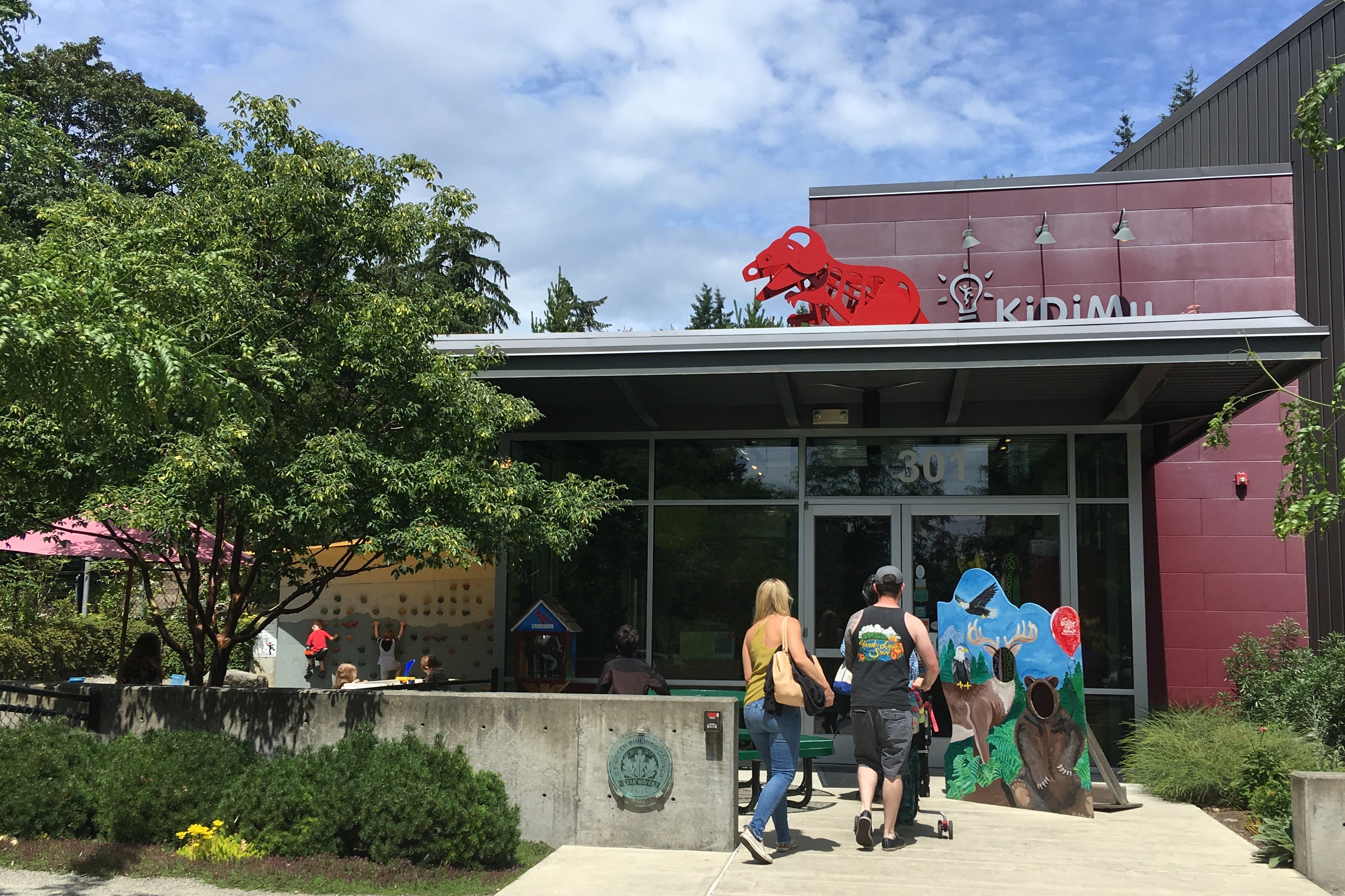
The museum is a short walk from the ferry terminal. (directions below) They’re open Monday through Saturday 10 – 4, Sundays 12 -4. Admission is $8 for adults and children (babies under 1 year are free), with discounts for senior and military. The Museums for All rate is $1 per person with proof of participation in EBT, CHIP, Provider One or WIC. (Info current as of July 2018.) You could see / do everything in the museum in an hour. We relaxed and settled in and played for a long time and were there for about 2.5 hours. It is best aimed at 3 – 6 year olds, as are all Children’s Museums, but fine for toddlers and still engaging for my 7 year old.
Entry Zone
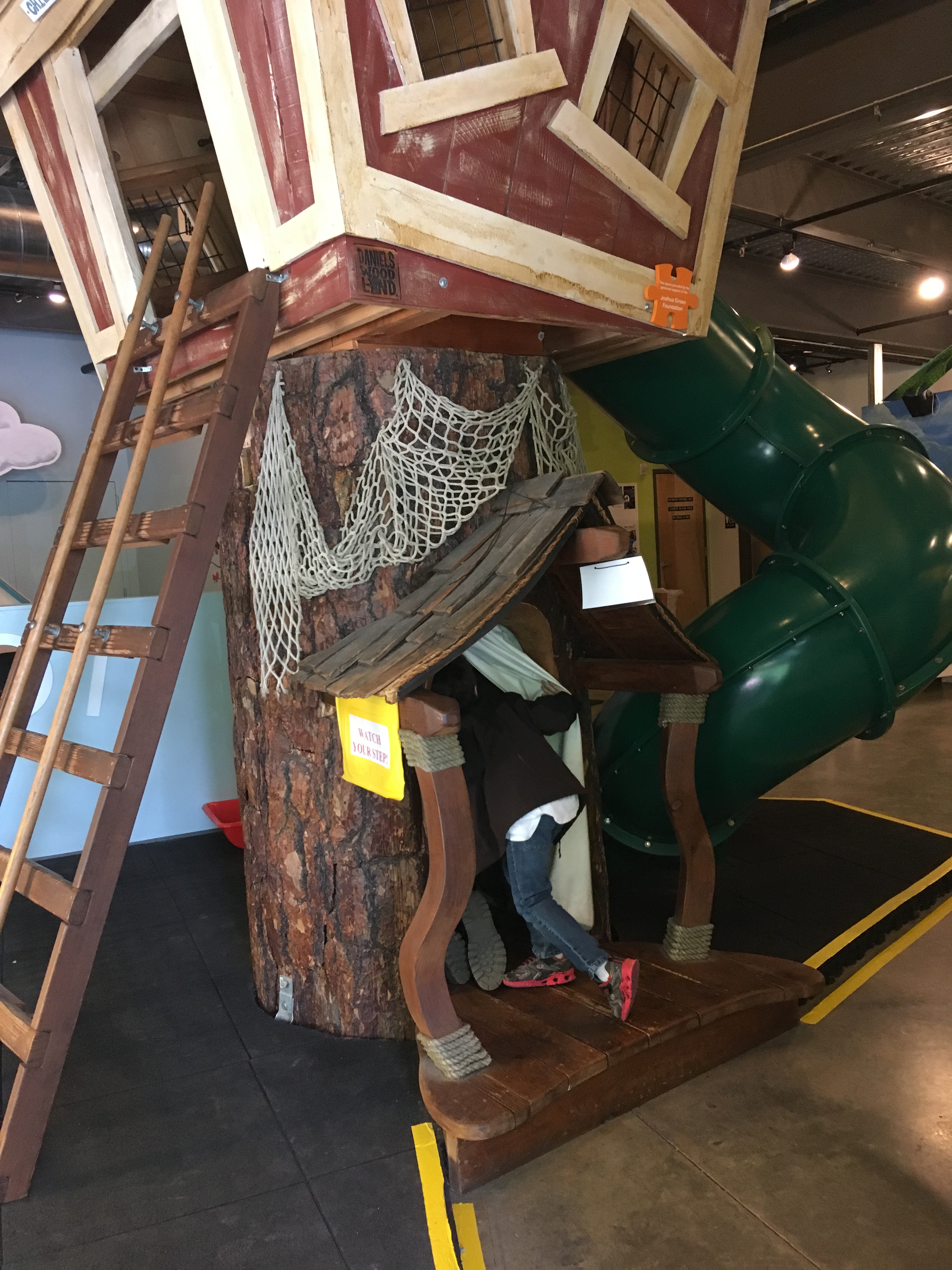
Just inside the entrance, you’ll find a small gift shop area and this climber.
Tucked behind it is a dress up zone, currently stocked with firefighter costumes and books.
This is the toddler area, with toys, story books , musical instruments, and a playhouse.
The Bank
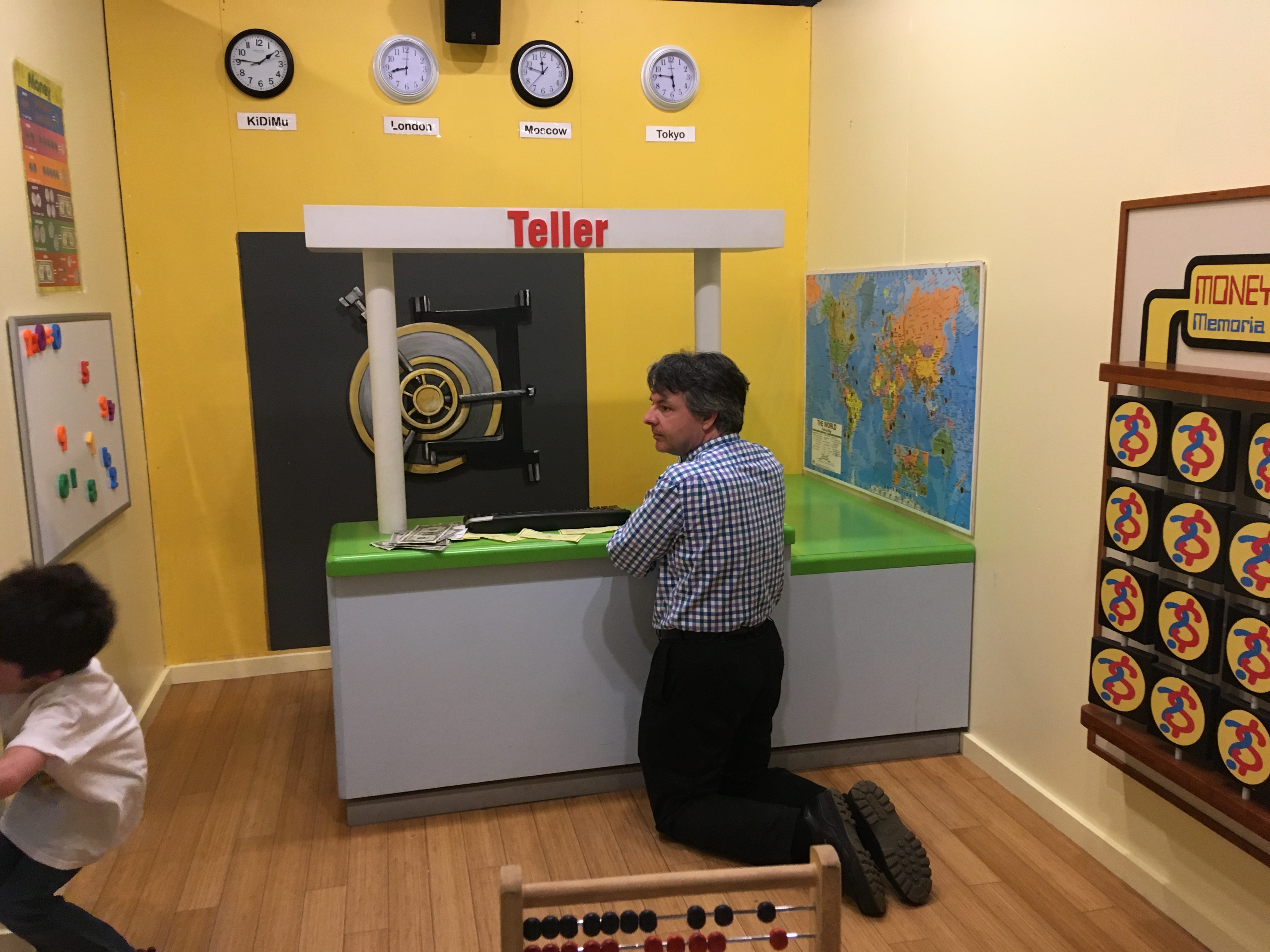
The first room is bank themed. It included play money, an abacus, a world map, and clocks set to different world time zones.
There was a memory game where you had to find and match a picture of the front of a type of money with a picture of the back of it.
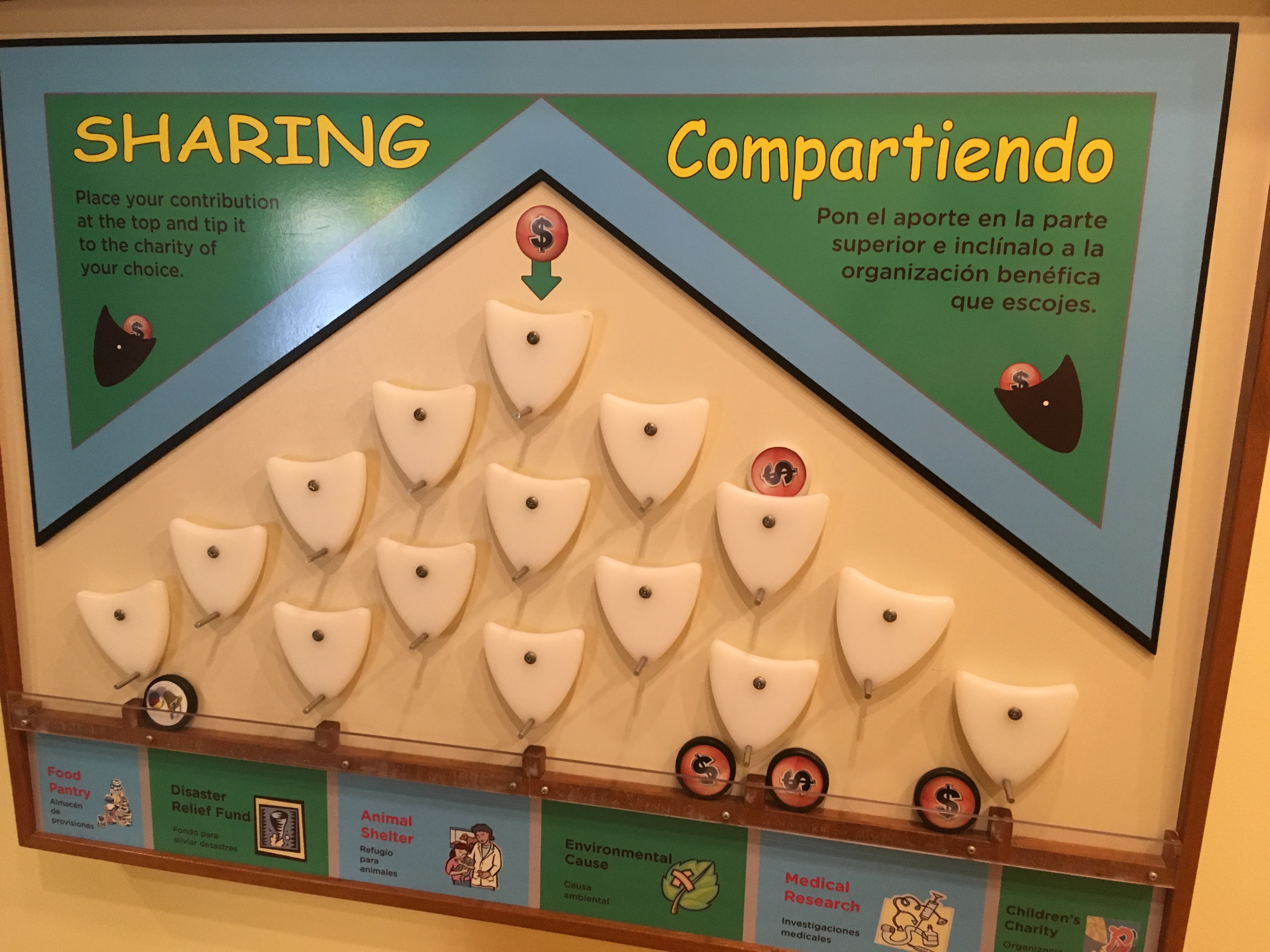
The bank also included this board for talking about what causes to donate money to,
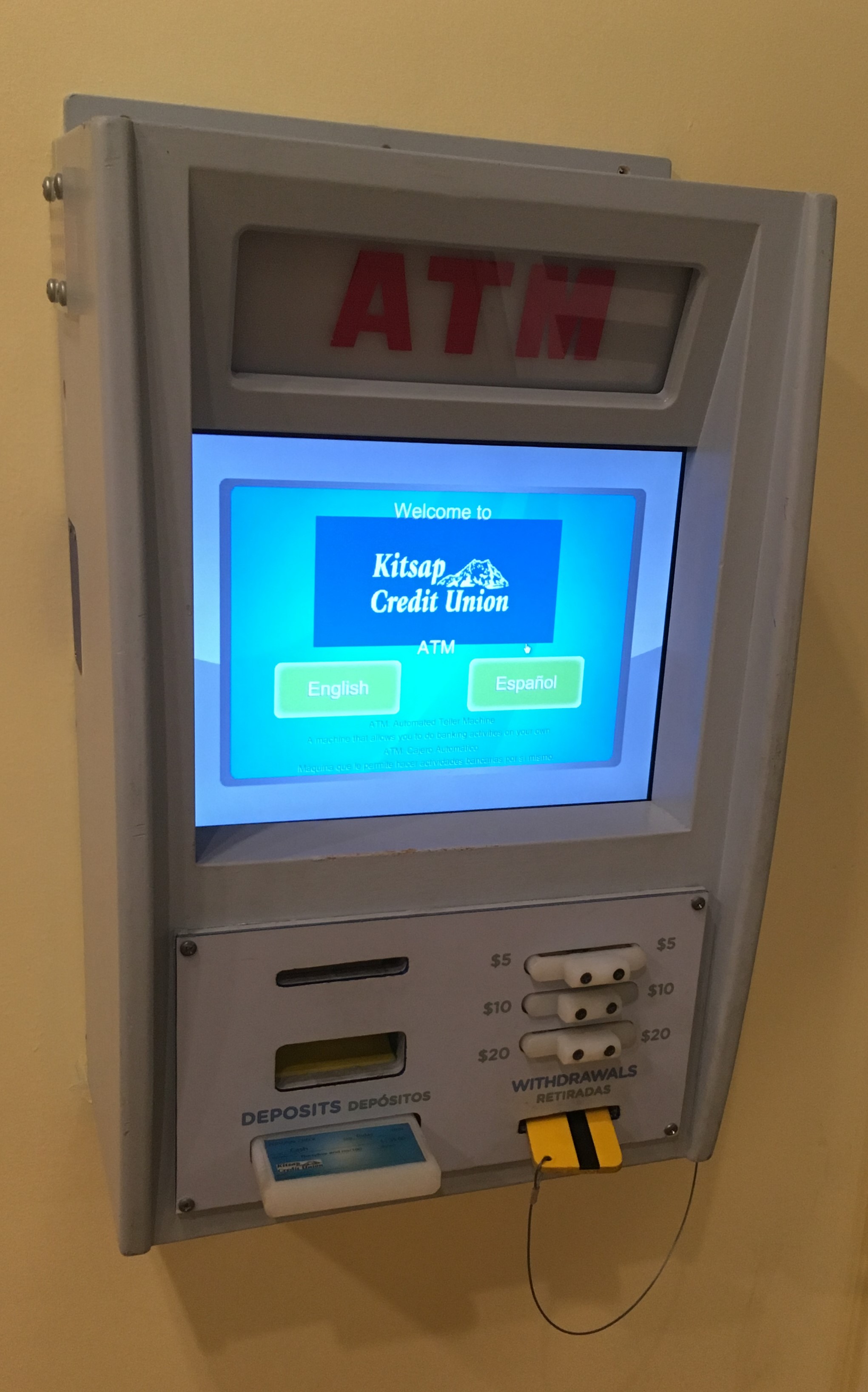
an “ATM” – I don’t think the screen did anything, but you could pull “money” out of the slots, and re-insert it,
and this “roulette wheel”.
You start with $20, and when you spin, you may earn a few dollars (by gathering recyclables, washing cars, or caring for a cat) or spend a few dollars (buying a gift for a friend, or repairing something you’ve broken). Some of the wedges were about making a choice about whether or not to buy an optional item, and you spun the middle spinner to decide. Our son was engaged for quite a while, and has talked about this often in the days since the trip as he makes real decisions about whether to spend his allowance or not.
The Doctor’s Office
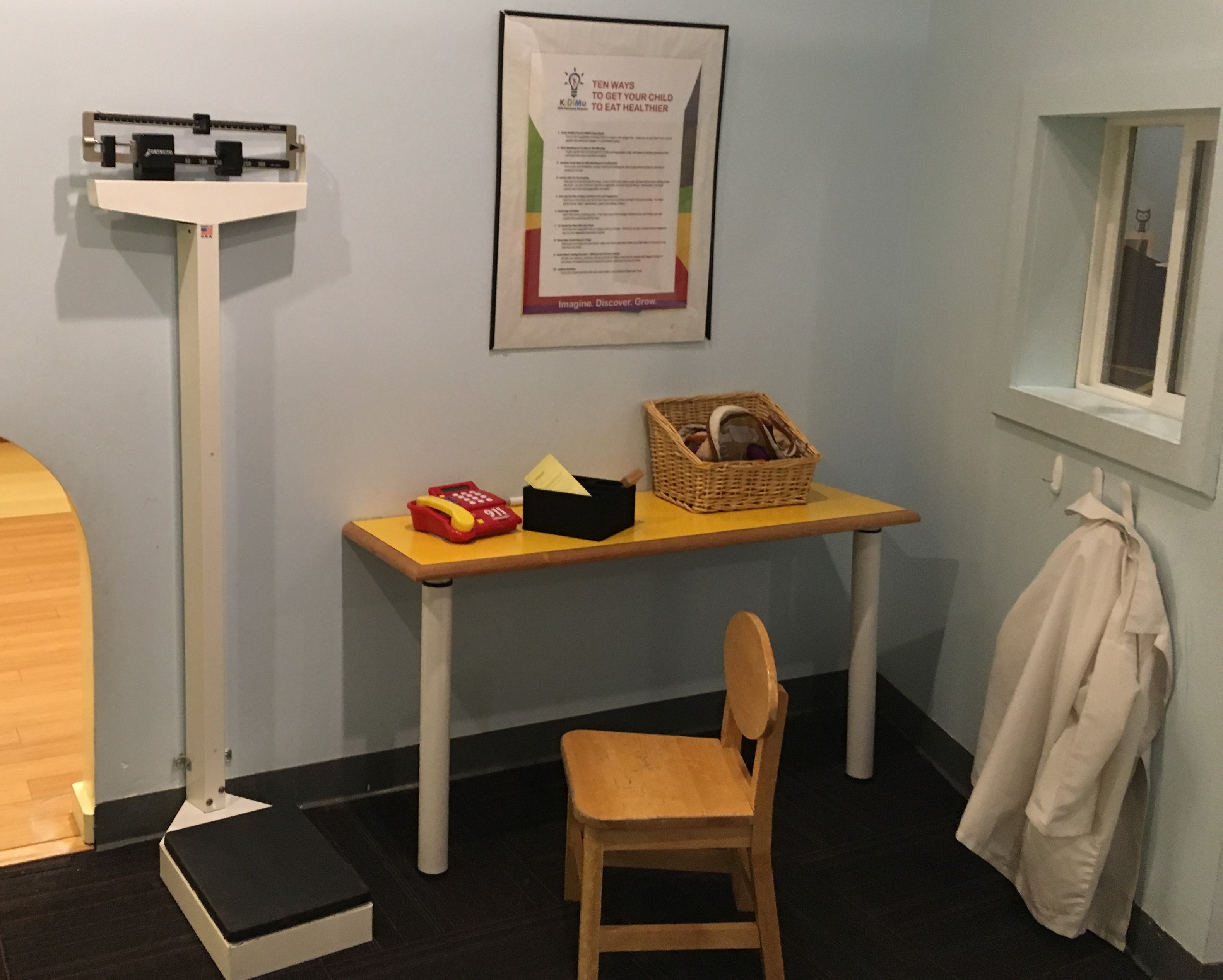
There are posters and rugs showing the different systems of the body (skeletal, digestive, etc.), a pretend sink and fake teeth with information on the importance of hand-washing and teeth-brushing, and an exam table with a doll patient and pretend medical equipment.
There’s an eye chart, a waiting room chair with books to read, and a food pyramid where there’s play food to velcro to it, which you sort into the correct food group category.
There’s a scale, a lab coat, and an apron your child can put on where you can attach stuffed organs (liver, heart, etc.) to the right place on the apron.
Transportation Zone
This features a small electric car they can climb into and pretend to drive, and little plastic cars they can paddle around in.
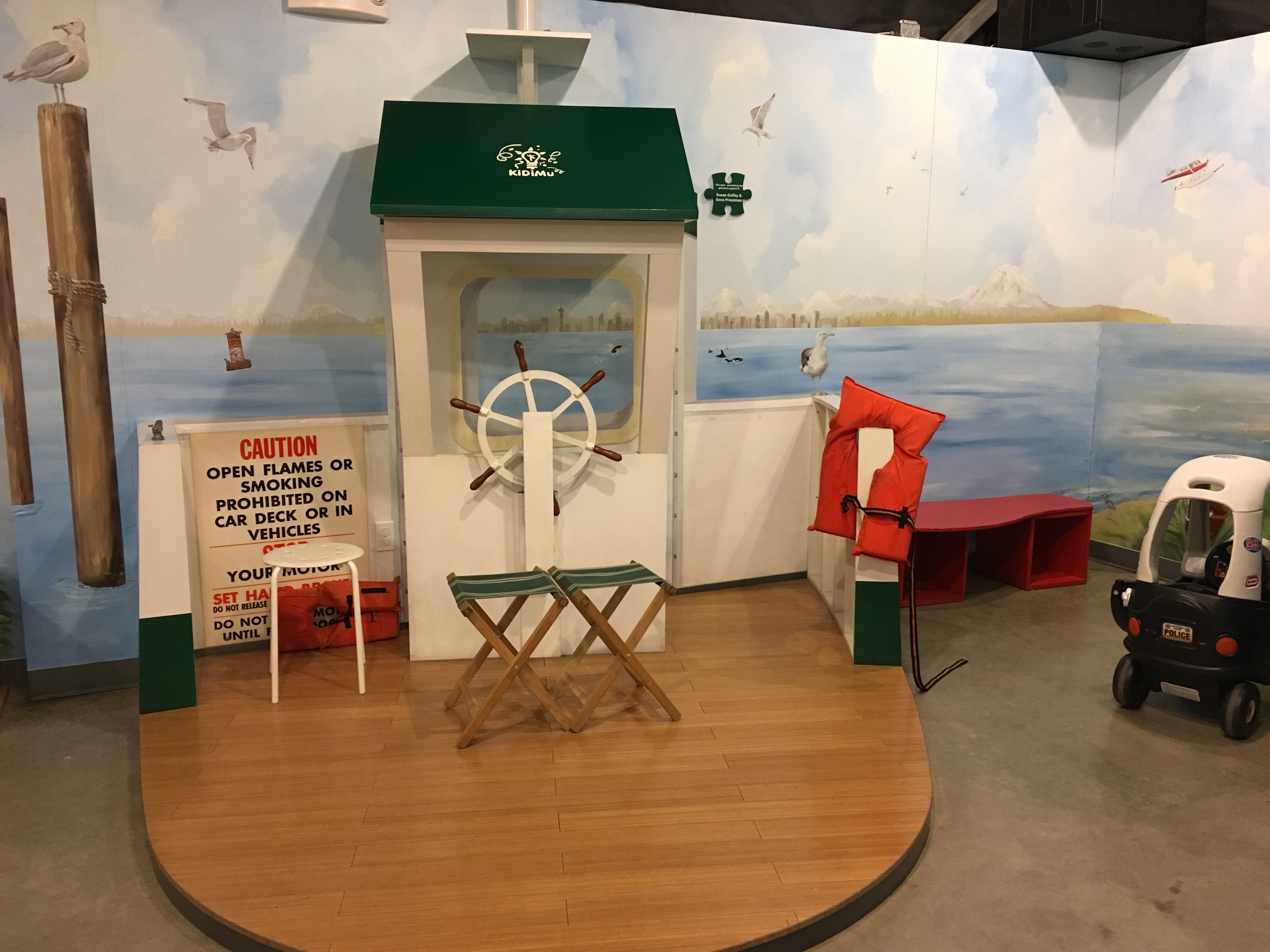
Plus a pretend ferry boat to capture the island experience.
Building Zone
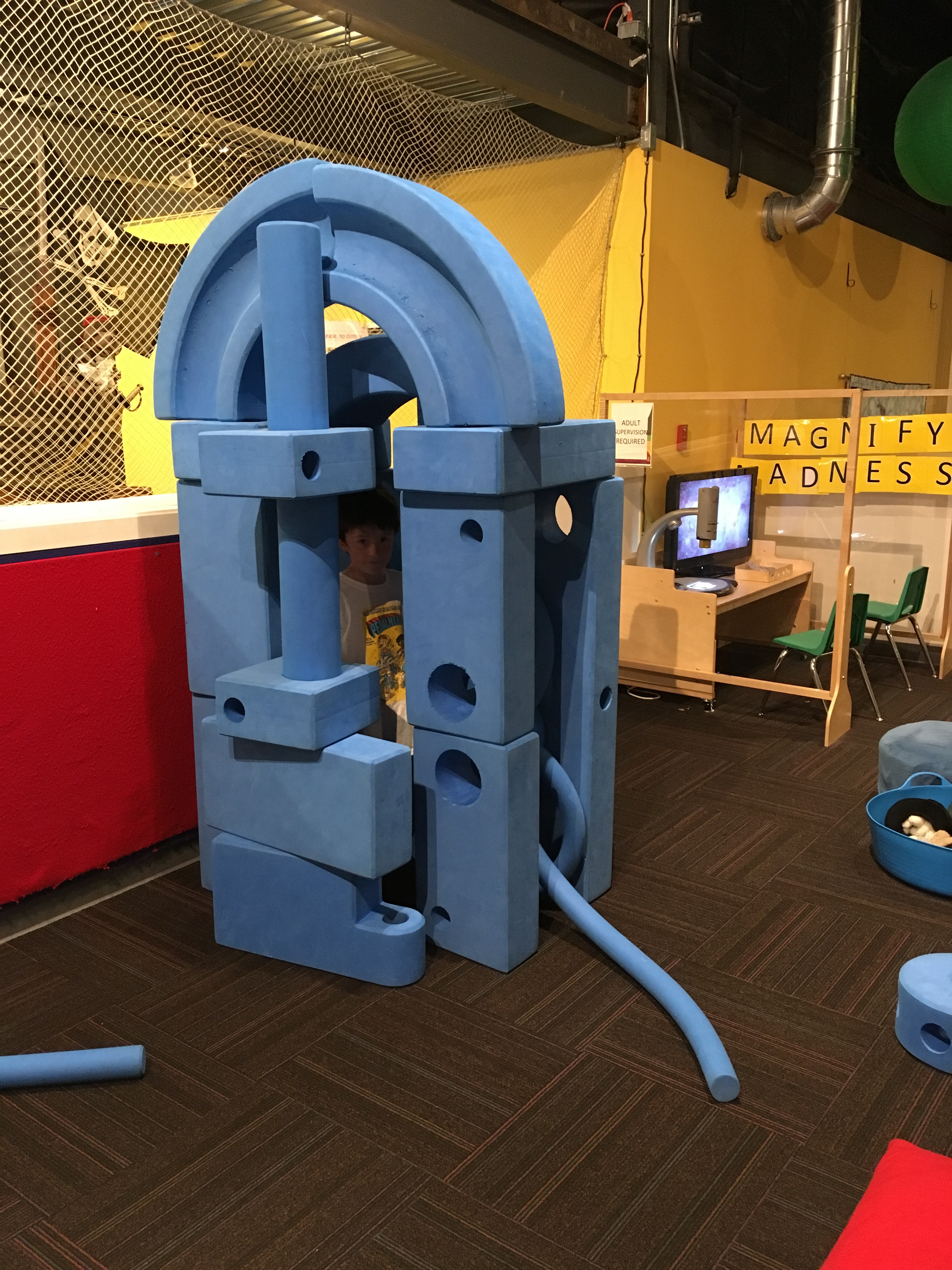
This featured Fort Blocks, which I hadn’t seen before. The cool thing about them is they are big, and you can build pretty big structures with them. The down side is that even for our seven year old who has experience with a lot of building tools, they were a little tricky to assemble… he could build a wall of them, but couldn’t really figure out how to get them together to form a 3D cube.
Grocery Shopping and the Mail
My son LOVED the grocery area when he was four. At age 7, he passed it by. But it’s a nice grocery area, with plenty of plastic foods and food boxes to weigh, to load in your bag or cart, and to check out at the cash register.
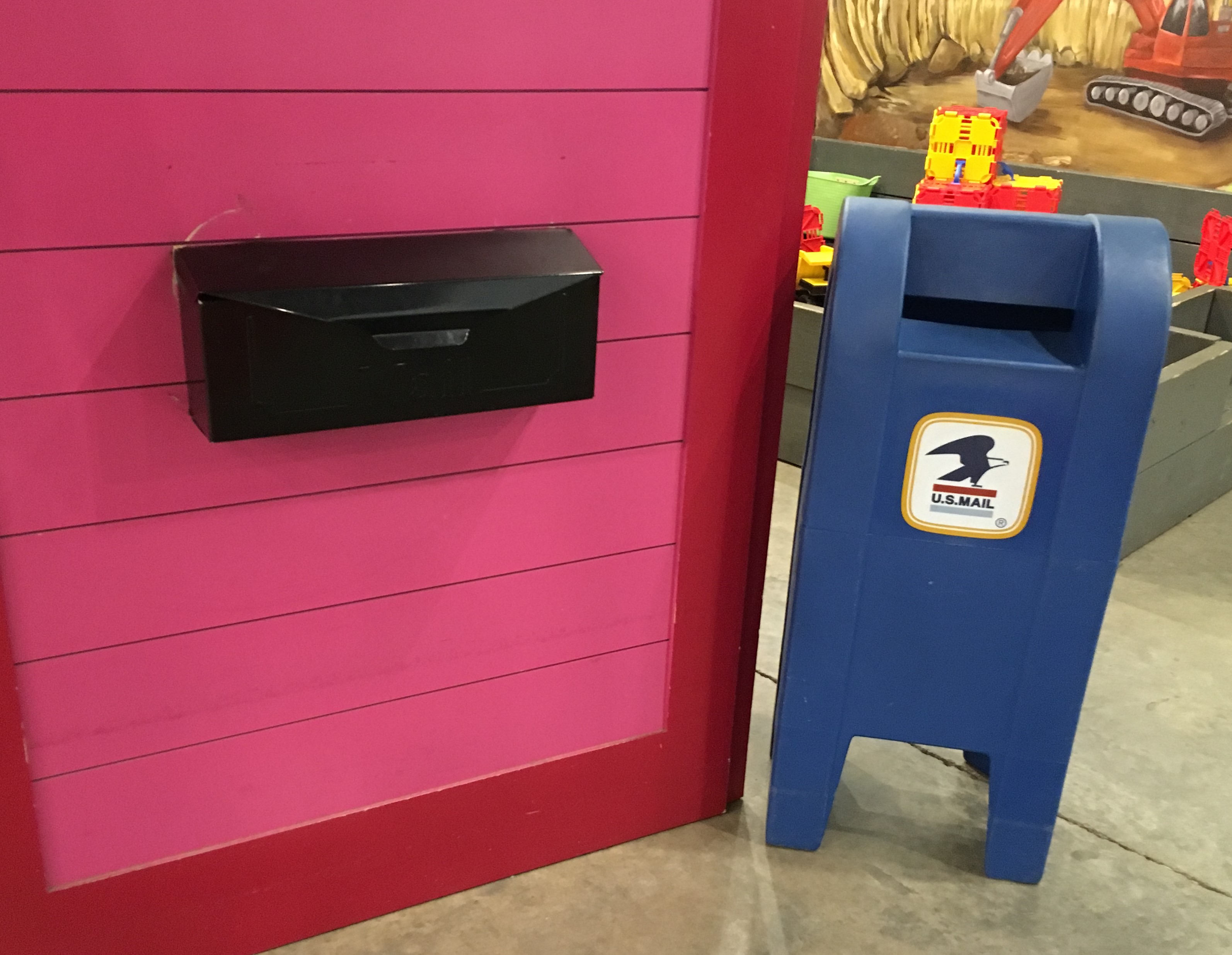
Outside the store was a mailbox, with pretend letters to put in and take out, and there were several residential style mailboxes on walls nearby so your child could “deliver the mail.” I can see a three year old loving this play opportunity!
Outdoors
They have a climbing wall, gravel to load into buckets and dump trucks and transport around the area, and a water table.
Upstairs
There’s a giant Lite Brite board (where you push the colored pegs into the board and they glow) which appeals to ages from toddler to adult.
At the Magnifying Madness station, you place a card under a microscope and the image is projected on the screen. We had fun bringing up a family photo on our phone and placing that under the microscope to project.
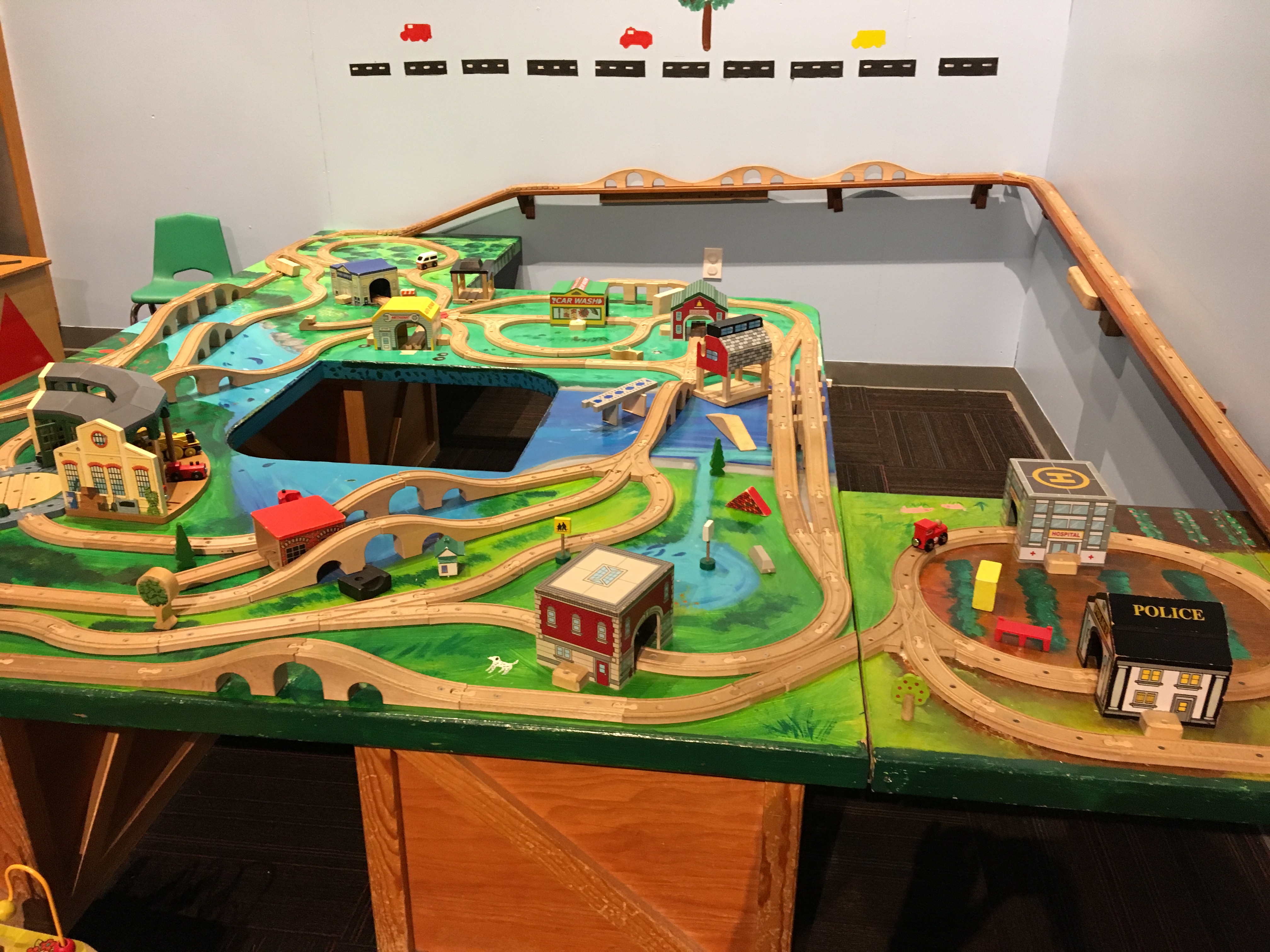
They have a small train table for free building tracks on,
and then a large track layout for playing on.
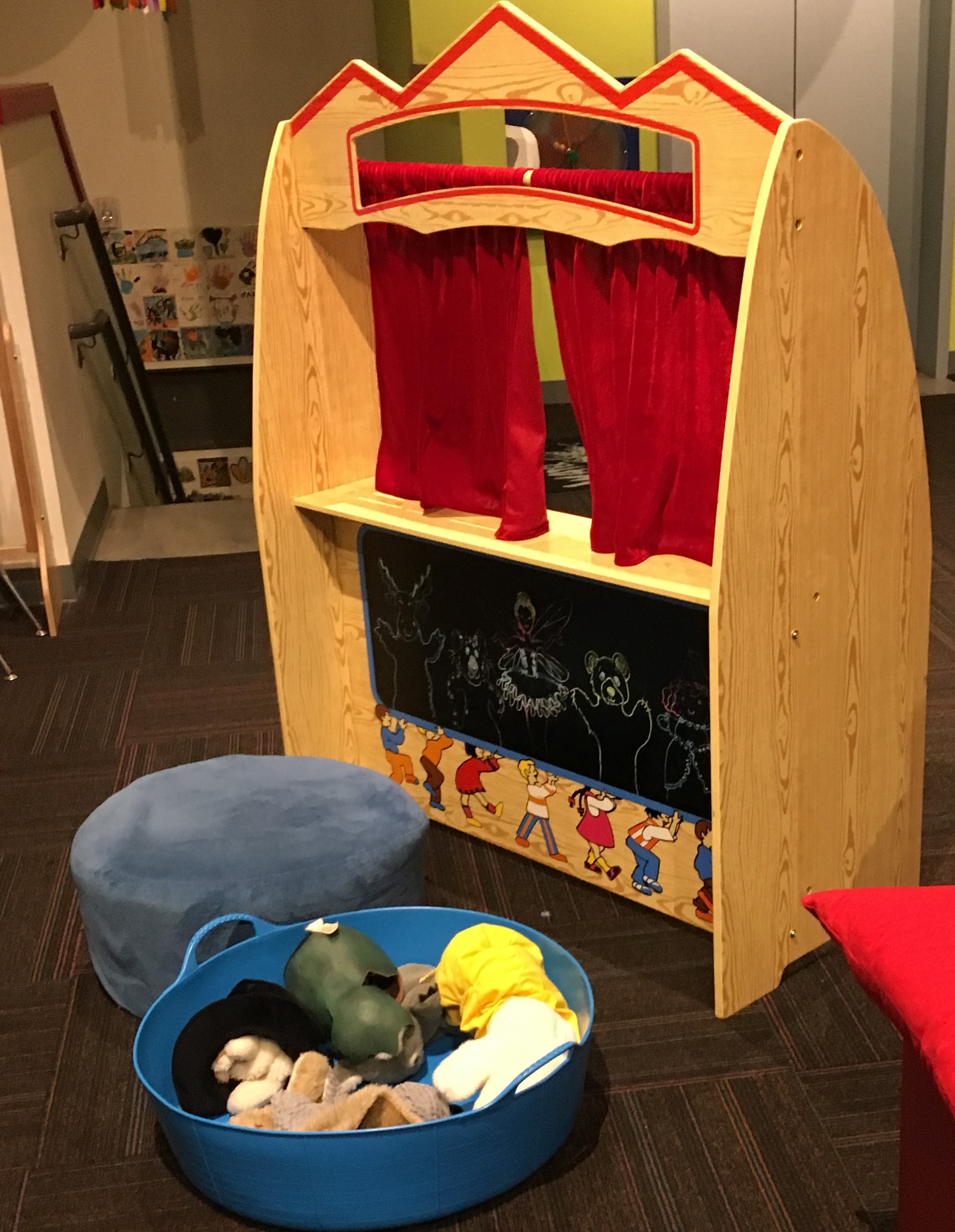
There’s a puppet theater for putting on a show, with books nearby for inspiration.
And blue foam blocks for building.
Motion Madness
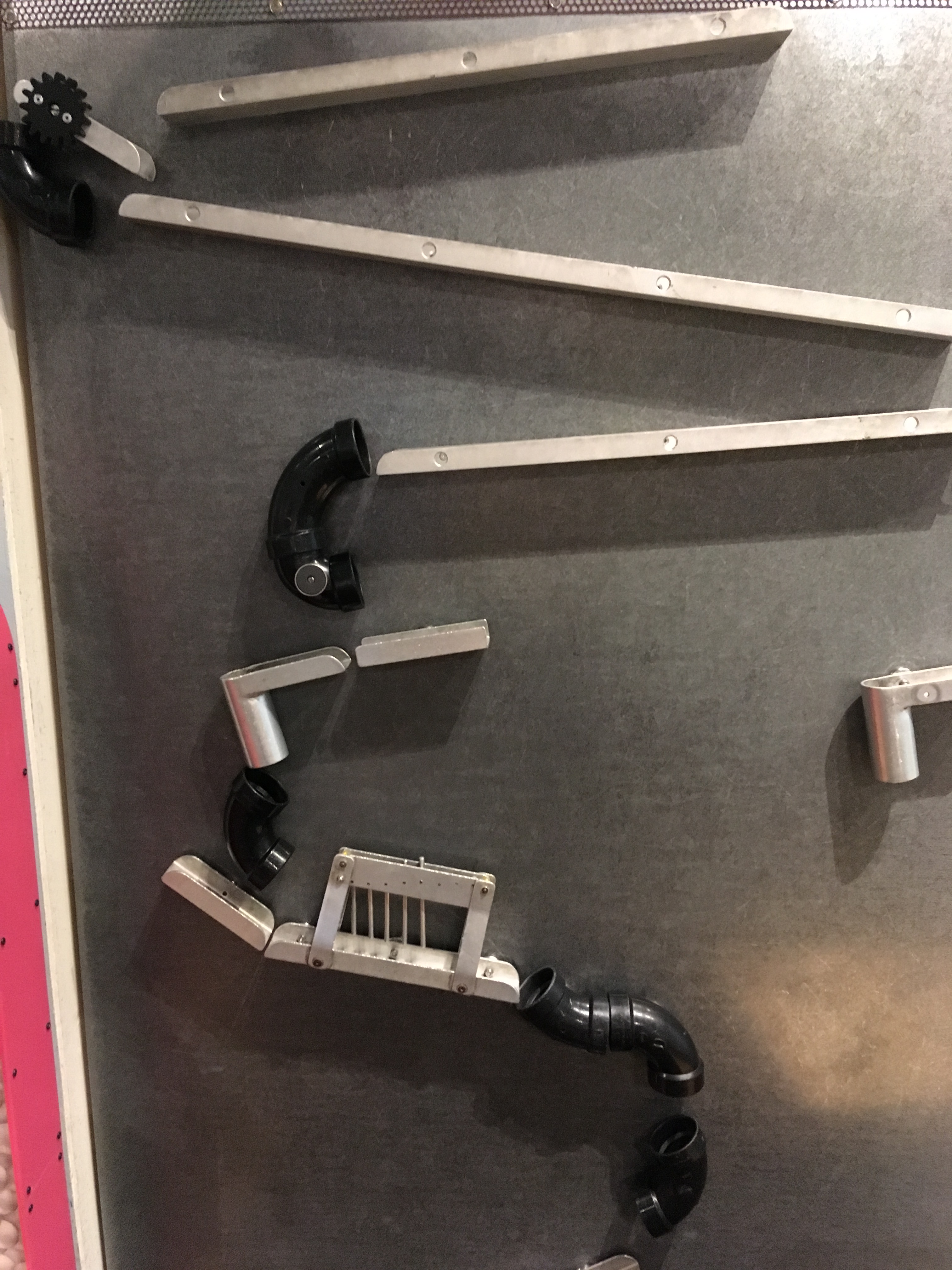
The remainder of the upstairs area is Motion Madness – Fun with Physics where there are several different exhibits to explore motion with golf balls. This is our favorite part! There’s this tower, where you simply place golf balls on the track at the top, and they roll down.
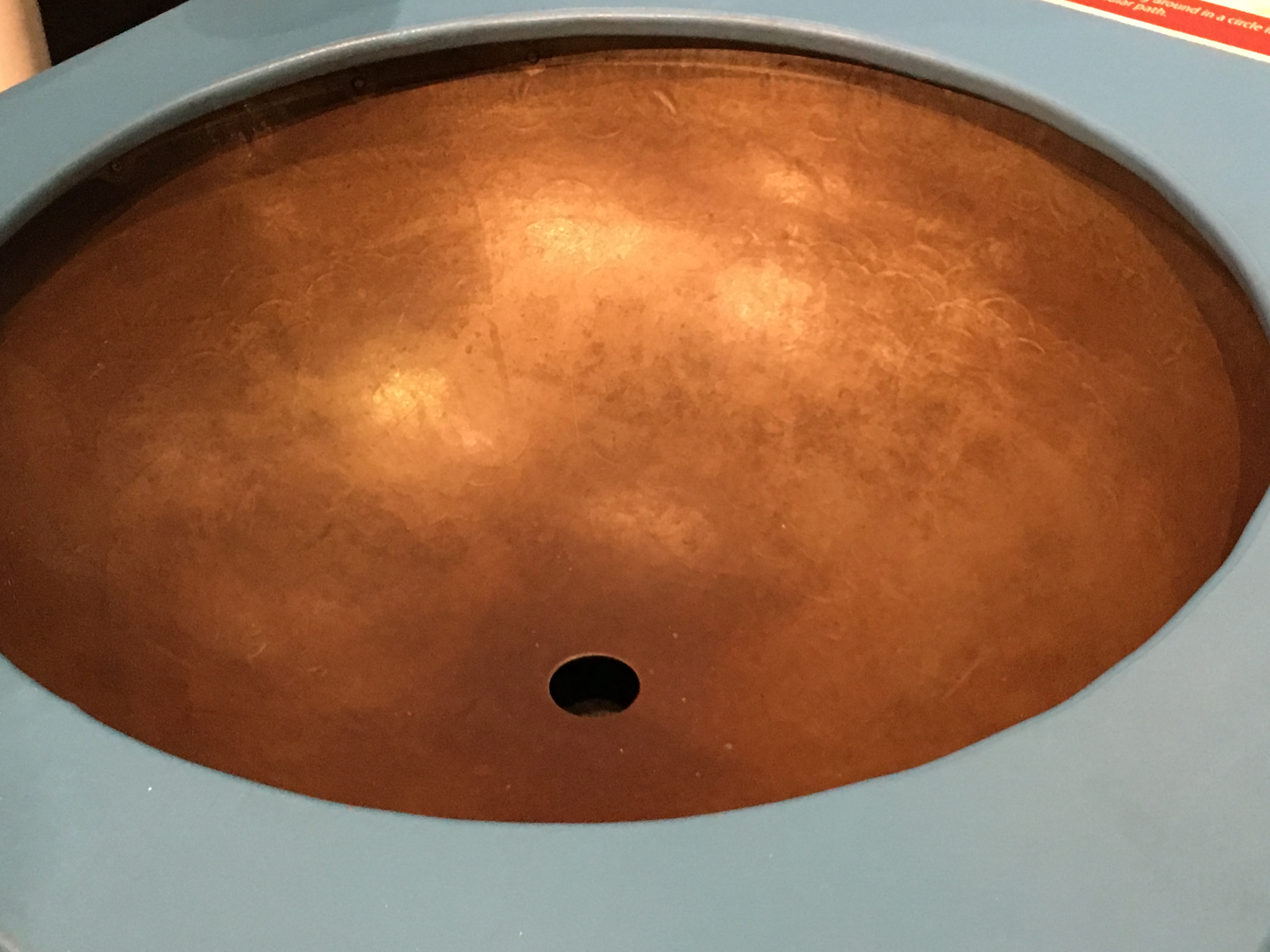
There’s a gravity well, where you drop the balls in and they spin round and round before falling through the hole in the middle.
A skee-ball style ramp game.
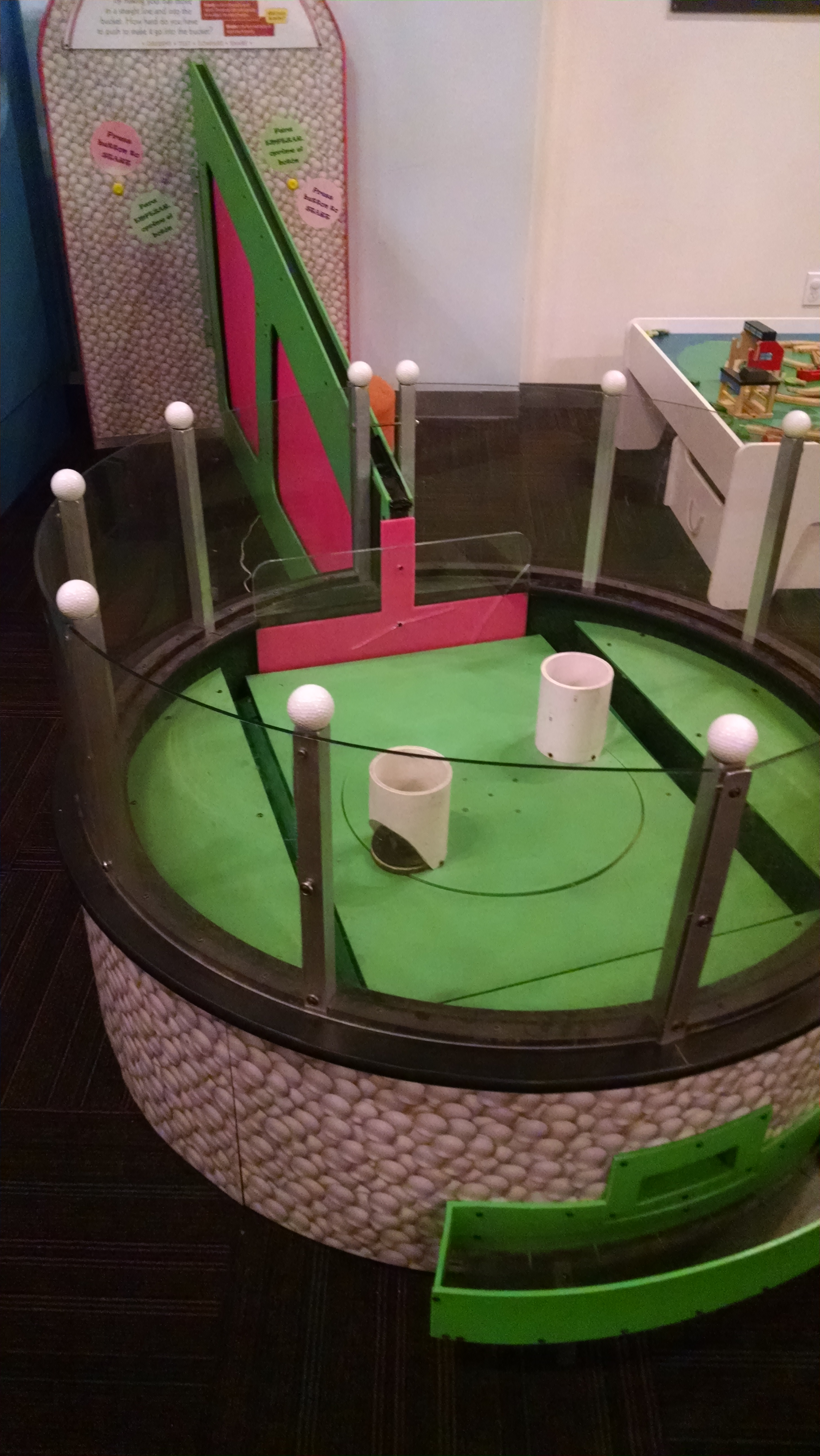
Another ramp that has a rotating platform at the bottom, where you have to time your ball drop just perfectly in order to get the ball in the cup.
A ball maze that you can take apart and re-build. (I LOVE ball mazes – I think they are a great place for kids to explore the idea of tinkering – you build it, test it, adjust it till it works, test it more, then re-build it to be even cooler.)
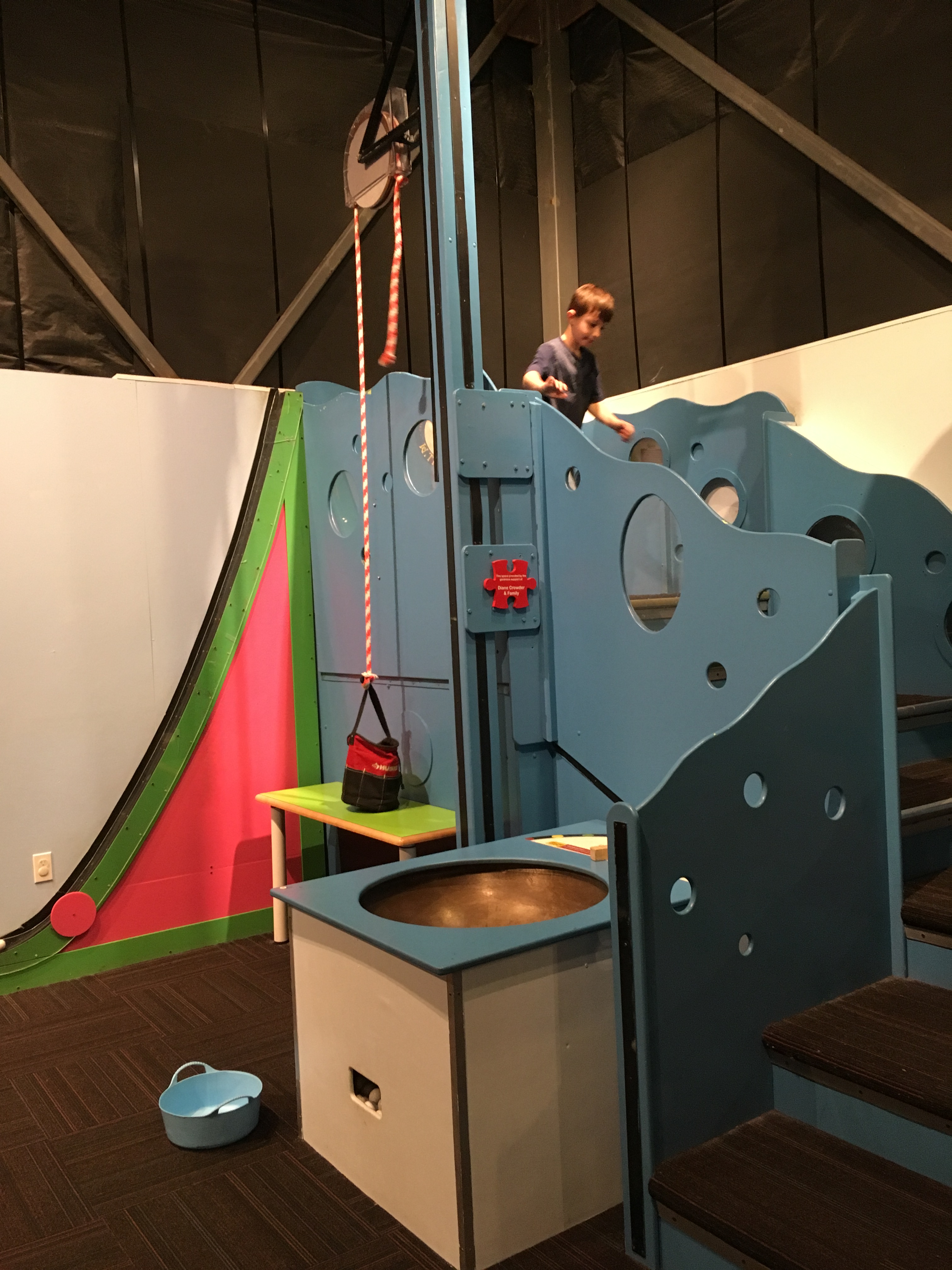
And, my favorite… a tall platform you climb stairs to get to. There’s a basket on a pulley that you can load up with balls at the bottom, then use the rope to haul it up to the top.
From the top, there’s a giant ramp to send the balls down.
Treats in Town
When you finish at the museum, it’s easy to take a short walk into town (Winslow) for treats. We saw a pizza place, many lovely looking restaurants, wine-tasting venues, and a bakery. (Here’s a dining guide.) We decided on ice cream at Mora. There was a huge line outside, but they had seven people on staff, and moved us through quickly. And the ice cream was great! We had the dulce de leche and the strawberry cheesecake. Next door to Mora was a crepe place, and we were tempted to try that… maybe next time. After ice cream, we did the 0.5 mile walk back to the ferry for our trip home.
Other Activities on the Island
Next door to the Children’s Museum is the Bainbridge Island Museum of Art, which offers free admission. In the downtown area, there are also many art galleries and gift shops, which looked quite nice, but we’re not really a shopping family. (Although Eagle Harbor Books was a very tempting option.) If you choose to bring a car and/or stay longer, you’ll find lots of info about lodging and activities at www.bainbridgeisland.com.
Getting There
Use Transit to the Ferry Terminal
Use Metro Trip planner (or Google Maps or whatever) for directions to the ferry terminal in downtown Seattle (Colman dock). In our case, the easiest route is to take a bus to the Pioneer Square station in the bus tunnel, then walk 0.3 miles to the terminal.
The bus fare is $2.75 for adults, $1.50 for kids age 6 – 18, and free for those under 6. If you don’t often take the bus, read How to Ride Metro. Buses can be delayed off schedule, so I also find it helpful to download the One Bus Away app to my phone, which gives up-to-the minute updates on when to expect your bus to arrive.
We usually bring a couple books along in case our child gets antsy on the bus. But often he’s happy to just look out the window for the ride.
Now, obviously you could drive to downtown Seattle and park, but that would be pricey! Or you could drive to Seattle and take your car on the ferry – but then you have to be there much longer before ferry departure time, and it’s more money and more effort, and makes this trip actually MORE complicated than just walking on the ferry and walking into town.
Taking the Ferry
You can find the ferry schedule here. The ferry runs approximately every hour, but the schedule varies greatly, so be sure to check it if you’re picky about your timing. As a walk-on passenger you only need to arrive ten-ish minutes before a ferry time. There is no need to make a reservation to walk-on, as there’s usually plenty of room for passengers. When you arrive, buy your tickets, or use your Orca card. Fares are $8.35 round trip for adults, $4.15 for kids 6 – 18. Here’s a FAQ with more info.
The ferry trip is a lovely little cruise across Puget Sound. If you want a preview of what the trip will look like, just go to YouTube and search for Seattle to Bainbridge ferry, and you’ll find lots of videos of varying quality.
If you haven’t taken a ferry before, you should! My husband and I had a conversation on this trip, and we think that if someone is visiting Seattle for a few days, the 5 most quintessentially Seattle experience you could have are: Pike Place Market, the Underground Tour in Pioneer Square, seeing the view from the top of the Space Needle, riding the monorail to MoPoP, and taking a ferry. Not that we don’t also love the zoo, and the science center, the aquarium and more, but we think those 5 are the things most unique to Seattle.
The ferry crossing is only 35 minutes. We eat lunch on the ferry (Ivar’s chowder and hot pretzels!) and you pretty much have to go straight to the restaurant as soon as you board, get your food, sit and eat, and you’ve arrived. On a nice day, you might instead opt to stand outside on the deck and enjoy the view. If it’s a rainy day, bring along a deck of cards, or you can often find a public jigsaw puzzle in process somewhere on the boat.
Getting to the Museum
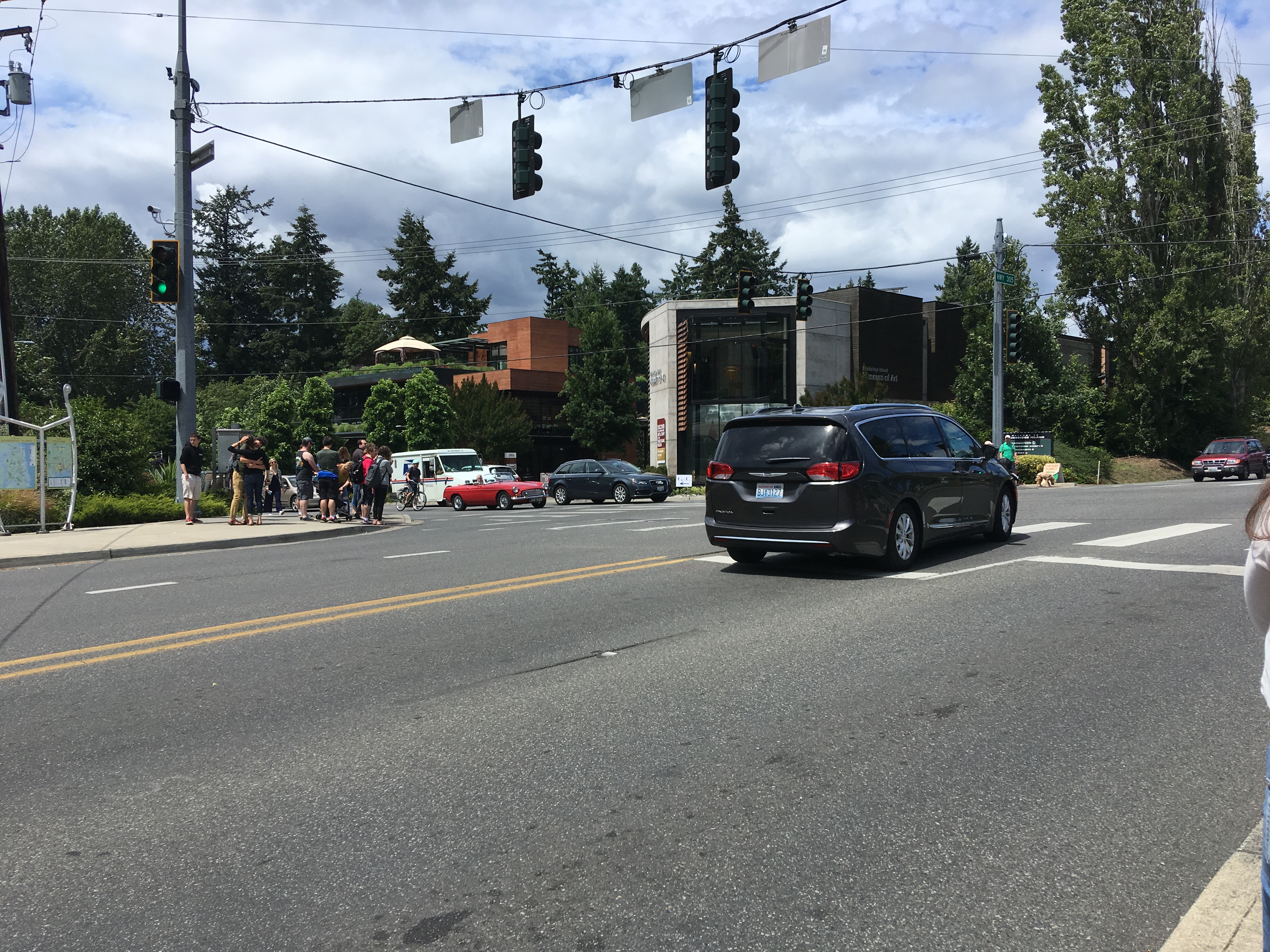
When the ferry arrives, just walk off with everyone else… this puts you on a road walking straight into town. (Here’s a map to orient you.) In about 1/4 mile, you’ll come to the first real intersection. That’s Winslow Way East. Look across the street to the northwest corner of the intersection – you’ll see the art museum there.
There’s a path between the art museum and the building to the west of it. Walk down that path and you’ll come to Ki-Di-Mu.
Costs:
For our family – 2 adults and a 7 year old, it was $7 each way for the bus, ~21 for the ferry, $24 for the museum, plus the cost of lunch on the ferry and ice cream.
For school year fun and learning (for you and your child), consider taking a parent-child class (for ages birth to 7) sponsored by the parent education program at one of our local community colleges. We offer everything from parent-baby classes to coop preschools to art and science enrichment for elementary age kids.
A sensory bin is a simple toddler play activity: take a plastic tub, fill it with rice (or another filler), add scoops and containers to pour into (or other tools) and a few of your child’s small toys, and let your child play. The benefits for your child are: learning to use tools, using fine motor skills, and sensory exploration. The benefits for you are that your child will play independently for quite some time while you get other things done! (Expect some clean-up time when you’re done!)
Children are curious about all things in life, and that includes being curious about death. As adults, we may feel like it’s not a polite thing to talk about it, or that talking about death is morbid, but it’s a normal thing for kids to be interested in. And it’s helpful to talk openly about death long before a child experiences a loss of someone they care about. Here are tips on: finding teachable moments, big ideas to talk about, talking about the loss of loved ones, grief, and using media to open the discussion.
Teachable Moments
Parents in my classes ask: “when should I talk to my child about death?” I say: whenever a teachable moment presents itself. Because death is a part of life. There will be plenty of chances to talk about it.
Here are just some of the opportunities I’ve encountered with my youngest child in the past year or so that led into conversations about death:
Once, on the walk to my son’s kindergarten, we saw a dead squirrel. Another time, we found the leg of a bird, and then there was a lost cat sign up for months, which led to lots of discussions of what might have happened to the cat. On the way to first grade, we drive past a cemetery.
On Memorial Day, he asked whether we would have a party for this holiday, and I explained that we honor Memorial Day but don’t really “celebrate” it, which led to a whole discussion of death, war, what is a generation, and so on.
A member of our church, a teacher at school, and a student at school have died, and he heard people speaking about these deaths and being sad about them.
His older sister’s pet gecko died and we buried it together.
We heard on the news about many people being killed in a shooting. (I try not to listen to the news much around him… but this was a TV that was on in a public place.)
His pea plant died.
We see flowers on a sign post on the side of a highway where a fatal car accident occurred.
Somehow at school, a discussion came up of the danger of thunderstorms, and he worried for a few days about whether his dad would be struck by lightning and killed.
He was wondering about heaven.
He’s seen death occur in many books, movies, and TV shows.
Each time one of these ‘teachable moments’ came up, we talked openly about death, the dying process, and grief. None of these were long drawn-out, or stressful conversations. Most were brief (thirty second? one minute?) discussions, where I try to be as matter-of-fact about things like decomposition as I am about things like new buds coming out on a tree. I try to talk about grief as a natural emotion similarly to how I talk about other emotions. I talk about what I believe happens after death as I talk about other aspects of my spiritual beliefs. So, this had been a conversation we’d been having with my son on random occasions for years.
And… then his grandmother died. My mom had Alzheimer’s and had been fading for a few years. We had been open with my son about this and the fact that she was no longer able to do the things she had done before. Then, I had to travel to be with her for a few days as we moved her into hospice care, and then my husband and I traveled for her funeral. Around this time, we had lots of long conversations with my son about death.
I was so glad that we had a long history of open and honest conversations about this part of life. I can only imagine how hard it would be for a parent who had tried to avoid this subject for years to suddenly have to explain it for the first time when she is managing her own grief over the loss of a parent and the child’s loss of a grandparent.
Developmental Stages of Understanding
When talking with a child about anything, it always helps to have some knowledge of their developmental stage, and what they’re likely to be able to understand, versus what might simply be over their head at this age. Here is how children’s understanding of death evolves:
Preschool age (3 – 5). Even if you explain what death is (when something living stops functioning – stops breathing, growing, etc.), they may not be able to grasp what you mean. They may believe death is temporary and reversible. Although children see many deaths in movies and stories, they don’t really see a lot of what happens afterward when that character never returns. If someone you loved has died, expect that the child will ask from time to time when that person is coming back.
Early elementary age (5 – 9): Children come to understand that death is final. They aren’t clear on what causes death. They also learn that all living things will someday die, but tend not to yet grasp that they themselves will someday die. The child may ask a lot of questions about death – it’s not morbid, it’s just trying to understand a complex topic.
Tweens (age 9 – 12): They understand what death is – that organisms no longer function in the way they did when they were alive. They understand that death is final, and that they will die someday.
Teenagers: Begin to wonder about the meaning of life and form beliefs about what happens after death. Some begin taking risks, as if to test their own immortality.
There are a few key ideas about death to convey at some point – not all at once, but in multiple minute-long conversations through their childhood:
Death is the cessation of life functions. Use simple terms and concrete examples from their life experience. “When an animal dies, it no longer breathes, or eats, or moves or feels hungry.” “Do you remember when your pea plant died, and it stopped growing?” “Their heart stopped, and their brain doesn’t work any more.”
Death is caused by physical reasons. Describe in a simple, non-graphic way what caused a death. Explain enough that they understand… for example, don’t just say “she died because she was sick”, because then the next time your child is sick with a cold, they might think they might die. Explaining something like “she’s really sick, with a disease called _____. It’s not something I would expect you or me to get…”
It’s not your fault. Children are inherently self-centered – their world view rotates around themselves. This can often mean that if someone dies, they wonder if it was their fault. “I said ‘I hope you die’ and then they did!!!” This can lead to a lot of guilt and shame. Reassure them that the death is not their fault.
Death is permanent.
Don’t confuse them by saying the person “went to sleep” because then it can be scary to go to sleep, or saying the person “went away” because then they will worry when you “go away” to the grocery store that you may never come back. Using the word death is actually helpful to reduce these anxieties.
Everything that is alive will someday die.
You may also address that different things have different expected life spans. We might expect some pets to only live for a few years. We expect people to live for many decades. (Again, you may need to reassure them that you or other important adults expect to be around for a long while still.)
At some point, we’ll need to acknowledge that not only old people / animals die. It can happen to someone very young, it’s just less likely
Share your own beliefs. One of the reasons it’s important to talk to your children about hard things (read “Better You than YouTube”) is so you can share your own values with them and talk about the beliefs that are important to your family.
You may worry that you don’t know what to say about things like what death feels like, or what happens after you die. It’s OK if you don’t have all the answers. You can say to your child “No one knows for sure. I believe ________.”
In some family’s beliefs, those who have passed away continue to be present in some way – you might say things like “grandma is watching over you” or “someday you’ll see him again in heaven”. This is fine, just be clear that we don’t expect to see that person in our world again, just so children don’t get confused about what to expect, or expect that person to be present in the same way they used to be.
Note: one thing that can confuse children is when parents say things like “he’s happy up in heaven now” but the parent is clearly grieving and sad. They may not understand why you’re sad about something that makes the departed one happy. You can explain that you are sad the person is no longer with you, and you can’t spend time with them any more.
Talking about the Possibility someone they love will die
Be thoughtful about whether you bring it up.
There’s typically no reason for you to push the topic or start the conversation, unless you believe a death will come soon to someone they care about. (Just as we’d talked to my son about his grandmother as she declined, when our 16 year old dog was ailing, we let my son know that Rufty might not be with us much longer.) This honesty about a coming loss allows them to build special memories, and say some goodbyes so there are fewer regrets later on about what was not done or said. (Note: I have a full post on how to talk about things if a child’s parent is facing a terminal diagnosis or in hospice care.)
If there’s not an impending death of a loved one, I wouldn’t really bring up the possibility. But… if they bring it up, don’t change the subject.
Let them know it’s OK to talk about it, and you’re glad they feel comfortable asking you.
If they’ve asked a question:
clarify exactly what they’re asking. Sometimes they want just a simple basic answer and we go into the Big Talk about everything they’ll ever need to know about death and totally overwhelm them.
Turn the question around, and ask them what they already know. This lets you set a baseline for what you need to talk about versus what they already understand. It also allows you to correct misconceptions. For example, if they ask when someone will come back to life, we may need to explain the permanency of death, and how it’s different than when kids just “pretend to be dead” while playing.
Address underlying concerns. Often when someone asks a question, there is an underlying concern behind the question. If your child seems worried when they ask you about something, think what fear might be behind the question. If a child asks you “can parents die?”, they may really be asking “will you die? Who will take care of me?” If you suspect this is the case, you can put it into words for them: “are you worried I won’t be here to take care of you?”
Reassure. First, unless you have reason to suspect otherwise, say “I don’t expect [that person] to die any time soon. I know that idea feels scary to you, but I expect [they] will live for a long time yet.” (Note, you didn’t promise anything, because we can’t ever really promise that.) Then reassure that even if that were to happen, they would be OK: “But if I did die, here’s who would take care of you.”
Talking about Grief
Don’t be shy about talking about grief. It is one of many emotions that we humans experience. (Emotional literacy is a key life skill we want our children to gain.) Sadness about someone’s loss is a reflection of the fact that they mattered to us. Share what your feelings have been about various losses in your life.
But also talk about the wide range of reactions that people may have. Some may be sad. Some may be angry. Some may not seem to react at all. Sometimes there is a feeling of relief. Sometimes all these moods come and go unpredictably. And some may react on a different schedule. It’s all OK.
Know when to move on.
Sometimes your child may ask more questions in the moment. Sometimes not. Your child may have initiated a discussion about death, then they seem ready to move on before you think “we’re done talking about this.” Follow the child’s lead and move on. Prolonging the conversation will only cause discomfort.
Sometimes there losses that we would consider big in a child’s life where they don’t seem to react. Give them time and space for their own reaction. And other times, there are things we think of as small sadnesses – seeing a dead bunny by the road, or a death in a storybook, where our child may suffer deep grief. Don’t dismiss these feelings or tell them “don’t feel bad.” Honor their right to their feelings, whatever the cause.
Don’t avoid talking about the person who has died. Even though they’re no longer here, you can still remember them. Your child may want to do a ceremony, or create a shrine to help them remember. You could establish new traditions of continuing to do a favorite thing they did with the person who has passed away.
Your child may need help remembering that the person won’t come back. They may ask again and again when they will return. They are not doing this to upset anyone. They’re just wrapping their minds around the permanency of death.
Your child may “play” death. They are just trying to understand. It’s fine to use puppets or stuffed animals to tell the story or play things out. It may also help your child to draw their feelings and memories.
Many children will regress or have behavioral challenges after a death of a loved one. Be patient and understanding with them, but don’t overly coddle them. Normal family rules should still apply. The sooner you get back to normal routines, the better. This helps you all move forward to the “new normal” of what your life will look like in the future.
If a loved one has died, you may decide not to have the child participate in the funeral. If they will attend the service, be sure to prepare them – telling them who they will sit with, how they should behave, and what will happen. For example,
“Lots of people who loved Grandma will be there. We will sing, pray, and talk about Grandma’s life. People might cry and hug. People will say things like, ‘I’m sorry for your loss,’ or, ‘My condolences.’ Those are polite and kind things to say to the family at a funeral. We can say, ‘Thank you,’ or, ‘Thanks for coming.’ You can stay near me and hold my hand if you want.” (source)
If the person’s body will be at the service, talk to your child about that. (Note: although people worry that seeing a body would be upsetting to children, they typically take it in stride). Explain burial if they will go to the cemetery. Explain if there will be a wake or reception of some sort – explain that people will talk and share happy memories of the one who has passed.
If you expect to experience a lot of strong emotions at the funeral, you may want to either not bring the child or ask another adult to help care for the child and sit with the child during the service. Remind your child that it is not their fault you are sad.
There are several excellent books and some shows that are explicitly designed to help children understand death and manage grief. There are also many excellent books and movies that include a death that you can use to help you start a conversation.
To learn how (and why) to talk about other difficult topics with your child (including sexuality, “tricky people”, scary topics, and more: read Better You Than YouTube.
















 More Good Days with Kids