Author Archives: Janelle Durham

Unknown's avatar

About Janelle Durham

I am a parent educator and social worker, and teach music and science to children age 1 - 8.

Easy Play Anywhere Games

It’s super helpful to have ideas for simple games that can be played anytime / anywhere, so when you’re stuck in a line or a waiting room, you’ve got a way to entertain kids.

Most of these work best for children age 5 and up. A few, like I Spy and Scavenger Hunt, are good for younger kids – I’ve marked those with an asterisk.

Talking / Listening Games

These games can be played anywhere, with no materials. (They even work great over the phone or on Zoom.) They can work with two people or with a group. No need to move around to play, so they’re good for restaurants, car trips, etc.

Progressive Stories. One person starts a story: “Once upon a time, a polka-dotted elephant…” then the next person continues “… boarded a spaceship headed for… “

Packing the Suitcase. One person starts with something like “My aunt was going on a trip to Japan and she packed her toothbrush…” and the second person says “My aunt… packed her toothbrush and a four leaf clover.” The third person repeats what has come before and adds a new item. Keep going till someone makes a mistake.

Two Truths and a Lie – Each person tells two true things about themselves and one lie. Others have to guess the lie.

Would you Rather? Ask any question using the format “would you rather ______ or _______” and the other(s) choose their preference, and why.

Fortunately / Unfortunately. One person starts a story with something as simple as “One day I decided to go for a picnic in the park.” Then the next person says “Fortunately [fill in the blank]” then someone else jumps in with “Unfortunately [fill in the blank]” and keep on going… on and on…

Never Have I Ever: One person says “never have I ever _______” and describes something. If you’ve never done it either, you leave your fingers down. If you HAVE done it, raise a finger and keep holding it up. The next person says “never have I ever”. At the end of the game who ever has the most fingers up “wins.”

Play 20 questions. “Is it an animal, vegetable, or mineral?” (Learn more.)

Geography. Someone names a place (city, country, whatever category you decide on). The next person needs to name another place that STARTS with the letter that one ENDED with. So, for example, CaliforniA, ArkansaS, South CarolinA. Can also do animals or other categories following the same rules.

*I’m thinking of an animal that starts with the letter A. You say that… someone guesses it, then it’s their turn to say “I’m thinking of an animal that starts with the letter R, or whatever. Instead of animals, you could do Star Wars characters, Pokemon, or whatever. [For younger children, simplify this by describing things: “I’m thinking of an animal that’s small and brown… we’ve seen one in our backyard… it has long ears…”]

Categories. On NPR’s Sunday puzzle, he sometimes has a puzzle like “If I give you the 5 letter word Piano, can you give me five women’s names that start with the letters in PIANO?” (e.g. Paula, Inez, Amy, Nadia, Olivia). We pick any five letter word, and do categories like “Cities in Washington” or “Models of Car” or “Animals” or whatever.

And if all that was too cerebral, try: Rock Paper Scissors and Thumb Wrestling.

*I Spy. One person finds something they can see around them, says “I spy with my little eye….” The other person searches for it. When they find it, it’s their turn. For toddlers, this is simple “I spy something red” or “I spy a dog.” For older kids, it’s more sophisticated “I spy something starting with the letter L” or “I spy something that was made before 1980.”

Paper and Pencil Games

These just require something to write on. Paper, white board, the Zoom white board, etc.

Tic-Tac-Toe. Draw out a grid – you and opponent take turns drawing in X and O.

Hang Man. You come up with a word, draw out the hangman. Participants guess letters.

*Doodle Game. One person makes a random scribble, then the other person needs to use that scribble as the foundation for a drawing – creating some artwork that somehow includes that scribble. For young children, they always do the scribble, the grown-up always completes the drawing.

Dots and Squares. Draw several columns of dots. Person 1 draws a line between two dots, then person 2, then person 1 again… whenever they complete all four sides of a box, they write their initial in the box.

Draw on Your Head. The child places the paper on top of their head. Then you give a clue, like flower, bird, house, etc. They draw a picture on top of their head without looking, and then share it.

Find details on these and more pen and paper games here: https://www.thelondonmother.net/easy-pen-and-paper-games/

Moving Around Games

*Play Simon Says. Or Red Light, Green Light. Or any of the MANY variations on Tag.

*Scavenger Hunt Fetch. Ask child(ren) to find certain objects – they run and find it and bring it back.

*Charades. Give a clue to one person – they act it out – others guess. For younger children, you act things out, they guess.

On the Move Games

These are for when you’re walking or moving in a car or on a bus or train…

License Plate Game. How many states or provinces can you spot license plates from over the course of a trip. If you print a map of the states, your child can color each in as they find the license plate, which will reinforce geography knowledge for them.

Find the Alphabet on Signs. Find a sign with the letter A on it. Then another sign with the letter B. And so on. (Or do the same with numbers.)

*Find Colors. Spot something red, then orange, yellow, green, blue, purple…

*Scavenger Hunt. Prepare (or find online) a list of items to try to spot as you travel. Or you can create Bingo boards. For younger children, just tell them one idea at a time to search for – can you find an animal?

Punch Buggy. If you see a Volkswagen Beetle and call Punch Buggy, you get to punch someone. P’diddle, P’daddle. After dark, if you see a car with one missing headlight, you say p-diddle, and if you see a car with no headlights, you say p-daddle. You get to kiss someone.

Encore. Name a word – other people try to sing songs including that word.

While You Were Sleeping. When someone wakes up from a nap, make up a crazy story of “what they missed”.

There are more fun ideas for road trip games here: https://www.erieinsurance.com/blog/road-trip-games-to-play


Connecting to Nature from Home

TL; DR: There are so many physical and mental health benefits of spending time outdoors and connecting with nature. But parents may face barriers to getting outside. Perceived barriers could be: the parents’ lack of knowledge / experience with nature, minimal access to wild lands, and health/disability issues which limit ability to explore outdoors. This post will highlight super simple ways to connect more to nature by just looking out your window more, by bringing a little of nature into your home, by spending time in your own yard or in any outdoor space, or by using webcams and educational videos to learn more about nature.

Looking out the window:

Studies of hospital patients have shown decreased need for pain medications and shorter post-operative stays for those who can see nature outside the hospital window. Here are some things you can do without even going out:

  • Weather Checks: Notice what the weather is, even if you’re not going out. Teach about weather. In my lesson plan about Weather Science, you’ll find ideas about teaching weather vocabulary, drawing the weather, creating weather charts, observing and identifying clouds.
  • Notice seasonal changes: The view outside your window is always changing. Maybe the flowers are blooming, or the leaves are changing colors. With your child, take a picture from the same view once every week, and then compare them side by side to notice what has changed.
  • Gaze at clouds – what shapes do you see?
  • Keep a tally: Decide what you’ll count: birds? people passing by? dogs? cars? Whatever it is, looking outdoors and counting means lots of time looking outdoors!
  • Tell stories: when a car passes by, imagine who is in it, and what they might be doing.

Bringing Nature In

Try any of these easy activities:

  • Dissect vegetables and fruits. When you’re prepping food, try “dissecting” it with your child – carefully cutting it apart and examining the parts. You can use books or the internet to learn more about plant parts. Save your seeds – apple seeds, cherry pits, or whatever.
  • Sprout seeds Use seeds you saved, or dry beans. Fold a paper towel, wet it, put it in a ziplock baggie. Add a seed. Seal the baggie and tape it to a window with the seed facing in where you can see it. Wait a few days.
  • Once you’ve sprouted your seeds, if you have access to dirt or potting soil, you can plant them. You can use any container you have.  For example, if you have a margarine or yogurt tub, poke a couple holes in the bottom for drainage, set it on its lid before putting it in the window. Or you could make a terrarium from a 2 liter bottle.
  • Propagate a succulent plant. If you have a succulent, you can gently twist off a leaf or two, let it dry for a day or two, set the leaf on top of some soil. Every day or two, spritz some water on the soil to keep it moist. After a few weeks (this is a slow process!) they will have roots. Then plant those roots in the soil. Water these new plants once a week, and they will grow. It can take months for that leaf to become a little plant – this is a slow process, but I love my little baby succulents!
  • Plant potatoes in a container. (Just do a search for that, and you’ll find all the details!) Grow sweet potato vines.  Grow celery from the base of a bunch of celery, or lettuce from the core.
  • If you have celery, cabbage, or white flowers, you can teach about the science of wicking by putting them in colored water, and over 24 hours or so, they’ll pull the color up into them.
  • Vegetable prints. You can cut the base off a stalk of celery, or the base off of a bell pepper, or slice mushrooms in half, then use those to print paint in fun designs. Lots of plastic water bottles and plastic soda bottles have a sort of flower shape on the bottom that if you dip it in paint you can print flower gardens. (see pictures)
  • Consider a pet. But please don’t buy any pet without serious research… I firmly believe that if I bring an animal into my home, I’m making a commitment to caring for that pet for its natural lifetime. A manageable starting place for a family with young children is a betta fish, perhaps with a nerite snail to manage the algae.

Your Backyard / Sidewalk

Getting outside helps connect you to nature, but it can also let your kid MOVE more and get out some energy. It’s also a great opportunity to let them use their “outside voice”! Don’t let the weather stop you from going out. Being outside in the rain or cold won’t make kids sick! Just have them put on appropriate clothes for the weather.

  • Work on a garden together. Or even on an outdoor project like building raised beds, building a brick retaining wall or a cobblestone path. “Heavy work” is great for children, and helps them burn up a lot of energy as well as gain pride from building something real.
  • Make a bird feeder, hang it up, and then keep a record of what kinds of birds you see. Learn about those birds online. Here is a guide to bird calls for birds commonly found in the Pacific NW.
  • Go on a bug hunt.
  • Nature crafts: gather grass, flowers and more to spell out your name, or to make bookmarks (take a piece of contact paper or clear packing tape, lay your flowers on it, then put another piece of packing tape on top to seal it. Trim the edges to a nice shape). Make a wind chime, from old keys or a plastic cup and beads.
  • Don’t feel like you have to entertain them or educate them continuously outside. It’s also fine to let them discover ways to self entertain. Put out toys or equipment that are fine for outdoors: jumpropes, balls, toy shovels if there’s somewhere they can dig, a container of water and scoops and funnels, sidewalk chalk, etc.

Walking in your Neighborhood

While I love going on long hikes and discovering new wilderness areas, there are also a lot of health benefits to walking anywhere – including just walking around your neighborhood every day. If you’re walking the same loop every day, it might start to feel repetitive… here’s some ways you can keep it interesting:

  • Notice nature’s changes: Nature provides an always-changing experience…. and we have time to stop and observe, ask questions, and learn. Have new trees blossomed? Have trees dropped leaves or seeds? Are there birds? squirrels? bugs? What did yesterday’s wind blow around?
  • Practice traffic rules: practice at looking both ways before you cross the street – and talk about what you’re looking for and making judgments about whether it’s safe to cross. Teach about turn signals, stop signs, watching for driveways and more.
  • Learn navigation: teach addresses and street names. Bring a paper map and teach how to use it. Use a mapping app on your phone and teach how to use it. For little ones, practice turning left and right on command. Draw a map of the neighborhood.
  • Play red light, green light.
  • Try “nature shopping“, where the child gathers a collection of natural items, like rocks or pinecones or leaves.
  • Collecting photos: on every walk, you can take photos of things you want to remember and make a little photo album of your favorite finds.
  • Scavenger Hunts: prepare a list of things you would expect to be able to see or hear or do on your outing. Bring stickers along and as you’re out on an adventure, any time you find one of the items on the list, your child can put a sticker on it. Then when the scavenger hunt is complete, you can have a snack when you get home as a reward. Ideas for scavenger hunts:
    • Things to listen for: crows, bird calls, running water, wind in the leaves, people’s voices in the distance, dogs barking
    • Things to look for: pinecones, mushrooms, ferns, moss, spider web, bugs
    • Things to do: go up or down stairs, cross a crosswalk, wait for a light… if you know your neighborhood, it will be easy for you to make a list they can successfully complete
    • Go on a bug scavenger hunt
    • Go on a numbers scavenger hunt – how long does it take you to find all the numbers 1 – 10?
    • Go on a letters scavenger hunt: can you find all the letters A – Z on your walk? Check street signs, license plates, etc.
    • For more ideas, just search “backyard scavenger hunt.”
    • For older kids: try Pokemon Go,  geocaching or letterboxing.

Resources for Hands-On Activities

The Wild Network is dedicated to easy ideas for getting kids outdoors and connected to nature. They have lots of wild time ideas at https://thewildnetwork.com/wild-time-ideas/ and more inspiration – https://thewildnetwork.com/inspiration/

The National Wildlife Federation encourages parents to ensure that children get one “green hour” outside every day. They have lots of activity ideas at: https://www.thegreenhour.org/.

Nature Mentoring has 22 ideas for Sharing Nature with Beginners: https://nature-mentor.com/nature-connection-activities/

Virtual Nature

Lots of zoos have webcams that let you observe animals in action. Check out: https://zoocamerasaroundtheworld.com/. You’ll find the Panda Cam from Atlanta, the penguins from Woodland Park in Seattle, otters from Chattanooga, and many more. The San Diego zoo has many live cams, plus lots of videos. The National Zoo has four. The trick with live webcams is that sometimes you see nothing… At the exact moment I type this, if I try to look at the naked mole rats in DC, all I see is an enclosure with a spinach leaf and a piece of corn on the cob. So, plan on flipping between several webcams till you find one with some good action going on. Here’s a  Virtual Field Trip Lesson Plan you could use to enhance your viewing.

There are also aquariums with webcams: Monterey Bay Aquarium, Georgia Aquarium, and the Seattle Aquarium has a virtual field trip.

There are also lots of great nature videos on National Geographic Kids, Ranger Rick from the National Wildlife Federation, and National Geographic on Disney+.

Parenting Style

There is no one right way to parent. We all make compromises each day that juggle the concrete short-term needs of the day with long-term goals for our child, balanced with our child’s temperament and our own. Having a vocabulary for talking about our parenting style can help us make more intentional choices that can guide us, over time, to becoming the type of parent that we want to be.

Let’s start with a quiz. For each spectrum, there will be two statements representing two different parenting approaches. If the one on the left describes you perfectly, make a mark on the left end of the spectrum (yellow). If the one on the right is exactly what you would say, make a mark on the right end. If you’re somewhere in between, mark somewhere in between, wherever feels right.

What is your approach to parenting a 6 month old baby?

Parent-Led. Parents create structure by scheduling feedings and naps. They may leave a baby to “cry it out” so the baby learns to self-soothe. Attachment-Style. Parents watch for baby’s cues to decide when to feed or to settle to sleep. Parents always respond to crying.

What is your approach to early learning? (for a 2 – 5 year old)

Structured learning. Parents buy educational toys, sign a child up for classes, and when they play, the parent works to find ways to teach new ideas. Child-Led. They have a variety of toys, go out on adventures to see what child discovers / decides to do. When they play, parent follows child’s lead

What is your approach to supervising at the playground? (for a 5 – 8 year old)

Close Supervision. Parents help children on the swings, remind them about rules, encourage them to try all the activities and play nicely with others. Free Range. Parents sit back and let child explore – it’s OK to climb up the slide. If kids squabble, parents allow them to sort it out on their own.

What is your approach to school and extracurriculars (for a middle schooler)

The Director. To get good at anything you have to work hard. Kids don’t want to work hard, so parents have to push, make choices for them. Unschooled. Parents trust their child’s choices about what to do, when to eat and sleep. Children learn what they’re passionate about.

What do your answers say about your parenting style?

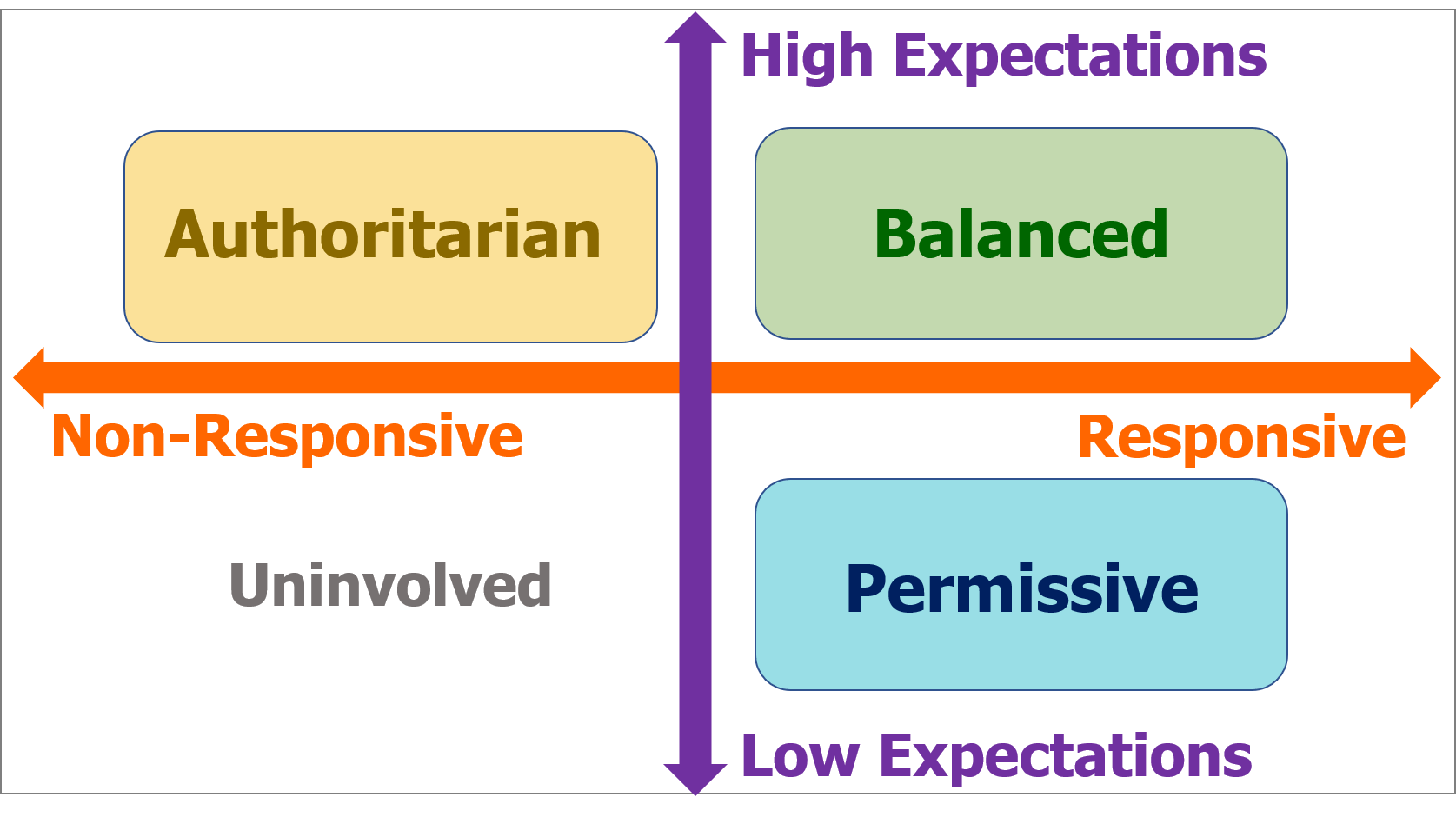
Parenting styles are often talked about as three categories. If you tended to make marks in the yellow zones, you may be an authoritarian style parent. If you tended to mark blue, you may be permissive. If you were always in between, that’s called authoritative (or balanced).

Parenting Style and Choice

One way to think about parenting style is how you handle choices. A permissive parent offers a wide range of options and lets the child make the choices. An authoritative parent offers fewer options and tries to educate and persuade the child about how to make the best choice. An authoritarian parent offers few choices, generally dictating what will be done.

The permissive parent may value independence and imagination, and believe that if they allow the child to follow their passions, they can trust them to do their best. The authoritative parent may value hard work and smart decision-making that balances short term desires with long-term goals. The authoritarian parent may value obedience, and believe that learning to follow the rules and doing their best at their assigned tasks is the path to success.

Balancing Expectations and Choices

Parents are generally attempting to prioritize their child’s long-term well-being and success, and feel that they have wisdom and perspective that helps them to know what’s best for the child. Children generally prioritize their own happiness in the moment, and don’t worry much about the long-term. So, part of parenting style lies in how we negotiate that conflict.

Parents who have high expectations for their child’s success (however the family defines success, whether that’s in academics, athletics, financial, support for the family, etc.) tend to want more control over their child’s choices, so lean authoritarian or authoritative. Permissive parents may place more emphasis on the child’s happiness than on their accomplishments.

Authoritarian parents believe they know what is best for their child, are not responsive to a child’s individual desires, and apply the same rules in all situations. Authoritative and permissive parents are more responsive to the child as an individual, and also adapt to the situation. (For example, if the child has had a rough week, the parent may let them skip an assigned chore.)

Questions to Reflect On:

What style of parent do you WANT to be?

What type of parent are you on a rough day?

Are you the same style as your parenting partner? Or different? How is that going?

Are you the same style of parent that YOUR parents were? Or are you very different? Why?

Also, check out my post on defining your parenting vision / your family’s mission / and imagining – “15 to 20 years from now, what do you hope your family is like??

Learn More

I’ve written before about the four parenting styles, about other parenting labels like helicopter parents, free range, and tiger moms, and how parenting style might affect how we handle choices in our families.

This article on Parenting for Brain has more info on all these types including citations from the research, including a fun bit of trivia that: “In the US, roughly 46% of parents use an authoritative parenting style, 26% authoritarian parenting style, 18% permissive parenting style, and 10% neglectful parenting style…. European-American parents are about 2% more likely to have an authoritative style, while Asian-American parents are 2% more likely to have an authoritarian style.”

Here is a free printable handout of this post’s content on parenting style.

The Economics of Parenting Style

I’ve written before about the four parenting styles, about other parenting labels like helicopter parents, free range, and tiger moms, and how parenting style might affect how we handle choices in our families.

Yesterday, there was an article in the NY Times called Is Education No Longer the Great Equalizer, and it quoted extensively from “The Economics of Parenting,” by Doepke, Sorrenti, and Zilibotti, that is a fascinating way to think about parenting through an economists’ lens. They say the “basic parent-child conflict is that the parent attaches a higher weight to the future utility of the child” versus the child places a higher weight on their “full enjoyment” of the moment.

They say that parenting styles “come down to whether, and how, parents interfere with the child’s choice.” The permissive parent lets the child have their way, and may go out of their way to offer a wide range of choices. The authoritative parent attempts to shape the child’s preferences, by offering choices but also educating about why they believe particular choices are the best ones for the child’s long-term well-being. The authoritarian parent offers few choices, dictating what will be done. Their emphasis is on what children do, not what they think, so there’s no need to persuade them that it’s the right option… it’s the only option.

They also state that permissive parents value either independence or imagination, authoritative parents value hard work, and authoritarian parents value obedience.

Doepke, Sorrenti, and Zillibotti then look at the interaction between the economy and parenting styles. In societies with a wide array of career opportunities and a low degree of income inequality, “the gap between the top and the bottom is small… Parents are less concerned about children’s effort, and thus there is little scope for disagreement between parents and children. Therefore, most parents adopt a permissive parenting style, namely, they keep young children happy and foster their sense of independence so that they can discover what they are good at in their adult life.” If parents believe that their child can be financially successful no matter what, it’s easy to let them pursue their talents and their joys.

In societies where there’s little social mobility, where most children will have the same profession as their parents, the parents have little incentive to be permissive and let their children discover something they’re good at (they may see talent as irrelevant in a world where there aren’t career choices available) and or to be authoritative and convince their child of anything. If the parents’ experience is that you need to do whatever work that is available to survive, they tend to be authoritarian – conveying ideas like “you just have to follow the rules – you don’t have to like it.”

In a society with a high degree of income inequality, the choices a child makes could have a big impact on their economic well-being. The parents know their children have a wide array of job opportunities and want to persuade them to choose the one that will give them the best chance of success. So, a larger share of parents are authoritative. They also tend to be highly involved, ensuring that the child is taking the best advantage of any available opportunity and learning to make “good choices” (as the parent defines them). The authors acknowledge that authoritative parenting requires more effort on the parents’ part than the other options.

The parents’ current economic status also influences parenting style. “richer parents can use monetary rewards to persuade their children to comply with their wishes. Poor parents lack the resources… and may be more likely to resort to authoritarian methods such as corporal punishment.”

Doepke, Sorrenti, and Zillibotti were discussing how this might be see on a country by country basis, but it clearly also comes into play in micro-societies of neighborhoods – for example, a neighborhood with few economic opportunities might tend toward authoritarian values.

For parent educators and others who work with families, I think these ideas add to a deeper understanding of influences on parenting style. Understanding a family’s culture and socioeconomic class, especially if it is different from our own, increases our empathy and ability to communicate.

Parent Educators, here’s a handout you can share to introduce parenting style.

Screen Time – Connection, Context, Content

As a parent, you’ve likely seen countless cautions about the potential dangers of screen time for young children, and you’re exposed to continuous marketing of screen content for children. You know the American Academy of Pediatrics says children 18 – 24 months can begin exploring screen content with their parent, and children 2 – 5 should be limited to 1 hour a day, but you know 10 month olds who are proficient at swiping through photos of themselves on a phone. It can be hard to make sense of it all. Instead of the “just say no” approach to screens, let’s try a more nuanced approach:

We argue that this long-held focus on the quantity of digital media use is now obsolete, and that parents should instead ask themselves and their children questions about screen context (where, when and how digital media are accessed), content (what is being watched or used), and connections (whether and how relationships are facilitated or impeded).           

– The Media Policy Project 

Connection – Are Relationships Facilitated or Impeded?

Screens can disconnect us from each other. In natural communication, we have a series of “serve and returns” – you say something, I respond. I ask a question, you answer. Screens can interrupt that. We’ve all experienced a time when someone glancing at their phone, or the TV that is on “in the background”, pulls our attention away from a conversation we’re in the middle of.

If parents are using a screen, we may not notice a child’s bids for our attention, which can lead to attention seeking behavior, risk-taking, and potentially injury. (This TED Talk video illustrates that nicely while it talks about how parent-child connections build the brain.) When a child is using a screen, they can seem zoned out and a parent may get very frustrated, feeling like they’re not being listened to. For all of us, we can get very irritable when someone else interrupts our screen use, and there can be a “withdrawal period” where it’s hard for us to disconnect from the screen and re-connect to others.

On the other hand, screens can help us to connect. Long-distance, video chats have been a key way for kids to connect to family and friends who are distanced, whether geographically or due to COVID. There are ways we can enhance the connection – peekaboo, puppet shows, guessing games, reading stories, show and tell, drawing together… And screens can connect us with others right at home if we use them together. Co-watching shows and co-playing games can be fun for both participants, can be an enjoyable shared experience to talk about later, can lead us into great conversations about complex topics that might not come up otherwise, or extend the screen experience into real world experiences (like watching a show about science, then doing a hands-on experiment together).

Goal: Decrease times when screens disconnect your family, increase connection during screen use.

Context – Where, When, How?

Co-watching with our child any time they’re watching would be optimal. But let’s be realistic. One of the biggest reasons parents use screen time is to keep kids busy while we do something else! Screens are the easiest way to take a demanding child and keep them passive, stationary, and entertained. And sometimes, we just need that break. Just be intentional and don’t overuse it. Be mindful about unconscious screen time – the TV that’s on all the time, continuous social media check-ins, the Candy Crush… A question to ask yourself… if I didn’t have the screen option, what would we do otherwise?

Consider screen time limits and curfews. Consider screen-free times (like mealtime, family time). Some families have screen free time one hour per day, one full day each week, one week each year.

Set rules for where screens can be used – many experts recommend children only use screens where parents can overhear / see what the child is watching. Consider screen free places (like dining table, bedrooms). Some families have screens in low traffic areas of the house – out of sight, out of mind.

Some families say screen time has to be earned – the child has to complete chores to earn it. Some offer a standard amount each day, but it’s a privilege that the child can lose as a punishment. These can both be viable strategies, but be careful not to make screens too special – a forbidden fruit.

Goal: Whatever rules you set for where, when, how and how much, be sure they are rules you can stick to and enforce consistently. If you let them cheat it some days, they’ll ask to cheat it every day!

Content – What is Being Watched?

All screen use is not equal. For example, social time on screens, like Skype/Facetime calls to family aren’t really “screen time” – they’re social time where the screen is the mechanism that connects us, and don’t need to be limited as other screen use does. (Although you should still practice good screen hygiene – keep screens 18 – 24” from face, use blue shade in the evening, use good posture during calls, take breaks to rest your body and your eyes, and spend time outside in nature each day.)

There’s lots of great educational content for kids. Don’t feel like your kids have to use screens to learn what they need to learn in life. If there are other things they could be doing in the moment – like finger painting or playing in a playground – do that! But, if there are times they’ll be using a screen anyway, choose content that helps them to learn new ideas (like science shows), or experience things they can’t experience at home (like wildlife shows), or drill them in things that are best learned by rote practice (like learning the alphabet or basic math skills).

When choosing content for entertainment time – whether that’s social entertainment for the whole family, or solo entertainment for the child – there’s a wide range in quality, developmental appropriateness and questionable content in children’s media. Read reviews and seek out recommendations for the best content. A fabulous resource is www.commonsensemedia.org.

Try to minimize addictive content. Many screen time activities have lots of reward moments, where your brain is flooded with dopamines, and you want to keep using to get more of the feel-good chemicals. For example, many apps and video games are designed to keep you playing forever: every time you clear one level, another presents itself and you want to keep on playing. Many video apps will auto-play one video after another. Choose slower-paced, calmer items that you “consume” one at a time, without that same addictive reward process, and without ads that make a child crave more.

Goal: choose age appropriate, educational or entertaining content that matches your family’s values and priorities.

Tips for Reducing Screen Time Battles

Plan your screen time – agree ahead of time on when it will start, when it will end, and what you will do together after screen time. Ask them what reminders they need about the plan – for example, do they want to set a timer they can see? Then stick to the plan!

When you’re nearing the end of screen time, instead of giving warnings that you’re about to take the screen away, give reminders that “when you end screen time well, then we get to…”

Instead of just yanking the screen away in the middle of whatever they’re doing, try “joining them” on screen – watching what they’re watching and talking about it, and seeing when a good endpoint is coming (the end of an episode, the completion of a level). Then gradually transition them off.

Resources