This is a companion piece for “Building Resilience in Children“. This post offers a deeper look at theories of resilience, and links to some key research in the field.
What is Resilience?
So, what is resilience? And how do you know if you have it?
If you were lucky enough to never face any challenges, you’d never know if you have resilience (and honestly, you probably wouldn’t, because we build resilience by facing and mastering challenges in our lives.)
But, for most of us… challenges come to us on a far too regular basis, right?
Types of Challenges We Might Face
Anytime we face a life transition, or a new developmental stage, that’s a challenge. (These predictable developmental cycles are called “periods of disequilibrium.”) Whether that’s a toddler who falls down many times before they learn to walk, or the new parent who has to cope with all the tantrums that might cause. There’s midlife crises, there’s the challenges of aging… those are “expected challenges” that any developmental psychologist can tell you are typical, but that doesn’t mean they’re not hard for the people going through them.
There’s also all the unexpected challenges – the fall in the mud puddle, the flat tire, the spilled milk, the flu.
And then there’s interpersonal challenges – the boss who makes unfair demands, the girlfriend who says she’s “just not that into you,” or the parent who lets you down.
Challenges just keep on coming.
But… and people in the midst of adversity hate it when you say this… each of those moments of adversity is a learning experience. Each one offers “opportunities for personal growth.” Each one helps us learn how to stretch and how to bounce back.
Bouncing Back
One way of defining resilience is “doing better than expected in difficult circumstances.” We all have times when it seems like life is trying to knock us down, in small ways or in big ways. The question is: how will we respond? It seems there are three main pathways of response: Will we let adversity pin us down? Or will we bounce back up the status quo? Or end standing stronger and taller than ever before? And how can our family and our community and our beliefs help us to bounce back?

Resilience is a really complex issue. There are lots of factors that influence our response to adversity. Several different models have been developed to examine factors. I’ll share a combination of those that shows my best current understanding.
Protective Factors vs. Risk Factors
The reality is that hard things come into everyone’s life at some point. Sometimes they’re expected challenges like a move to a new home, but often adverse circumstances arrive out of the blue – an illness, a home break-in, or a job layoff might appear in our metaphorical inbox. When a challenge hits, we start running with it, and we figure out our response as we go along.
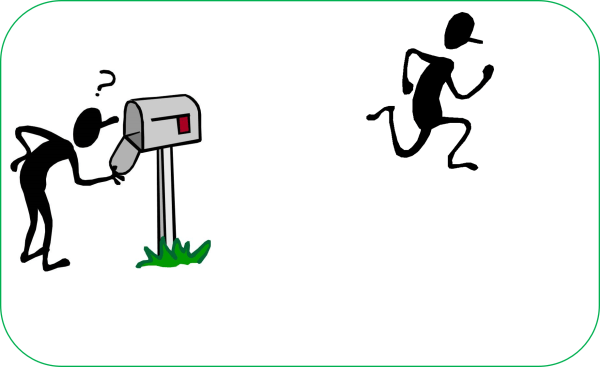
Several things affect our response and whether or not we end up in a good place in the end. The risk factors drag us down. They challenge our ability to cope and to recover from this challenge, and increase the chance of poor outcomes. The protective factors – things that make it easier for us to cope – lift us up and make it more likely we’ll have a positive, empowered result.
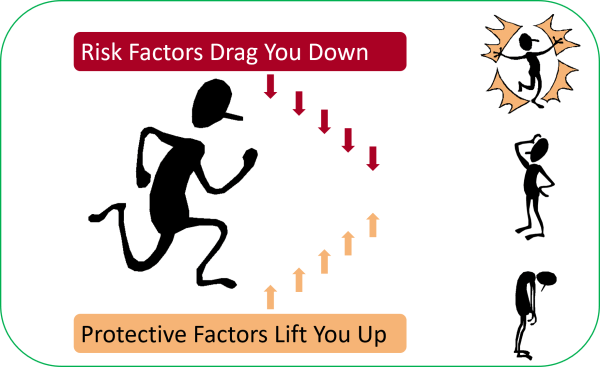
What tips the balance for good outcomes is when the protective factors outweigh the risk factors. When we have so many good things going for us that the hard times are easy to overcome.

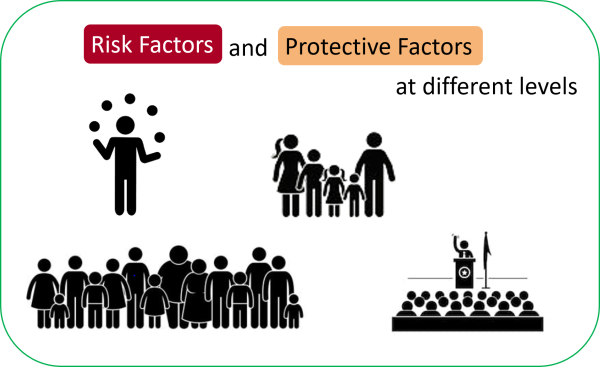
Among the factors that influence our response, some are on the individual level – specific to that person and the ways they interact with the world, some are found within their network of family, close friends and communities, and some are influences from the broader society as a whole.
Individual Factors
Some people are just inherently more resilient than others, no matter what life throws at them. Dr. Thomas Boyce has researched the human stress response for 40 years, and he says some people are dandelions, and some are orchids.
Dandelions are people who can go through almost anything, and be unfazed by it all. Orchids are a lot more sensitive – they’re more vulnerable to stress, and need more support to weather the storms. But given the right nurturing care, they can thrive and become incredibly beautiful.
So what individual factors help to make us more or less resilient?
- Internal Locus of Control – Developmental psychologist Emmy Werner found that resilient people have a strong internal locus – they believe they are in control of their own destinies. Even if bad things happen to them, they feel they can choose how to let that impact them.
- Confidence – Resilient people have confidence in their own competence. And they have a growth mindset… instead of thinking of themselves as “not good” at something, they think “I’m not good at it yet. If I just keep working hard, I bet I’ll figure it out.”
- Temperament – it’s easier to be resilient when you have a sense of humor about life, when you’re naturally easy-going, naturally flexible, and calm.
- Mental and physical health – Our mental health is influenced by many things beyond our control – genetic, epigenetic, and environmental. Depression can make it supremely hard to bounce back from challenges, and anxiety can mean that even small challenges quickly become overwhelming as you spin into worry about how much worse it might become. Physical illness and disability are challenging circumstances on their own, often creating chronic adversity, and they can also make it harder to bounce back from other challenges. Good mental health and physical health is a huge protective factor.
- Goals – Having goals you’re working toward helps with resilience – it’s the “eyes on the prize” focus that helps you push through the hard times. Resilient individuals tend to have things outside themselves that give them a reason to get up every day. This can be an interest or passion, such as music or art. This can be big dreams they’re working toward. Or, it can be knowing that other people are counting on them.
- Perception – According to psychologist George Bonanno, a key individual factor is how we interpret difficult circumstances. Do we perceive an event as traumatic or as an opportunity to learn and grow? Sometimes even something tragic, while very sad in the short term, might also be a powerful life event that changes someone for the better in the long term. This positive perception… finding meaning in loss… is more likely for people who have a spiritual or religious faith.
Which brings us to the next set of protective factors.
Family and Close Community
Our family of origin, and the close communities that we interact with throughout our lives (like a child’s school, an adult’s workplace, or a church community) have a huge impact on resilience. When these circles are healthy, they provide the key protective factor of a secure base.
From these communities, we learn our values – what does it mean to be a good person? We learn about faith – whether that’s a belief in a higher power, or a belief in a greater good, faith can provide a strong beacon of hope in the darkness of despair. We learn our stories. The most powerful stories are when members of our communities say “we’ve had good times and bad times, but we are a strong, resilient people and we keep moving forward together.”
In these communities, we find our key relationships. Researchers at Harvard found that no matter the source of hardship, the single most common factor for children who develop resilience is at least one stable, committed relationship with a supportive adult. Whether that’s a parent, friend, clergy, teacher or coach. That person offers us emotional support, they help us to see our own strengths, they teach us how to plan and how to cope in healthy ways.
In these communities, we can learn that we are valued, and that we can contribute in meaningful ways. If we have clear roles, we can see that our commitment is essential, and sometimes on our darkest days, what keeps us going is knowing that other people are counting on us, and we have to show up for them.
These communities can also be a source of concrete support – a ride to the doctor’s office after an injury, a bed to crash on when a relationship falls apart, a loan when we can’t pay a bill, someone to watch our kids for us – all these “little things” can help carry us through a hard spot.
Now, the problem is that our families and our communities are not always healthy. And just as a healthy home base can build resilience, an unhealthy family is devastating to our long-term resilience.
There is some really important research in health and mental health called the ACE’s study – where ACE stands for adverse childhood experiences.
Researchers asked people about their childhood – had they experienced things such as abuse, witnessed domestic violence, had parents with mental health issues or addiction or who were incarcerated, or had experienced homelessness. 60% of people have one or more of these experiences in childhood. The more you have, the less resilient you’ll be as an adult. About 12% of people have an ACE score of 4 or higher. With a score of 4 or higher, you’re four times more likely to experience addiction, 3 times more likely to have heart disease, respiratory disease and diabetes, far more likely to experience mental health challenges, and 6 times more likely to say you never feel optimism or hope.
The good news about ACE’s is that they can be overcome.
Knowing about the negative impact of ACE’s and working to mitigate it is the first step. Another key step is connecting to healthy relationships and healthy communities. The research is really clear that even for kids from very toxic home environments, even just one healthy relationship with one positive mentor in the community is a huge boost on their path to recovery.
Now let’s look at the impact of Society and Resources.
Societal Factors and Resources
We have a strong cultural narrative in America – the cultural narrative that everyone can succeed if they “just try hard enough.”
But we don’t have a level playing field in America – we’re not all starting from the same place. A person who is living in poverty, in a crime-ridden neighborhood, where drug use is a common escape from the pain of living just doesn’t have the same resilience resources available to them. Or, even if someone had all the other advantages they could have, if they happen to have dark skin, or happen to be female, or gay, or trans, or disabled, or non-Christian, they have to carry the weight of systematic oppression. click to add That weight makes it harder to magically “bounce back” from challenges.
It is so much easier to be resilient if you happen to have been born into a stable, white, middle class family. If you made it through childhood with an ACE score of 0. If in adulthood, you’ve always had resources… so whatever challenge might arise, you’ve got back-up plans: car insurance, home insurance, health insurance. Flexible hours at work, paid sick leave, and short-term disability pay. Cash in the bank. A safe, warm home. People to take care of you, people to take care of your kids. If you’ve got the skills to research and access any services that you need. If you can speak with educated words and a voice of authority and white skin that afford you respectful treatment by those you encounter. All of these things make it easy to “bounce back” from whatever happens.
So, let’s start talking about how we can build resilience in ourselves and in others.
Building Resilience
At the Societal Level
Let’s first look at this societal level, and what we can do to tip the balance.

We can work to dismantle systematic oppression. Respect and support cultural identities as tools for empowerment. Help increase equitable access to concrete resources and safe communities. Support organizations which work to increase hope in impoverished communities through the arts, access to job opportunities, and tools to help people reach for their dreams.
At the family and community level:
- Think about the Stories We Tell. Stories can mobilize sources of faith, hope, and cultural traditions. When you’re facing difficult times, it helps to feel like you’re a part of something bigger. There are three types of stories we can tell – 1) our people are always successful (unfortunately, this can bestow a sense of entitlement if you as an individual are successful or a sense of personal failure if you’re not at the moment), 2) our people are never successful and things always get worse for us, or 3) our people have a history of weathering challenge and emerging stronger than before. That third kind is the best for building resilience for future adversity.
- Build Relationships, and Be a Mentor. Remember, a key factor in resilience for children or for anyone is having a relationship with someone who believes in them, encourages them to be their best possible selves, and helps them keep moving when life seems too hard. You can be one of those people – not just for your friends and family, but for anyone you encounter in the broader community. Any time we interact with anyone in a way that reflects their inherent worth and dignity, we build their resilience.
- Invite and Value Contributions. Let people know that their presence in the community matters, and that they can make valuable contributions. This is even in the little things. I’ll occasionally ask a child to help me as I set up or tidy – even a three year old can be asked to help carry something. Sometimes kids are surprised to be asked, because we often don’t ask them. But when we do, and we thank them for their help, it increases their sense of efficacy.
- Concrete Support. Lending a helping hand to a parent with their hands full, offering a ride to someone recovering from an injury, helping someone work on a resume, passing on news about available affordable housing, or accompanying someone to a support group meeting are just some examples of simple things we can do to help people get back on their feet after a challenge. Keep your eyes open for your opportunities.
At the individual level:
- Build others’ internal locus of control. Support others in viewing themselves as having control over their destiny. You can use a framework of “I have… I am… I can…” that encourages someone facing hardship to think about what resources they have, to tell themselves a positive story of who they are, and to think about concrete steps that they can take to help improve their situation.
- Support a growth-based mindset. Carol Dweck has researched what she calls “the Growth Based Mindset” which is a belief that we are capable of learning more and doing better. And Angela Duckworth has researched what she calls “Grit” as a vital mechanism in achieving success despite barriers. One way to build these things is to talk about mistakes, failures, and setbacks as normal parts of learning, not as reasons to quit. Remind yourself and those around you that everyone runs up against things they can’t do. The ones who succeed are the ones who pick themselves up and try again.
- In terms of Temperament – some people are naturally more fearful, and when things seem hard, their anxiety takes over. Researchers at Yale have learned that if we accommodate too much, it actually makes anxiety worse. If we tell someone “I know that’s scary, so you don’t have to do it”, it actually validates that this thing is way too scary and way too powerful. Instead, we can say to ourselves and others “It’s OK to feel scared. We all feel scared. Let’s make a plan for how we can do it anyway.”
- We know Mental Health and Physical Health are huge protective factors. So, at the societal level, we can be doing public policy advocacy to increase access to health care. But, at the individual level, with ourselves and others, we can think about self care. We can remember that it’s important to prioritize self care – it helps to help recharge our batteries to give us enough energy to face whatever challenges may come.
- We know that having a goal in mind helps us to keep pushing forward. Ask people to tell you about their dreams. Help them to figure out what the next manageable step is toward achieving that dream. Emphasize that even when challenges seem hard in the short term, we can work to overcome them and not let them block us from that long-term goal.
- Perception – Learn how to re-frame challenges for yourself, and share with others what you have learned. There are three aspects to re-framing:
- If you find yourself believing that when bad things happen it’s always your fault, try reframing to “sometimes bad things happen that are beyond my control. What I can control is how I respond to them.”
- Stay focused on fixing the specific problem rather than thinking it’s a sign of some global problem. For example, if you don’t get a job you were hoping for, remember that it’s not that you are fundamentally unemployable. It’s just that one job that said no…. keep trying till you find the right fit.
- View problems as impermanent – it will get better in time, and there are steps you can take to help it improve.
In the end, some of the most important protective factors that build resilience and increase positive outcomes are the stories that we tell ourselves about the challenges that we face, and the stories that we tell those in our community about who we are, and what we’re capable of. If we believe that we are strong, and can overcome anything, the chances are much higher that we will.

 More Good Days with Kids