Tag Archives: emergency preparedness

Talking to Young Children about Emergency Drills

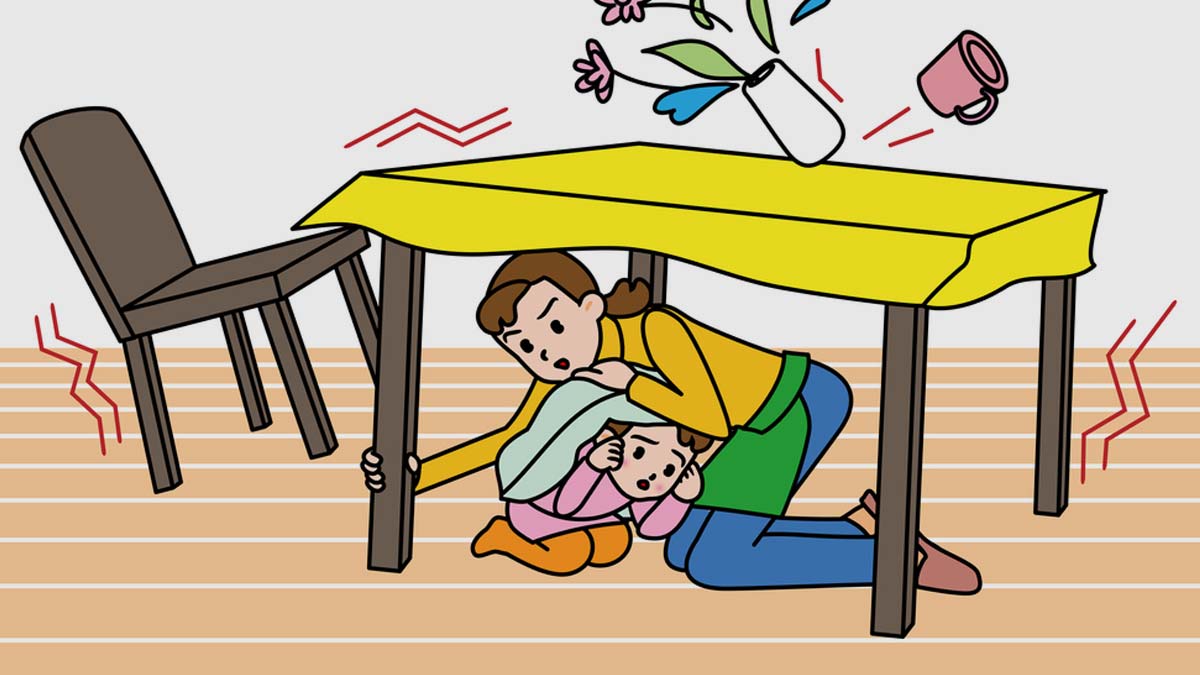
Image from: https://www.teepublic.com/t-shirt/1684401-this-is-a-drill-this-is-only-a-drill

As adults responsible for children’s safety, parents and teachers of preschool age children need to know and to practice what we would do in case of an emergency. Fire drills, earthquake drills, tornado drills and, sadly, lockdown drills are an essential part of planning how to keep children safe.

But… how do we talk to children age 3 – 5 about what we’re doing and why?

My general approach to talking to young children about scary topics, is to:

  • talk about how likely something is to happen
  • talk about how we would know it was happening
  • teach children what they themselves can do to make it better and
  • explain what the adults will do to make it better.

I use this approach when doing fire drills and earthquake drills. (Read this post for all the details on how I talk with children about earthquakes.) A key point is that when you talk about the possible dangers of these emergencies, keep it gentle. The goal is to Prepare Not Scare. For example, I want them prepared by knowing that in an earthquake they need to drop down to their hands and knees because otherwise they might get knocked over and I want them to know to cover their heads / necks in case things are falling. That is information that will help to keep them safe. I do not tell them that buildings can fall down and people can die. That’s really scary and doesn’t build their ability to take safe actions.

So, that’s information I share if I know the drill is coming. However, at some facilities, they do drills without warning the staff. (The idea is that the drill is more realistic if we’re not all prepped and ready for a drill.) If I’m lucky, I have already done a pre-planned drill with this group of children so we have had a chance to talk about this before. But once, I got surprised by an unexpected drill with a group of children on their second day of class when they were still getting to know the classroom and the teachers.

In that case, we just execute all the steps of our drill, and then move on. In a class with three and four year olds, I would typically just resume the day’s activities. If they seemed unfazed by it, I wouldn’t talk it through with the whole class, but if individual kids had questions, I would answer them. With older children, I might sit them down and explain more in the moment. If you are a parent who knows that your child did a drill that day, just be aware of it. Some children will never go back and ask “why did we do that thing?” If they don’t ask, and don’t seem to have any concerns about it, I don’t worry about it. If they ask questions, or seem worried about something, then talk it through.

If they have questions or concerns about the possible emergency, such as about a fire, then I explain more details, in a realistic but non-scary way. If they have questions or concerns about why we do drills, I explain that grown-ups are responsible for keeping kids safe if an emergency happens. And the whole trick with an emergency is that we don’t know when it will happen, and we don’t know exactly what will happen.

I explain that we have to have some plans we’ve practiced in advance, just in case. Our fire drills help us practice – what if we all needed to get out of the building quickly. Our earthquake drills help us practice – what if we all need to stop moving and stay where we are. Lockdown drills help us practice – what if something dangerous was happening outside, and we all needed to gather together inside where we could all keep an eye on each other. Drills are all about practicing – listening to the grown-ups and doing what they ask you to do quickly. And we’ll probably never need to use those emergency skills, but if we do, we have all practiced them and will know how they work.

My approach to lockdown drills is a little different than natural disaster situations. I do NOT explain why we would do a lockdown. I just say “if it seems like something dangerous may be happening outside the classroom, sometimes it is safest to stay in the classroom.” I don’t talk about bad guys and guns and bullets and so on. I do not want the children in my care to be fearful that people are dangerous and that a shooting is imminent or inevitable. I want them to feel safe in their world.

[I do acknowledge that I have some privilege here – I teach in a quiet suburb of a liberal city in a state with tighter gun control laws than many other states. Your environment and needs may differ.]

Now, I might not have talked about bad guys and guns, but sometimes one of the children will! Then I can address that yes, sometimes people do bad things that harm others, including using guns. But I can go back to my message of: how likely is it to happen here – not likely. What do we do to protect ourselves? Exactly what we’re doing.

How to Talk to YOURSELF about lockdown drills…

I totally understand that you, as a parent or teacher, may have a lot of anxiety of your own about school shootings, and a lot of fear where you’ve played through in your head – “what if it happened at my child’s school.” Running a lockdown drill as a teacher, or knowing as a parent that your child participated in a lockdown drill may bring that all up for you.

I would encourage you to do some processing of your own concerns, reaching out to other parents, teachers, or therapists for support as needed so that you can get to a place where you can be calm when talking to your child about these things (or at least put on a good act of being calm). During our unexpected lockdown drill, I was grateful that I am able to remain calm in these sorts of situations and focus on getting through the mechanics of a drill without going down my personal rabbit hole of “what ifs.”

Here are some articles you may find helpful:

More about Talking with Your Child

If you want more ideas for how to have these conversations, I find this article Talking to Kids about School Lockdown Drills has some really helpful modeling of what to say. For example: “Even though we might hear about it when something like this happens in a school, there are thousands and thousand and thousands of schools where it never happens and it’s never going to happen. So nothing bad is likely to happen at our school. The school is all set up to keep you safe and the principal and the teachers… have all kinds of ideas and plans to protect your school and keep anyone bad away. … You’re practicing to be safe. That’s really important. … When you practice something enough, then you don’t even have to think about it. We practice [safety] all the time, like stopping at a corner and looking both ways before we step into the street.”

That article also has this really helpful description of understanding and calming anxiety: “Let me tell you why you feel so weird when you’re scared. There are two parts to your brain. One feels your feelings… The other part thinks. …When you get scared, you sometimes forget to take good breaths. And … your brain, which is hungry for the good oxygen… gets worried, too. … It thinks it’s supposed to panic and get you ready to run away! … Your heart is probably feeling like it’s racing as it sends out energy and blood to your arms and legs so you can run. But you’re not going to run, so there you are, just wondering why you feel like this, why your muscles feel tight. Your body takes energy away from your belly … so you feel those butterflies there…. you might feel dizzy. … But you can tell that part of your brain, the part that does the thinking, that you’re safe and okay. … By taking some good, oxygen-filled breaths, so nice and big that you fill your belly… Imagine that you’re blowing out candles on your birthday cake. You could even put up one finger and pretend it’s a candle you’re blowing out. And then when you’re good and empty of air, your body and brain want to fill up again with oxygen, so you’ll take a lovely breath in. And your brain starts to feel calm again. And when the brain is calm, your body can calm down, too. Like magic. Do it with me.”
Talking to Kids about Earthquakes

Every year on the third Thursday in October, it’s the Great American Shakeout – it’s a good once-a-year reminder to talk with your child about earthquakes and to do an earthquake drill. Focus on how to prepare… not scare.

Earthquake Drills

As a parent or teacher, you need to know what to do in case of an earthquake:

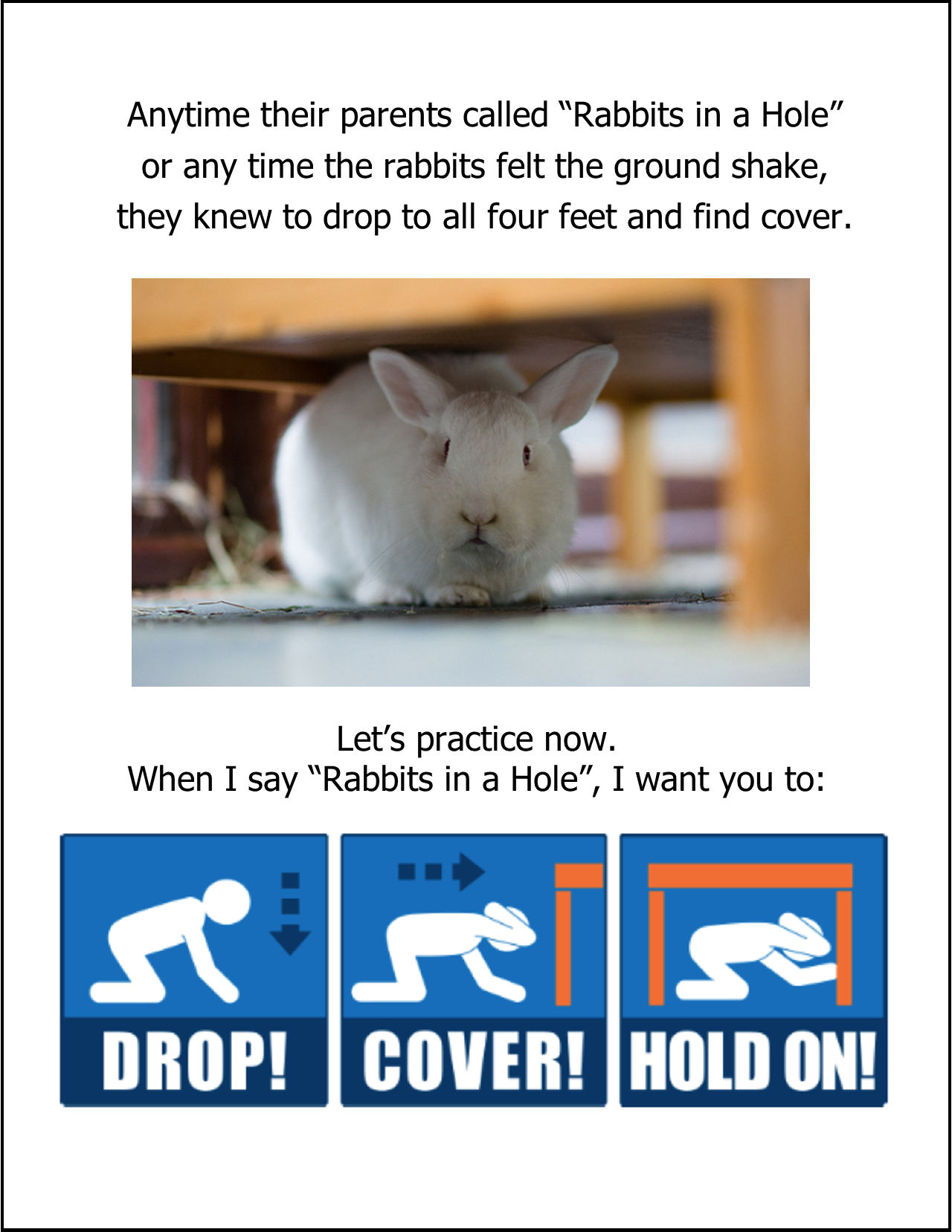
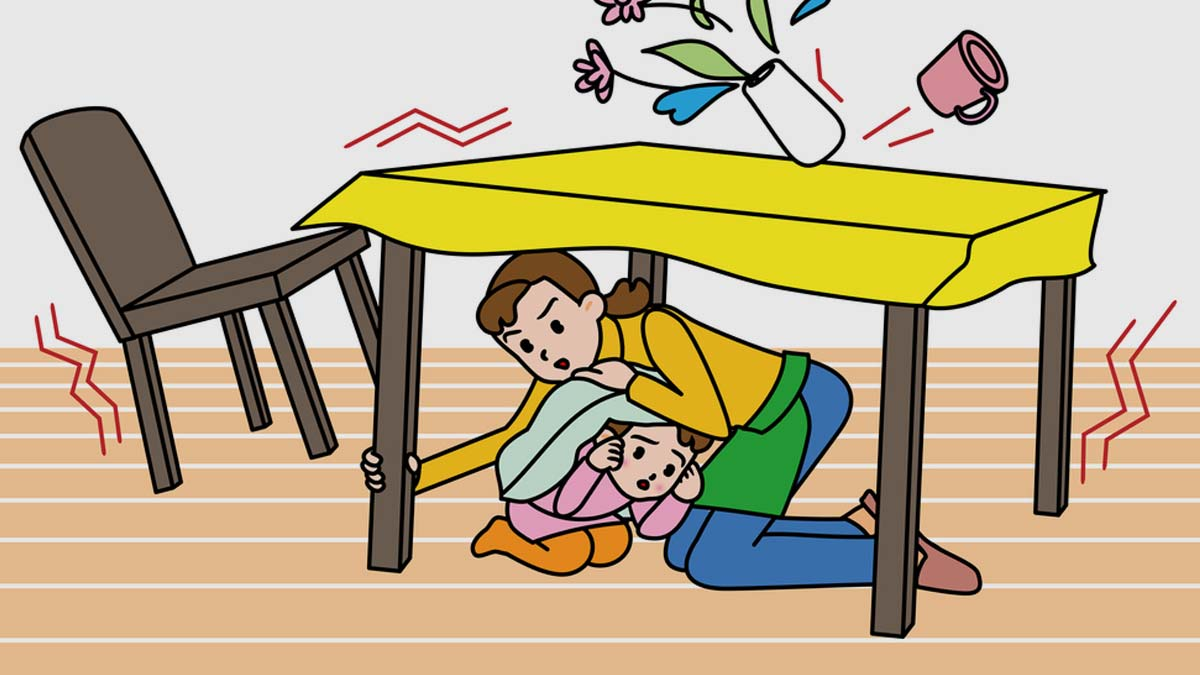
  • DROP down onto your hands and knees (before the earthquake knocks you over). This position protects you from falling but allows you to still move if necessary.
  • COVER your head and neck (entire body if possible) under a sturdy table or desk. Explain “this will help protect you if things are falling down.”
    • If there is no shelter nearby, cover your head and neck with your hands. Crawl away from windows and things that could fall.
  • HOLD ON to your shelter (or continue covering your head and neck) until the shaking stops. Be prepared to move with your shelter if the shaking shifts it around.

If you are with a child, you should drop down, cover the back of your neck with one hand, and then crawl toward the child to cover them with your body.

You can practice this with young children in a playful way.

In my parent-child classes, with one and two year olds, I just practice the positions. I show the child how to crouch low, then tell the parent to crouch over them, then we say the rhyme “jack in the box you sit so still. Won’t you come out now? Yes I will!”

For ages three and up, I read the Rabbits in a Hole book (see below), and then we practice. I chant this rhyme:

Rabbits in a Hole, Stop Now Please! Get down low, on your knees.
Earthquake is Rumbling, Sounds Like Thunder. Cover your head and get safe under.
Earthquake is Over. Everything is Still. Won’t you come out now? Yes I will!

A Children’s Book about Earthquake Response

I’ve written a children’s story book to teach this method: It’s called Rabbits in the Hole: A Story about Earthquake Preparedness, and you can download it by clicking on that link.

Talking about Earthquakes

There may be other times where your child has questions about earthquakes – perhaps they heard about one in the news or in a story, or maybe they recently experienced an earthquake, and they’re working to process it. Here is my general approach when talking about any topic that might be scary for a child:

  • How likely (or unlikely) this thing is to happen.
  • Whether we can do anything to predict it, prevent it, or help ensure it doesn’t become a big problem.
  • How they would know this thing was happening.
  • What they could do if it happened.
  • What the grown-ups would do to make it better.
  • Reassure them that even if bad things happens to people, people are tough and resilient, and pull together and make it through.

So, let’s walk through this with questions your child might have about earthquakes.

How Likely Is an Earthquake?

In many parts of the world, the answer is extremely unlikely. In other regions, it’s quite likely your child will experience many earthquakes over their lifetime. Be honest about your situation. If the likelihood is low, that can be very reassuring for your child. If the likelihood is high, we acknowledge that and then focus on how we prepare and how we learn about earthquakes so we can respond if and when one happens.

Can you predict or prevent an earthquake?

You can’t. And that can feel scary. Say to your child “We can’t do anything to prevent them, and we can’t really predict when one is coming. But we don’t need to worry about them every day, we just make a plan for what we’ll do if or when one happens. And every once in a while, we practice how to respond.”

How will I know if there’s an earthquake?

Many adults leading earthquake drills for kids teach what to do, but never stop to think about whether a child would  know when to do those things. It’s important to describe what an earthquake might feel like, using non-scary descriptions. I’ve said things like “If you’re sitting down, it may feel like someone is holding onto your chair and shaking it back and forth. If you’re standing up, you’d start feeling all wobbly, like you’re in a bounce house and the other kids are bouncing a lot.” If you’re ever in a situation where there’s a similar sensation, point it out: “Wow – when everyone in the stadium stomps their feet, it feels almost like an earthquake.” “The way the bridge at the playground sways back and forth sort of reminds me of an earthquake.”

After one 4.6 earthquake in Seattle, here are some descriptions people shared on social media: “I thought it was the dog bumping against the bed.” “It was like being in one of those coin-operated beds that wiggle and shake.” “I heard dishes rattling.” “My dog started barking just before it happened.” “My cat freaked out and bolted out of the room.” “I thought it was a loud truck driving by.” “There was a big rumbling booming sound like thunder, then my whole house shook for about 20 seconds.” There were also LOTS of people (including my whole family and folks at work) that slept through the quake and never noticed anything!

Sharing descriptions like these will hopefully illustrate to your child what it might feel like so they can recognize it, but do it in a non-frightening way.

What you DON’T want to do: don’t go online with your child sitting next to you and search for photos and videos of earthquakes. This can be frightening out of context. If they’ve already seen scary images, you’ll need to reassure them and remind them that a news station will always search a whole city for the single most scary image to share. For example, in Seattle, we once had a 6.8 quake, and if you looked at the news, they kept showing one collapsed brick building in downtown Seattle.  But that was the only collapsed building in town. They didn’t not show photos like one my partner took of the worst damage at Microsoft campus, which was of the drink cooler that came open and spilled 20 cans of soda down to roll around on the floor. So be honest with your child, and say that yes, bad things can happen in an earthquake. But it is more likely that they won’t than that they will.

Let your children know that sometimes an earthquake only lasts a few seconds, and you’re not even sure you felt it. Other times it may last long enough for you to take action to protect yourself.

Some additional guidance for parents

This is more than you would teach kids, but it’s worth knowing. (Source for recommendations.)

If you are driving: pull over, stay in your car with your seat-belt buckled (and your child buckled in their car seat) until the shaking stops.

If you’re in bed, stay in bed! Lay facedown, cover your head and neck with a pillow and your hands.

What NOT to do:

  • Do NOT stand in doorways. In modern buildings, the doorways are no stronger than other parts of the house. You are safer on your knees and under a table.
  • Do NOT try to run outside or run around inside the building. Although it is safer to be near an interior wall, away from windows, it’s not a big enough benefit to risk running to another room during an earthquake. It’s better to drop, crawl a few feet to the safest space, cover, and hold.

What Will the Grown-Ups Do?

Explain to children that during an earthquake, if a grown-up is nearby, they will help to shelter the child by putting their body over the top of the child. If the grown-up is not nearby, the child should still drop, cover and hold right where they are and trust that as soon as the shaking is over, their caregivers will come to them as quickly as possible.

After the shaking, the grown-ups will help to make sure everything is safe around them, and they can help by staying calm and listening well to what they’re told to do. If there’s anything that could be dangerous or needs to be fixed, the grown-ups will help to figure that out.

Talking about Recovering from a Quake

Don’t expose your young child to pictures of cities devastated by earthquakes. That will only frighten them, and that level of damage is beyond their control and ours. If they have seen those pictures, acknowledge that this is possible and it’s tragic, but it’s not likely to happen to them.

Do talk about (or show pictures of) damage that is challenging but manageable. Good ones might be of a grocery store – there may be big spills and some broken glass that the grown-ups would need to take care of, but soon everything will be set back to right.

If you have a story of someone your kids know who experienced an earthquake but everything turned out OK, that’s a good story to tell. (In general, it’s a helpful lesson for children to hear that challenging things can happen to people, and they can be OK. That actually teaches resilience better than telling your kids that nothing bad will ever happen to them.)

I tell stories about the two biggest earthquakes I’ve been in (a 6.8 and a 5.1): in one, we were at a children’s theatre watching a play about Winnie the Pooh, where they were talking about taking the bounce out of Tigger, then the room started bouncing – we all thought it was a special effect at first! Winnie the Pooh asked us to evacuate the theater after the earthquake, and everyone left calmly, and we went home, so the bummer was that we didn’t get to see the end of the show, but we were all OK, and our families were all OK. The other time, we were at Disneyland watching Fantasmic, and as the pirate ship came around the bend, things started swaying and rumbling. Again, it felt like a special effect. But then they stopped the show, turned up the lights, and asked us to leave the park. So, we didn’t get to see the end of the show, but we did get to calmly evacuate through the back part of the park (the employee areas no one is ever allowed to see) which was super interesting, and we went back the next day and everything was OK. They did have some aftershocks, so after each one, they would close the ride, quickly inspect it, and then go right back to having fun.

Telling a story like this, or any personal story you know, can help to teach that earthquakes can be a big problem, but more often, they are totally manageable if we stay calm and know how to respond.

More Resources