Note: I have a more general post on talking to children about the concept of death that I would recommend for most readers. This particular post is much more specific than that – it is focused on how to talk to a very young child (age 2 to 5) about the impending / expected death of a parent (or a grandparent.other adult who is very involved in the child’s day to day life.) It may be relevant as someone is nearing end of life or has been placed in hospice care.
First, I want to acknowledge that this is a very heartbreaking thing to have to talk about. For you, as the adult who is in the midst of this difficult situation and will have these sad conversations with the child – this is hard emotional work, and I encourage you to seek out support for yourself as well and to do the self-care that nourishes you through these hard times.
But, although it is challenging, I think it is important to have these conversations. To be honest with children about the realities of the upcoming loss. Trying to shield the child from anticipatory grief will only make it harder for them when the loss happens and the full grief becomes a part of their life. Talking about it now allows them to begin to process it, and allows you to create meaningful and loving moments with them as you begin with saying goodbyes.
Let’s look at what a child this age is capable of understanding, and some key ideas to talk with them about.
Explaining Death to a Young Child
Before talking about the upcoming loss of a child’s loved one, it’s best to start by making sure they have an understanding of what death is.
Explain what death is in very concrete ways – this is not the time for flowery metaphors like “go to a better place.” Instead, share these ideas:
- Death is the cessation of life functions. Use simple terms and examples from their life experience. “Do you remember when your pea plant died, and it stopped growing and started to shrivel up?” “Do you remember when we saw that dead squirrel in the park? They looked like they were sleeping, but their heart had stopped, and their brain didn’t work anymore.”
- Death is permanent. Once something has died, it will not come back to life. If someone we love dies, we won’t see them again.
- Everything that is alive will someday die. Some things / beings live a very long time, and others live for a short time. Sometimes death happens suddenly, sometimes someone is sick for a long time before dying.
- Death is caused by physical reasons. Describe in a simple, non-graphic way what can cause a death.
- Even though someone may not be alive any more, we can always hold them in our memories.
For a preschooler, age 2.5 – 5: Even if you clearly explain what death is, they may not be able to grasp what you mean. Permanence is hard to understand. They may believe death is temporary and reversible, and may ask things like “but when will they come back?”
Teachable Moments
I often recommend that parents wait for teachable moments to talk about death. For example, if a child sees a dead bug on the window sill, or an animal that was hit by a car, or they hear that a friend’s pet died. Those are times a parent can introduce the topic. Or any time a child asks about death, calm, matter-of-fact answers are helpful. You can take advantage of these same moments. But, if you, or a close family member, is facing the end of life soon, you may feel the matter is too urgent to wait for teachable moments to appear, and may intentionally bring it up through conversations, or pretend play / storytelling, or through media.
Books and Shows
Media offers an entry way into the topic. Here are several recommendations for books about death and grief: https://imaginationsoup.net/childrens-picture-books-grief-death/; https://www.familyeducation.com/videos/12-childrens-books-help-explain-tragedies-death; https://pjlibrary.org/blog/january-2017/childrens-books-about-death. Examples include the Memory Tree by Teckentrup (video), What Happens When a Loved One Dies by Jillian Roberts. (Video)
There are many shows and movies where a character dies that you could use to introduce the subject. Two that I know of that are focused on helping a child understand death are the Mr. Roger’s goldfish episode and the Daniel Tiger episode.
If you have some time (days or weeks) to prepare, you could gradually sneak little conversations about death in and around all the normal toddler and preschool daily activities – don’t force it and don’t talk about only this… trust that you can gradually bring these conversations in.
Talking about their Loved One
Once a child has a basic understanding of what death means, it is time to begin the conversation about the loved one who is nearing end of life. Much of the info here comes from these helpful resources: Preparing a Child for [a Death] from the American Cancer Society, Sue Ryder’s articles on Telling a Child Someone is Dying and Supporting a Child…, How to Talk with Children about Serious Illness and Death from Hospice of Red River Valley, and Supporting Children… when a family member has an advanced serious illness.
Be Specific about What’s Happening
If we use vague euphemisms, it’s confusing. Saying “mommy is sick” or “grandma went to sleep” or “daddy is going to go away soon” can cause a child to worry that the next time anyone gets sick in any way, or goes to sleep, they too will die, or any time any one leaves the room or the house, they might not come back. (This video talks more about how it’s helpful to use the word death instead of euphemisms.)
So, be clear about what disease is happening (e.g. cancer), what you might guess the timeline will be and what to expect. (As much as you can guess.) You don’t want to overwhelm them with details, but do give an honest overview.
An extremely important thing to address is who will care for them. Reassure them that they will be OK, and all their needs will still be tended to.
Having this conversation will be hard for you. You may cry. It’s OK. You can be honest with your child about how you are feeling. (Do be sure to get lots of support elsewhere so your child does not feel like they have to help you feel better.) But it’s OK for them to see your feelings.
How They May React
When you tell them, they might be very upset. Or they may have very little reaction. It may just be too hard for them to really grasp the meaning of the situation.
Even if your child won’t talk about it, they may play this out – you might see pretend play scenarios involving hospitalization, death, and dinosaur attacks and more. This is a normal part of them making sense of it all.
They may have times they worry a lot about it, there will be many more times where they seem to have no awareness of it and are just focused on being happy toddlers / preschoolers. This video is very helpful for understanding how this is developmentally normal.
Even if they aren’t voicing any concerns related to the illness, they may show some of these behaviors: regression (e.g. needing diapers again after having been potty trained, or thumb sucking after they had stopped), clinging, sleep disturbances, separation anxiety, or fear of the dark. You might see anger and temper tantrums. It is fine to give them extra support and be a little more relaxed about “the rules” but don’t go too far into total permissiveness. Having the old familiar routines and rules is actually reassuring to children and helps give them security that although there will be some huge changes, other things will stay the same.
There are a lot of things in any child’s life that are out of their control, and especially for your child in this moment. Giving them choices anywhere you can (like what clothes to wear or what to eat for breakfast) can help them to feel more powerful.
It might also be helpful to give them “jobs” they can do to help out, even if it’s as simple as bringing a cup of water or snack to the ill person, or helping to fluff their pillow. Feeling like they can make a difference for the person they love is empowering to a small child.
When to Have the Conversation
With an older child, like an elementary age or middle school child, a parent would be able to plan this out – plan a quiet time for a long uninterrupted conversation in a private place for a single focused conversation. The reality of small children and attention spans and how much they can take in at a time means that you just have to be on the lookout for an opening… when you have a moment where things are quiet and neither they or you are tired, stressed or hungry, there may be a chance to start the conversation. While you have their interest and engagement, keep going. But watch their cues. When they wander away, or disengage, or start pushing the conversation away, let it go. You can talk some more some other day.
Don’t put off the conversation waiting for the perfect moment to get it right. There is no perfect moment. The important part is to start the conversation, don’t avoid it.
And know that this is not a one and done conversation. Your child may continue to bring it up off and on, and ask questions, and ask to be told again something you think you’ve told them several times. This is part of the process of them taking in and understanding the information.
Answering their Questions / Concerns
Some common questions come up for kids. Listen for them, or even if they don’t voice these questions, you may want to talk about these issues proactively.
- “Is it my fault?” Kids are naturally very self-centered. They may wonder/worry that they caused the illness because they were mad, or bad, or whatever. They need to be reassured that it’s not their fault.
- “Are you leaving because you don’t love me?” Reassure them this is not the case!
- “Will _____ die too?” If one loved one is dying, they might worry that others will too. I don’t ever promise that won’t happen, because none of us can promise that. But I do tell them I think it is HIGHLY unlikely.
- “Will I die too?” I think it’s only fair to say “yes, you will die someday but I think it won’t be for a very long time.” If they ask “Can I die too to be with you?” let them know that as much as you love them, you want them to live a long and beautiful life.
- “What happens after you die?” You can share your beliefs with them about this. Other important people in their lives might share different beliefs. That’s OK. I say it as “No one knows for sure, but here is what I believe.” Whatever you share, it is helpful to be clear that a dead person’s body will not come back to life and someone who has passed will not be visible / tangible to them in the same way as before death.
- “Will it hurt?” Be honest about whether the dying process may or may not hurt and how health care will support that. But say that death itself does not hurt, and after death, there is no pain.
- “Can we fix it?” Tell them that you really wish you could, but some things can’t be fixed. Reassure them that you are doing all you can to help these be as easy as it can be on everyone, and that even though it is still very hard, in the long run, you know they will have a happy life.
Books to Read
These are some books that could be effective for the person whose passing is nearing to read to the child. (You could even make a video of them with the child in their lap reading it aloud to them.)
With each, I include a link to the book description* and also a link to a video of a read aloud so you can see if the book feels like the right fit for your situation.
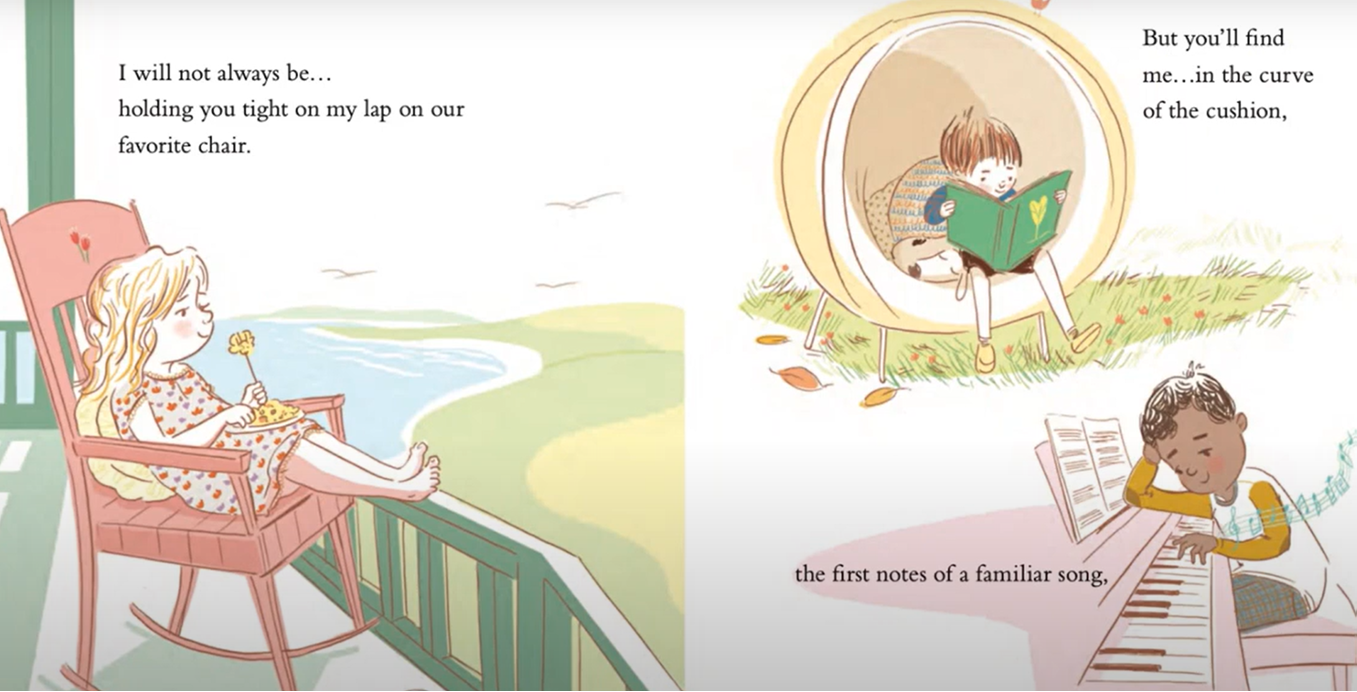
You’ll Find Me by Amanda Rawson Hill. (Video) This is beautiful. “I will not always be greeting the morning with you, but you’ll find me… in the way the sun spills through your window whispering wake up sleepyhead… I will not always be holding you tight in my lap, but you’ll find me… in the first notes of a familiar song…” The image at the top of this post is from this book.
You’ll Always Have My Love by Jennifer Chobar. (Video) Although I don’t think the rhymes are the best children’s writing, I do think there are beautiful messages in this book! I think it would be a very sweet thing for the person at life’s end to read to the child, if their belief system includes the idea that they’ll be watching over the child after they die.
When Mama Goes to Heaven by Jayna Russell. (Video) Talks about how the person they have lost can still be “found” in all the beauties of the world.
The Goodbye Book by Todd Parr. (Video) Could be read after someone’s passing, but I also think it could be read beforehand, as a chance to preview what the feelings might be like and how to hold them gently.
Creating Memories
By being honest with a child about what’s coming, you create the opportunity to create special rituals and preserve memories. Make lots of videos, take lots of pictures, write letters to be given to them on each birthday, plan a memorial service together, whatever feels meaningful to you.
You can also do more things with all the other adults who will help to support the child after the death, strengthening all those relationships, and showing them that those adults have your trust.
Still Living Your Life
Sometimes when death is coming, families let that overwhelm everything. Every day becomes about that.
It’s OK to still do all the “normal” things that “normal” families do with small kids. And let your kid be a kid! Go to the playground, watch Bluey together, dance together, see friends for playdates, go to preschool or story time, and so on. And it’s OK to have bad days when you’re cranky at your kid, like all parents have days they’re cranky at their kids!
Nearing the end
As the health situation worsens, and the end comes closer, be honest with the child about what is happening and what to expect. Keep reminding the child that they are loved and that they will be well cared for, and although many things will change, that will remain the same.
It might be tempting to keep the child away from a loved one who is becoming quite sick and frail. But it is hard for the child if someone “disappears” from their life before they are truly gone, so follow the child’s lead. If they want to be with the person, let them be! If they are ready for a break, give them a break. Allowing them to have choices in the moment is helpful. There’s no easy path, but again, letting them have some choice and control can help.
Here is info on supporting a child when a family member is dying in a care facility.
Resources for those who remain:
After the passing, here are some resources that will be helpful to those who are caring for the child:
- Supporting Preschoolers who are Grieving and Children and End of Life Rituals from NACG (childrengrieve.org)
- When Families Grieve from Sesame Street
- Books that can be read to the child after the loss: Missing Mummy by Rebecca Cobb. (Video), Lost in the Clouds by Tom Timm Disbury. (Video), The Memory Box by Joanna Rowland (Video). Something Very Sad Happened by Zucker (Video.) The first two are about the loss of a mother. The third isn’t specific. The last is about the loss of a grandmother. But I believe the reader could adapt these to the child’s situation.
- One important thing is that people continue to talk about the person who has died. Sometimes they avoid this because they fear it will make the child sad. It actually tends to be healing and calming to children to continue to hear about this person who was so important to them.
Note about links for book titles: these are Amazon affiliate links, so I would get a small referral fee if you clicked through and then purchased, but I also encourage you to get the book from your favorite independent bookseller.
More Resources:
There are lots more helpful resources on these sites:
- National Alliance for Children’s Grief
- Resources on Parent Death for parents and caregivers from Dougy Center, their section on supporting the youngest grievers, and their info on family members with an advanced serious illness.
- Resources for Parents from the Bright Spot Network for parents with cancer and parents who are cancer survivors. They offer an online support group for parents facing stage IV cancer.
Note: my other more general post on Talking to Children about Death covers some of this same info, but also has other tips and resources you may find helpful.


 More Good Days with Kids