
TL; DR: My recommended pet for first timers is a betta fish. But whatever family pet you’re thinking about getting, some key things to take into consideration are:
- start-up costs for the animal and its needs (shelter, food, etc.)
- daily effort needed (e.g. feeding, walking) and weekly/monthly effort (changing litter box, cleaning cages / tanks, purchasing food, etc.)
- vacation issues – if you go away for a weekend or a week, what needs will the pet have?
- lifespan cost and effort: how long will the pet live? how much effort / cost does it take to keep the animal fed? what health care costs might you face?
- annoyance factor: does the pet create lots of noise or unpleasant odors or does it make messes that must be cleaned? Is it nocturnal? what about allergies?
- reward: what joys can be found in owning this pet?
- making the decision that’s best for your family
Background
I know a lot of people start by thinking about the rewards of pet ownership – they imagine how fun it will be to play with their puppy, or snuggle their kitten, or watch the hamster roll around in its ball. Those are all joyful experiences, but owning a pet is also a lot of work and responsibility and there are plenty of non-joyful aspects.
When I was a kid, I volunteered at a local animal shelter. I saw so many good animals relinquished – some of which went on to other homes but many that were euthanized. Sometimes pets were relinquished because their owner’s life circumstances changed in unexpected ways and they weren’t able to continue to care for the animal, but more often they decided they just didn’t want to.
I believe quite strongly that when you take a pet into your life, you are committing to that animal’s health and well-being for its natural lifespan, so it’s important to think carefully before taking on that commitment.
Who Makes the Decision?
If your child is asking for a pet, remember it’s really going to be the parent who ends up being mostly responsible for the pet. Tweens and teens may be more responsible than younger children, but will still need lots of support. So, the adult has final say. If there are multiple adults in the household, they need to talk it through and be sure they are in agreement about the pet and about who will be responsible for which aspects of pet ownership.
So, if my child asks for a pet, I first need to decide whether I’m willing to consider it at all. If I am, then I make my children do all the needed research. If they want a pet, I go through the topics covered in this article with them, and I tell them they have to know the answer to those questions before I will consider the pet, and we have to have a care plan for the pet before bringing it home.
Start-Up Costs
Part of the research is learning about ALL the things you’ll need for the animal. We tend to only think of a few of the supplies at first, then they start adding up. Consider:
- cost of the animal itself (note: where possible, please consider adopting a pet from an animal shelter or rescue facility rather than buying a new pet from a store or a breeder. There are many great animals who need a new home! Adoption is also often cheaper than purchasing.)
- where they’ll live / sleep: an aquarium? hutch? bird cage? dog crate? pillows to sleep on? What other things are needed to make that the appropriate habitat for them: a light? a heat lamp? a pump? a heater? places to hide?
- what are their toileting needs? will you need poop bags? litter box? do you need bedding (e.g. cedar shavings in a rodent cage)
- what feeding supplies do you need? food dish? water bottle?
- what toys and accessories will you buy to enhance the fun of pet ownership? chew toys? costumes? hamster ball?
- any needed medical care: vaccinations? spay / neuter?
- for dogs and cats, there might also be licensing fees, pet deposits at an apartment, and so on
Effort – Regular Care and Maintenance
What will you need to do every day to care for your pet? What else will need to happen on a regular basis (like once a week, or once a month)?
- Feeding: how much time, effort and clean-up does feeding entail?
- Obtaining food: how often will you need to go to the store to buy food – can you get food at any grocery store or do you have to go to a specialty pet store?
- Toileting / Hygeine: letting a dog out or taking it for a walk several times a day? changing a litter box? cleaning shavings? cleaning a tank? What supplies will you need and what are the on-going costs?
- Cleaning up after your pet: if you have a pet that roams the house, even if they are housebroken, there may be times you need to clean up feces or urine. They may also chew shoes, scratch up furniture and so on. Birds are known for scattering feathers, poop, seeds and more around their cages.
Dog Walkers, Day Care and Vacation
How many hours can your pet be left alone? How will that work around your daily schedule of work, school, and children’s activities? Will you need a dog walker? Doggy day care?
How many days can they be left alone? What care will they need while you’re away on a vacation? How easy will it be to find someone to provide that care? How much will it cost?
Some people take their pets along on vacations – if you plan to do so, how will that limit your options for where you can stay and what you can do on your trip?
Lifespan Cost and Effort
In choosing a pet, it’s essential to be aware of their expected lifespan, so you can decide whether you want to commit to the cost and effort for that full time period.
In addition to the effort and costs above, what are some other things to consider? If you’re getting a dog, will there need to be a lot of upfront effort in obedience training? With any pet, as they get older, health issues may cause complications (e.g. incontinent cats, arthritic dogs who can no longer climb stairs.)
Consider vet costs, and how you’ll handle them. I will be honest with you that as much as I’m committed to caring for a pet as well as I can for its lifespan, when our betta fish was ailing, I was researching what I could do – articles talked about taking him to a vet. Buying a new betta costs $15 – I don’t know what a vet visit costs, but I chose instead to provide hospice care at home – keeping him as comfortable as I could for his final days.
For my dogs, of course I took them to the vet and provided all needed basic medical care. But had they developed a complex condition that would have taken thousands of dollars to treat, I would not have done so. If I had that money to spend on pet well-being, it would make more sense to me to donate to a local animal shelter or spay-neuter program which would benefit many more animals.
Your ethical stance on this may be different than mine, but you should think about what it is before you have a pet and before you face decisions about their medical care.
Annoyance Factor
Pets can have behaviors that are normal and natural for them but can be troublesome for humans. Before purchasing / adopting a pet, do some searching online to learn more or ask people you know who own that animal.
Some examples:
- dogs bark – some breeds bark a lot more than others
- cats jump on kitchen counters; cats mark – spraying urine on vertical surfaces
- birds chirp and squawk – often early in the morning
- rodents smell bad
- although geckos are silent, the crickets that they eat chirp a lot (especially the big ones)
- many popular pets (e.g. hamsters, mice, hedgehogs) are nocturnal animals which means they may be asleep all the hours that your child is awake, and may be squeaking, scratching and disruptive at night
- fish tanks can get very overgrown with algae if you’re not careful.
There are options for mitigating each of these annoyances, but they are part of pet ownership to consider.
Another issue: are there pet allergies in the household? Allergies to cats and rodents are pretty common, and dog allergies are not unusual (though some dogs are hypo-allergenic.) If you’re not sure if there are allergies, try spending time with an animal before committing – for example, if you’re considering a rodent, perhaps you could offer to pet-sit a rodent for someone who is going on vacation – having it in your home for a week would help you know what you’re getting into.
Reward?
What are the best parts of owning any particular type of pet? Again, search online to learn more and ask people you know who own that type of pet.
Think about what reward you most want and what pet most fulfills that. Some examples:
- something pretty / interesting / relaxing to look at in exchange for a fairly low level of care? Fish. Some reptiles. Some birds.
- something more active but that is mostly confined to its cage? rodents, some reptiles
- a manageable way for your child to practice responsibility? Fish, reptiles, some rodents.
- something to cuddle? Some cats, most dogs, some rabbits.
- something to get you out in the world and engaging with others? Dogs.
If you’re considering a cat, realize that they can have very different temperaments – some are social, some shy, some playful, some grumpy, some cuddly, some avoidant.
If you’re considering a dog, please realize that different breeds have very different traits – if you want a guard dog, or a dog that plays fetch, or a dog that lies to quietly snuggle, do your research to figure out what breeds match that. Don’t just pick based on appearances.
What’s Best for Your Family?
You can evaluate all the info above and take into account your own goals, limitations, and priorities and make the best decision for your family. I can share just a few examples from my experience.
Dogs
For the first 50+ years of my life, I owned at least one dog. I don’t at the moment. Because my past three dogs have each lived 15 – 17 years. That’s a lot of joy and love, and the dogs were a huge part of our family life and memories. But that was also a lot of dog walking, paying for boarding when vacationing, scooping poop, paying vet bills, not being out of the house for more than 8 or so hours at a time, and so on. It’s more than I’m willling to take on right now.

On the other hand, I know someone who has a dog who is a sweet but needy, anxious little dog who needs a lot from her. He worships the ground she walks on and is very sad when she’s away at work or elsewhere. She likes having him to care for because having to stay calm and reassuring for the dog helps to distract her from her own worries.
Rodents (and snakes)
When I was a young kid, we got 2 pet gerbils. One was sweet and cuddly. The other was mean and bit. To my memory, they were pretty good pets overall, until my brother’s friend took the mean one out of his cage and the gerbil bit him and the kid dropped it. I think it was a few days before we were able to find the gerbil in the pantry and get it back into the cage. (This is why you should have the rule of “you can only take the animal out of the cage when there is adult supervision.”)
In college, my room-mate had a corn snake, which was an easy room-mate. Quiet, non-obtrusive, easy to watch or easy to ignore. It only needed fed once a week – it ate pinkie mice. (Brand new baby mice, so young they didn’t have fur yet.) My room-mate wanted to save herself a trip to the store, so one week she bought two pinkies. The snake ate one, and was too full to eat the other. So the mouse just lived in the snake cage for a week… and it turns out that snakes are so stupid that once a mouse has been there for a while, they stop noticing it. So, I ended up taking pity on the terrified mouse and getting it out of the snake cage and getting a mouse cage and suddenly I had a pet mouse.
I had him for about six months. He was a little loud and stinky for an ideal dorm pet, and did need weekly cage cleanings. But it was manageable.
Reptiles
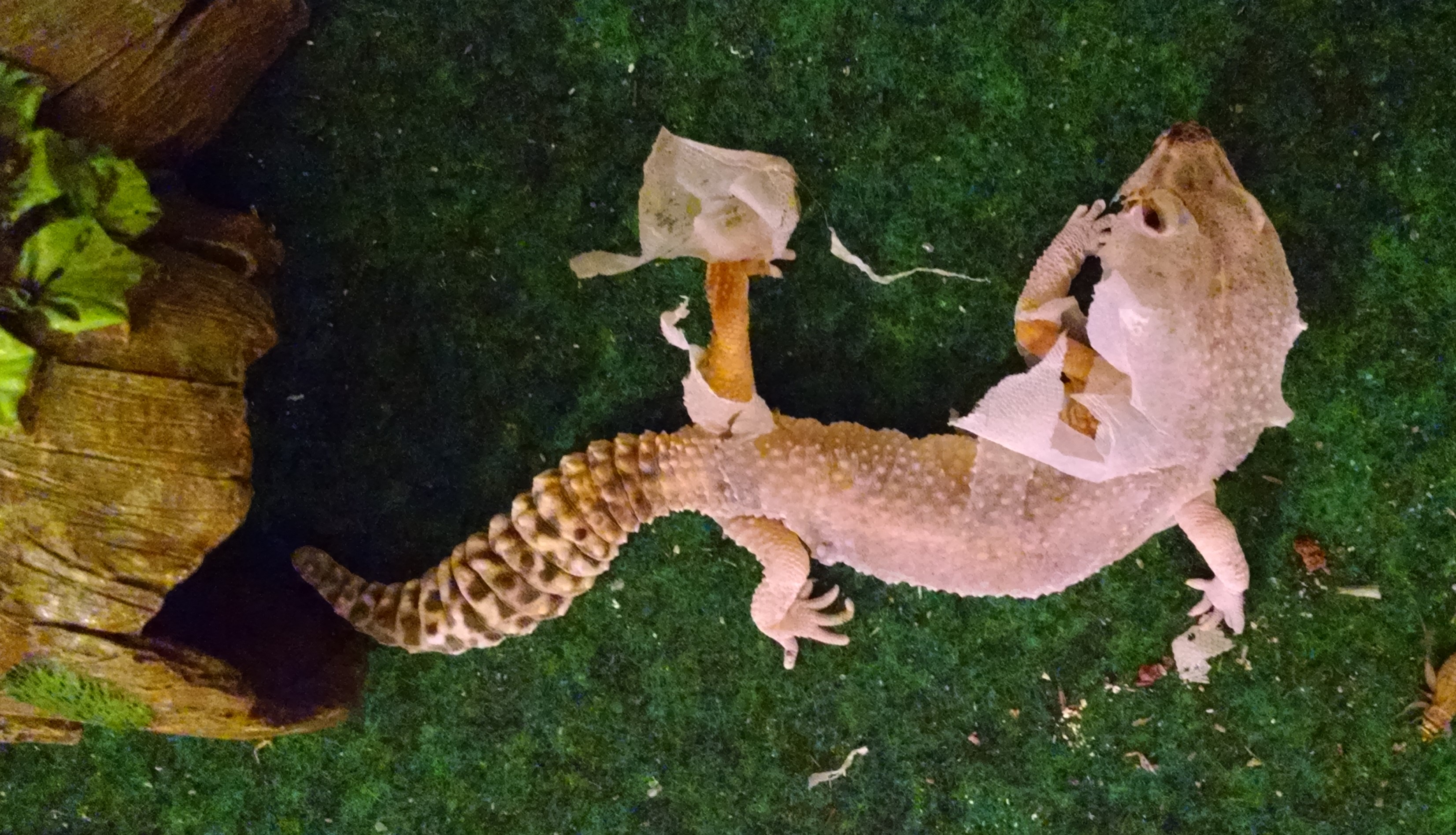
When my daughter was in middle school, she wanted a leopard gecko. (The gecko she got is shown in the picture above, where she’s shedding her outgrown skin.)
My daughter did all the research, took on all the responsibility and so on. The only thing I had to do was drive to the petstore every ten days to buy crickets. In general, the gecko was a very easy pet who provided some entertainment when you wanted it but didn’t care if were busy and paid no attention other than daily feedings.
I swear my daughter told me that the lifespan of a gecko was 3 to 7 years, and that’s what I thought I agreed to. She swears she told me 10 – 15. In the end, her gecko lived to 10. That means that when my daughter went off to college 1000 miles away, guess who took over care of the gecko? And what else did that mean? It means in the end, I drove to the petstore every 10 days for 10 years straight.

Fish
My daughter also had a betta fish for a few years. My youngest has had two betta fish – each lived for about 2.5 years. In that time, the effort was feeding it twice a day and cleaning the tank once a month. And going to the pet store for supplies a handful of times over those 5 years. For my son (who has ADHD), it was a manageable level of responsibility, and the family had the relaxing vibe of a fish and a snail hanging out in their aquarium on the counter.
What’s Best?
Were the dogs a more rewarding pet than the fish? Yes, of course, by far. But, at different times in the life of your family, you may make different tradeoffs between reward and effort. There’s no one right answer, but making an informed choice is important.
Learning More
Whatever pet you’re considering, it’s easy to do lots of online research to answer all the questions I’ve offered here. Do look at multiple sources, and be aware of their biases. (For example, a pet store that wants to sell you a pet and supplies may have a motivation to convince you that pet ownership is easy-peasy.)
Good luck on your journey to pet ownership!
Here’s my guide to owning a betta fish.
 More Good Days with Kids