Tag Archives: attachment parenting

Parenting Style

There is no one right way to parent. We all make compromises each day that juggle the concrete short-term needs of the day with long-term goals for our child, balanced with our child’s temperament and our own. Having a vocabulary for talking about our parenting style can help us make more intentional choices that can guide us, over time, to becoming the type of parent that we want to be.

Let’s start with a quiz. For each spectrum, there will be two statements representing two different parenting approaches. If the one on the left describes you perfectly, make a mark on the left end of the spectrum (yellow). If the one on the right is exactly what you would say, make a mark on the right end. If you’re somewhere in between, mark somewhere in between, wherever feels right.

What is your approach to parenting a 6 month old baby?

Parent-Led. Parents create structure by scheduling feedings and naps. They may leave a baby to “cry it out” so the baby learns to self-soothe. Attachment-Style. Parents watch for baby’s cues to decide when to feed or to settle to sleep. Parents always respond to crying.

What is your approach to early learning? (for a 2 – 5 year old)

Structured learning. Parents buy educational toys, sign a child up for classes, and when they play, the parent works to find ways to teach new ideas. Child-Led. They have a variety of toys, go out on adventures to see what child discovers / decides to do. When they play, parent follows child’s lead

What is your approach to supervising at the playground? (for a 5 – 8 year old)

Close Supervision. Parents help children on the swings, remind them about rules, encourage them to try all the activities and play nicely with others. Free Range. Parents sit back and let child explore – it’s OK to climb up the slide. If kids squabble, parents allow them to sort it out on their own.

What is your approach to school and extracurriculars (for a middle schooler)

The Director. To get good at anything you have to work hard. Kids don’t want to work hard, so parents have to push, make choices for them. Unschooled. Parents trust their child’s choices about what to do, when to eat and sleep. Children learn what they’re passionate about.

What do your answers say about your parenting style?

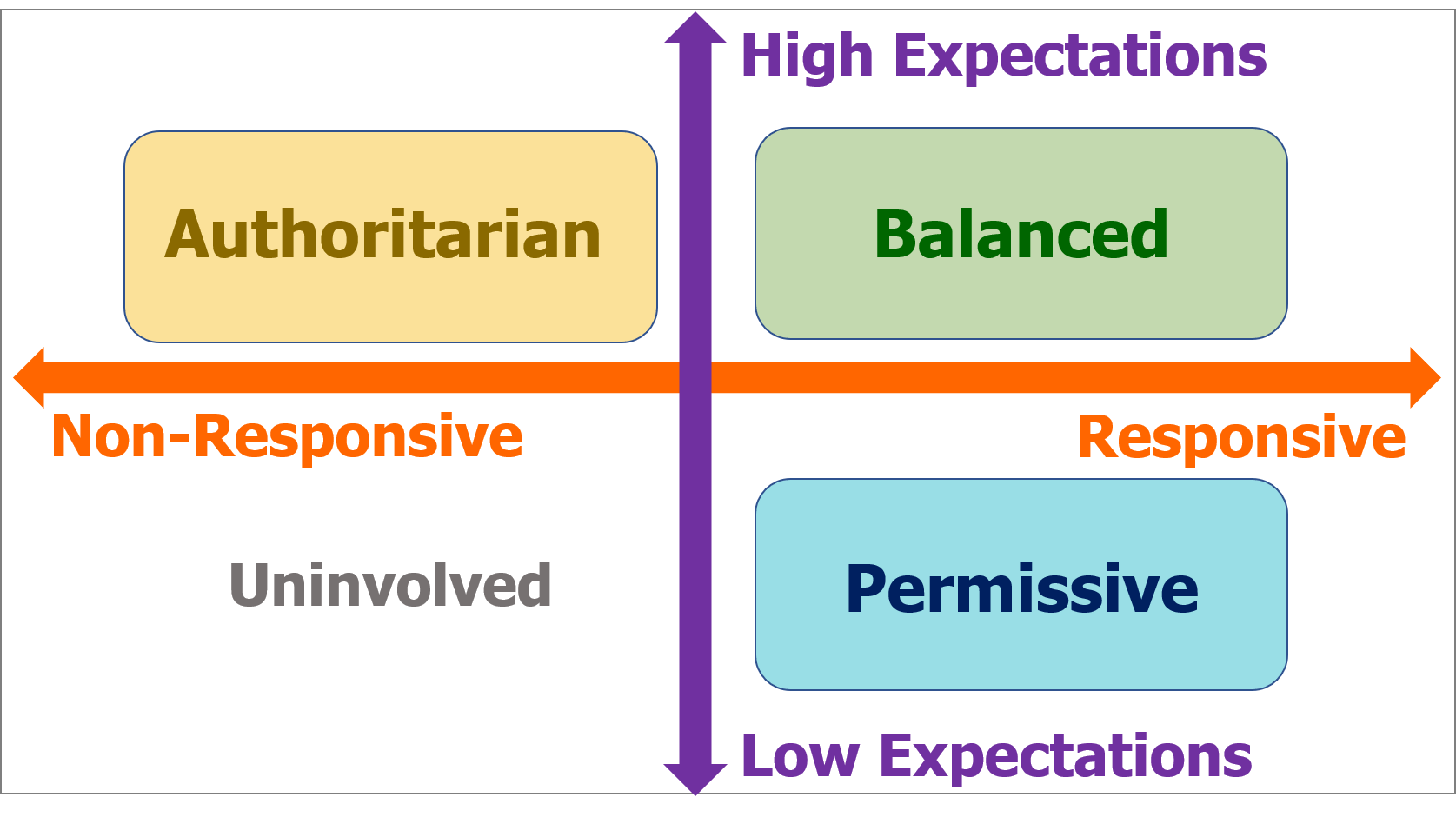
Parenting styles are often talked about as three categories. If you tended to make marks in the yellow zones, you may be an authoritarian style parent. If you tended to mark blue, you may be permissive. If you were always in between, that’s called authoritative (or balanced).

Parenting Style and Choice

One way to think about parenting style is how you handle choices. A permissive parent offers a wide range of options and lets the child make the choices. An authoritative parent offers fewer options and tries to educate and persuade the child about how to make the best choice. An authoritarian parent offers few choices, generally dictating what will be done.

The permissive parent may value independence and imagination, and believe that if they allow the child to follow their passions, they can trust them to do their best. The authoritative parent may value hard work and smart decision-making that balances short term desires with long-term goals. The authoritarian parent may value obedience, and believe that learning to follow the rules and doing their best at their assigned tasks is the path to success.

Balancing Expectations and Choices

Parents are generally attempting to prioritize their child’s long-term well-being and success, and feel that they have wisdom and perspective that helps them to know what’s best for the child. Children generally prioritize their own happiness in the moment, and don’t worry much about the long-term. So, part of parenting style lies in how we negotiate that conflict.

Parents who have high expectations for their child’s success (however the family defines success, whether that’s in academics, athletics, financial, support for the family, etc.) tend to want more control over their child’s choices, so lean authoritarian or authoritative. Permissive parents may place more emphasis on the child’s happiness than on their accomplishments.

Authoritarian parents believe they know what is best for their child, are not responsive to a child’s individual desires, and apply the same rules in all situations. Authoritative and permissive parents are more responsive to the child as an individual, and also adapt to the situation. (For example, if the child has had a rough week, the parent may let them skip an assigned chore.)
Questions to Reflect On:

What style of parent do you WANT to be?

What type of parent are you on a rough day?

Are you the same style as your parenting partner? Or different? How is that going?

Are you the same style of parent that YOUR parents were? Or are you very different? Why?

Also, check out my post on defining your parenting vision / your family’s mission / and imagining – “15 to 20 years from now, what do you hope your family is like??

Learn More

I’ve written before about the four parenting styles, about other parenting labels like helicopter parents, free range, and tiger moms, and how parenting style might affect how we handle choices in our families.

This article on Parenting for Brain has more info on all these types including citations from the research, including a fun bit of trivia that: “In the US, roughly 46% of parents use an authoritative parenting style, 26% authoritarian parenting style, 18% permissive parenting style, and 10% neglectful parenting style…. European-American parents are about 2% more likely to have an authoritative style, while Asian-American parents are 2% more likely to have an authoritarian style.”

Here is a free printable handout of this post’s content on parenting style.

Parenting Style: Are You a Helicopter Parent? Free Range Family? Tiger Mom?

Popular media likes simple, black and white labels for more complicated ideas. For this post, I’ve gathered some trendy labels for different parenting styles. For five topics below, I’ll give two statements… decide which one comes closer to representing your feelings, and then see what “label” that would get you. I include links to resources where you can learn more about that parenting style. I often find that reading about other people’s philosophies helps me clarify what my own parenting philosophy is, and thus live it more effectively.

How should you care for a young baby? (under 6 months)

A: Parents should determine a schedule for baby’s feeding, diaper changes, and nap times. Parents provide structure, a predictable environment, and a consistent response style to train baby’s internal clock. They may leave a baby to “cry it out” as it learns self-soothing behavior.

B: Parents watch baby for hunger cues and feed on demand. They watch for toileting cues to know when a diaper change is imminent. When tired cues appear, they settle baby to sleep. Parents always respond to crying. Parents focus on being responsive to the child, and the family’s schedule adapts around baby’s needs.

If you chose A, that’s “parent led” style. One proponent of parent-led style is Gary Ezzo, author of On Becoming Baby Wise.

B is “child led” style. One proponent of baby-led style is the Sears family, authors of The Attachment Parenting Book.

Here are articles comparing a daily schedule for Parent-Led vs. Baby Led families

How much do you schedule enrichment activities (for your preschool age child)?

A: “Children are exposed to enrichment videos… from early infancy as well as specialized books and toys [and enrichment activities] designed to ensure that they are well-rounded and adequately stimulated for excelled development… considerable family resources are being invested to ensure that the children have what are marketed as the “very best” opportunities.” [Source]

B: “He doesn’t need toys… He sometimes picks up a stick and one moment it’s an airplane. Then it becomes a car, then a train, then a monster from the lagoon. What amazes me about this is his creativity and delight as he plays… In order for a child to be able to play like this and be inventive, he needs unscheduled time.” [Source]

These are the Scheduled vs. Un-Scheduled Parents. It may be best to find a good balances between the two sides. Here is an AAP article on the importance of play (and unstructured time): http://pediatrics.aappublications.org/content/119/1/182.full

How much do you intervene in your child’s conflicts? (for 5 year olds on the playground)

A: “I tried to be prepared and attentive. I would get up mid-conversation to help my boys negotiate and share if I sensed trouble was brewing. I parceled out snacks, helped them on the swings, and watched over my kids… being on top of things… was what good parents did.”

B: “Adults didn’t impose their notions of correct behavior onto the children’s natural, boisterous play. Play fighting was considered [normal]… Fighting, crying, and making up again were normal ways of figuring out how to get along… it was important not to interfere in this…”

These summaries are taken from Parenting without Borders by Christine Gross-Loh. A describes her observations about American parents versus Japanese parents. She goes on to discuss research that shows that at age 12, the Japanese kids are more empathetic and respectful of their peers. They treat other people right because it’s the right thing to do, and they know people will be unhappy if they do otherwise. Kids in America report that you need to be nice to others, because if you’re not, you’ll get caught and you’ll get in trouble with your parents or teachers.

How much do you protect your child vs. allowing free exploration?

A: These parents have a high level of oversight and supervision, providing frequent advice, reminders, and assistance. Parents protect from harm and upset, and help with decision making. Parents “smooth the way” by being actively engaged with teachers, coaches, etc.

B: These parents encourage children to actively and independently explore their worlds. “We don’t want our kids to fall off a bike. But we do want them to learn to ride. We can [either] hold onto handlebars forever, or wish them luck and then let go.”

A is the Helicopter Parent. Learn more at http://parenting.blogs.nytimes.com/2009/03/04/in-defense-of-helicopter-parents/; http://www.schoolofsmock.com/2013/08/19/helicopterparenting/  – Your Hovering Doesn’t Help

B is a Free Range Parent. Learn more at https://time.com/3828533/free-range-parenting/ and http://www.theatlantic.com/features/archive/2014/03/hey-parents-leave-those-kids-alone/358631/

How would you approach school, homework, and piano practice? (for a 10 year old or so…)

A: “What [these] parents understand is that nothing is fun until you’re good at it. To get good at anything you have to work, and children on their own never want to work, which is why it is crucial to override their preferences… Once a child starts to excel at something—whether it’s math, piano, pitching or ballet—he or she gets praise, admiration and satisfaction. This builds confidence and makes the once not-fun activity fun.”

B: “[This] includes trusting your child in what they choose to learn; you extend that same trust to other areas of your child’s life, like foods, media, television, bedtime. Parenting is supposed to be joyful, and it can be when we learn to connect with, rather than control, our children. The focus of our life is on happiness and pursuing our interests with reckless abandon together. We totally immerse ourselves in our passions every single day.”

A describes a “director” approach to parenting. Amy Chua, self-described “Chinese Mother”, describes this in Battle Hymn of the Tiger Mother: Learn more: http://online.wsj.com/article/SB10001424052748704111504576059713528698754.html  or Video: www.youtube.com/watch?v=TlHLyHw47AU

B is Radical Un-Schooling. Read more from Dayna Martin at Radical Unschooling: https://daynamartin.com/the-evolution-of-childrens-rights-radical-unschooling/ , https://learninghappens.wordpress.com/2011/09/24/unschooling-is-not-child-led-learning/  Or Video: www.youtube.com/watch?v=aFgVgRvmSeM

Another perspective on parenting styles

Researchers in psychology and child development often refer to 4 styles of parenting: Authoritarian, Authoritative, Permissive, and Uninvolved. (Learn more here.) On that scale, all the A choices above (Parent-Led, Helicopter Parent, etc.) lean toward the Authoritarian – high on demand, low on responsiveness.

All the B choices (Child Led, Free Range Parent, Radical Unschooler) lean toward Permissive – high on responsiveness, low on demand.

You may have heard the phrase “all things in moderation.” That definitely can apply to parenting. Any of these approaches can work well if applied with a light touch. But they could all be taken too far. Parents who go too far in the authoritarian direction may end with children  who follow rules and don’t get into trouble, but might be less creative, and less happy. Parents who go too far in the permissive direction may end up with kids who are creative and happy, but have a hard time succeeding in school, peer relationships, and work.

Wherever you stand, it may be helpful to moderate a little toward the center of the spectrum between these extremes… an authoritative parent tries to find a good balance between challenging their kids to help them succeed while at the same time honoring them as individuals.

Parent Educators, here’s a couple options for a free printable handout on parenting style spectrums1. Parenting Style

Also check out this article on: 23 Parenting Philosophies and Methods Explained.
