Author Archives: Janelle Durham

Unknown's avatar

About Janelle Durham

I am a parent educator and social worker, and teach music and science to children age 1 - 8.

Election Stress and Parenting

This year has been an especially tense year related to politics in the United States. “Every year the American Psychological Association takes a look at the leading causes of stress in the U.S…. This year… all the usual suspects like money, health and family are still wearing people down, but one issue is dominating – politics… the future of the nation… 80% of Republicans rated it a top stressor, so did 79% of Democrats and 73% of Independents.” (NPR)

When parents are stressed, we tend to be less patient, get annoyed more quickly – sometimes over-reacting to small things. Our children feel that stress and may wonder if they are doing something wrong that is the reason their parents are unhappy, or may worry that bad things will happen to their family.

If you’re feeling stressed about the election, admit it to your child – let them know that they are right about what they are noticing about your feelings. But also reassure them that they have done nothing wrong and you are not upset at them. Also, reassure them that things will be OK in the end – I know that you yourself may not be feeling confident right now that things will be OK in the long run, but this is a time to dig down for whatever optimism you have, or faith or resilience, in order to reassure your child.

I have an approach for talking to kids about anything that scares them or scares you or raises your anxiety levels high – it’s especially relevant to things we may feel we have little control over (like national elections!).

  • Be thoughtful about how much exposure they have to the issue that is concerning
  • If they bring it up, or ask a question, don’t avoid it, just answer it briefly with a simple reassuring explanation.
  • Talk about how likely (or unlikely) the thing you’re worrying about is to happen.
  • Tell them what will be done to prevent bad outcomes as fall-out from that.
  • Reassure them that even if bad things happens, people are tough and resilient, and pull together and make it through.

So, to apply that approach to the election:

Be thoughtful about media exposure:

While you might be tempted to doom-scroll media and social media binge for all the most recent updates, try to save that for times your child is not observing you. If you are checking on things, just remind your child that their world is OK, you just have some worries about things in the outside world but that they are still safe and loved.

In 2016, when my child was almost 6, I did something that I wouldn’t recommend you repeat – I came home from work at 8:30 pm on election night and was upset and turned on the TV to watch – he heard it, got out of bed, and came to watch with me. We were all up VERY late that night, upset over election results. (And I imagine that other parents may have had a similar experience on election night 2020 for opposite political reasons.) A better choice would have been for me to turn it off, get him settled for bed, and then do what I needed to do to process the results. And I could have reassured him from a belief that I DO hold, even though it was hard to hold in that moment: as MLK said “Let us realize the arc of the moral universe is long, but it bends toward justice.”

Responding to their questions

Even young children will hear about the election – I remember when George W Bush was up for election (and with the whole Bush v. Gore hanging chads saga) my older kids who were early elementary at the time had lots of questions. Answer questions as simply as possible, then ask them if they have more questions before continuing to info dump your own anxiety on them.

For younger children, say under 8 years old, I would focus as much as I could on optimistic perspectives, reassuring them that they’ll be OK, and focusing on the things in our personal life that we do have control on and not as much about the broader world that we have less control over.

How Likely / Reducing Harm

RIght now, I have a 13 year old who follows me around asking me “the polls are so close, who’s going to win?” I tell him that millions of people around the world want to know that, and nobody has a good answer to that. Then he asks me again, “yeah, I know, but what do you think is going to happen?” I acknowledge that he’s feeling anxious and that it’s hard to sit in uncertainty.

He wants to know what will happen after the election – he has a lot of worries about what things will be like if one candidate wins.

Because my child is a teenager, I talk more openly about what challenges we would likely face over the next four years, and also talk about what people and organizations who are politically aligned with us will be doing to help mitigate the harms. And about the idea of checks and balances – while not perfect by any means, different governmental systems can reduce the most extreme policies.

Resilience

I also talk about how I’m coping with my own worries about that by thinking about all the positive reasons that I think that even if things are hard for a while (especially for certain marginalized groups), over the next many years things will get better. I talk about the ways that our society has progressed over my lifetime and his grandparents’ lifetime – progress is not fast or easy, but it does bend toward justice. We also talk about what we can do as individuals to help with that progress.

Self Care

If you need support processing your worries about this election, reach out to friends and family. Or, if there is political strife within your friends and family, search online for things like Facebook groups or Reddit forums where you can find people who share your views to help you not feel so alone. (Note: if a forum is soothing to you, stay in – if it just escalates your emotions even further, move on from it.) Do the usual self care things – sleep, get outdoors for a walk, eat well. We’ll get through this.

More resources: check out my posts on Reducing Parental meltdowns and handling your anger in the moment.
Kids’ Books on Resilience and Growth Mindset

In my parent ed classes, I present a session called “Raising Bold Kids” where we talk about grit, the growth based mindset, independence, teaching children to problem solve, and resilience. This year, someone asked if I had books I would recommend reading to children to help teach these sorts of skills. Here’s a list!

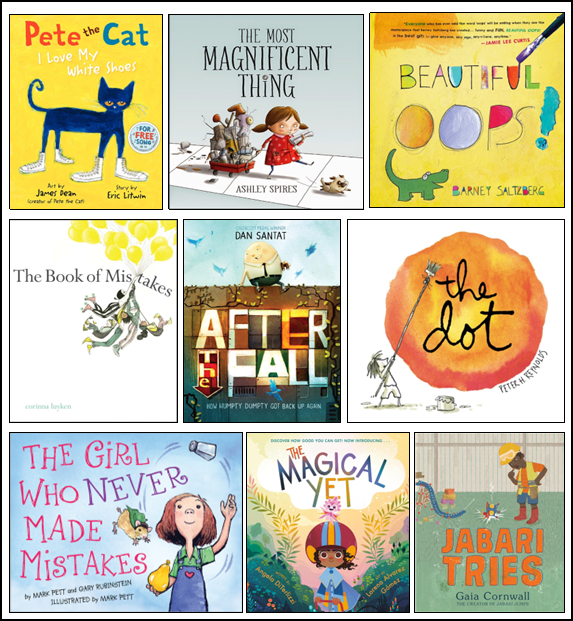
The Girl Who Never Made Mistakes by Pett and Rubinstein. (Video) This tells of Beatrice, famed far and wide for never making mistakes. One day she slips and almost makes a mistake. She worries about that all that day. She watches friends ice skating but is afraid to join them because she doesn’t want to risk falling. At the talent show: “for the first time in as long as anyone could remember, Beatrice made a mistake. And it was a big one!” She ends up laughing about it, then starts taking more risks, and trying things like ice skating – where yes, she falls down a lot, but she also has lots of fun. Great read-aloud for age 4 – 7.

The Most Magnificent Thing  by Spires. (Video.) A little girl wants to make the most MAGNIFICENT thing. She draws it out, and knows exactly how it will work. But when she tries to make it she fails again and again and gets very discouraged. But then she looks at all the things she made, finds the best thing about each, tries again and succeeds. People love all her “failed” experiments and take them home to use. Great read-aloud for ages 3 – 7. I appreciate that it really shows her emotions and how she deals with them, and lets kids know it’s OK to make mistakes.

Rosie Revere, Engineer by Beaty. (Video) Rosie dreams of being an engineer, and builds cool stuff out of trash, but then her uncle laughs at her and she stops inventing till Aunt Rose (Rosie the Riveter in her later years) comes to visit. They build a heli-o-cheese-copter. It only flies for a moment and Rosie is discouraged, till Aunt Rose says “it’s the perfect first try! This great flop is over, it’s time for the next”. They keep building together. Ages 3 – 7.

Jabari Tries by Gaia Cornwall. (video) Jabari wants to build a flying machine to fly across the back yard but it keeps crashing. He reluctantly lets his little sister help, and in the end, gets inspiration from her that leads to success. Nice story with a Black family that includes being inspired by Black inventors and engineers and also shows Dad encouraging a frustrated child to take a break, take a deep breath and try again. For more inventor themed books, check out Izzy Gizmo and Audrey the Amazing Inventor.

After the Fall (How Humpty Dumpty Got Back Up Again) by Santat. (video) Humpty loves sitting atop the wall, looking at birds. But after he falls and is put back together again, he develops a fear of heights and lives a sad life dreaming of flying. In the end he overcomes his fears and learns to soar.

Pete the Cat – I love my white shoes by Litwin and Dean. (video) Although I find many of the 60+ Pete the Cat books to be disappointing, this first one is magic. Pete’s walking along, singing his song, steps in a pile of strawberries, blueberries, and so on. Does Pete cry? Goodness no, he just keeps walking along singing his song.

All of those books model the Growth Based Mindset. If you’re looking for a book that is more explicitly about the mindset, you might also like:

The Magical Yet by DiTerlizzi and Gomez. (video) Talks about how failing at something (riding a bike) can be disappointing and make you want to quit trying. Then talks about the importance of keeping trying till you succeed. Protagonist is a person of color.

Growth Mindset Ninja by Nhin. (Video) “What you do is add the “yet” to everything. Then wait for the magic to happen in your brain.” And also check out: Your Fantastic Elastic Brain (Video)

Here are three art-specific books to choose from:

Beautiful Oops – Saltzberg (video) is a fun lift the flap which shows how to turn things like an accidental drip of paint, or a stain from a spill, into art. Ends with this message: “When you think you have made a mistake, think of it as an opportunity to make something beautiful.”

Book of Mistakes – Luyken (video). Shows illustrations in progress as the artist keeps making adjustments: “It started with one mistake… making the other eye even bigger was a bigger mistake… but the glasses – they were a good idea.”

The Dot and Ish by Reynolds – this is a two pack of books. In the Dot (video), a child named Vashti is afraid to try drawing. She makes one dot on the paper. The teacher frames it! Vashti decides she can paint a better dot, and makes dots of all sizes and colors. Then she encourages others to try. In the Ish (video), Ramon loves to draw anytime, anywhere. After his brother makes fun of one of his drawings, he gets self-conscious and crumples all of his artwork. Then he discovers his sister has been saving and hanging his art. He learns he doesn’t have to draw the perfect house – something that’s house-ish is just fine. He starts experimenting with drawing-ish, poems-ish, and so on, just enjoying creating.

Note: the book links are Amazon affilate links – I do get a small bonus (at no cost to you) if you click on these links and then purchase anything on Amazon. The videos are on YouTube – I encourage you to use them to preview but then purchase a legitimate copy of the book or get it from your library. It’s important to support authors and artists!

Find more book recommendations.

Resources for Learning Ukulele

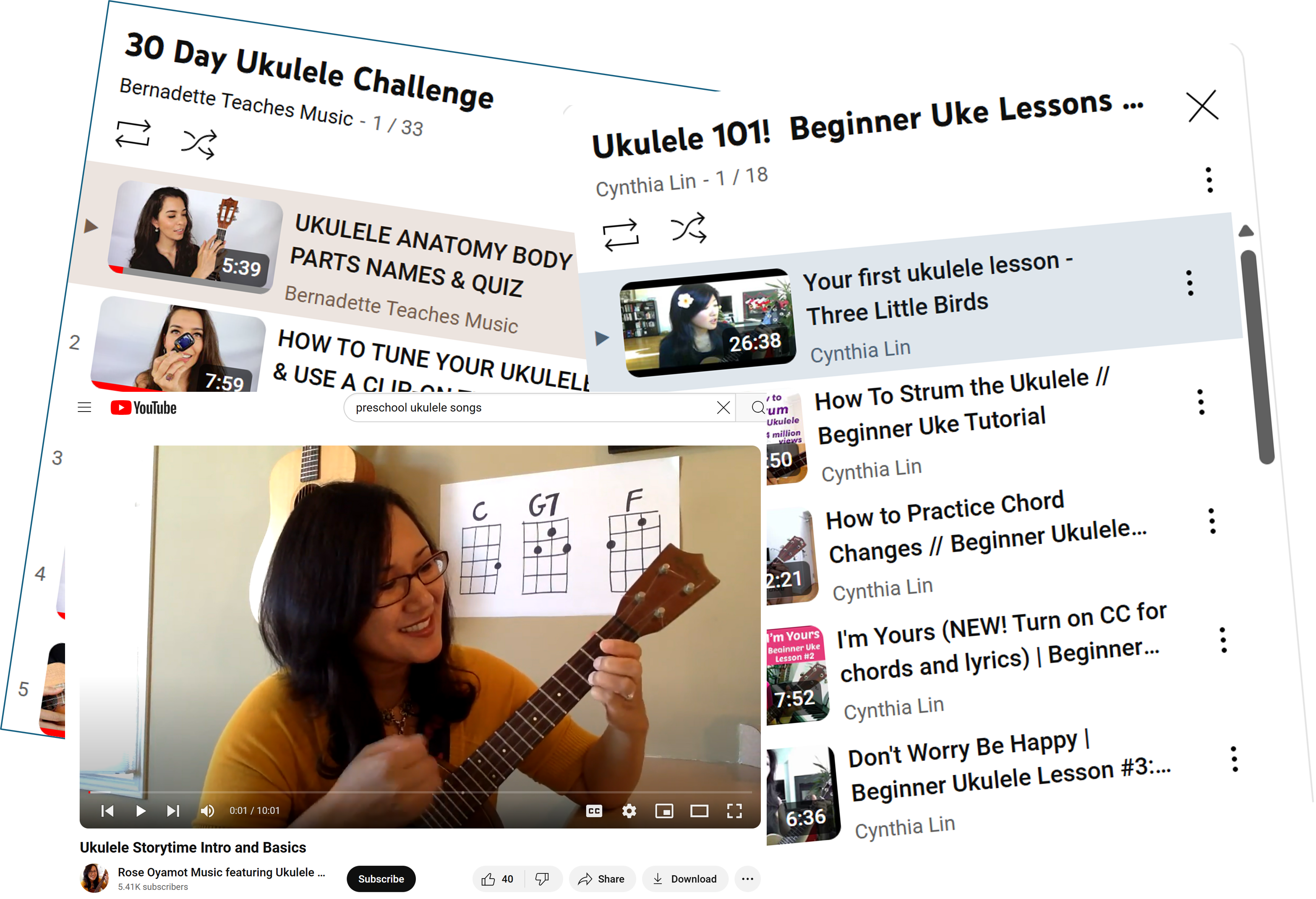
Once you’ve mastered all those preschool songs in my Beginner Uke for Preschool Teachers series, you may find you’ve fallen in love with ukulele and want to learn more.

Here’s my approach: Most mornings when I’m playing on my ukulele, I think of a song I want to work on, go to YouTube and search for “[song title] ukulele” and then work through the tutorials I find.

I’ve also used the book Daily Ukulele (Amazon affiliate link). I flip to the next song, try it on my own, then search for tutorials of it to build more skills or search on YouTube for “[song title] play-along” if I am feeling confident and want to practice playing it at tempo.

Here are the YouTube channels I have learned the most from:

Someday I’ll be good enough to keep up with: Matt Dahlberg and Christopher Davis-Shannon.

Many of those instructors have Patreons, where for a small monthly fee you can access PDF song sheets, additional tutorials, live jams and lots of other supplemental material. Morristown has all of their song sheets available for free.

I’m working on a collection of singalongs from the songbook Rise Up Singing.

If you want written chords for songs; For any song you want to learn, you can do a google image search for “[song title] ukulele chords” and come up with several versions in different keys – play around to find the one that suits your voice best. 

If you really want to improve your playing, find other people to play ukulele with!! Search for a group in your area – they’re often free, drop-in-anytime groups. Or if you can’t find one locally, there are some online groups as well. My group, on the Eastside of Seattle has some free songbook PDF’s with lots of fun songs to play along to.

Have fun playing ukulele!!

More Kids’ Songs on Ukulele

This is the end of my full series on Beginner Ukulele for Preschool Teachers and Children’s Librarians. Start at the beginning!

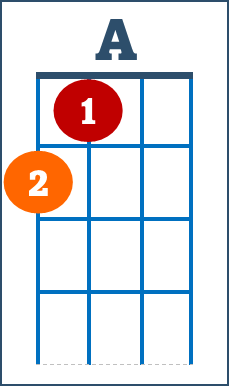
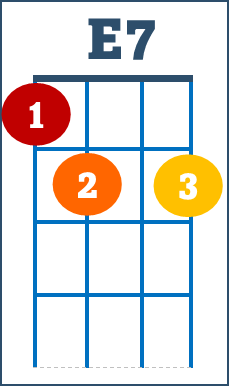
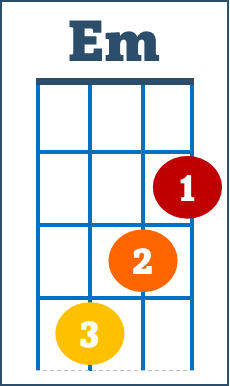
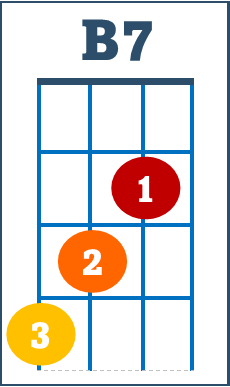
Just for the fun of it, let’s briefly learn 8 more chords and 5 more songs:

(C) Do you know the muffin man,
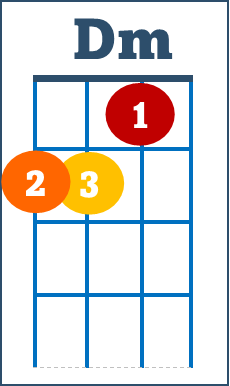
the (Dm) muffin man, the (G) muffin man.
(C) Yes, I know the muffin man
he (Dm) lives on (G) Drury (C) Lane

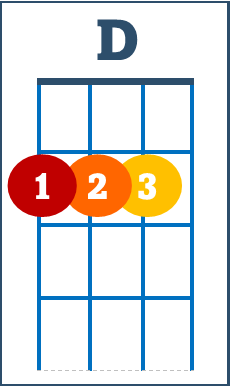
There (D) was a farmer (G) had a (D) dog
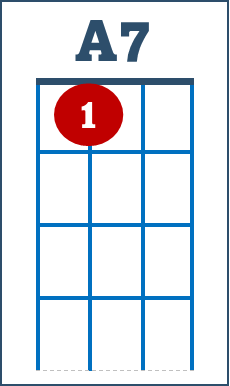
And Bingo (A7) was his (D) name-o
B-I-(G) N-G-O! (A7) B-I (D)-N-G-O!
B-I-(G) N-G-O! And (A7) Bingo was his (D) name -o

(A) Five Green and Speckled Frogs (D) sat on a speckled log,
(A) eating some most delicious (E7) bugs. Yum yum.
(A) One jumped into the pool, (D) where it was nice and cool
(A) now there are (E7) four green and speckled (A) frogs

You’ll notice Em and B7 are the same chord shape, just shifted up or down one string. That makes it easier to transition between them, although as an intermediate player, I find I’m still not smooth at making that shift.

The (Em) ants go marching one by one hur(G)rah hurrah
The (Em) ants go marching one by one hur(G)rah hur(B7)rah
The (Em) ants go marching (D)one by one,
the (Em) little one stops to (B7)suck his thumb
and they (Em)all (D)go (Em) march(B7)ing
(Em) down (B7)to the (Em) ground
(B7)to get (Em) out (B7)of the (Em) rain.
Boom (B7)Boom (Em)Boom.

D7, C, G Songs for Ukelele

This is part of my full series on Beginner Ukulele for Preschool Teachers and Children’s Librarians. Start at the beginning!

Playing D7 Chord

There are two ways to play D7: the “Hawaiian D7” and regular D7. Play with them both, and use the one that is easier for you or that you think sounds better for the song.

(G) Old McDonald (C) had a (G) farm. E – I (D7) E – I (G) O.
And on that farm he (C) had a (G) _____. E – I (D7) E – I (G) O.
With a _____ here and a _____ there. Here a ____ there a _____.
Everywhere a __________.
Old McDonald (C) had a (G) farm. E-I (D7) E-I (G) O

(G) Where is Thumbkin, Where Is Thumbkin?
Here I am! Here I am. (D7)How are you to(G)day sir?
(D7)Very well I (G)thank you. Run (D7)a(G)way. Run (D7)a(G)way.
Pointer… tall man… ring man… pinkie

(G) She’ll be comin’ ’round the mountain when she comes
She’ll be comin’ ’round the mountain when she (D7) comes
She’ll be (G) comin’ ’round the (G7) mountain
She’ll be (C) comin’ ’round the mountain
She’ll be (G) comin’ ’round the (D7) mountain when she (G) comes