
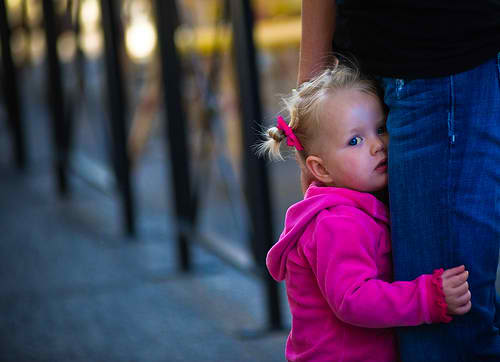
Any early childhood educator can tell you that some children leap with both feet into any new situation, trying new things, chatting easily with strangers, and rolling with any new experience that comes their way. Other children will enter the classroom slowly, hover on the edges (or behind their parents’ legs), gaze around with big eyes, duck their head when someone talks to them, and be hesitant to try new activities. These children get labeled as shy or timid or resistant, and the implication is often that there’s something wrong with the child or some problem they need to outgrow.
Let’s instead think of these kids as the slow to warm up kids. They need time to observe a situation, time to figure out how things work, space to decide whether they feel comfortable with someone, and respect for their right to move at their own speed. If they feel pressured to change, then they can turn into shy kids… shyness often is based in a fear of being judged negatively.
Instead, we can accept that this cautious approach may be a core part of their temperament, respect that introverts have many important strengths, give them plenty of time to flourish in their comfort zones, and also give them concrete tools that help them when they need to take on new experiences.
Understanding Temperament
Temperament is used to describe a child’s in-born personality. Researchers talk about 9 different temperament traits, and then how they cluster to form personality types. The slow to warm up child may be: cautious of new situations, slow to adapt to change, sensitive to things like noise and bright colors/lights, serious, and low activity level. Some also have very intense reactions to challenges.
There is no temperament type that is the best or the worst – they’re just different. Whether a child’s temperament is easy to work with or challenging often depends on “goodness of fit” with their environment and with the people in that environment. If a parent is an extroverted athletic person, and their child is as well, and they are running and shouting on the playground together, that’s a good fit. That child and parent may not fit as well at library story time. Or if that parent has another child who is slow moving, hesitant to try new things, and likes quiet places, that’s not as good of a fit.
For all children, no matter their temperament, it is helpful to them to have plenty of time in “good fit” settings – if they are in places they feel comfortable, with people they are comfortable with, and doing things they enjoy, they will really thrive. The science of brain development shows us that when children feel safe, their oxytocin flows and their brains have a high degree of neuroplasticity – they are open to learning and growing. When children are stressed and anxious, it is harder for them to learn. So prioritize finding safe spaces for them where they can relax and learn.
And… all children also need to learn how to stretch – how to push outside their comfort zone and cope with settings that aren’t as easy, and work with people who might not do things in the ways they would be most comfortable with. So, caregivers can give slow-to-warm up children challenges that help them work out their adaptability muscles. We can and should have them try things that are hard for them. But when we do that, a little extra support from their parents and teachers can help them to be successful.
Could it be more than just temperament?
Some parents with a slow to warm up kid wonder – could this be autism?
There are some common characteristics. A slow to warm up kid may not like sudden loud noises, and that can look like sensory processing issues that are common amongst autistic children. A slow to warm up kid may avoid eye contact, as does an autistic child. Autism is a spectrum disorder – some children display intense behaviors that are unmistakable. Others are more subtle and could be hard to tell apart from a slow to warm temperament.
A key question could be: once your child has warmed up and is comfortable somewhere, do they engage in play and learning in ways that are similar to most other children? If they continue to act in ways that seem different from other neurotypical children, you might choose to learn more about autism and about assessment and see if that feels like the right description for your child. Keep in mind that about 15% of children are slow to warm up and about 2% of children are autistic.
Either way, here are a bunch of ideas for how to help a slow to warm child be successful.
Set the Stage
Sometimes you’ll choose things that are way outside their comfort zone. But let’s make sure they have practice also with things that are “proximate” to their comfort zone, where there’s only so many challenges to manage once.
- Are they more comfortable at home than elsewhere? Then host playdates on your own turf before trying the other child’s house.
- Choose the time of day when your child is most relaxed and flexible for any new activities.
- Pair a new activity with a familiar activity. “After we try the new music class, we’ll go to the library and pick up some books to read.” (Just be careful not to set it up as a punishment/reward that comes off as “after you do this thing you’ll probably hate, then you get to do something you like” – present them both as positive experiences.)
- Is your child sensitive to noise and crowds? Then visit places at the least popular times so there are fewer people. (One parent’s child was invited to a Saturday party with all their classmates at a trampoline gym. They went to the gym by themselves on Tuesday morning to get familiar with it before the big party.)
- Will your child be expected to wear unusual clothes (a gi, a leotard)? Let them wear them at home before the class.
- Consider choosing parent-child classes or co-op preschool where you volunteer in the classroom rather than drop-off programs for a while till your child is more comfortable with new people.
- Choose long-lasting programs. When my oldest child was little, we’d do a 4 week gymnastics class, then a 5 week art class, then we’d go to story time a couple times, then we’d try music class. He never got to settle in anywhere. With my other kids, I tended to choose things like play-based preschools that included tumbling, art, story time and music all in that one familiar setting we could attend with the same families for months.
- Have a babysitter come to your house and watch the children while you’re still at home but busy so your child gets familiar with them and enjoys their attention before you leave them together for the first time.
Preparing – What to Expect
Slow to warm kids do better when things are predictable – they know what to expect and what is expected of them. You can help with this by:
- Showing them pictures or videos of the activity you’ll do or the place you’re going
- If possible, visit the location before the event you’ll be attending – you may want to try observing a class before joining the class
- Review what the schedule will be – what activities will happen and what will be expected of them. Don’t leave out things just because they’re obvious to you… it might be obvious to you that before you go swimming you’ll go into a locker room and change into swimsuits – but if your child doesn’t expect this, it could be one more challenge for them
- If you can meet the teacher before a class, or meet some of the other kids before an event, that can help
- Try reading books or watching videos about similar experiences
- Do pretend play to practice what the activity will be like
Getting Things Off to a Good Start
Make sure the first day goes as well as possible!
- Allow plenty of time to get there so you’re relaxed, not rushed.
- Arrive early so you and your child can be some of the first to enter the space. That will be so much better for them than arriving in a classroom that is already full of strangers.
- Let your child come in gradually, and engage slowly when they’re ready. You may sit together on a bench at a playground for a while before they decide to play.
- If the teacher greets your child, don’t push your child to respond. If the teacher asks a question, give your child time to respond – don’t jump in too quick to answer for them. If they are clearly not ready to respond, answer the question for them. (But don’t apologize for them! If a child always hears their parent say “sorry – he’s shy”, that creates a self-fulfilling prophecy. You can talk to the teacher at another time, out of your child’s earshot, to let them know that your child is slow to warm and give suggestions on what seems to help.)
- Many young children do best in a new setting if the parent sits down on the floor and lets the child sit down on their lap and observe for a while. Let them decide when they’re ready to move away – don’t push them before they’re ready. Every time you push them forward one step, they’ll retreat two.
- If your child needs to make decisions, give them time to think through their options. Let them know they can change their minds later.
- For drop-off programs, have a goodbye ritual you do each and every time: help your child plan what they’ll do next (“go sit with your teacher so you can hear the story” or “as soon as I go, you can try out the play-dough table”), say your goodbye and walk away as if you’re totally confident that they’ll do fine without you.
Your Parenting Style
Slow to warm up kids can be frustrating for parents. It can seem like they are stubborn, and you may feel like you should be pushing them more. But try to be flexible. If you push, they may get even more resistant.
Slow to warm up kids who worry a lot can cause parents to worry a lot. If you take the sink or swim approach, they may be even more frightened of future challenges. Try to be patient. Empathize with their worries but also convey confidence that they can be OK and they can take on any challenge with the right support.
Never shame your child for their temperament or compare them unfavorably to others. (“Why can’t you be more like _____?”)
Let your child know that you love and accept them. When you ask them to try new things or face their fears, you’re not trying to change them or fix them. You just want to help them grow so they have more opportunities.
Help them Understand their Own Temperament
We want to be careful not to overly label a child and define them as only one thing. Both positive labels and negative labels can limit a child… a child who is labeled a graceful dancer may be hesitant to try sports, a child who is labeled as wild tends to stay that way.
However, thinking about categories can help people understand themselves and help them to feel seen and understood. So, as a child moves into their elementary school years, you don’t want to say “you’re so shy, it’s so hard for you to go into new settings.” But you can say “I’ve noticed that when you go somewhere new, it takes you a little while to warm up. Some things I’ve tried that seemed helpful to you were…” Or “you’ve noticed that some other kids seem to have an easy time trying new things and making new friends, and it feels harder for you. I know you just need a little more time to settle in. But I also know you get there eventually. Remember when…”
The Strengths of Slow to Warm Up Kids
Slow-to-warm kids tend to be great observers, noticing details others don’t. They tend to have good impulse control and think before they act. They may not have a lot of friends, but can be very loyal to those they do connect with. They can be very empathetic. When they are comfortable somewhere, they can be just as happy and just as adventurous as any child.
Look for Role Models
Find friends, family members or others who have that cautious personality. Ask them to talk to your child about what helps them and how they’ve learned by stepping outside of their comfort zones.
Books and Videos
I found some books about kids who are shy, or who worry or whisper. These might be nice reads for you and your child to help them feel seen and maybe inspire them to step outside their comfort zone a bit. Find the recommendations here: https://gooddayswithkids.com/2022/02/13/books-for-shy-kids/
You can also choose videos that have shyer, quieter characters like Daniel Tiger in the original Mr. Rogers, not just loud and bold characters. Help them see the strengths of all personality types.
Resources
Here are helpful resources where you can learn more about how to support a slow-to-warm child.
- Children with Shy or Slow to Warm Up Temperaments: https://www.zerotothree.org/resources/198-children-with-shy-or-slow-to-warm-up-temperaments
- Parenting kids with slow to warm up temperament: https://www.easternflorida.edu/community-resources/child-development-centers/parent-resource-library/documents/parenting-the-slow-to-warm-temperament.pdf
- Understanding Temperament – Approach / Withdrawal: https://centerforparentingeducation.org/library-of-articles/child-development/understanding-temperament-approachwithdrawal/
- Learn more about “goodness of fit” and how you can help a child who isn’t “fitting” well with a setting or a person: https://centerforparentingeducation.org/library-of-articles/child-development/understanding-goodness-of-fit/
- Learn more about how to best support children with all different temperamental traits: https://gooddayswithkids.com/wp-content/uploads/2013/10/38588-temperamentchart.pdf
- For adults who are “slow to warm up”, check out Susan Cain’s writing about Quiet: The Power of Introverts.


 by Davis and Keyser. Simply the best book on this topic.
 More Good Days with Kids